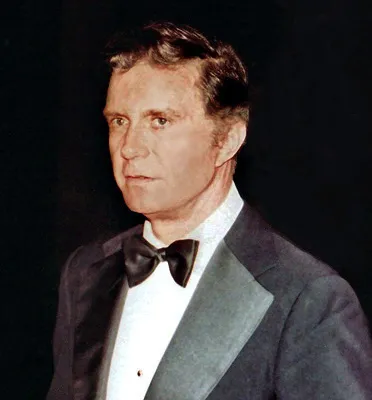
Cliff Robertson
Human Design Chart
Biography
He was the only child of Clifford Parker Robertson, Jr., heir to a southwestern land fortune and Audrey Willingham Robertson. His parents divorced when he was two, his mother dying a few months later of peritonitis. His grandmother, Eleanora, herself a divorcee, adopted Cliff and raised him in La Jolla, CA with occasional visits from his dad. Cliff's dad, a romantic figure, didn't work so Cliff received his old fashioned Presbyterian work ethic from his grandmother. At nine years old he said he was 11 in order to get a job selling magazines. At 13 years he washed airplanes in exchange for flying lessons. Flying since he was 15, he now has a commercial pilot's license and owns the only perfect Spitfire, a vintage World War II airplane, in the world.
After spending two and a half years in the US Maritime Service, in 1947 he entered Antioch College as a journalism major. Moving to New York City, he tailed subjects for a detective agency and parked cars at the Stork Club to finance his studies at the Actors Studio. Always working, he acted on television playing a space cadet in "Rod Brown of the Rocket Rangers" in 1953 and played the lead in "Days of Wine and Roses" in 1958, later being passed over for the part when Jack Lemmon starred in the film. Robertson began his film career in "Picnic" in 1956 and signed a seven-year contract with Columbia Pictures spending much time on suspension for refusing unacceptable roles. One of his most famous roles was John F. Kennedy in "PT 109" in 1963. It is said that Kennedy personally picked Robertson for this role.
Robertson found no work for a period of four years when he blew the whistle on producer David Begelman who cashed a check for $10,000 by forging Robertson's name. This story is told by him in "Indecent Exposure," written in 1977.
The Human Design of Cliff Robertson: Manifestor 5/2
Manifestor 5/2 — Design at a Glance
Cliff Robertson was a Manifestor. His design marked him as a pioneer and visionary whose task it was to lead the world into a new future. Similar to an emperor in ancient Rome, he possessed the great vision of an empire but did not wage the necessary wars himself. Instead, he sent others out to conquer foreign lands for him. This kind of leadership inevitably polarized: Because he often thought further ahead than his surroundings, he was misunderstood. Some people loved his huge dreams and followed him, while others rejected or even hated him because of these visions. To find the right followers, it was crucial for him to inform others about his plans in a timely and precise manner. This formed his ideal strategy. If he adhered to this strategy and lived up to his authority, his system rewarded him with a feeling of inner peace. Living against this design, however, made him feel an enduring, deep-seated anger inside. His life energy thus worked not through harmonious cooperation but through initiated impulses that either met resistance or acceptance, depending on whether he informed others.
Splenic Authority
Cliff Robertson lived with an internal authority rooted in the Spleen Center. This center served as his health and alarm system, equipped with a pronounced survival intelligence. For this configuration, both the Emotional and Sacral Centers were open; only Projectors or Manifestors can carry this specific authority. His decision-making was based on spontaneous inner knowledge: A sudden impulse signaled whether a situation, environment, or society was right for him and served his health. This first impulse was the reliable indicator of what was correct. However, since this Spleen voice was a very fine, singular impulse in the present moment, there was a risk that it could be drowned out by external influences. This required high vigilance from him; occasionally, a retreat helped to follow these subtle signals more clearly. Since knowledge about the right path was always only available in the moment, his plans often changed at short notice. Long-term commitments were therefore difficult and ill-suited for his design. Instead, he needed much freedom and flexibility to rigorously distance himself from harmful influences and effectively protect himself. His lifestyle was marked by this need for spontaneity and rejection of rigid structures in favor of reactive, instinct-driven adaptation to the moment.
The 5/2 Profile — Heretic / Hermit
Cliff Robertson revealed through his 5/2 Profile as someone carrying an inner conflict between a desire for public recognition and the need to withdraw. Line 5 brought with it the potential of a hero – someone others admire and want to learn from – while line 2 urged him to stay in his 'cave' to gather strength and focus on himself.
This configuration created tension: On one hand, he wanted to share his gifts and act as an example; on the other hand, he preferred to remain undiscovered and spend time alone. As long as the world did not 'discover' him, he worked hard on himself, using his withdrawal to grow for a possible public role. But if he waited only for others to recognize him as a hero, this could lead to frustration, since the heroic life was not well suited to the lone-wolf approach.
Line 5 demanded hope and promise while also requiring practical solutions in times of crisis to fulfill that promise. Harmonious relationships were important to justify the efforts. At the same time, he had to learn to set boundaries and take sufficient alone time so that his presence and clear insights could be appreciated by others without him feeling overwhelmed.
Split Definition — Defined & Open Centers
Cliff Robertson revealed himself as someone who was constantly under an internal pressure to ask questions and understand connections. His defined Head and Ajna centers created a trustworthy, specific mental function; he always thought, was perpetually in the process of understanding concepts. However, this configuration did not mean that he possessed the energy to directly put these thoughts into the world – fighting against it only led to frustration. Instead, his defined Throat acted as a fulcrum point, transmuting these mental concepts into communication and action once the timing was right.
His defined Heart Center gave him a constant willpower and the desire to control his life himself. He tended to make promises and keep them, which strengthened his self-esteem. Yet this strength had to be balanced with his open nature. His open G Center had no fixed identity; he relied on being initiated by the environment to find direction and love. The typical trap of this center – the question 'Who am I?' or searching for a fixed role – could confuse him if he was in the wrong place. Only in correct environments did a beneficial identity crystallize for him.
Additionally, his open Sacral Center was vulnerable to conditioning energy from the environment. He lacked a constant generative flow and instead absorbed the vitality of others. This led to him easily overextending himself when he didn't listen to his inner authority and set boundaries. His defined Spleen Center offered an escape: It gave him spontaneous, intuitive intelligence in the present moment. Rather than rationally planning, he trusted this physical warning or confirmation to stay healthy and make decisions that served his well-being. Thus, he balanced his strong mental and willful drive through intuitive clarity and acceptance of his open, adaptable nature in identity and energy.
Channels for logic, intuitive clarity and devoted strength.
Cliff Robertson revealed himself through a sharp, analytical mindset that always sought verifiable patterns. The Logic Channel 63-4 connected his Head to his Ajna Center and drove him to use doubt as a necessary filter for truth. His skepticism was not a lack but a tool: He tested ideas on their consistency before accepting them. Only what practically worked and logically held up found his approval; unfounded belief had little room with him.
At the same time, he possessed the ability to achieve immediate, intuitive clarity. The Brainwave Channel 57-20 channeled insights from his Spleen directly into his voice. This allowed spontaneous outbursts of pure intuition that hit the core of a matter in the present moment. He often knew faster than others what was true and spoke this truth to awaken the survival consciousness of others. This connection of deep instinct and clear articulation gave his words a transformative power, as long as he focused on the present.
In interaction with his environment, he acted as a skilled mediator between instinct and will. The Channel of Devotion 44-26 connected his Spleen to his Heart Center. Here lay an entrepreneurial sense: He could instinctively recognize what the collective needed – whether it was a product or an idea – and used his ego strength to convincingly sell this. He was designed to generate resources and organize the tribe for his benefit, waiting until the market recognized his gifts.
Additionally, specific Gate influences shaped him: Gate 45 brought an energy-intensive attraction and awareness of hierarchies. Gate 64 ensured that he mentally processed past experiences to form clear concepts from them. Gate 23 contributed to the ability to explain otherness and thus enable mutations in the collective. Finally, Gate 48 gave him depth to recognize patterns and strive for perfection, though this sometimes ended in frustration as pure recognition did not always translate into practical solutions.
Individual Circuitry — Circuit Signature
Cliff Robertson revealed himself through his design as someone who combined creative impulses with strategic clarity. His chart had a split definition, meaning that his energetic forces did not work in one continuous flow but existed as two parallel, independent blocks. This often required support from others to integrate and make these separate energies actionable.
The Knowledge Circuit connected his Throat Center to the Spleen through the Flash of Insight Channel (20-57). This shaped a capability for innovative ideas to be immediately put into words or expressed, driven by pulsating, acoustic creativity. Parallel to this, the Understanding Circuit linked his Head with Ajna (Channel 63-4). Here lay power in focused logic and visual strategy to improve things – yet without emotional involvement of the Solar Plexus. These two circuits were energetically separate; his creative expression did not flow directly from his logical planning.
A third area was the Ego Circuit, which connected Heart and Spleen (Channel 26-44). This stood for the ability to devote oneself and cooperate within the 'tribe', meaning community or family. It was about creating resources communally through communication and mutual support. As there was no connection to the Sacral Center, calm was necessary to maintain these social energies. Thus, Cliff Robertson lived with these three distinct energy fields: creative expression, rational strategy, and cooperative devotion, each following its own laws.
Left Angle Cross of Dominion 2
Cliff Robertson was marked by the left cross of authority region 2, a configuration that describes a deep connection to collective consciousness and the ability to lead within group structures. This design element suggested that he often directed his energy towards serving the community or larger systems rather than pursuing purely individual goals. The mechanics of this cross point to a nature seeking stability through integration and an understanding of complex social dynamics. Thus, Cliff Robertson appeared as someone capable of uniting different perspectives while maintaining a calm yet assertive presence. His actions were less driven by impulsive lone-wolf mentality but rather by an instinctual knowledge of how to be effective within existing frameworks. This did not necessarily mean loud dominance, but rather a subtler form of influence based on respect and shared alignment. The energy of this design promoted an understanding that true strength often lies in the ability to support and hold others together while maintaining an overview of the big picture. Cliff Robertson lived this dynamic by investing his personal resources into contexts that fostered broader benefit.
Saturn Return · Uranus Opposition · Chiron Return · 2nd Saturn Return — Life Cycles
Cliff Robertson went through four central astrological cycles, structurally shaping phases of his life. The first Saturn return marked a transition into a phase of consolidation, where early impulses were condensed into stable structures. This did not happen as a sudden break but rather as a gradual solidification of personal responsibility and identity within the social framework.
The opposition to Uranus brought a period of necessary detachment from established patterns. Here an internal conflict between the need for stability and the drive for change was evident. This cycle challenged him to question rigid stances and explore new freedoms, often accompanied by feelings of restlessness or resistance against external constraints.
With the Chiron return, Cliff Robertson entered a phase of fulfillment. If he had lived according to his inner strategy up until then, this period condensed his sense of purpose. It was not a time of healing old wounds in a pathological sense but rather a bloom where his incarnation goal became clearer and more experiential. The second Saturn return concluded this development by transferring the gained insights into a mature, sustainable life form. These cycles provided the rhythmic underpinning for his personal growth without external circumstances alone determining it.
Manifestor · Splenic Authority — Synthesis
Cliff Robertson was a Manifestor whose life seemed marked by a strong inner drive towards initiation and leadership. His design points to a visionary who pioneers new paths (Manifestor type), yet the authority in the Spleen required decisions in the present moment – an instinctive weighing of health and well-being as the basis for his actions. This combination of wanting to initiate something and needing spontaneous, physical confirmation formed a thread through his existence by being both a trailblazer and attentive to subtle signals from his body.
Robertson lived in a recognizable paradox: His Profile as Hero/Natural Talent (5/2) points towards the desire to help others and gain admiration, yet simultaneously he often withdrew and nurtured his inner world. The defined Head Center with the Logic Channel (63/4) intensified this internal conflict through constant questioning and seeking stability – an intellectual struggle that compelled him both to act outwardly and withdraw into introspection.
3 Defined Channels
Incarnation Cross - Left Angle Cross of Dominion 2
Solar Return
The Solar Return shows the moment when the sun returns to its exact birth position - your personal solar year.
Life Cycles
Discover the life cycles with a detailed triple view (birth chart, cycle chart, composite).
Human Design Profile
- Type
- Manifestor
- Strategy
- To inform others before acting
- Authority
- Splenic Authority
- Profile
- 5/2 - Heretic / Hermit
- Definition
- Split Definition
- Incarnation Cross
- Left Angle Cross of Dominion 2
- Date of Birth
- 09.09.1923 09:38
- Place of Birth
- Los Angeles, CA, United States
Frequently Asked Questions
What was Cliff Robertson's Human Design type?
What Profile did Cliff Robertson have in Human Design?
What Authority did Cliff Robertson have?
What incarnation cross did Cliff Robertson have?
When was Cliff Robertson born?
Discover your own Human Design
Are you also a Manifestor? Find out in a personal reading how to use your initiation power peacefully and dissolve resistance.
More Personalities
Back to overviewSissy Spacek

Anémone

Ann-Margret

Arletty
Arno
Artus