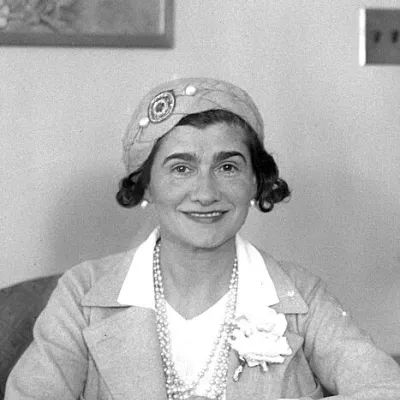
Coco Chanel
Human Design Chart
Biography
She was left in a convent orphanage at 12, abandoned by her itinerant peddler dad whom she never saw again. Later she did meet her siblings and their kids. At 20 she took to the stage briefly where she met a rich patron who put her into an apartment. When she met Boy Combon, he encouraged her dreams by setting up her hat boutique.
The radical simplicity of her designs was widely imitated; the Chanel suit was classic for the 20th century. She set the stage for bobbed hair and shortened skirts and remarked that "style and fashion are not the same thing."
Her lovers included a Russian Grand Duke who gave her a gift of perfume, a scent which she manufactured as her Chanel N.5; it alone made her a millionaire.
During the Nazi occupation she closed her business doors, but she did have a German lover. After the war, women who had collaborated with the enemy were dealt with harshly, run through the streets with shaven heads. Not Chanel, she quietly left France in exile for nine years.
She made a comeback in 1954 at age 71 with a new collection. It was not a great success in France but the American buyers were wild for her style; they had adopted her. This show held the last personally designed Chanel suit.
Afraid of the night, Chanel took morphine to help herself sleep.
She died on the night of 10 January 1971, Paris. The Empire of the House of Chanel continued.
Coco Chanel — Generator with Profile 2/5
Generator 2/5 — Design at a Glance
Coco Chanel revealed herself as someone with tremendous inner endurance, comparable to a workhorse. Her Human-Design profile identified her as a Generator, a type that possesses and utilizes a great deal of sacral energy to achieve things in life. However, this energy was not available for arbitrary initiative but primarily unleashed through reacting to external signals.
The strategy of her design involved waiting for impulses from life and then acting when the sacral center gave a clear "yes." Coco Chanel followed this principle of responding rather than initiating. When she used her strength in harmony with this mechanism, she experienced deep satisfaction and fulfillment.
Her design did, however, present two specific risks. One danger lay in expending energy on tasks that did not intrinsically bring her joy; this led to burnout when sustained over time. The other stumbling block occurred when she was prevented from working on her heart project despite having abundant energy still available to work with.
If Coco Chanel did not live according to this design – particularly by constantly trying to take initiative herself – she encountered frustration and a lack of energy. Her path to effectiveness thus lay in responding intuitively to life impulses, thereby channeling her immense endurance productively and satisfyingly.
Sacral Authority
Coco Chanel revealed herself as someone whose decision-making process was based on a deep, physical resonance. As a Generator, she possessed sacral authority, an inner guidance unique to her type, and her strategy was also her authority. This simplified her process: She didn't need complex analysis but listened to her "gut feeling." This manifested in immediate physical reactions to external stimuli – as bursts of energy or through sounds like grunts or a confirming hum.
Her design also required an open Emotions Center, meaning she did not act impulsively but waited for this clear sacral response. When her Sacral motor engaged, Coco Chanel felt vital and alive. She then had seemingly inexhaustible energy and tackled her work with great enthusiasm. She was born to move through life joyfully and immerse herself in activities without an external goal taking precedence.
Additionally, her activated Spleen Center acted as a supportive authority. This gave her the ability to react quickly and spontaneously. She had direct access to her physical well-being and instinctive perception. Coco Chanel reliably followed these inner signals, making her actions authentic and direct. Her energy was not a rational construct but a physical fact that drove her as long as the internal motor engaged.
The 2/5 Profile — Hermit / Heretic
Coco Chanel navigated between the urgent need for withdrawal and the expectation of always being available to others. Her design indicated a tendency to handle her energy selectively: she had to be called upon before she could fully unleash her potential. This aligned with the mechanics of Profile 2/5, known as "Natural Talent" or "Hero and Saviour". Line 2, the Hermit Line, ensured that Chanel needed much time for herself to look inward and gain clarity about her priorities. Without these phases of isolation, she would have been deprived of her strength.
At the same time, Line 5, the Hero or Illusion Line, projected an aura in which others sought solutions. People expected help and guidance from her, often compared to that of a monk who meditates alone but is constantly asked for advice. For Chanel, it was crucial to carefully examine what she committed to and when she needed to say "No". Her contribution should be time-limited; similar to a taxi driver who drops off a passenger at their destination and then continues on a new route. Through this balance of persistence in accepted commitments and the protection of her boundaries, she avoided losing herself while helping others.
Split Definition — Defined & Open Centers
Coco Chanel revealed herself as someone who constantly felt the mental pressure to ask questions and understand things. This tendency resulted from her defined configuration between Head Center and Ajna Center. She had a firm way of thinking that made her a source of inspiration for others, yet without the direct energy to immediately implement these ideas. The attempt to release this mental pressure through hasty actions would have caused frustration; instead, her strength lay in asking questions and stimulating the awareness of others.
At the same time, Coco Chanel possessed enormous vital force, drawn from her defined Sacral Center. As a Generator, she relied on being asked or moving towards something for her sacral energy to say "Yes" and provide full satisfaction. Initiating actions without this confirmation led to exhaustion and resistance. Her endurance was based on trusting this inner voice rather than making mental decisions about the physical availability of energy.
Her defined Spleen Center provided strong body awareness and intuition in the present moment. She knew what was healthy and correct, without rational justification. This spontaneous judgment protected her and allowed her to live in the moment instead of getting stuck in theoretical concepts.
In contrast, her vulnerability was revealed through several undefined centers. Her open G Center meant a lack of firm identity; she tended to blend with her surroundings and sought direction and love from external initiation rather than determining it herself. The open Heart Center left her susceptible to the pressure to prove her worth, often leading into cycles of promises and disappointment. Additionally, her open Solar Plexus absorbed others' emotions, putting her at risk of personalizing foreign moods and feeling emotionally unstable. Finally, her open Root Center took on external stress, leading to a sense of restlessness in trying to release it rather than simply observing it as an external phenomenon.
Channels for caring values and abstract understanding.
Coco Chanel revealed herself as someone deeply rooted in the responsibility for the well-being of her environment. This attitude stemmed from Channel 27-50, which connects the Sacral Center with the Spleen Center. Through Gate 27, the Gate of Care, and Gate 50, the Gate of Values, an energy worked to protect tribal structures and uphold traditional orders. She functioned as a natural provider whose aura automatically attracted trust, though she had to learn to regulate her own energy through sacral reactions to avoid overload.
Parallel to this, Channel 64-47 shaped her mental experience. This channel connects the Head Center with the Ajna Center and filters every experience through a kaleidoscope of mental images. Coco Chanel always sought out a story or perspective that made sense, driven by Gate 64 (Confusion) and Gate 47 (Understanding). Her mind was constantly active, playing with possibilities and trying to understand the mysteries of life, which often led to inner unrest until clarity suddenly emerged.
In addition, other gates influenced her design. Gate 29 demanded persistence and correct saying yes in dealing with challenges, while Gate 30 emphasized recognizing feelings and accepting limitations as destiny. Gate 8 pushed her to stand individually for group goals and express her identity, supported by Gate 14, which promoted skillful power accumulation and self-control. On the personality level, Gate 28, focusing on risks in the here and now, and Gate 63, using doubt as a motor for mental improvement, played roles. In her design, Gate 44 worked with awareness and resource management, Gate 24 with cyclic renewal of knowledge, and Gate 42 saw experience as the key to completing processes.
Collective Circuitry — Circuit Signature
Coco Chanel was marked by two distinct, parallel energetic streams. As a person with split definition, she did not have a continuous connection between these areas; they acted as separate, independent forces within her.
One stream connected her Head and Ajna Centers through the Reflective Circuit. Here, the Abstraction Channel (Gates 64/47) was active. This configuration directed her attention to reflecting on past events in order to decipher hidden connections within them. It was less about cold logic than emotional understanding of experiences from the past. The resulting insights were meant to be shared and processed collectively with others. This process unfolded in waves – with a beginning, middle, and end – and was strongly influenced by visual impressions as well as emotional currents.
The second stream connected her Sacral and Spleen Centers within the Protector Circuit. Active here was the Preservation Channel (Gates 27/50). This area carried a primal energy focused on protection and preservation. It dealt with what is necessary for survival, specifically in contexts of care, nurture, and sustenance. This connection emphasized themes like defense and securing livelihood or family structures. It operated timeless and relied on instincts as well as the sense of touch.
Both circuits formed separate islands in her design: on one hand, abstract emotional meaning-making from the past; on the other hand, instinctive protective life force for the present moment.
Right Angle Cross of Contagion 3
Coco Chanel's Human Design profile indicated a tendency towards a profound, almost fateful connection with her essence. She was someone who not only accepted but actively and passionately embodied her identity in the world. This attitude stemmed from the configuration of the right Infection Cross 3. In Human Design mechanics, this cross marks a phase of intense self-discovery and integration where the individual learns to live their energy authentically and attract or influence others as a result. It's not about superficial adaptation but rather the powerful emanation of one's core essence. Coco Chanel lived this dynamic in the past tense: she processed her inner structures and let them manifest outwardly. The mechanics of this cross describe a process where the self becomes a magnet – not through targeted marketing in the modern sense, but through the pure presence of authentic being. Her life force followed this pattern of integration: what was internal became the foundation for external impact. Without this inner coherence, her emanation would have remained weak; instead, she shaped her environment by consistently living her truth. This wasn't a conscious act of self-presentation but a natural consequence of her energetic structure aimed at rooting herself and thus becoming irresistible to others.
Saturn Return · Uranus Opposition · Chiron Return · 2nd Saturn Return — Life Cycles
Coco Chanel's Human Design profile indicated a tendency towards structural anchoring that crystallized into clear milestones. Her first Saturn Return around the age of 27 marked the transition from preparation to established existence. This was evident in 1910 when she founded the fashion house Chanel – a moment where years of groundwork culminated in a sustainable outcome and solidified her professional identity.
The Uranus opposition around the age of 39 often brought sudden, expansive energy that broke through established patterns. For Coco Chanel, this occurred in 1922 with the launch of the perfume Chanel No. 5. This success wasn't a gradual step but a marked expansion of her sphere of influence, making her creative vision visible on a new level and imprinting her reputation indelibly.
The Chiron Return around the age of 49 is a cycle of fulfillment in which one's inner purpose increasingly unfolds. Coco Chanel experienced this phase starting from 1932 with the beginning of her romantic relationship with Paul Iribe. This wasn't a process of healing old wounds but an affirmation of her essence through deep connection, enriching both her personal and creative expression.
Her second Saturn Return around the age of 57 completed this structuring. Returning to Paris in 1940 signalled not just a geographical movement but reintegration into her center. This step underscored the constancy of her design: after years of expansion and personal development, she returned to the foundations to consolidate her achievements on a new, more mature level.
Generator · Sacral Authority — Synthesis
Coco Chanel lived a life deeply influenced by her sacral energy (Generator type) and the associated work ethic. Her ability to immerse herself in activities that truly fulfilled her – evident from her body's reaction to external stimuli (sacral authority) – formed the foundation of her creative power. The Line 2/5 in her profile indicates that while she had a natural talent and a calling for solutions, she also required significant periods of withdrawal and inner orientation to use her energy effectively. This oscillation between engagement with others and the need for solitude shaped her work style and how she presented herself to the world.
A central paradox in her design lay in the interplay between constancy and change. The defined Mental Center created a constant pressure to question and understand, while the Meaning Seeker circuit established a deep connection to the past and her experiences. At the same time, the documented cycles – foundations laid, successes achieved, relationships formed, return to Paris – depicted a life full of new beginnings and transformations. This combination of deeply rooted thinking and the ability to reinvent herself continually allowed her to challenge conventions and create lasting values.
2 Defined Channels
Incarnation Cross - Right Angle Cross of Contagion 3
Solar Return
The Solar Return shows the moment when the sun returns to its exact birth position - your personal solar year.
Life Cycles
Discover the life cycles with a detailed triple view (birth chart, cycle chart, composite).
Human Design Profile
- Type
- Generator
- Strategy
- To respond - wait for something to respond to
- Authority
- Sacral Authority
- Profile
- 2/5 - Hermit / Heretic
- Definition
- Split Definition
- Incarnation Cross
- Right Angle Cross of Contagion 3
- Date of Birth
- 19.08.1883 16:00
- Place of Birth
- Saumur, France
Frequently Asked Questions
What was Coco Chanel's Human Design type?
What Profile did Coco Chanel have in Human Design?
Which Authority guided Coco Chanel?
What incarnation cross did Coco Chanel have?
When was Coco Chanel born?
Discover your own Human Design
Are you also a Generator? Find out in a personal reading how to use your sacral energy correctly and discover deep satisfaction.
More Personalities
Back to overviewAaliyah

Alexia

Angèle

Anne-Marie

Arcángel

Arno