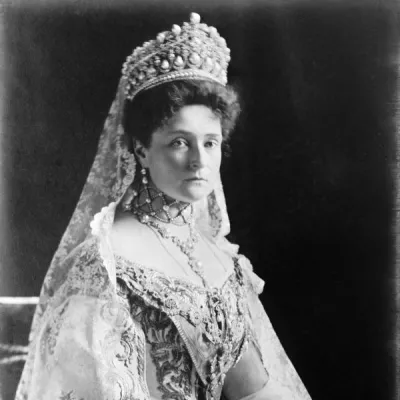
Czarina of Russia Alexandra
Human Design Chart
Biography
Her life dramatically changed when she married her friend Prince Nicholas Romanov of Russia on 26 November 1894. Suddenly she was in control of a vast fortune as her husband became the Tzar of all Russia upon the death of his father in 1894. Tzar Nicholas was a man who was spectacularly unqualified to rule. In 1915, during WW I, Nicholas was at the front leaving Alexandra as a defacto ruler in Petrograd. Only listening to her favorite confidante, the monk Rasputin, she removed key governmental officials and replaced them by appointing incompetent friends of Rasputin into their posts.
Alexandra was the fifth of seven children of her parents, Prince Louis IV of Hesse-Darmstadt and Princess Alice. Her childhood was spent with her brother Ernst and sister May. When she was six years old, her mother died, on 14 December 1878. Her fun and mischievous nature turned somber. Brought up in the English fashion, she learned history, literature and the geography of England and Germany. She had a retentive memory and excellent handwriting. A shy, sensitive girl with self-restraint, she played the piano brilliantly but grew extremely self-conscious. She enjoyed listening to music, especially the works of Wagner. She liked to spend her hours working on her needlepoint. Alexandra enjoyed visiting her grandmother, Queen Victoria at Osborne House.
She met her future husband, Tzarvich Nicholas when she was nine-years-old. They developed a friendship before their engagement. After their marriage, Alexandra quickly gave birth to four daughters beginning with Olga in 1895, Tatiana in 1897, Marie in 1899, and Anastasia in 1901.
The Human Design of Czarina of Russia Alexandra: Generator 5/1
Generator 5/1 — Design at a Glance
Czarina of Russia Alexandra possessed immense physical endurance and strength, comparable to that of a workhorse. However, this energy was not available for arbitrary initiatives but was released exclusively when she responded to inner impulses from her Sacral Center. Her Human Design dynamics required her to wait for signals from life and only act upon clear internal confirmation – a process of reacting rather than initiating.
This mechanism created a clear tension field: If Czarina of Russia Alexandra acted against her internal resonance or suppressed the urge to work on her heart projects, she risked energy loss and frustration. Conversely, ignoring this sacral guidance led to burnout as the tremendous power was then channeled towards false tasks. The strategy involved waiting for a “yes” from the gut and responding with action.
Living in harmony with this reaction rewarded her design with a deep sense of satisfaction and fulfillment. Energy was inexhaustible so long as it wasn’t squandered through forced tasks or suppression of passion. The central challenge lay in curbing her own initiative to wait for the right moment, thereby fully utilizing her endurance without falling into persistent frustration.
Sacral Authority
Czarina of Russia Alexandra had an inner compass located not in her head but deep within her body. Her design allowed direct access to an inexhaustible energy source, activated by spontaneous physical resonance with external stimuli. As a Generator, her strategy was also her authority: She needed to wait until she was externally approached before reacting from the Sacral Authority.
This reaction often manifested as a soft “Hmm,” a grunt or a sudden surge of power in the abdominal area – the so-called “gut feeling.” So long as her Emotional Center remained open and short-term moods did not block the process, she could clearly perceive these physical signals. When the sacral motor kicked in, she felt vital and alive; work then became not a duty but a source of enthusiasm and satisfaction.
Her path involved fully immersing herself in activities without burdening them with rigid goals or purpose-driven constraints. The focus was on the process itself, driven by natural joy in doing. If her Spleen Center was also activated and connected to the Sacral Center, this would enhance her ability for quick, instinctive decision-making. She could then rely confidently on this immediate physical perception to give the right answer at the right moment, free from excessive mental analysis or doubting indecision.
The 5/1 Profile — Heretic / Investigator
Czarina of Russia Alexandra was characterized by a deep need for private reflection and self-knowledge paired with the ability to offer altruistic solutions in times of crisis. Her design as Hero/Researcher (Profile 5/1) created tension: While Line 1 demanded withdrawal and intensive learning, the magnetic pull of Line 5 attracted others seeking answers. This could lead to exhaustion if she took on other people’s problems without setting clear boundaries. Gate 35 emphasized her selflessness in sharing experiences, while Gate 22 fostered a courteous, attentive demeanor that often went unnoticed or even led to humiliation when she did not take up her true role. The challenge lay in maintaining the balance between sharing her knowledge for others and the necessary time for personal research. Only through learning to say no could she maintain this balance and optimally utilize her gifts without sacrificing herself.
Single Definition — Defined & Open Centers
Czarina of Russia Alexandra possessed a massive, constant vital energy source that served as the motor of her design. Her defined Sacral Center generated a daily supply of strength that felt like a constant hum and urged her towards activity. However, this energy was only available in response to inquiries; an immediate yes or no decision determined its availability. Initiated actions without prior questioning led to the loss of this connection and resulted in resistance as well as exhaustion, since the mind suppressed the sacral answer.
Parallel to this, her defined Root Center acted as a constant background pressure for movement and survival security. This pressure was always present and had to be guided by strategy; otherwise, it transformed into obsessive stress or was projected onto others. The combination of Sacral and Root energy created a dynamic foundation that, however, had to remain strictly reactive to be effective.
In contrast, her Head, Ajna, G, Heart, Solar Plexus, and Spleen Centers were open. These centers did not have a constant identity, emotion, or willpower. Instead, they reflected the environment. An open Head Center tended to absorb mental pressure waves and questions from others without identifying them as its own truth. The open Ajna Center allowed flexible thinking but was prone to adopting concepts of the environment rather than forming consistent theories.
The open G Center meant a lack of fixed identity and direction; she adapted to those around her and did not actively seek a firm self-image, instead allowing external initiation to guide her directions. The open Heart Center lacked constant willpower or the need to prove value, making it vulnerable to conditioning that wanted to keep promises for recognition.
The open Solar Plexus Center absorbed and amplified emotions of the environment without having its own stable emotional base. This could lead to feeling emotionally out of control or avoiding confrontation to minimize taking on foreign feelings. Finally, her Spleen Center was open, which caused a fundamental fear of survival and vulnerability to spontaneous decisions that often did not serve long-term well-being. She tended to cling to people with defined Spleens for a sense of security, even if these bonds were unhealthy.
Channels for the power of natural maturation.
Czarina of Russia Alexandra exhibited an approach aimed at not only experiencing personal events but transforming them into collective wisdom through reflection. Her design indicated that the complete cycle completion without premature termination was essential to avoid frustration and gain depth.
This impulse is shaped by the Maturity Channel 53-42, connecting the Root Center with the Sacral Center via Gate of Beginnings (53) and Gate of Growth (42). This mechanism requires stepping into a new experience, living it fully, and reflecting afterward to extract the wisdom contained within. Each new experience builds on the previous one; if a cycle is prematurely ended, it must be repeated. The energy serves higher good by translating personal depth into information for others.
Additionally, other gates were at work: Gate 35 sought change and progress through interaction, with true satisfaction only coming afterward through the meaning of the experience. Gate 5 emphasized following one's life rhythm and maintaining stable habits to build energy. Gate 22 promoted openness and calmness, especially the ability to listen until the end to support individual mutations in social fields. Gate 47 responded to past experiences by creating collective sense from random image sequences, with sharing distress bringing clarity. Finally, Gate 54 linked worldly success with mystical insight, where a partner or buddy supported development.
Czarina of Russia Alexandra utilized these configurations to learn from empirical history and avoid mistakes by valuing experiences as part of an endless journey free from rigid expectations.
Collective Circuitry — Circuit Signature
Czarina of Russia Alexandra had a tendency to process past experiences in waves and share emotional insights gained with others. Her design indicated that she drew meaning from the past not through cold logic but through felt understanding. This energy runs cyclically – with beginning, middle, and end – similar to the emotional waves of the Solar Plexus Center.
This trait roots in the active Meaning Circuit. While other circuits often look towards the future or build rational structures, this configuration focuses on emotions and historical events. The right side of her design deals with the past; reflecting on old events serves to uncover their deeper meaning.
In Czarina of Russia Alexandra's case, this circuit is activated by the Maturity Channel between Sacral and Root Centers. These two centers are directly connected and form a continuous energetic flow. This means that her emotional processing (Sacral) is immediately linked with her endurance and survival instinct (Root). The resulting insights were meant to be passed on to the collective to enable learning from history. As this is a Simple Definition, this connection exists as a clear, isolated stream within her system without being interrupted by separate groups. Thus, the energy remains focused on the cyclic nature of emotional learning and its transmission.
Left Angle Cross of Separation 1
The Czarina of Russia Alexandra revealed herself through a profound imprinting that defined detachment and separation as her central life task. Her design suggested that she could truly find her own identity only when she built distance from groups, family structures, or old bonds. This was not merely a desire for independence but an archetypal process of the 'Left Cross of Separation'.
This mechanism describes the path to clarity through consciously cutting threads that no longer serve their purpose. For the Czarina of Russia Alexandra, this often meant experiencing loneliness as a necessary space for self-discovery. The necessity to separate was the key to becoming internally clear and releasing herself from collective expectations or outdated role models. Her design indicated that she discovered her true nature through this separation rather than merging into others' adaptation. Thus, the process of separation was not a loss but the prerequisite for building an authentic, independent personality.
Saturn Return · Uranus Opposition · Chiron Return · 2nd Saturn Return — Life Cycles
In 1899, at the age of 27, the Czarina of Russia Alexandra faced a profound life turning point. With the birth of her third daughter Marie, she entered her first Saturn Return phase. This cycle marks more than just biological change in her design but signals the beginning of the first major maturation threshold. It is the moment when years of internal development condense outwardly and taking responsibility becomes the central task.
The first Saturn Return acts as a catalyst for structure and stability. It demands that one examine their foundations and establish a solid base for further life. For Czarina of Russia Alexandra, this was evident in her role as mother: Marie's arrival was not an isolated family event but an expression of this energetic maturity. The design indicated that earlier questions would now surface and a new level of seriousness and commitment became effective. It was about providing support and strengthening one’s own structures. This maturation process shaped her stance sustainably, leading her to integrate responsibility as an integral part of her identity. The mechanics of the Saturn Return thus facilitate the transition from potential energy to concrete reality in everyday life.
Generator · Sacral Authority — Synthesis
A central red thread runs through the entire chart: deep, sacral energy (Sacral Center defined) paired with the ability to process experiences in a cyclical manner (Maturity Channel). This combination implies a person who is persistent and powerful but whose fulfillment is inseparably linked to *responding* to impulses – not initiating independently. The open design of many centers suggests that she is strongly influenced by her environment, requiring constant adaptability but also emphasizing the need to orient herself through her own sacral authority (gut feeling) and set boundaries to avoid conditioning.
The central paradox lies in the interplay between deep energetic capacity and a lack of internal definition in crucial areas like identity (open G Center), emotions (open Solar Plexus), and willpower (open Heart Center). This creates tension between the need to be active and release energy and the challenge of making authentic decisions that are not determined by external influences or conditioning. Thus, she is destined to respond to life while simultaneously learning to find herself in a constantly changing context and preserve her inner truth.
1 Defined Channel
Incarnation Cross - Left Angle Cross of Separation 1
Solar Return
The Solar Return shows the moment when the sun returns to its exact birth position - your personal solar year.
Life Cycles
Discover the life cycles with a detailed triple view (birth chart, cycle chart, composite).
Human Design Profile
- Type
- Generator
- Strategy
- To respond - wait for something to respond to
- Authority
- Sacral Authority
- Profile
- 5/1 - Heretic / Investigator
- Definition
- Single Definition
- Incarnation Cross
- Left Angle Cross of Separation 1
- Date of Birth
- 06.06.1872 03:45
- Place of Birth
- Darmstadt, Germany
Frequently Asked Questions
What is the Human Design type of Czarina of Russia Alexandra?
What Profile does Czarina of Russia Alexandra have in Human Design?
Which Authority guides Czarina of Russia Alexandra?
What incarnation cross does Czarina of Russia Alexandra have?
When was Czarina of Russia Alexandra born?
Discover your own Human Design
Are you also a Generator? Find out in a personal reading how to use your sacral energy correctly and discover deep satisfaction.
More Personalities
Back to overviewAaliyah

Alexia

Angèle

Anne-Marie

Arcángel

Arno