
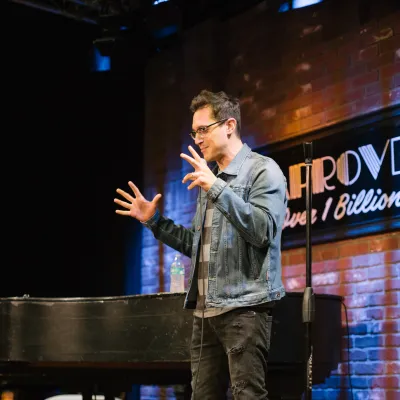
Dan Levy
Human Design Chart
Biography
He began his career as a television host on MTV Canada. For producing, writing, directing, and acting in the final season of Schitt's Creek, Levy became the first person to win a Primetime Emmy Award in all four major disciplines in a single year. His work on the show has additionally earned him four Canadian Screen Awards out of eighteen nominations, among several other accolades.
He is the older brother of actress Sarah Levy, who plays waitress Twyla Sands in Schitt's Creek. His family celebrates both Christmas and Hanukkah. Levy's father is Jewish and his mother Deborah Divine is Protestant.
Levy splits his time between Toronto and Los Angeles, though he has said that London, England is his "favorite city," after having lived there in 2005. He lives with his dog, Redmond.
Levy previously avoided labelling his sexual orientation publicly, though in a 2015 interview with Flare he was called "a member of the LGBT community." In a 2020 interview with Andy Cohen, Levy said that he is gay and has been out since he was 18.
Dan Levy — Manifesting Generator with Profile 4/6
Manifesting Generator 4/6 — Design at a Glance
Dan Levy's Design inclines towards lightning-fast action capability paired with a constant need for variety. As an Manifestor Generator, he possesses consistent energy from his defined Sacral Center, allowing him to skip steps and quickly pull things into his life. This hybrid configuration combines the endurance of a Generator with the direct impact of a Manifestor.
The challenge lies in this speed tending to omit crucial intermediate steps or starting multiple projects simultaneously without clear internal confirmation, leading swiftly to frustration, which is the non-self theme for this type. Therefore, the strategy does not merely involve initiating but responding to impulses and continuously "testing" his own resonance. Only when the Sacral Center gives a clear yes is the action sustainably satisfying.
Under these conditions, Dan Levy can optimally utilize his creative power. Instead of focusing on one thing at a time, he benefits from a play mode with various tasks simultaneously. Deep satisfaction arises not through linear progression but through joy in variety and rapid advancement as long as internal authority agrees. This allows him to use energy efficiently without falling into overload or dissatisfaction.
Sacral Authority
Dan Levy's design points towards intuitive, body-based decision making. As a Generator, he possessed sacral authority—the only type whose strategy and inner authority are identical. This simplified his process: rather than responding through deliberate thought, he reacted to external stimuli with a direct gut feeling. These signals manifested as bursts of energy or vocal reactions like grunts or "mmhms." Such moments marked times of vitality and inexhaustible energy, allowing him to immerse himself fully in activities—without compulsive purposefulness but out of pure enthusiasm.
Additionally, his activated Spleen Center served as a supporting authority. Since this center is often directly connected to the Sacral Center, Dan Levy could make decisions quickly and spontaneously. He had immediate access to his instinctive perception and physical well-being. This combination of sacral energy and spleen-based intuition created a reliable inner compass: when both centers aligned, he acted not only passionately but also accurately. His life purpose involved listening to these bodily signals and trusting them rather than overriding them with intellectual deliberation. Thus, his energy was efficiently directed—spontaneously, vibrantly, and in harmony with his natural disposition.
The 4/6 Profile — Opportunist / Role Model
Dan Levy's Design set a tendency towards experimental action in the first decades of life, followed by a later inclination toward the role of a wise role model. As a 4/6 profile, Line 6 initially acted like Line 3: In his younger years, he actively sought resonance through diverse relationships and friendships. The fourth line demands recognition from the community; without this approval, leadership loses its influence, making stepping back upon rejection an issue.
With the activation of the sixth line, an internal conflict emerged: the heart's need for belonging (Line 4) clashed with the head's desire for detached meaning-making (Line 6). This tension between wanting to be part of a group and the urge to stand above it shaped his development. The sixth line aimed to grasp the big picture, which was often challenging. It involved deciding whether change (mutation) would be accepted or rejected. Rationalization served as orientation, while a strong need for security and fixation on material things acted as a protective mechanism against rigidity. This dynamic preserved his individuality but required constant balancing between cooperation and inner distance.
Single Definition — Defined & Open Centers
Dan Levy's Human Design profile indicates a tendency towards continuous mental activity and clear self-determination. His defined Ajna Center provided a consistent, trustworthy thought process; it was difficult for external influences to sway his concepts, and he processed data and creativity in a specific way. This mental energy flowed directly into his defined Throat Center, allowing him to consistently express what he thought. His voice served as a focal point to transport inner information outward, thus making communication and action effective in the world.
At the same time, Dan Levy had a reliable identity through his defined G Center. This gave him a clear sense of direction and the ability to inspire others with this orientation without needing to control their paths. His capacity for action was also supported by a defined Sacral Center, which provided a constant source of vital energy. However, this power was fully available only when he responded to external requests rather than initiating on his own; his inner authority served as a filter to ensure that his energy was used for fulfilling tasks.
In contrast, his open Head Center showed vulnerability to mental pressure and the tendency to identify with others' questions or seek inspiration where it wasn't needed. His open Heart Center made him susceptible to wanting to prove his worth through promises or competition, even though he couldn't sustain this energy consistently. Additionally, his open Solar Plexus absorbed emotions from his environment, which could lead to misunderstanding foreign moods as his own instability. His open Spleen Center was marked by a deep survival fear and the temptation to cling to unhealthy situations for a false sense of security. Finally, his open Root Center took on external stress, leading him to misinterpret adrenalized pressure from the environment as his own drive or escape through hyperactivity.
Channels for inspiration, authentic action and insatiable seeking.
Dan Levy's Human Design profile indicates a tendency towards a concise, individual presence that works through authentic behavior rather than pure rhetoric. This attitude stems from Channel of Inspiration 1-8, connecting the G Center with the Throat Center. Gate 1 offered the bold expression of a unique perspective, while Gate 8 formed this as a contribution to the community. The effect was not achieved through explanations but by living his individuality and inspiring others to discover their own uniqueness.
This public presence was reinforced by Channel of Research 34-10, linking the Sacral Center with the G Center. Gate 34 provided inner strength to hold onto personal convictions, while Gate 10 translated this self-confidence into concrete actions. This promoted deep self-love and independence, enabling him to take unconventional paths without being distracted by external resistance. His response to life served as confirmation for others to live their own truth.
Additionally, his chart showed a pronounced gift for narrative construction through Channel of Curiosity 11-56 between Ajna and Throat Centers. Gate 11 generated abstract ideas that Gate 56 transformed into engaging stories. This mechanism was less about pure fact delivery and more about sharing perspectives and experiences to stimulate listeners and open new viewpoints.
Individual Gates complemented this picture: Gate 7 projected future-oriented leadership patterns, while Gate 13 stood for continuity and the accumulation of collective experience. Gate 2 enabled external changes to be directed into new evolutionary directions. In the background, Gates like 29 with its persistence in handling challenges as well as 23, which through explanation allowed diversity, played a role. Gate 15 facilitated adaptation to natural rhythms, Gate 9 focused on precise refinement, and Gate 12 brought a poetic, reserved quality into creative expression.
Individual Circuitry — Circuit Signature
Dan Levy's Human Design profile indicates a tendency towards individual, impulsive creativity paired with deep, often unspoken inner strength. His Knowledge Circuit connected the Throat and Identity Centers through Channel of Inspiration (Gate 1–8). This generated sudden, acoustic or pulsating idea flashes that he could directly translate into his unique expression form – an energy of 'now' that brought forth new things by deviating from the known.
Parallel to this, his Centering Circuit connected the Identity with the Sacral Centers through Channel of Research (Gate 10–34). This connection created a stable individual life force and strong self-worth, but it was missing: The direct line to the Throat Center. His firm convictions therefore often remained internal, hard to verbalize, yet fundamental to his existence.
Thirdly, the Meaning Circuit shaped his perception by connecting Ajna and Throat Centers through Channel of Curiosity (Gate 11–56). Here it was about emotionally processing past experiences. His thoughts (Ajna) sought meaning behind events before expressing them as wave-like visual or felt insights. These three circuits formed a cohesive whole in Dan Levy: Inspiration and inner stability flowed into reflective, meaningful communication over the past, with the emotional wave setting the rhythm.
Right Angle Cross of the Sphinx 3
Dan Levys design points to a tendency towards profound, often unspoken wisdom that manifests not through loud declarations but through quiet presence and inner clarity. This attitude stems from the configuration of the right cross of the Sphinx 3, a pattern indicating a strong connection to collective knowledge and spiritual depth. People with this expression tend to intuitively grasp complex interconnections without needing to articulate them immediately.
The mechanics of this cross describe an internal condensation process: experiences are not superficially processed but deeply integrated into one's essence. This often leads to a calm authority that attracts others due to the stability it radiates, rare in the chaos of the external world. Dan Levy demonstrated someone who utilized this inner resonance to understand himself and his environment less through active control but by being present with clear, perceptible energy.
This was not about explaining mysteries but embodying a truth accessible to others when they are ready to listen. This configuration promotes a lifestyle of reflection and trust in one's internal compass, independent of external expectations or validations.
Saturn Return · Uranus Opposition — Life Cycles
Dan Levys design points towards profound inner transformations often accompanied by a strong desire for personal freedom. This configuration typically manifests in two critical life phases. The first Saturn return marks the transition from youth to full responsibility; here, years of groundwork condense into a sturdy structure forming the foundation for further life. Simultaneously, the Uranus opposition acts as a catalyst for change, often bringing tension between established duties and the drive towards autonomy, leading to conscious break-ups with old patterns. For Dan Levy, this mechanism meant achieving stability not through rigid adherence but by integrating new degrees of freedom. The Uranus influences challenged him to let go of expectations no longer serving him while the Saturn return ensured these changes culminated in a solid life structure. The result is a personality that has learned to combine responsibility with flexibility rather than being torn between duty and freedom. This dynamic shaped his development towards self-determined action based on both inner order and adaptability.
Manifesting Generator · Sacral Authority — Synthesis
A central red thread in this design is the dynamic connection of inner authenticity and external expression. Sacral authority provides a constant, immediate reaction to the environment, while the defined mental center processes these impulses into concepts. This combination of gut feeling and cognitive ability is reinforced by the channel of inspiration, allowing creative expression and capturing attention – a pattern that continues in the knowledge circuit where individual insights are transformed and carried outward. The profile as networker/role model underscores this tendency to influence through connection and leading by example.
The design harbors a central paradox between the desire for community and the necessity of individual unfolding. Line 4 in the profile seeks validation and belonging, while line 6 prefers a distant, philosophical perspective (profile role). As an Manifesting Generator, the challenge lies in not skipping steps too quickly but waiting on the sacral impulse – an internal conflict between the drive for rapid initiation and the need to stay with the flow of energy. This tension shapes life through recurring cycles and demands a balance between connection and autonomy.
3 Defined Channels
Incarnation Cross - Right Angle Cross of the Sphinx 3
Solar Return
The Solar Return shows the moment when the sun returns to its exact birth position - your personal solar year.
Life Cycles
Discover the life cycles with a detailed triple view (birth chart, cycle chart, composite).
Human Design Profile
- Strategy
- To respond - wait for something to respond to
- Authority
- Sacral Authority
- Profile
- 4/6 - Opportunist / Role Model
- Definition
- Single Definition
- Incarnation Cross
- Right Angle Cross of the Sphinx 3
- Date of Birth
- 09.08.1983 13:13
- Place of Birth
- Toronto, Canada
Frequently Asked Questions
What Human Design type is Dan Levy?
What Human Design profile does Dan Levy have?
How does Dan Levy best make decisions?
When and where was Dan Levy born?
What is Dan Levy's incarnation cross?
Discover your own Human Design
Are you also a Manifesting Generator? Find out in a personal reading how to unfold your multi-talents and direct your energy wisely.
More Personalities
Back to overviewSissy Spacek

Aldair

Alizée

Anémone

Angeli

Ann-Margret
