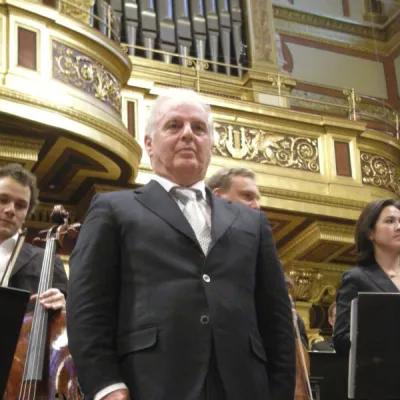
Daniel Barenboim
Human Design Chart
Biography
They played chamber music as a team with violinist Pinchas Zukerman. He and du Pre were a magic couple, both charismatic and joyful, giving the music world glamour and passion. A film was released in 1999 about the sisters, "Hilary and Jackie," which exposed a 16-month affair that Barenboim had with Hilary during a period when he and Jackie were separated. With the release of the film, Barenboim was quoted as saying, "Couldn't they have waited until I'm dead?"
Du Pre came down with multiple sclerosis in 1973 which brought on profound personality imbalances that created tremendous friction in her family. Barenboim cared for Jackie during her illness, but he also set up a household with another woman and fathered two children during the difficult years. His wife died on 19 October 1987, London.
What does Generator 4/1 mean for Daniel Barenboim?
Generator 4/1 — Design at a Glance
Daniel Barenboim's design shows a tendency towards high endurance, comparable to that of a workhorse. However, this strength does not manifest through his own initiatives but exclusively as a reaction to external impulses. The central dynamics of his design require him to wait for an inner 'yes' from the gut – the so-called sacral impulse – before he takes action.
This mechanism harbors two critical pitfalls. First, acting without internal enthusiasm leads to energy waste and burnout since the large capacity of a Generator is used for tasks that do not resonate with him. Second, deep frustration arises when he is prevented from working on his heart project despite having the power to do so.
In harmony with this design, responding to life signals and then acting results in profound satisfaction. If Daniel Barenboim lives against this strategy – such as by constantly initiating rather than waiting – he encounters persistent frustration or a lack of energy. His success thus depends on whether he picks up the signals from his environment and responds with his characteristic endurance once the inner confirmation signal is received.
Sacral Authority
Daniel Barenboim's design shows a tendency towards decision-making through internal resonance, rather than cognitive analysis. As a Generator with sacral authority, his process was simplified: strategy and inner guidance are identical. This requires an open emotional center, allowing decisions to be made not in the head but physically in the gut. This resonance manifested as a direct reaction to external stimuli – perceptible through an internal voice, grunting, or sudden bursts of energy.
The mechanics require waiting for this external impulse and awaiting physical confirmation before acting. Once this sacral motor kicked in, Daniel Barenboim experienced vitality and inexhaustible energy. He tackled his tasks with great enthusiasm and immersed himself in the activities without strict purposefulness being necessary. Life was experienced as vivid through this resonance.
Additionally, the spleen center acted as a supporting authority, giving him immediate access to instinctive perception and physical well-being. This configuration allowed for quick, spontaneous reactions. Daniel Barenboim could reliably be guided from this intuitive level, emphasizing his ability to make rapid decisions in everyday life. The joy of doing itself was paramount, driven by the continuous confirmation of his sacral energy on what engaged him.
The 4/1 Profile — Opportunist / Investigator
Daniel Barenboim appeared as someone whose essence was deeply rooted and hardly swayed by individual courses. His design showed a tendency towards quickly distancing himself when lacking acceptance from the environment, often misunderstood externally as stubbornness or inability to accept criticism. This reaction protected his large but cautious heart from injuries caused by 'well-intentioned' change impulses from others.
This pattern arises from his Profile 4/1 (Networker/Researcher), the only fixed profile in Human Design. It marks the transition from 'I' to 'You,' meaning that inherent qualities are so deeply anchored that fundamental change is neither possible nor desired. Line 4 brings this sensitive heart, which closes off when not accepted. This can impair self-confidence as the life path may be challenging.
At the same time, Line 1 (Recruit) imprints a pattern of commitment and struggle. Here, Daniel Barenboim learned when to stand firm and when to hold back. This constellation required time to grow and accumulate experiences to distinguish between acceptance and avoiding commitments.
However, once he found inner security and recognized his life theme, he acted stable like a rock in the storm. In this state, he was particularly gifted at teaching. The challenge lay in effectively conveying deep, transpersonal knowledge; linguistic skills were crucial here to overcome rigidity in knowledge dissemination and ease understanding by others.
Split Definition — Defined & Open Centers
Daniel Barenboim was characterized by a mechanical foundation of four defined centers: Ajna, Throat, G Center, and Sacral. This endowed him with a constant mental conceptualizing ability, a reliable source of expression, and a stable inner identity and direction. His mind was always active, continuously generating concepts and serving as an external authority for others. The connection between Ajna and Throat enabled him to directly translate his thoughts into speech and action, promoting clear and honest communication. The defined G Center gave him a deep sense of self-love and a clear purpose in life, while the Sacral Center served as a constant source of vital energy. However, this energy was only available when he responded correctly to external impulses; initiatives without prompting led to frustration and exhaustion.
At the same time, Daniel Barenboim was influenced by five open centers (Head, Heart, Solar Plexus, Spleen, Root) situational contexts. His open Head Center made him vulnerable to mental pressure and inspiration from others, lacking these as a constant personal trait. He tended to be distracted by doubts or questions from his environment rather than solving them as his own problems. The open Heart Center led to a lack of ego-driven willpower; he often sought ways to prove his worth, which could result in cycles of promises and disappointment. His open Solar Plexus absorbed emotions from the surroundings, making him emotionally vulnerable and personalizing foreign feelings or avoiding confrontation. The open Spleen Center generated a fundamental fear of survival and a tendency to cling to unhealthy situations for a sense of security through others. Finally, his open Root Center took on external stress, making him susceptible to burnout or hyperactivity when he tried to alleviate this pressure through his own efforts. These opennesses required him to always use his inner authority and strategy to recognize conditioning from the environment without internalizing it.
Channels for structured insight and persistent discovery.
Daniel Barenboim's design tended towards spontaneous, innovative insights that were processed and expressed through assimilation. This required patience with timing, as knowledge was often 'light years ahead' and only accepted by the collective after repeated explanation. The Channel of Structuring 23-43 connects the mind to the Throat Center: Gate 43 receives inspired knowledge as sudden breakthroughs, while Gate 23 processes and efficiently communicates this information. This configuration forms a unique perspective that changes others' thinking, for example through precise key words. The challenge was to let go of control and wait for the right timing to accept these ideas; only then did individual knowledge enter the collective and mutate it. Without this strategy, genius was often rejected or felt foreign.
Additionally, other gates were at work: Gate 1 emphasized uniqueness and creative expression in the here and now, while Gate 62 promoted logical details, pattern recognition, and fact clarification. Gate 56 allowed for abstraction of mental processes into pictorial narratives. In the background, Gates 30 (Recognizing Feelings), 16 (Experimenting towards Mastery), 20 (Integration in the Now), 31 (Leadership through Transmission), and 59 (Genetic Strategy of Binding) shaped the design. These elements supported the ability to develop techniques that enhance efficiency and helped communicate innovative thinking clearly enough for it to be understood and adopted.
Individual Circuitry — Circuit Signature
Daniel Barenboim's design tended towards two separate, parallel functioning energetic systems. Through his Split Definition, these forces did not activate automatically from within but required resonance from outside to become effective. This created an inner duality between pulsating creativity and cyclical reflection.
The Knowledge Circuit connected his Ajna with the Throat Center through the Channel of Structuring (Gates 43-23). This connection allowed him to structure and express his own thoughts and ideas acoustically. The energy here was pulsing, focusing on immediate individual creativity, transforming new knowledge into the world.
Completely independently, the Meaning Circuit worked, connecting the Identity with the Sacral Center through the Channel of Discovery (Gates 46-29). Here flowed a cyclical, visual energy dealing with the past and emotional experiences. This area served to learn from earlier events and share these insights together.
Since these two circuits were not connected in Daniel Barenboim, they existed as separate segments. One system stood for immediate creative expression in the now, the other for emotional processing of the past. Both required external validation or interaction to fully unfold their power and impact his life.
Juxtaposition Cross of Insight
Daniel Barenboim's Human Design reveals a tendency to gain understanding not in isolation but through the conscious juxtaposition of different elements. For him, knowledge was not a static state but a dynamic process of contrasting perspectives. The Insight Juxtaposition Cross describes precisely this mechanism: Understanding here does not arise from considering individual parts in an abstract space but rather through the active relationship between opposites or differences.
This pattern shapes an attitude where comparison and differentiation are central. Daniel Barenboim was someone who found meaning by relating divergent elements. The structure of his design supports learning based on the tension between different viewpoints. It is about understanding the nature of knowledge by situating it within its contrasting poles.
This configuration does not mean that conflicts should be avoided but rather that they can be used as a source of clarity. By delving into the differences between seemingly incompatible elements, Daniel Barenboim opens up to a deeper understanding of connections. Thus, insight results from the quality of comparison itself. His inner compass oriented towards this ability to discover new meanings through juxtaposition – placing different things side by side – and to comprehend complex matters in their full context.
Saturn Return · Uranus Opposition · Chiron Return · 2nd Saturn Return — Life Cycles
Daniel Barenboim's Human Design structured his life as a clear sequence of relationship formation, artistic recognition, and institutional foundation. These phases corresponded to the four prominent astrological cycles in his chart. The first Saturn Return at age 25 promoted stability and commitment; this was evident in 1967 with his marriage to cellist Jacqueline du Pré. The Uranus Opposition around age 41 often marks a point of radical change or public affirmation of one's path. During this phase, Barenboim won the Grammy Award for Edward Elgar’s Violin Concerto in A minor with Itzhak Perlman in 1983, solidifying his artistic recognition. The Chiron Return between ages 49 and 51 is a fulfillment cycle where the Incarnation Cross unfolds and one experiences their life purpose. This occurred in 1991 when he won another Grammy for Brahms’ Three Violin Sonatas, confirming his profound musical mission. Finally, the second Saturn Return at age 57 led to consolidation into long-term structures. In 1999, Barenboim founded the West-Eastern Divan Orchestra, transforming his artistic vision into a lasting institutional form. Each cycle thus served not only as a time marker but actively shaped the transition from personal connection through individual success to collective responsibility and enduring legacy.
Generator · Sacral Authority — Synthesis
Daniel Barenboim's chart reveals a profound thread of transformative power through reaction. As a Generator with sacral authority, he is destined to react to impulses from life (rather than initiate them), and his energy unfolds most strongly in action itself. This reactive mode is reinforced by the connection between Sacral Center and G Center – a synergy that channels a strong identity and direction when he acts authentically. The openness of his centers for emotions, root, and head points to deep sensitivity and an ability to absorb external influences, making him a mirror of collective energies – but also susceptible to conditioning. His defined Throat ensures that these transformed energies can be clearly expressed if filtered through his inner authority.
A central paradox lies in the tension between his capacity for deep reaction and the open nature of many centers. He is a strong Generator whose energy flows most effectively when responding to external stimuli, yet he constantly perceives the energies of others and can be influenced by them. This field of tension manifests in the need to set clear boundaries and not lose himself in the emotions or stress of others to maintain his own direction and authenticity – a balance between receiving and expressing that shapes his life.
2 Defined Channels
Incarnation Cross - Juxtaposition Cross of Insight
Solar Return
The Solar Return shows the moment when the sun returns to its exact birth position - your personal solar year.
Life Cycles
Discover the life cycles with a detailed triple view (birth chart, cycle chart, composite).
Human Design Profile
- Type
- Generator
- Strategy
- To respond - wait for something to respond to
- Authority
- Sacral Authority
- Profile
- 4/1 - Opportunist / Investigator
- Definition
- Split Definition
- Incarnation Cross
- Juxtaposition Cross of Insight
- Date of Birth
- 15.11.1942 11:35
- Place of Birth
- Buenos Aires, Argentina
Frequently Asked Questions
What is Daniel Barenboim's Human Design type?
What Profile does Daniel Barenboim have in Human Design?
What authority determines Daniel Barenboim's decisions?
What is Daniel Barenboim's incarnation cross?
When was Daniel Barenboim born?
Discover your own Human Design
Are you also a Generator? Find out in a personal reading how to use your sacral energy correctly and discover deep satisfaction.
More Personalities
Back to overviewAaliyah

Alexia

Alizée

Angèle

Anne-Marie

Arcángel