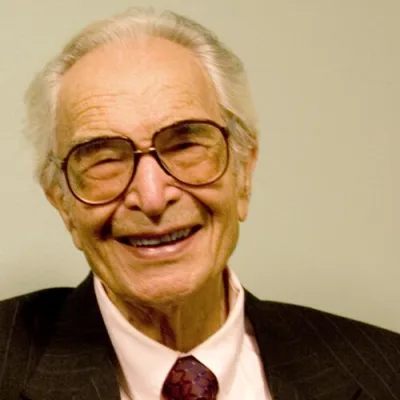
Dave Brubeck
Human Design Chart
Biography
In the late '40s, he formed experimental groups. In 1948, Brubeck began recording. One of his more memorable recordings was his "Take Five," 1959. A notable composer of composition frames, time signatures and advanced harmonics, he always was original and captivating. In the 1970s, Brubeck worked with a small group featuring his three sons, Chris, Daniel and David.
He had problems with clogged arteries that required by-pass surgery on 8 January 1989.
He died of heart failure in Hartford, Connecticut on 5 December 2012.
Dave Brubeck — Generator with Profile 4/6
Generator 4/6 — Design at a Glance
Dave Brubeck was a Generator. His design endowed him with immense inner endurance and productivity, comparable to the strength of a workhorse that could provide energy over long distances. However, this sacral energy wasn't released through self-initiative but responded to impulses from his environment. His strategy involved waiting for a signal and responding with a clear 'yes' from within before acting.
This mechanism significantly determined his well-being. When Dave Brubeck reacted and worked on things that received his inner approval, he experienced deep satisfaction and a sense of fulfillment. Conversely, ignoring these internal signals led to two specific pitfalls. Either he wasted his energy on tasks without genuine enthusiasm, which exhausted him, or he was prevented from pursuing his heart's project despite the available energy. Both scenarios resulted in persistent frustration and a noticeable lack of energy. His success thus depended less on constant pushing forward than on learning to respond intuitively to what truly spoke to him. Only then could he unleash his full potential without exhausting himself or feeling blocked.
Emotional Authority
Dave Brubeck exhibited a decision-making stance characterized by emotional wave movements. His inner authority lay in the defined Emotional Center, meaning that his perception of the world was always colored by his current mood. What appeared inspiring at one moment might be negatively evaluated in the next. These fluctuations were not instability but a mechanical process: The feeling in each moment merely represented a temporary snapshot, not necessarily the ultimate truth.
Quick and spontaneous decisions based on these initial emotional impulses would often have negative consequences for him. Instead, his design required patience and time to gain clarity. Dave Brubeck had to let decisions mature, ideally over several nights. Only when the initial intense feelings faded and an emotional distance emerged did calmness set in. This process of 'sleeping on it' was essential, especially for long-term life decisions with significant consequences. Only then could he reach a deeper, more comprehensive understanding that transcended his current mood. His strategy involved hesitating and asking questions repeatedly until the emotional wave subsided and a stable foundation for further action was created.
The 4/6 Profile — Opportunist / Role Model
Dave Brubeck's design showed a tendency that shifted noticeably throughout his life. In his first thirty years, he experimented intensely, particularly in relationships and friendships. This phase resembled Line 3: full of curiosity and experimentation. However, once the sixth line became active, an internal conflict emerged. The desire to belong to a community – the heart of the fourth line – clashed with the need to withdraw and contemplate the meaning of life – the head of the sixth line. This contrast between connection and distance shaped his inner stance.
In later years, he was expected to take on the role of a wise mentor. His design showed spiritual security that overcame confusion. He enjoyed the diversity of data and could serve as inspiration without offering direct solutions. Crucial was vigilance not to get lost in enthusiasm. His fourth line guaranteed survival through maintaining his own rhythm; passive waiting transformed into active performance. At the same time, he looked ahead to the first line of the next hexagram for an inventory check. His big heart remained cautious to avoid opening up to false people and getting hurt. Cooperation with others was paramount, always accompanied by the necessity of preserving his own rhythm.
Split Definition — Defined & Open Centers
Dave Brubeck's Human Design revealed a tendency towards constant mental pressure coupled with profound emotional authority. He was someone who struggled under the weight of perpetual inspiration - defined Head and Ajna Centers generated an unending stream of questions and concepts, but lacked their own energy to implement them. This state could lead to mental anxiety when he tried to immediately turn these thoughts into actions instead of waiting for the right moment.
His defined Sacral Center, on the other hand, was a source of immense vitality and fertility. Here lay his true strength: not in initiating but in responding. When asked, his Sacral Center could answer with a clear 'Yes' or 'No', giving him the necessary energy for lasting satisfaction. Attempts to make decisions purely from the mind often led to frustration and exhaustion as the sacral power was then unavailable.
At the same time, his defined Solar Plexus shaped his emotional wave as an inner authority. Dave Brubeck tended to make decisions only after waiting out these emotional cycles to gain clarity. Impulsive actions in the highs or lows of his mood would cause chaos; patience was key to emotional truth.
His open centers revealed specific vulnerabilities. The open Throat Center made him susceptible to the pressure of forcing attention through excessive talking, although proper communication came spontaneously and invited. His open G Center meant a lack of firm identity; he tended to align with the environment and often futilely sought a fixed direction or love instead of waiting to be initiated. An open Heart Center drove him into the cycle of wanting to prove his worth through promises, which he mechanically could not keep. Finally, his open Root Center absorbed external stress, leading to hyperactivity when he tried to escape this foreign pressure rather than recognizing and letting it go.
Channels for intimacy, rational clarity and abstract comprehension.
Dave Brubeck was someone whose inner rhythm and emotional depth were inseparably intertwined. His design revealed a tendency towards intense intimacy that fostered not only romantic but also creative fertility. This was marked by the Channel of Union 59-6, linking sacral sexuality with an emotional wave of pleasure and pain. This configuration required patience; true clarity emerged only after the emotional wave subsided, often complicating relationships initially but leading to deep trust in the long run.
Parallel to this, Dave Brubeck had a mind that sought sudden insights. The Channel of Awareness 61-24 connected spontaneous inspiration with rational processing. His mind did not work linearly but waited for moments of 'Satori', where knowledge simply arrived. Music often served as an outlet for his constant mental pressure. Additionally, the Channel of Abstraction 64-47 permeated him, filtering every experience through a kaleidoscope of possible interpretations. This experiential mind constantly sought stories and patterns that made sense, even if it caused temporary confusion.
Furthermore, Gates like 5 (Rhythm) and 35 (Change Through Interaction) set his pace and oriented him towards new experiences. His energy was further channeled through Gate 14 (Power and Direction) as well as Gate 27 (Care), helping him shape creative impulses with grace and caring warmth. Gate 34 in his design gave him a strong, though sometimes unoriented power that promoted the common good, while Gate 55 in his Solar Plexus allowed extreme mood swings he had to learn to navigate consciously.
Individual Circuitry — Circuit Signature
Dave Brubeck's Human Design revealed a tendency towards separate, parallel functioning energetic blocks. Through his Split Definition, two independent groups existed: one linking the Solar Plexus with the Sacral Center, and another connecting Ajna with Head Center. These areas did not flow into each other but coexisted as distinct forces side by side.
In the area of Ajna and Head, the Knowledge Circuit operated through the Channel of Awareness (Gates 61-24). This promoted innovative flashes of insight and the ability to transform new knowledge. Simultaneously, in the same center pair, the Meaning-Finding Circuit was evident through the Channel of Abstraction (Gates 64-47). Here it was about reflecting on past experiences and finding meaning in old events to share these insights later. Both circuits thus utilized the same connection between Head and Ajna but with different focuses: once on new transformation, once on past significance.
Independently, the Archer Circuit operated in the lower chart. Through the Channel of Union (Gates 59-6), it linked the Sacral with Solar Plexus Center. This configuration brought forth primal energies of protection, care, and family preservation. It stood for instinctive life force and emotional wave movement necessary to nourish and defend one's environment. Dave Brubeck thus lived with these clearly delineated energetic fields: creative intuition and past reflection above, as well as instinct-driven protection below - without direct exchange between these two main areas.
Right Angle Cross of Consciousness 4
Dave Brubeck's Human Design profile carried the signature of the right Consciousness 4 Cross. This configuration was characterized by a fundamental attitude marked by deep, often silent dedication to the essential. In Human Design, this cross marks a specific approach to the world: it is not about loud action or obvious leadership but rather an inner presence that can be almost meditative. The energy of this configuration works from within outwards, carried by an unshakable certainty about one's path, which rarely needs to be defended or explained.
For Dave Brubeck, this meant that his authority arose not through external validation but through a quiet, inner resonance. He was someone who could sense complex connections and express them in ways that touched others without overwhelming them. The right Consciousness 4 Cross combines high sensitivity with clear yet unobtrusive structure. It is a design of 'quiet power' that consists simply in being present and exerting influence through this presence. Dave Brubeck lived this quality by focusing on the essence of his expression form, thereby creating an atmosphere in which others could discover their own depth. His way of interacting with the world was marked by this unspoken intimacy and trust in his inner compass without seeking recognition.
Saturn Return · Uranus Opposition · Chiron Return · 2nd Saturn Return — Life Cycles
Dave Brubeck's design unfolded in clearly structured phases marked by planetary cycles. In 1949, at age 29, he started a trio that later became the quartet with Paul Desmond. This coincided with his first Saturn Return, a phase where years of groundwork often condenses into a solid professional foundation. The structuring of his musical identity happened here through discipline and consistency.
Ten years later in 1960 at age 40, he performed for US President Lyndon B. Johnson and King Hussein I at the White House. This corresponded to the Uranus Opposition, a time of heightened visibility and public recognition where one's radiance often comes into focus. The mechanics of this cycle favored moments of broad resonance and public appearance.
In 1972, at age 52, he began a new collaboration with Paul Desmond. This coincided with his Chiron Return, a fulfillment cycle between the ages of 49 to 51 (here slightly delayed or interpreted as a transition phase), where the incarnation cross unfolds and purpose becomes experiential. It was not about healing but rather the blossoming of one's own purpose through renewed connection.
Finally, Dave Brubeck converted to Catholicism in 1980 at age 60. This marked his second Saturn Return, a phase of inner maturation and spiritual anchoring where external successes are often replaced or complemented by deeper belief structures. His life paths thus showed themselves as the result of structural condensations and public affirmations.
Generator · Emotional Authority — Synthesis
He was a Generator whose life was marked by deep sacral energy. This power fueled an indefatigable work ethic, which was always tied to the emotional wave (emotional authority). The profile as a Networker and role model points to a path that initially distinguished itself through experimentation but later should have met expectations of wisdom and cooperation. The defined Head Center generated constant pressure to understand things and inspire others (Channel 1-8), while the connection between Sacral and Solar Plexus (Pairing) created an intense, creative essence that required waiting for emotional clarity.
A central paradox lay in the tension between the need for community (Line 4 in Profile) and the desire for independent reflection (Line 6). This inner conflict was evident in recurring turning points of his career (documented events at Saturn Return, Uranus Opposition, Chiron Return), which were marked both by collaboration and the search for new forms of expression. He thus lived a dynamic of connection and distance that fueled his creative energy but also presented challenges.
3 Defined Channels
Incarnation Cross - Right Angle Cross of Consciousness 4
Solar Return
The Solar Return shows the moment when the sun returns to its exact birth position - your personal solar year.
Life Cycles
Discover the life cycles with a detailed triple view (birth chart, cycle chart, composite).
Human Design Profile
- Type
- Generator
- Strategy
- To respond - wait for something to respond to
- Authority
- Emotional Authority
- Profile
- 4/6 - Opportunist / Role Model
- Definition
- Split Definition
- Incarnation Cross
- Right Angle Cross of Consciousness 4
- Date of Birth
- 06.12.1920 18:35
- Place of Birth
- Concord, CA, United States
Frequently Asked Questions
What was Dave Brubeck's Human Design type?
What profile did Dave Brubeck have?
What authority did Dave Brubeck have?
What incarnation cross did Dave Brubeck have?
When was Dave Brubeck born?
Discover your own Human Design
Are you also a Generator? Find out in a personal reading how to use your sacral energy correctly and discover deep satisfaction.
More Personalities
Back to overviewAaliyah

Alexia

Alizée

Angèle

Anne-Marie

Arcángel