
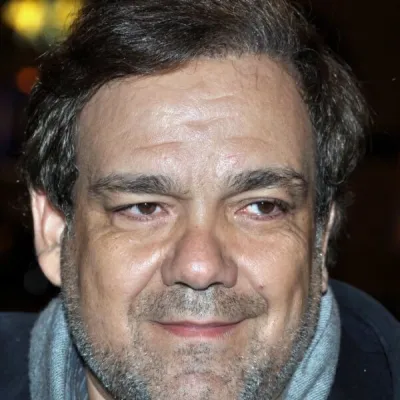
Didier Bourdon
Human Design Chart
Biography
Didier Bourdon as a Manifesting Generator 1/3 in Human Design
Manifesting Generator 1/3 — Design at a Glance
Didier Bourdon revealed himself as someone who quickly brought things to life, driven by a hybrid energy that combined the speed of a Manifestor with the constant power of a Generator. His design tended to skip steps and simultaneously take up multiple impulses – yet this dynamic only worked smoothly when carried by clear inner confirmation.
As a Manifesting Generator, Didier Bourdon had a defined Sacral Center, giving him a steady source of energy. However, his strategy was not in initiating but responding to external impulses. Only when the Sacral Center responded with a clear "Yes" did the quick implementation become a source of deep satisfaction rather than frustration. Without this resonance, he tended to skip important steps or overwhelm himself through multitasking, quickly leading into the non-self theme of frustration.
His actual creative power unfolded in "play mode". As soon as variety and fun went hand in hand with sacral confirmation, parallel work on various projects was not an obstacle but a strength. The demand to finish one thing before starting another contradicted his nature; instead, he drew satisfaction from acting quickly and diversely – provided that he waited for the inner signal before taking action.
Sacral Authority
Didier Bourdon showed a decision-making approach that did not start in the Head Center but waited for a physical response from his body. His design indicated that he could only find inner clarity through reacting to external stimuli rather than actively planning or analyzing. This mechanism is determined by his sacral authority, an instance specific to the Generator type and its strategy of integrating with inner guidance.
For Didier Bourdon, this meant paying attention to signals from his defined Sacral Center: a grunt, a hum, or a spontaneous "mmh". These bodily sounds were not random noises but precise responses to what was addressing him. When this resonance occurred, he felt an immediate surge of energy and vital aliveness. This state signaled to him that he was moving in the right direction. In such moments, he had inexhaustible energy and devoted himself to his tasks with great enthusiasm, completely free from obsessive purpose thoughts.
His life task consisted of listening to this inner voice and letting it guide him instead of following intellectual deliberations. By waiting for this physical confirmation, he could practice his work with joy and satisfaction. His sacral authority challenged him to stay present and react to the next impulse, allowing him to dissolve into his activities entirely and experience a deep sense of fulfillment.
The 1/3 Profile — Investigator / Martyr
Didier Bourdons design points to a tendency to validate theoretical knowledge through practical experience. His Profile 1/3, the Researcher and Experimenter, defined this dynamic: Line 1 urged intense study and inner reflection, while Line 3 promoted trying things out and learning from mistakes. This combination created a life task where self-earned insights were central.
The solar energy of Gate 41 (Line 1) demanded a deep investigation into limitations and the protection of imagination through selective delegation. This gave him a mysterious emotional intelligence but could lead to overexertion as many emotions had to be processed simultaneously. At the same time, Gate 28 (Line 3) brought in adventure-seeking and risk-taking. Here it was about achieving personal goals through trial and error.
The challenge lay in integrating these two aspects: The desire for perfect knowledge had to be balanced with the need for action-oriented learning. If Didier Bourdon valued something as good, he had previously tested it both theoretically and practically. His judgment thus rested on a synthesis of solar depth and secular experimentation, making his assessments trustworthy.
Single Definition — Defined & Open Centers
Didier Bourdon was characterized by a massive, constant energy infrastructure. Seven defined centers – Ajna, Throat, G, Heart, Sacral, Spleen, and Root – created an extremely stable, self-referential presence. This resulted in an unshakable will (Heart), clear identity (G) as well as the ability to directly translate mental concepts (Ajna) into speech or action (Throat). The motor was reactive-sacral with high vitality, supported by intuitive security in the present (Spleen) and persistent progress pressure (Root). This combination of Heart, G, and Sacral created a dominant aura; thinking, willing, and doing stood barely in internal contradiction. Bourdon had the energy to act, the will to do so, as well as the mental structure for communication.
In contrast, the open Head Center and the open Solar Plexus Center appeared as the only “windows”. Bourdon was not continuously inspired or emotionally wave-like. Inspiration was only taken up when needed, emotions reflected but not experienced as his own waves. This protected him from mental overload and emotional instability, making him a clear mirror for the environment in these areas. He tended to question whether he was inspiring enough or had to avoid confrontation, which is typical for the vulnerability of open centers rather than representing his own thought patterns. This openness allowed him to perceive and reflect on others' emotional moods without personalizing them.
Channels for intuitive presence, rhythm, leadership, insight, devotion, care, ambition.
Didier Bourdon showed a basic attitude where radical innovation met logical leadership. His design connected the impulse to force new directions through individual intuition with the need to integrate these into existing social patterns. This created a tension field between mutative solo ventures and collective acceptance.
Beat 14-2 gave him the role of key holder: access to material resources, to drive mutation. Gate 14 focused on power competence, Gate 2 on higher knowledge as director of movement. This energy was ready to take him and others in a new direction, driven by sacral generativity and G-Center identity. Innovation here did not happen through planning but as spontaneous responses to life.
At the same time, The Alpha Animal 7-31 worked as a mechanism for logical, collective leadership. Gate 7 provided the role of self, Gate 31 the voice of the leader. This configuration required that innovation prove itself logically superior and beneficial to the common good to be carried by the majority. Didier Bourdon could show the way but only if the collective invited him. The radical novelty of the beat had to be channeled through this structure of collective leadership to be effective.
Additionally, Perfect Form 57-10 shaped his behavior: intuitive insight (Gate 57) met self-behavior (Gate 10). This allowed spontaneous, appropriate action in the present, free from future fears, inspiring others by example. Structuring 23-43 linked mental insight with assimilation to clearly express innovative perspectives when the timing was right.
Devotion 26-44 used instinctive vigilance (Gate 44) and ego strength (Gate 26) to sell fitting solutions to the tribe. Preservation 27-50 ensured through care (Gate 27) and values (Gate 50) the preservation of the tribe. Transformation 32-54 drove ambition through continuity, while Maturation 42-53 ensured that experiences were cyclically processed to gain wisdom.
Didier Bourdon was called upon to live his unique energy not as an isolated impulse but as a catalytic factor that only became fully effective through the invitation of the collective.
Individual Circuitry — Circuit Signature
Didier Bourdon showed himself marked by a Simple Definition, meaning he did not carry all answers within and needed exchange with others to experience wholeness. His design connected logical strategy with individual identity and the protection of the tribe.
The Knowledge Circuit linked for him two separate areas: Ajna- with Throat Center for structured expression as well as Identity- with Sacral Center for individual life force. The Understanding Circuit linked Throat- and Identity Centers, allowing a rational, emotionless transmission of insights. In the Meaning-Making Circuit, Sacral- and Root Centers flowed together, energetically processing past experiences.
The Ego Circuit connected Heart-, Spleen-, and Root Centers to a unit of cooperation and resource care. Here it was about mutual support in the tribe without constant life force input, making rest periods necessary. The Protector Circuit linked Sacral- with Spleen Center, emphasizing instinctive protection and care for the family. Finally, the Integration Channel connected Identity- with Spleen Center to guide strength from reactions to life through intuitive knowledge.
The Solar Plexus Center remained open; emotional waves were not part of his direct processing chains. The awareness stream of instinct in the Spleen Center underscored the tribe-oriented orientation. This configuration promoted a clear, strategic stance that brought new ideas into harmony with traditional security and individual expression, always dependent on external impulses for completion.
Right Angle Cross of the Unexpected 4
Didier Bourdons design pointed towards a tendency of unpredictable turns that shaped his life as a series of surprises. This configuration is defined by the right cross of the Unexpected 4, an archetypal imprinting that governs deeper, often unconscious life dynamics and forms the karmic backdrop.
The core of this mechanism lies in unpredictability itself. It's not about planning strategies but rather about handling or actively creating the unexpected. This theme was central to his existence: plans often fell apart in favor of spontaneous events, which did not appear as chaos but as necessary corrections to the path. The energy of this cross demands an openness towards chance, for these moments were those of greatest clarity and proof.
Instead of orienting himself around rigid structures, Didier Bourdon found himself in situations marked by sudden changes. The right cross of the Unexpected 4 means here that life itself became a teacher by constantly presenting new, unexpected challenges. Overcoming these moments was less about preparation than adaptability and trust in the flow of events. This dynamic created a backdrop where the unexpected was not seen as disruption but as an essential part of his personal development.
Saturn Return · Uranus Opposition · Chiron Return · 2nd Saturn Return — Life Cycles
Didier Bourdon showed himself clearly at age 27 in 1986: founding the comedy trio Les Inconnus with Bernard Campan and Pascal Légitimus. This step marked the transition from youth to adult responsibility and identity. For his design, this was a critical turning point where internal structure solidified.
The first Saturn return acts as a cycle point often leading to the condensation of years of groundwork into something tangible and enduring. Instead of just experimenting, something substantial and lasting emerges here. Didier Bourdon did not use this moment for mere play but to establish a firm form. The founding of the trio was no coincidence but the concrete manifestation of his stabilizing identity.
Through this action, his inner order became visible externally. What might have still been in flux now gained clear contours. The connection with his partners formed the foundation on which he stood from then on. It was about reliability and creating a framework that would endure beyond the moment. Thus, individual development turned into a joint project defining his adult role.
Manifesting Generator · Sacral Authority — Synthesis
Didier Bourdons design reveals a central thread of dynamic adaptability fueled by the combination of an Manifesting Generator with defined Root, Heart, and G Centers. This constellation allows for quick reactions to impulses (Sacral Center), paired with inner direction-finding and the drive to make things happen (G Center). The defined Root provides the necessary energy to initiate changes and face challenges, while the Heart ensures willpower and self-determination. These elements combine in a steady flow of action, adaptation, and the search for authentic unfolding – a life marked by reactive initiation and the implementation of personal values.
The central paradox lies in the interplay between the manifesting aspect (quick initiation) and the Generator strategy (reacting to impulses). Bourdon seems destined both to initiate things and respond to life, requiring constant navigation between proactive shaping and receptive action. This tension carries the risk of skipping important steps or scattering energy but can also be a source for innovation and creative expression when strategy and authority are in harmony.
8 Defined Channels
Incarnation Cross - Right Angle Cross of the Unexpected 4
Solar Return
The Solar Return shows the moment when the sun returns to its exact birth position - your personal solar year.
Life Cycles
Discover the life cycles with a detailed triple view (birth chart, cycle chart, composite).
Human Design Profile
- Strategy
- To respond - wait for something to respond to
- Authority
- Sacral Authority
- Profile
- 1/3 - Investigator / Martyr
- Definition
- Single Definition
- Incarnation Cross
- Right Angle Cross of the Unexpected 4
- Date of Birth
- 23.01.1959 11:00
- Place of Birth
- Alger, Algeria
Frequently Asked Questions
What is Didier Bourdon's Human Design type?
What Profile does Didier Bourdon have in Human Design?
What Authority does Didier Bourdon possess?
Which incarnation cross is active for Didier Bourdon?
When was Didier Bourdon born?
Discover your own Human Design
Are you also a Manifesting Generator? Find out in a personal reading how to unfold your multi-talents and direct your energy wisely.
More Personalities
Back to overviewSissy Spacek

Aldair

Alizée

Anémone

Angeli

Ann-Margret
