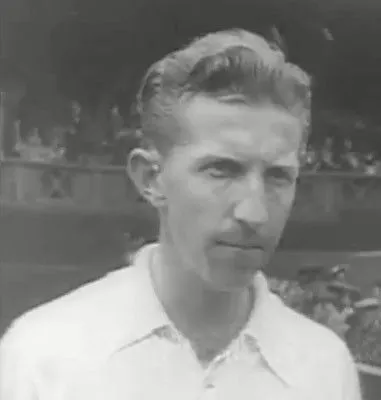
Donald Budge
Human Design Chart
Biography
In 1937, he was named the Most Outstanding Amateur Athlete of the Year. In 1938, he created a record that has never been equaled. He won the Australian, French, Wimbledon and U.S. singles championships.
His first pro match was held in Madison Square Garden on 3 January 1939 before 16,000 fans. Whenever he toured and wherever he played, he was a top draw.
Among his business concerns, he invested in a string of laundries. During the summers, he was in charge of Chatham Hall Boy's School in Virginia, in the fall and spring he commuted between tennis clubs, and during the remaining months he took vacations. His two books, "On Tennis," and "How Lawn Tennis is Played" are still basic books for any serious participant.
The copper-haired champion died on 26 January 2000 in Scranton, PA following injuries sustained in a December auto accident.
Donald Budge — Reflector with Profile 5/1
Reflector 5/1 — Design at a Glance
Donald Budges design laid the foundation for a life without constant, internal energies. As a Reflector, he had no defined centers, making him a sensitive mirror of his environment. He not only absorbed the aura of other people but also reflected subtle vibrations from nature, influenced by seasons and astronomical constellations. This extreme sensitivity required a specific lifestyle: Important decisions needed at least one lunar cycle to gain clarity. By following this strategy, he could observe himself free from attachment and was rewarded with a feeling of joyful surprise. If he lived against his design, deep, lasting disappointment ensued – both towards himself and the state of the world. His role was to mirror the energy of the moment rather than act from a fixed inner core. This configuration shaped his experience through constant adaptation and perception of the external field instead of internal impulses.
No Inner Authority
Donald Budge lacked an inner authority – rare in the Human-Design landscape. His design required a different approach to decision-making: He sought exchanges with many different people, activating latent potentials in his open centers through energetic interactions. This dialogue allowed him to view issues from numerous perspectives and express information in diverse ways.
Evaluating this complex data was a time-consuming process. Donald Budge needed time and solitude to discern the red thread and separate what fit him from what did not. Through this filtering, he developed his specific intelligence: the ability to meaningfully organize and structure information. This formed his capital for success as a Projector.
A key element for him was choosing his environment. He sought places where he felt comfortable and could exchange with trustworthy people. Over time, this trusting dialogue deepened his sense of what was right for him. By not making premature decisions but carefully condensing information from the dialogue, he found his individual truth and structuring power.
The 5/1 Profile — Heretic / Investigator
Donald Budge emerged as someone who gathered profound knowledge to offer others for problem-solving. His design as a 5/1 – Hero and Researcher – combined the magnetic aura of Line 5 with the thorough research work of Line 1. Others often sought him out for solutions, making him a central figure who needed clear boundaries to avoid being drained by an abundance of requests.
This dynamic was strengthened by specific energies. The fifth line from Gate 45 gave him intuitive leadership qualities and the talent for innovation in crisis times. He acted as a genetic leader, respected because he offered practical solutions and could shape the 'tribe'. Simultaneously, Line 1 from Gate 36 determined his approach to resistance and uncertainty. Here lay his foundation: Deeply exploring crises was essential for him, as without this willingness to face challenges, no progress was possible. While Jupiter in this configuration sometimes led to excessive resistance against changes, the fundamental strategy of a 5/1 – learning and sharing insights – helped find balance between private research and public problem-solving. Donald Budge optimally utilized his gifts when he learned to say No as well, maintaining a beneficial tension between his inner knowledge reservoir and others' external expectations.
No Definition — Defined & Open Centers
Donald Budge's design featured no defined centers, indicating a complete openness to external influences. His mechanics were characterized by the ability to absorb and reflect the energy and moods of his environment rather than generating them independently. The open Head Center and Ajna Center meant that he did not possess consistent mental inspirations but drew these from context; he could easily get entangled in other people's questions or seek answers that weren't truly his own. This led him to learn how to distinguish between genuine intuition and conditioned mental pressure.
The undefined G Center did not give him a fixed identity or life direction, instead making him a mirror of his environment. He tended to adapt to the people he interacted with and found his orientation only through the right place and relationship. The open Heart Center showed that he was not consistently willful; ideally, he avoided giving promises to prove his worth as this often ended in cycles of overextension and self-doubt. Instead, he could perceive others' willpower and learn when a commitment was truly correct for him.
His open Sacral Center also meant that he did not possess constant generative energy. He absorbed the vitality of his environment which could lead to exhaustion if boundaries were neglected. His open Solar Plexus absorbed emotions like a sponge; he had to learn not to personalize these as his own but rather observe them as transient waves. The undefined Spleen Center lacked consistent intuition for health and well-being, making him prone to spontaneous decisions often stemming from fear or false security. Finally, the open Root Center took in stress and adrenaline from the environment, leading him to learn not to misinterpret this pressure as his own drive but rather regulate it consciously. Donald Budge lived in constant interaction with his environment, whose wisdom lay in perceiving these influences consciously and navigating them through inner authority.
Channels & Gates
Donald Budge's configuration combined collective belonging with the ability to overcome resistance. Gate 45-45 in the Throat Center gathered energy on a tribal level and represented the royal hierarchy of blood; it received its power from the Heart Center and expressed willpower as a benefit for the tribe, where like-minded forces attracted each other. Complementarily, Gate 26-26 in the Heart Center allowed a weak ego to focus perception through surrender and move a conservative tribe towards accepting innovations to prevent genetic retardation – a role typically taken by sales managers who needed their breaks. On an emotional level, Gate 6-6 formed the elemental building block for further development through friction; it regulated the BH value as a biological limit and used emotional waves in the context of fertility or infertility, without which growth was not possible. Finally, Gate 36-36 stood for the darkening of light: It released strong emotional energy by understanding crises as impersonal, cyclical movements with beginning, middle, and end. The decline here paved the way for new experiences so that development through these necessary phases of darkening was propelled forward. This combination of tribal willpower, innovative persuasiveness, friction-induced emotional development, and crisis-driven experience formed the foundation of his inner dynamics.
Circuit Signature
Donald Budge's design showed an internal energetic system with no continuous, hard-wired pathways. His configuration was entirely undefined, meaning he had no permanent, automatic impulses or fixed character traits dictated from within. Instead, his entire interior functioned as an open resonance field that like a mirror absorbed and reflected the energies of his environment and those around him. This setup shaped a lifestyle strongly determined by external influences; he reacted sensitively to moods, expectations, and energies of others, often without immediately distinguishing what was truly his own authentic truth. Since no centers were connected or even individually defined, he lacked a stable inner compass for decision-making or identity search. He had to learn to consciously use this reflection to find his way in various roles and situations rather than seeking a fixed, unchanging essence. His experience of the world was marked by this high adaptability and ability to adopt different perspectives as his system was free from internal blocks or rigid patterns. This required constant vigilance against foreign energies so he did not slip into others' identities.
Left Angle Cross of Confrontation 1
Donald Budge displayed a basic attitude shaped by the left cross of Confrontation 1. This configuration indicated a tendency towards direct and often challenging action. It described a path where internal tensions and external resistances were not avoided but actively addressed. For Donald Budge, this meant using conflicts as a necessary motor for change. Instead of seeking harmony at all costs, he sought the truth in confrontation. This mechanism promoted an honest, sometimes blunt way of dealing with oneself and others. It was not about destructive pursuit of conflict, but breaking through illusions. Donald Budge lived this dynamic by confronting friction points that were required for his growth. Confrontation was no obstacle for him, but rather a path to clarity. It forced him to take a stand and assume responsibility for his own beliefs. This created an inner strength based on real experience, not prescribed dogmas. He used this energy to free himself from false patterns. Confrontation served as a tool for self-discovery. It helped him sharpen his own identity in the face of resistance. This process was demanding but necessary for his development. Donald Budge thus showed himself to be someone who accepted life's harshness and drew strength from it.
Saturn Return · Uranus Opposition · Chiron Return · 2nd Saturn Return — Life Cycles
Donald Budge lived through an entire lifespan marked by four prominent astrological cycles. His first Saturn Return around age 29 represented a significant maturation process; early experiences were condensed into a stable foundation for the next phase. Shortly after came the Uranus opposition, often characterized by inner unrest and the urge to change as old structures are questioned.
Around age 50, his Chiron Return occurred. This cycle did not signify healing in a medical sense but rather a period of flourishing life purpose. If Donald Budge had followed his internal strategy up until then, this phase revealed the unfolding of his incarnation goal as meaningful and experiential. It was a time of fulfillment where one's essence could fully manifest.
His second Saturn Return around age 58 concluded this sequence. This cycle demanded further consolidation; it was about securing the achievements of middle years to prepare for the next stage. These four cycles together formed a framework of building, breaking, fulfillment, and new stabilization that structured Donald Budge's path. They show how inner development manifests in external life stages: first through testing, then liberation, followed by purpose-finding, and finally confirmation of what had been achieved.
Reflector · No Inner Authority — Synthesis
Donald Budge lived as a Reflector, deeply influenced by the energies around him. Without defined centers, he perceived the world as a mirror and reflected it in his way of being (Design View). This openness, combined with the Profile of Hero/Researcher, led him to accumulate knowledge and make it available to others – a process fueled by constant search for new challenges and problem-solving (Profile Role). He was dependent on orienting himself through dialogue with others to gain information from energetic interactions in his open centers (Authority), thus living a cycle of adapting to external influences.
A central tension field characterized Donald Budge: the lack of inner authority paired with the drive to function as a knower. While he did not possess constant, personal energies (Design View), he tended to offer solutions for others (Profile Role). This led to a paradoxical situation where the need for external validation and orientation contrasted with his role as the presumed expert. The left cross of Confrontation underscored this dynamic by repeatedly presenting him with the task of dealing with external expectations (Cross).
Incarnation Cross - Left Angle Cross of Confrontation 1
Solar Return
The Solar Return shows the moment when the sun returns to its exact birth position - your personal solar year.
Life Cycles
Discover the life cycles with a detailed triple view (birth chart, cycle chart, composite).
Human Design Profile
- Type
- Reflector
- Strategy
- Wait a lunar cycle (approx. 28 days)
- Authority
- No inner authority - learn more
- Profile
- 5/1 - Heretic / Investigator
- Definition
- No Definition
- Incarnation Cross
- Left Angle Cross of Confrontation 1
- Date of Birth
- 13.06.1915 04:00
- Place of Birth
- Oakland, CA, United States
Frequently Asked Questions
What was Donald Budge's Human Design type?
Which profile did Donald Budge have?
What kind of authority did Donald Budge have?
What incarnation cross did Donald Budge have?
When was Donald Budge born?
Discover your own Human Design
Are you also a Reflector? Find out in a personal reading how to find the right environment and understand your unique mirror effect.
More Personalities
Back to overviewBaekhyun

Christian-Jaque
Jihyo

Marilyn

Pelé
Squeezie