Dylan Borlée
Human Design Chart
Biography
Human Design Analysis: Dylan Borlée as Projector 6/2
Projector 6/2 — Design at a Glance
Dylan Borlée revealed himself through a focusing aura that immediately exposed systemic flaws. His design was not set up for constant life energy but rather worked in phases of high intensity, followed by necessary rest periods to avoid burnout. This structure corresponds to the Projector type whose undefined Sacral Center does not provide a continuous energy source. Instead of continuous effort, he operated in cycles that required recovery to prevent exhaustion.
His ability to directly recognize weaknesses in his environment could be perceived as aggressive during direct confrontation. Human Design mechanics advise against immediate criticism here, as this provokes resistance. Instead, Dylan Borlée worked through harmonious example: by living functional structures himself, he attracted others seeking his solutions. This magnetic pull is characteristic of Projectors who are meant to "shine pleasantly" rather than shine their light directly into the faces of others.
Therefore, waiting for a sincere, appreciative invitation was his central strategy. Active initiative went against his nature; instead, he became effective when others sought his advice. Living by this principle earned him success as a reward. Ignoring this dynamic and acting on self-initiative without an invitation led to bitterness, the non-self theme of Projectors. His influence thus did not rely on dominant enforcement but on targeted resonance that arises when his specific knowledge is sought.
Splenic Authority
Dylan Borlée showed decision-making based on subtle, immediate inner perception. His design suggested that the first spontaneous impulse was the only reliable truth; hesitation or prolonged thought led to poor decisions and potential health costs for him. This mechanism stems from his Authority in the Spleen, a defined center functioning as a health and alarm system. With his open Emotional and Sacral Centers, he is either a Projector or Manifestor – the only types that carry this specific survival intelligence.
His intuition and physical well-being served as direct indicators of whether an environment or situation was beneficial. Dylan Borlée had the ability to rigorously distance himself from harmful influences and spontaneously act in his own best interest. However, this Spleen voice required high vigilance, as the impulse only appeared once at a moment and could easily be drowned out by external voices. Retreats for clarification were thus helpful to do justice to these fine signals.
Long-term commitments went against his nature, as what was right always showed itself in the current moment. Plans could change short-term, favoring strict rejection of rigid obligations. Instead, he sought maximum freedom and flexibility. His strategy consisted of binding himself as little as possible and instead spontaneously reacting to the immediate needs of his body and intuition to maintain health and clarity.
The 6/2 Profile — Role Model / Hermit
Dylan Borlée showed a development pattern that clearly divided into two phases. In the younger years, before the 30th year of life, the energy of the third line dominated his Profile 6/2. This manifested as intense experimenting and learning through trial and error. Dylan Borlée collected diverse experiences here, with retreats after mistakes serving as a driving principle to learn from these situations.
After the 30th year of life, the sixth line was activated. This shift marked the transition to the phase of deep reflection and integration. Dylan Borlée metaphorically retreated into a "cave" to look at his accumulated life experiences with distance. This period served for healing and acquiring deeper self-awareness. The sixth line represents highest reason and the pursuit of justice as well as peace, valuing that commitments are only entered into if they ensure security for future generations.
Simultaneously, the second line of the profile with its characteristic influenceability and extreme rhythm worked. These traits created a wide range of reactions that were sometimes perceived as bizarre from outside but valuable for understanding human diversity. After the phase of isolation, Dylan Borlée eventually reappeared as a wise role model. Others then sought his advice to learn from his introspective wisdom and ability for deep self-awareness.
Single Definition — Defined & Open Centers
Dylan Borlée revealed himself as someone whose existence was marked by a deep, physical instinct. His defined Spleen Center fostered spontaneous intuition and a strong immune system; he had to trust this 'now' awareness to experience well-being, as rational considerations often overshadowed these subtle signals. Complementarily, his defined Root Center acted as a constant, adrenaline-fueled pressure that propelled him forward and nourished existential awareness – an energy source for material prosperity that could become obsessive striving without inner peace.
In contrast, seven open centers revealed Dylan Borlée's receptivity to external influences. His open Head Center tended to absorb mental confusion and doubt from others rather than possessing consistent inspiration. The open Ajna Center meant he perceived answers as transient opinions, not personal truth. Communication through his open Throat Center was situational; it attracted attention when he waited, rather than actively demanding it.
His identity was flexible due to the open G Center; he found direction and love only in the right environment, lacking a firm inner orientation. The open Heart Center rejected arbitrary promises because of its lack of constant energy – he had to learn not to prove his worth. Without a defined Sacral Center, his energy was unstable; he risked exhaustion through 'borrowed' vitality and needed conscious rest phases. Finally, his open Solar Plexus reflected the emotions of the environment, making him vulnerable to emotional waves that did not belong to him. This openness was no deficit but a learning field: Dylan Borlée was designed to gather wisdom through reflection and situational adaptation rather than radiating constant qualities in these areas.
Channels for ambitious transformation through persistent effort.
Dylan Borlée exhibited a fundamental attitude characterized by relentless ambition: the drive to prove his worth within the social fabric through hard work and demonstrable competence. This energy came from Channel Transformation 54-32, which connects the Root Center with the Spleen Center. Through Gate 54, a constant motivating pressure was generated, driven by the desire to be seen and improve one's position. However, this ambition was not purely egoistic; it served the security of the 'tribe'.
Gate 32, the Continuity Gate, ensured that Dylan Borlée instinctively sought talents and alliances to secure the existence of his environment. The fear of failure or loss of status fueled this dynamic. Success here arose through loyalty and recognizing supportive allies via Spleen intuition. Dylan Borlée worked harder than others voluntarily to reinforce his significance, with recognition serving as reward for this effort.
Additional energies were at play: Gate 6 brought emotional waves and friction, while Gate 36 understood cyclical crises as movement. In the collective context, Gate 15 promoted logical behavior and adaptation to natural rhythms. Gate 10 supported integration through genetically determined behavioral rules for survival. On a personality level, gates like 52 (Focus), 19 (Resources), and 38 (Boundaries) demanded clear positioning, while Gate 53 represented the pioneer spirit for new cycles. Together, these factors formed a profile seeking transformation through constant effort and social anchoring.
Tribal Circuitry — Circuit Signature
Dylan Borlée was someone who built energy cyclically to contribute within cooperation frameworks. His design connected Spleen and Root Center via Channel Transformation (32-54). This created a specific dynamic: the ability to transform resources through intuition and necessity existed but was not consistently available.
This channel belongs to the Ego Circuit, which despite its name counts towards the tribe group. Here it's about collectively creating resources and mutual support. Since Dylan Borlée lacks a connection to the Sacral Center – the center of constant life force – there was no continuous energetic drive. Instead, strategic rest periods were needed for regeneration to rebuild necessary forces for the collective. Energy followed a principle of giving and taking; it had to be generated first before becoming effective.
This configuration shaped a lifestyle where recovery phases were not interruptions but essential prerequisites for contributing to the 'tribe'. Resource transformation thus did not occur in a steady flow but in waves enabled by pauses, ensuring cooperation took place on a solid, regenerated basis rather than relying on exhaustion.
Left Angle Cross of the Plane 2
Dylan Borlée is marked by the structure of the left cross on Level 2, a Human Design characteristic that provides him with a specific internal framework for his experiential world. This configuration does not appear as a random occurrence but rather as a fundamental orientation that fosters certain patterns in his perception and approach to challenges.
The left cross on Level 2 functions in Human Design as a structural backdrop influencing how Dylan Borlée processes impulses and reacts to his environment. It is an energetic condition creating stability in specific areas of life while requiring flexibility in others. This mechanism does not mean his life was predetermined but rather that he acted within this framework. Level 2 often refers to early developmental phases or fundamental needs for security and affirmation filtered through the "left" element, associated with intuition and inner perception.
For Dylan Borlée, this led to a tendency to initially reflect on situations internally before acting externally. This internal processing was not a sign of hesitation in a negative sense but an integral part of his orientation strategy. The design supported him in recognizing patterns that remained hidden to others by enabling him to intuitively grasp deeper connections. For him, this process was natural and spared him the constant need for deliberation about his next steps, as his inner compass was clearly defined through this configuration.
Saturn Return — Life Cycles
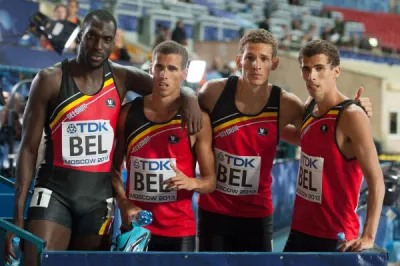
Dylan Borlée showed in 2019, at the age of 27, a clear confirmation of his adult role: The victory at the Indoor European Championships in Glasgow with the relay marked a decisive point in his identity formation. This success was no coincidence but rather the result of his first Saturn return cycle. During this period, years of preparatory work condense into a solid outcome. The person emerges from the phase of learning and experimenting to take on concrete responsibility within the social structure. Dylan Borlée established himself not only athletically but also in his personal framework as someone who has clearly defined their position. The Saturn return acts like a milestone: What previously existed as potential or ambition is now tangible reality and societal recognition. For him, this meant that his inner maturity became visible to the outside world. The mechanics of this cycle often require a certain toughness or discipline to stabilize the new identity. Dylan Borlée used this pressure productively. The title in Glasgow stood for the conclusion of a developmental phase and the beginning of a period during which he filled his role with more confidence and self-assurance. It was the moment when the child became an adult—not just in age, but in how he saw himself and how the world perceived him.
Projector · Splenic Authority — Synthesis
Dylan Borlées Design reveals a central thread of adaptability, fueled by the combination of a Projector type with the Spleen Center as authority and the Profile of Role Model. He is destined to recognize the quality in others (Projector), make intuitive decisions in the moment (Spleen), and only after years of experience share wisdom (Line 6). This configuration points to someone who subtly reads energy, attends to the needs of others, and fully unfolds only when they transition from observation into the role of mentor. The openness of many centers underscores this ability to adapt – he takes in information and energies, filters them through his inner authority, and thus offers a unique perspective.
At the same time, there is a central paradox in Dylan Borlées Design: the tension between his Projector nature, which waits for invitation, and the strong, defining energy of the Root Center, which pushes towards action and pressure. This creates a dynamic where he is designed to "project" and lead others, but simultaneously feels an inner drive to be active himself. This tension is amplified by Channel 54-32, which connects ambition with transformation – a desire for advancement that depends on his ability to intuitively recognize and accept the right opportunities (invitations).
1 Defined Channel
Incarnation Cross - Left Angle Cross of the Plane 2
Solar Return
The Solar Return shows the moment when the sun returns to its exact birth position - your personal solar year.
Life Cycles
Discover the life cycles with a detailed triple view (birth chart, cycle chart, composite).
Human Design Profile
- Type
- Projector
- Strategy
- Wait for the respectful invitation
- Authority
- Splenic Authority
- Profile
- 6/2 - Role Model / Hermit
- Definition
- Single Definition
- Incarnation Cross
- Left Angle Cross of the Plane 2
- Date of Birth
- 20.09.1992 13:25
- Place of Birth
- Woluwe St.Lambert, Belgium
Frequently Asked Questions
What is the Human Design type of Dylan Borelé?
What profile does Dylan Borelé have?
What authority does Dylan Borelé have?
Which incarnation cross is active for Dylan Borelli?
When was Dylan Borlée born?
Discover your own Human Design
Are you also a Projector? Find out in a personal reading how to unfold your leadership qualities and recognize the right invitations.
More Personalities
Back to overviewSissy Spacek

Alain-Fournier

Aldair

Anémone

Ann-Margret

Bourvil