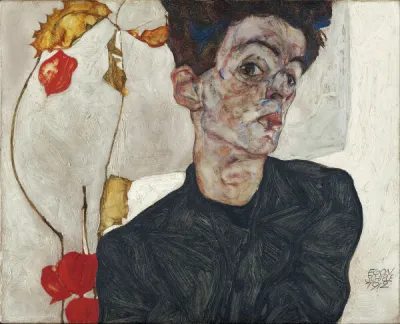
Egon Schiele
Human Design Chart
Biography
The Human Design of Egon Schiele: Manifesting Generator 5/1
Manifesting Generator 5/1 — Design at a Glance
Egon Schiele was a Manifesting Generator. His design inclined towards great speed, coupled with the ability to skip steps in the process and draw things into his life quickly. With the defined sacral center, he had constant energy but his strategy involved not initiating himself but responding to impulses from the environment. Only when the clear inner 'yes' of the sacral center was felt should he act.
This configuration brought two specific challenges with it. Firstly, he tended to overlook important intermediate steps due to his speed, leading him later to backtrack and rectify them – a potential source of frustration. Secondly, he often responded to multiple impulses simultaneously and started diverse projects in parallel. Without strict adherence to his inner authority, this creative drive could quickly turn into overburdening.
However, when the strategy was adhered to, that is responding to clear internal confirmation, he drew deep satisfaction from his work. Parallelism then became no hindrance but rather beneficial. His design promoted a 'play mode' where variety and fun were driving forces. The instruction to focus on one thing stood in opposition to his nature; instead, his creative power flourished through the simultaneous handling of various tasks as long as they all were supported by his inner center.
Sacral Authority
Egon Schiele revealed himself as someone who made life decisions not through intellectual deliberation but based on an immediate bodily resonance. His design inclined towards reacting to external stimuli with a spontaneous, visceral response – an internal 'yes' or 'no', felt in the gut as a surge of energy or rejection. This was the function of his sacral authority, available only to the Generator type and whose strategy merged reaction with inner decision-making. With his open emotional center, he could not distort these clear impulses through temporary moods or emotional turbulence; the sacral voice remained a reliable instance. When his system responded to an impulse, he felt vital and energized, enabling him to perform tasks with great enthusiasm and without obsessive purposefulness. Additionally, a supportive component through the active spleen center: it endowed him with the ability to act especially quickly and spontaneously, based on an instinctive perception of physical well-being. This configuration allowed him to reliably be guided by these deep, non-intellectual signals instead of falling into analytical deliberations. His energy was thus directly linked to the quality of the external invitation he felt as alive and satisfying.
The 5/1 Profile — Heretic / Investigator
Egon Schiele's design inclined towards being perceived as an authority figure who used profound knowledge to offer solutions for others. As a 5/1 – Hero/Researcher – he possessed the magnetic property that people sought his expertise and confided their problems to him. This aligned with Line 5 (Leadership), emphasizing leadership and respect from the tribe; he acted like a genetic leader who provided practical answers in times of crisis. Simultaneously, Line 1 (Resistance) anchored him deeply into researching uncertainty and dealing with resistance against change. This combination created dynamics where his problem-solving gifts were strongly sought after. Without clear boundaries, however, this threatened to become overburdening, akin to an expert exhausted by the flood of questions from others. His design thus demanded a balance between the private research process (Line 1) and public provision of solutions (Line 5). Only through learning to say no could he maintain this beneficial equilibrium and optimally utilize his talents without sacrificing himself.
Single Definition — Defined & Open Centers
Egon Schiele had a reliable internal identity and willpower, which were evident through his defined G Center and Heart Center. This configuration gave him a stable self-image and the ability to keep promises as well as use resources autonomously. His energy source was his defined Sacral Center, generating constant vital power; he acted most effectively by reacting to external stimuli rather than initiating action. Additionally, his expression was marked by a defined Throat Center, serving as a pivot point to translate energy from motor centers into clear communication and action.
At the same time, Schiele was vulnerable to external influences due to several open centers. His open Head and Ajna Centers made him receptive to inspirations and concepts from the environment, which could also lead to mental confusion or attempts to solve other people's problems as his own. His open Solar Plexus absorbed emotions from his surroundings, causing him to fluctuate between foreign feelings and his own. Furthermore, his open Spleen Center was characterized by a fundamental survival fear, making him cling to individuals or situations for a sense of security rather than trusting spontaneous intuition. Finally, his open Root Center amplified environmental adrenal stress, leading to cycles of pressure absorption and attempts to reduce it through hyperactivity. This mechanism described a person with strong inner structure who had to learn not to identify with the mental, emotional, and stress-induced waves of their environment.
Channels for presence, authentic power and spiritual leadership.
Egon Schiele lived an intense dedication to his own existence, driven by the need to establish himself as an authentic expression. His design connected the Sacral Center with the G and Throat Centers through three central channels that structurally supported this stance.
The Channel of Exploration 34-10 provided inner strength (Gate 34) to hold onto personal convictions while Gate 10 initiated behavior to accept and honor oneself, creating a basis for independence lived from deepest reaction. Parallel to this, the Channel of Awakening 10-20: It connected this self-behavior (Gate 10) with the Now Gate (20), making every moment an opportunity to recognize principles and transform individual knowledge into correct action. Schiele spoke for himself by demonstrating his self-love and trust through clear presence, inspiring others to be themselves.
This energy flowed directly into the Channel of Charisma 34-20 over. Here, the generative power of the Sacral Center (Gate 34) drove the urge for immediate manifestation through the thyroid system (Gate 20). This configuration allowed a quick, charismatic effect that had to be based on correct reaction to avoid obsession or chaotic outburst. His vitality showed as spontaneous self-endorsement when he only engaged in things truly serving him.
Additionally, the Channel of Initiation 51-25 shaped his nature. It connected the competitive ego (Gate 51) with the Self Spirit Gate (25), meaning a mystical ability for individuation. Schiele was set to be initiated through 'shocks' and thereby recognize the beauty of the animated and unanimated, leading from collective 'we are' to individual 'I am'.
Prioritized Gates in the Cross emphasize further aspects: Gate 45 summed up tribal energy while Gate 36 enabled cyclical crises as developmental processes. Gate 6 regulated emotional waves and growth through friction, and Gate 26 helped the ego surrender to perception and innovation. In the Personality Field, Gate 12 promoted individual mutation through restraint and creativity, while Gate 16 supported experimental mastery. Gate 15 in his design facilitated adaptation to natural rhythms, and Gate 29 in the Sacral Center stood for persistent affirmation of challenges.
Individual Circuitry — Circuit Signature
Egon Schiele was someone whose inner structure was strongly oriented towards preserving and strengthening his individuality. His design connected the Sacral Center – the place of life energy and intuition – directly with the Heart and Identity Centers, creating a closed, inward-focused energy chamber. The Heart Center steered his self-worth and emotional convictions while the Identity Center represented his core and essence. Through this connection, solidified, courageous stances emerged: 'I am who I am'. This inner strength not only served him but also radiated to affirm others in their uniqueness.
However, without a connection to the Throat Center, these deep convictions often remained hard to verbalize; they were expressed more through being than speaking. Parallel to this, channels took power from reacting to life (Sacral) and directed it into the present through intuitive knowledge and correct behavior. This promoted high self-affirmation and charisma in the here and now. As Egon Schiele had a Simple Definition, this energy flowed as a continuous stream between identity, heart, sacral center, and throat center, fueling his actions and expressive will directly from his inner conviction.
Left Angle Cross of Confrontation 1
Egon Schiele's Human Design revealed a tendency towards direct and often abrupt confrontation. He was someone who did not avoid conflicts but faced them head-on. This attitude stemmed from the so-called left cross of confrontation in his chart.
This pattern linked specific energetic channels that promoted an immediate reaction to friction points in life. Instead of pursuing harmony as the ultimate goal, he sought clarity through engagement. The energy of this cross drove him to deal with resistance rather than ignore or gloss over it. It was an internal mechanism that prioritized authenticity over social niceties.
For Egon Schiele, this meant that he did not smooth out situations but made underlying tensions visible. This was not a random trait but a firmly established energetic structure in his system. It shaped the way he interacted with the environment and other people: directly, without filters, and often challenging. His readiness to confront served to break through illusions and get to the heart of matters, even if it was uncomfortable. His chart indicated that he came closest to his deepest truth in such moments.
Saturn Return — Life Cycles
Egon Schiele appeared as someone whose inner structure was deeply rooted with death and impermanence. His design suggested that he did not shy away from finiteness but accepted it as an integral part of his existence and processed it artistically. This attitude became particularly evident in 1918, at the age of 28, during his first Saturn return. During this period, long-term patterns often crystallize, Schiele's mentor Gustav Klimt died. Subsequently, he produced drawings in the morgue of General Hospital. This was not merely a biographical coincidence but precisely aligned with the dynamics of his chart: The confrontation with another person's physical end served as a catalyst for him to clarify and make visible his own relationship to death. The first Saturn return marked the point where this deeply rooted theme, which had previously been latent, unfolded in concrete, tangible actions. His ability to face the inevitable without being overwhelmed defined this phase decisively.
Manifesting Generator · Sacral Authority — Synthesis
He was a Manifesting Generator whose life was characterized by a constant dynamic between sacral energy and the drive for rapid implementation (Design). This energetic foundation was reinforced by the Profile of a Hero/Researcher – he took on challenges, gathered knowledge, and shared it willingly with others (Profile Role). The defined Throat Channel (Centers) points to strong expressive power that always drew from an inner source. Through awakening (Channels/Gates), he experienced moments of deep self-awareness and acted impulsively driven by a desire for authenticity and living in the present moment.
A central paradox in his design lay in the tension between the ability to initiate things quickly (Manifesting Generator) and the necessity to engage with sacral reactions (Authority). This led him to be full of drive but also risked skipping important steps. The left cross of confrontation further amplified this dynamic by repeatedly presenting him with the task of aligning his inner truth with external expectations. A documented event, drawing in a hospital (Cycles), illustrates this internal conflict.
4 Defined Channels
Incarnation Cross - Left Angle Cross of Confrontation 1
Solar Return
The Solar Return shows the moment when the sun returns to its exact birth position - your personal solar year.
Life Cycles
Discover the life cycles with a detailed triple view (birth chart, cycle chart, composite).
Human Design Profile
- Strategy
- To respond - wait for something to respond to
- Authority
- Sacral Authority
- Profile
- 5/1 - Heretic / Investigator
- Definition
- Single Definition
- Incarnation Cross
- Left Angle Cross of Confrontation 1
- Date of Birth
- 12.06.1890 06:00
- Place of Birth
- Tulln an der Donau, Austria
Frequently Asked Questions
What was Egon Schiele's Human Design type?
What Profile did Egon Schiele have in Human Design?
What Authority did Egon Schiele have?
What incarnation cross did Egon Schiele have?
When was Egon Schiele born?
Discover your own Human Design
Are you also a Manifesting Generator? Find out in a personal reading how to unfold your multi-talents and direct your energy wisely.
More Personalities
Back to overviewAldair

Alizée

Angeli
Arletty
Artus

Baekhyun