Elisabeth Abegg
Human Design Chart
Biography
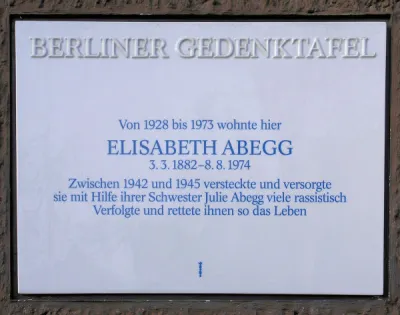
Between 1942 and 1945 Abegg temporarily housed dozens of Jews in her Tempelhof apartment and vacant neighbouring apartments, and secured permanent accommodation for them across Berlin, East Prussia and Alsace. She sold her jewelry to pay for some Jews' escape to Switzerland and tutored hiding Jewish children at her apartment.
She died on 8 August 1974 in Berlin.
Elisabeth Abegg as a Manifesting Generator 2/4 in Human Design
Manifesting Generator 2/4 — Design at a Glance
Elisabeth Abegg appeared as a person with hybrid energy: She possessed the constant, sacral power of a Generator but also had the lightning-fast manifestation ability of a Manifestor. This configuration significantly shaped her work style. Like all Generators, her core strategy was to respond to external impulses rather than initiate independently. However, unlike pure Generators, she could skip steps when implementing ideas and draw things into her life with remarkable speed.
This quickness presented specific challenges. Elisabeth Abegg tended to overlook important intermediate steps, often leading her to have to backtrack and make up for them – a process that quickly turned into frustration. Additionally, her energy frequently prompted her to work on multiple projects simultaneously by responding to various impulses at once. Without consistent regard for her inner authority, this creative drive could easily turn counterproductive.
Deep satisfaction came only through an attitude of playful experimentation. Crucial was the constant checking whether her sacral center confirmed the current impulse with a clear "yes." As long as she responded to this inner confirmation and sought variety, her quickness could be a blessing. The demand to focus on one thing alone went against her nature; instead, her potential flourished in "play mode," where she worked on different tasks simultaneously as long as each individual activity received her inner approval.
Sacral Authority
Elisabeth Abegg demonstrated decision-making that did not occur in the Head Center but rather through an internal resonance with external stimuli. Her design as a Generator determined both her strategy and her inner authority equally: sacral authority. This simplified her process considerably. A prerequisite was an open Emotional Center. Her responses manifested physically as gut feelings or bursts of energy – often audible through grunting, humming, or a clear "Mhm." This physical confirmation was the measure of authenticity, not intellectual analysis. When her Sacral Motor kicked in, she felt vital and alive. She had seemingly inexhaustible energy and tackled her work with great enthusiasm. Elisabeth Abegg was born to go through life with joy and contentment. She immersed herself completely in her activities without the need for an external purpose; the joy arose from the act itself. Supporting this sacral reaction was her active Spleen Center. This gave her the ability to respond particularly quickly and spontaneously. She had direct access to her instinctive perception and physical well-being. This spleen reaction served as a reliable complement to her sacral authority, enabling her to make decisions that were both energetically sustainable and intuitively accurate. Her life energy was sustained by listening to these inner signals and acting accordingly, which gave her a deep sense of correctness and well-being.
The 2/4 Profile — Hermit / Opportunist
Elisabeth Abegg revealed herself through a clear inner rhythm that swung between deep withdrawal and exchange in familiar circles. Her design as Profile 2/4, which combines the natural talent and networker aspects, established a basic structure: she needed phases of solitude to condense internal processes before turning back towards her community. This dynamic was not accidental but a mechanical necessity of her system.
During the withdrawal phases, marked by Line 2, Elisabeth Abegg delved into her own questions and doubts. Here she exercised control over her research process; each question served to elicit answers and clarify issues. This hermit aspect was essential for gaining inner security. Once this processing was complete, her focus shifted to Line 4. She now sought contact with her favourite people, not out of a lack of independence but to validate ideas and exchange knowledge.
The challenge of her design lay in communicating these phase changes. To create a safe environment, she had to clearly signal when she sought company and when she needed solitude. Only then could she protect her own rhythm, which was central to her survival and success. By waiting for the right moment within her network and using this time for active performance development, she transformed passive experience into concrete results. Her life followed this pattern: withdrawal for reflection, then engagement in a circle of familiar people to develop and share brilliant ideas.
Split Definition — Defined & Open Centers
Elisabeth Abegg's design revealed a tendency towards constant internal structure, characterized by five defined centers. Her Sacral Center served as a steady motor providing vital energy that could only be correctly utilized in response to external impulses. This contrasted with four open centers – Heart, Solar Plexus, Spleen and Root – which acted as sensitive antennas for external conditions.
The defined Head and Ajna Centers generated a constant mental pressure towards inspiration and concept formation. These thoughts were not directly actionable but served to inspire or put others under pressure. The defined G Center endowed her with a stable self-identity and inner direction, while the defined Throat acted as a reliable channel for expressing these internal states.
The challenge lay in dealing with the open centers. The open Heart Center tended to prove worth through promises and competition, which did not belong to the design energy. The open Solar Plexus absorbed foreign emotions leading to confusion; it was important not to identify these as one's own. The open Spleen was prone to survival fears and unhealthy dependencies on others' comfort frequencies; spontaneous decisions were risky. The open Root Center absorbed external stress; attempts to escape this pressure through hyperactivity led to exhaustion.
The red thread was the distinction between constant inner aspects – thinking, identity, energy – and situational outer ones like emotion, courage, health, and stress. Elisabeth Abegg used her internal authority not to fall into the conditioning of open centers. She showed herself as someone who learned to accept mental pressure without acting it out, waiting for life rather than initiating it.
Channels for logic, charisma, beat, rhythm and abstraction.
Elisabeth Abegg was revealed through a mental architecture that combined innovation with critical scrutiny. The Beat 14-2 channel gave her the impulse towards transformative renewal: Gate 14 focused on material resources for change, while Gate 2 directed direction and movement. As a 'key holder', she generated new perspectives for others through authentic living without having to actively pursue them. Simultaneously, the Logic 63-4 channel rigorously scrutinized these impulses. Here, Gate 63 of doubt connected with Gate 4 of formulation; her mind constantly filtered patterns for consistency and sought verifiable evidence before accepting answers as valid. This tension between intuitive direction change and logical validation shaped her approach to life.
Additional defined channels complemented this profile. The Rhythm 5-15 channel linked fixed habits (Gate 5) with love for extremes (Gate 15), maintaining a natural, biological flow in daily life and involving others in this energy flow. The Charisma 34-20 channel endowed her with the ability to manifest instantly: Sacral reaction (Gate 34) directly impacted expression in the present moment (Gate 20), creating charismatic but often self-absorbed vitality. Additionally, the Abstraction 64-47 channel filtered experience through mental images (from Gate 64 of confusion to Gate 47 of comprehension), working out inspiring stories or new perspectives from the chaos of possibilities.
Individual Gates like Gate 35 (Change through interaction) and Gate 23 (Explaining for mutation) supported this dynamic, as did Gate 9 in her design with its ability for detailed perfection. Thus, Elisabeth Abegg lived in balance between the urge to lead new directions and the necessity of underpinning these through logical consistency and experience.
Collective Circuitry — Circuit Signature
Elisabeth Abegg was revealed by her design as someone who expressed their unique identity pulsatingly and in the present moment. This trait came from the Knowledge Circuit, which linked her Identity with Sacral Center via the 'Beat' channel. Here it was about confirming one's path and creative expression.
Parallel to this, Elisabeth Abegg had a clear rational structure for the future. The Understanding Circuit connected Head, Ajna, Identity, and Sacral Centers through the 'Logic' and 'Rhythm' channels. This enabled sharing strategic insights free from emotional influence with the aim of improving things.
At the same time, she reflected past experiences in cyclical waves. The Meaning Circuit linked Head and Ajna Centers via the 'Abstraction' channel. Here stood the emotional understanding of the past to learn together with others.
These aspects were integrated. The Integration Channel 'Charisma' connected Throat and Sacral Centers. This helped Elisabeth Abegg draw strength from reacting to life and intuitively make it effective in the present moment.
Due to her shared definition, two energetically separate groups existed: one united identity, life energy, and expression; the other focused solely on the thought process from Head through Ajna down. This separation meant that rational planning and emotional or identity-related impulses did not directly interweave but stood as parallel forces alongside each other. Thus, Elisabeth Abegg navigated between strategic future shaping and her authentic, pulsating form of individual expression.
Right Angle Cross of Consciousness 1
Elisabeth Abegg's design was characterized by the right cross of consciousness 1. This configuration established a specific orientation for her perception and inner compass. In Human Design mechanics, such a cross describes how information is received and processed before it manifests in actions or decisions. It represents a fundamental aspect of consciousness that defines one's basic attitude towards existence and environment.
For Elisabeth Abegg, this meant that her internal orientation was determined by this specific cross configuration. She lived with a particular energetic signature that structured her thinking and feeling. The right cross of consciousness 1 is not a random element but a central building block in the chart, showing how someone constructs and interprets their reality. It's about internal filtering of experiences rather than external circumstances. Elisabeth Abegg moved within a framework defined by this consciousness structure. Her way of seeing and reacting to the world followed the laws of this design. It shaped her inner landscape and significantly influenced how she translated impulses from her environment into personal meaning. This aspect of her chart formed a constant element in her life, independent of external changes or events.
Saturn Return · Uranus Opposition · Chiron Return · 2nd Saturn Return — Life Cycles
Elisabeth Abegg's life was marked by clear, cyclical structuring points. Her first Saturn return around 1912 signified a phase of professional consolidation: at age 30, she began studying at the Kaiser-Wilhelms-University in Strasbourg. This cycle condensed years of groundwork into a solid academic foundation that enabled her later career.
The Chiron return around 1933 appeared as an achievement cycle where her incarnational purpose increasingly unfolded in life. At age 51, she resisted National Socialist interventions at the Luisenschule. This was not a moment of healing old wounds but a concrete exercise of her life's meaning: defending her pedagogical principles under extreme pressure. The experience of sense and purpose became tangible through active resistance.
Her second Saturn return around 1941 brought another structuring phase, this time as an existential test. At age 59, she was forced into retirement. This point condensed previous experiences and marked the end of an active phase characterized by external pressures. The maturation through these cyclical life phases – from academic foundation to ethical testing to enforced pause – shaped Elisabeth Abegg's design as someone whose professional and existential identity took their strongest contours in these specific time windows.
Manifesting Generator · Sacral Authority — Synthesis
Elisabeth Abegg's life was marked by an internal dynamic between the need for independent, creative development and deep connection with collective well-being. Her design as a Manifesting Generator with Sacral Authority points to a person who constantly possessed energy but could only unfold it through reaction to life rather than mere initiative. The connection of Head and Ajna Centers strengthened her mental drive to recognize patterns and generate knowledge – a process that always aligned with the rhythm of her Sacral Center. The profile as a natural talent and networker revealed a natural interaction between phases of withdrawal for inner reflection and the need for exchange and community.
A central paradox in Elisabeth Abegg's design lies in the tension between her ability to quickly initiate and transform things – an inheritance from her manifesting aspect – and the necessity to let go into the natural flow of life without forcing outcomes. This dynamic was evident in the interplay between individual expression and collective responsibility, particularly clear in documented events such as study and resistance, along with the resulting crisis. The constant struggle with this inner tension shaped her path and revealed a personality that was both innovative and deeply rooted.
5 Defined Channels
Incarnation Cross - Right Angle Cross of Consciousness 1
Solar Return
The Solar Return shows the moment when the sun returns to its exact birth position - your personal solar year.
Life Cycles
Discover the life cycles with a detailed triple view (birth chart, cycle chart, composite).
Human Design Profile
- Strategy
- To respond - wait for something to respond to
- Authority
- Sacral Authority
- Profile
- 2/4 - Hermit / Opportunist
- Definition
- Split Definition
- Incarnation Cross
- Right Angle Cross of Consciousness 1
- Date of Birth
- 03.03.1882 01:00
- Place of Birth
- Strasbourg, France
Frequently Asked Questions
What is Elisabeth Abegg's Human Design type?
What Human Design Profile did Elisabeth Abegg have?
Which authority guided Elisabeth Abegg?
What incarnation cross did Elisabeth Abegg have?
When was Elisabeth Abegg born?
Discover your own Human Design
Are you also a Manifesting Generator? Find out in a personal reading how to unfold your multi-talents and direct your energy wisely.
More Personalities
Back to overviewAldair

Alizée

Angeli

Arletty

Artus

Balthus