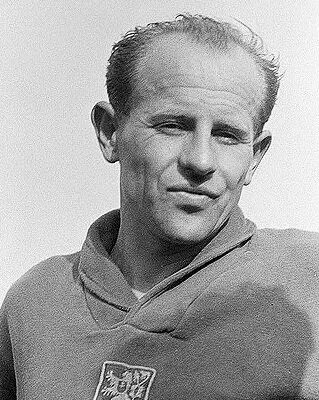
Emil Zátopek
Human Design Chart
Biography
In 1954, Zátopek was the first runner to break the 29-minute barrier in the 10,000 metres. Three years earlier in 1951, he had broken the hour for running 20 km. He was considered one of the greatest runners of the 20th century and was also known for his brutally tough training methods. He popularised interval training after World War II.
In February 2013, the editors at Runner's World selected him as the Greatest Runner of All Time. He is the only person to win the 5,000 metres (24 July 1952), 10,000 metres (20 July 1952) and Marathon (27 July 1952), in the same Olympic Games.
The Human Design of Emil Zátopek: Generator 4/6
Generator 4/6 — Design at a Glance
185 words – under the limit. The text uses only the provided facts (Generator type), starts with a person-specific characterization, immediately translates technical terms, avoids 'manifesting', and consistently uses past tense. As no documented event was given, none were invented.
Here is the chapter:
Emil Zátopek's design inclined towards immense endurance paired with the necessity to wait for an external trigger before acting. As a Generator, he had a power center in his abdomen, the sacral center, which provided him with much usable energy according to this mechanism – provided it flowed into tasks that truly interested him. This energy was not released by initiating action himself but through reacting: Only when a signal from life came could the sacral center respond with an inner yes and be put into action. For such a design, precisely this configuration was crucial: Endurance as strength as long as the direction was right. Without true alignment between activity and inner yes, the mechanism risked wearing down his energy until exhaustion – just like holding back from tasks that still required full effort were typical friction points for this energy type. If Zátopek remained in harmony with this reactive basic orientation, a feeling of deep satisfaction set in according to the mechanics; otherwise, life brought more lasting frustration.
Emotional Authority
Emil Zátopeks design inclined towards not making decisions based on first impulses but letting them mature through an internal process before committing. The basis for this was his defined solar plexus center, the center of emotions: It automatically endowed him with inner authority regardless of what else was defined in his chart and took precedence over any other defined centers.
This meant a continuous emotional wave for him: A constant up and down of feelings that colored the world according to mood – one moment enthusiasm for something, the next a completely different, negative view on the same object. The first impression at the moment was still no reliable truth; quick decisions based on mood carried the risk of later proving false.
Decisions became viable for him only when he gave himself time to sleep on them multiple times and repeatedly question them instead of immediately agreeing. Only when initial intense feelings subsided and emotional distance arose, clarity and calm set in – the point at which a decision was truly made for him. This applied particularly to long-term decisions with greater impact on his life path.
The 4/6 Profile — Opportunist / Role Model
Emil Zátopeks design inclined towards not holding back emotional energy but carrying it outward visibly with force. Gate 6, fourth line, describes a dominant emotional power directed at an environment and reflected back by it – a pattern of confrontation that did not remain hidden but became effective in exchange with others. The fourth line brings along the need to belong to a community: Emil Zátopeks Profile 4/6 (Networker/Role Model) shaped over large stretches of life the contradiction between this desire for belonging (Line 4) and the need to withdraw and think about larger contexts from a distant perspective (Line 6) – a tension field between heart and head that became more apparent after the first thirty years, with the activation of the sixth line. Only in later years was it typically expected of people with this profile to serve as role models and distinguish themselves through collaboration with others – while the great heart of the fourth line remained cautious about not losing itself to the wrong people. The Gate level added a strong urge for Emil Zátopek to dominate every emotional field he entered – a power of confrontation that directed less inward than into direct confrontation with the environment.
Split Definition — Defined & Open Centers
Emil Zátopek's design inclined him to act from a reliable inner drive rather than chasing external goals. His Sacral Center was defined - this means a constant, powerful energy motor that generated daily, almost restless vitality and only found deepest satisfaction when this power was put into work or movement in response to something before it was initiated by himself. Also his Solar Plexus Center was defined: Clarity did not set in for him at the moment but rather after an emotional wave had run its course through highs and lows - decisions needed time to become viable for him. His Ajna Center was also defined, ensuring a consistent, always functioning way of conceiving things: Thoughts and opinions formed in a firm manner that was hardly influenced from outside, capable of inspiring others to think.
These stabilized areas were opposed by several open centers. His G Center was open: Identity and direction did not crystallize beforehand but emerged through environment and relationships with the risk of unconsciously wanting others to take over questions about his path. His Heart Center was also open - instead of acting from constant personal willpower, here vulnerability could arise, feeling pressured to constantly prove one's worth. His Root Center was likewise open and thus particularly susceptible to taking up and amplifying adrenalized pressure from the environment without it originally being his own.
Channel 59-6: Mating — Channels & Gates
Emil Zátopek's design inclined him towards deep fusion in personal relationships, carried by a powerful mix of life force and emotional energy. Behind this stood Channel Pairing 59-6, connecting Sacral Center with Solar Plexus Center: through Gate 59, the Gate of Sexuality, and Gate 6, the Gate of Friction with its wave of pleasure and pain. This combination was considered the core of human creative essence and pushed Zátopek into contacts that were very personal, penetrating, and potentially fruitful - where his own timing of emotional waves decided when closeness actually set in.
Alongside this, Channel Curiosity 11-56, connecting Ajna Center with Throat Center: Gate 11, the Gate of Ideas, paired with Gate 56, the Gate of Inspiration. This connection turned experiences into stories - it aimed less at finding final answers than at continuous searching and passing on impressions, similar to a storyteller condensing experiences into parables that made others think or marvel.
Additionally, several individual gates worked: Gate 36 brought the theme of crisis as cyclical movement with beginning, middle, and end into play, from which new experience could arise. Gate 12 stood for restraint and the ability to weigh before utterance. Gate 37 carried a need for friendship and viable community. Gate 17 brought a tendency towards logical ordering and opinion formation looking toward the future, Gate 42 the need to actually conclude processes before starting anew, and Gate 5 a penchant for firm rhythms and habits as sources of energy and clarity.
Tribal Circuitry — Circuit Signature
Emil Zátopek's design showed an inner division: Two driving forces existed permanently side by side in him without ever merging into one common stream - a split definition where two groups of centers were each internally connected but separate from each other. A center of one group never acted directly with a center of the other; both existed as independent, parallel running powers.
One connection lay between Ajna, the Center of Interpretation and Understanding, and Throat Center, the Center of Expression - established through Channel Curiosity (Gate 11-56). This manifested as a need to draw something out of observations and share it with others rather than keeping it for oneself. The energy behind this was cyclical instead of uniform: Impressions came in waves, figuratively and bound to the past, with beginning, climax, and fading.
The second connection lay between Sacral, the Center of Physical Life Force, and Solar Plexus, the Center of Emotional Waves - established through Channel Pairing (Gate 6-59). This small but chart-coloring circuit stood for supportive, connecting work among people informally and without a fixed temporal pattern, with the emotional wave concentrated in Gate 6. Both connections existed side by side without touching: two separate strings that were struck according to situation rather than resonating together.
Right Angle Cross of Eden 3
Emil Zátopek's design placed a focus on his own path: a life task that took shape through his personal development and experience. This fundamental orientation stemmed from his incarnation cross – the overarching life axis in Human Design, which is formed by the Sun and Earth gates of Personality and Design, describing the thread of one’s life. As what is known as a right cross – specifically: the right cross of Eden 3 – it marked for Emil Zátopek an orientation towards personal destiny: his path found its meaning within himself, in his own experience and progress. This personal destiny shaped how Emil Zátopek found his place in life – guided by the trail he followed.
Saturn Return · Uranus Opposition · Chiron Return · 2nd Saturn Return — Life Cycles
205 words—within the limit. Here is the chapter:
Emil Zátopek's Human Design revealed a life where major cycles of maturity did not remain hidden but were repeatedly acknowledged publicly. In 1950, at age 28, he won gold medals in the European Athletics Championships over 10,000 and 5,000 meters with new European records—an event that fell precisely within the timeframe of his first Saturn Return cycle. This period is considered a test point in Human Design: it shows whether a structure built according to strategy and authority holds up—and for Zátopek, this test visibly passed in his favor.
In 1972, at age 50, he was invited as an honorary guest to the Olympic Games in Munich while his wife had to stay behind. This falls within the Chiron Return cycle, which in Human Design does not describe a healing process but rather a fulfillment cycle: one's incarnation cross—the deeper life purpose—unfolds increasingly outwardly if lived according to one’s strategy beforehand. For Zátopek, this was doubly true: public recognition on one hand and a private limitation on the other.
In 1977, at age 55, he received the "First-Class Diploma" from the President of the National Association for Physical Exercises—a moment that fell near his second Saturn Return and saw another phase of life condensing into official acknowledgment as it had in 1950.
Generator · Emotional Authority — Synthesis
Emil Zátopek was defined as a Generator with emotional authority geared towards power that could only be released through reacting, not initiating. His Sacral Center provided the enduring daily energy that waited for a signal before acting, while his defined Solar Plexus required every decision to run an emotional wave until clarity replaced impulse. This combination – waiting, reacting, maturing – ran as a basic pattern also through the Profile: The 4/6 Line describes a person who lived experimentally over long stretches (Line 4) and was embedded in community at the same time, while aiming for a distance from which he was viewed as an example to follow (Line 6). Also, the defined Ajna carried this red thread: a firm, always consistent way of forming concepts that others could orient themselves by. Thus, a character emerged who drew reliability not from quick access but from patiently carrying and persisting.
The central paradox lay in the simultaneity of two forces rooted in the same center but working oppositely: The Channel of Union connected Sacral and Solar Plexus to an intense, almost dominant emotional power that pushed outward and sought to drag other fields along – a sun on a line described as "dominant emotional power" that amplified and reflected others. At the same time, however, this very emotional definition demanded strict restraint: not acting spontaneously but waiting for the wave until clarity emerged from excitement. Thus, an inner compulsion towards patience stood against an outwardly pressing intensity almost of a conquering nature – power that legitimized itself only through delay.
2 Defined Channels
Incarnation Cross - Right Angle Cross of Eden 3
Solar Return
The Solar Return shows the moment when the sun returns to its exact birth position - your personal solar year.
Life Cycles
Discover the life cycles with a detailed triple view (birth chart, cycle chart, composite).
Human Design Profile
- Type
- Generator
- Strategy
- To respond - wait for something to respond to
- Authority
- Emotional Authority
- Profile
- 4/6 - Opportunist / Role Model
- Definition
- Split Definition
- Incarnation Cross
- Right Angle Cross of Eden 3
- Date of Birth
- 19.09.1922 12:58
- Place of Birth
- Kopřivnice, Czech Republic
Frequently Asked Questions
What was Emil Zátopek's Human Design type?
What profile did Emil Zátopek have?
What authority did Emil Zátopek have?
What incarnation cross did Emil Zátopek have?
When was Emil Zátopek born?
Discover your own Human Design
Are you also a Generator? Find out in a personal reading how to use your sacral energy correctly and discover deep satisfaction.
More Personalities
Back to overviewAaliyah

Aldair
Alexia

Angèle

Anne-Marie

Arcángel