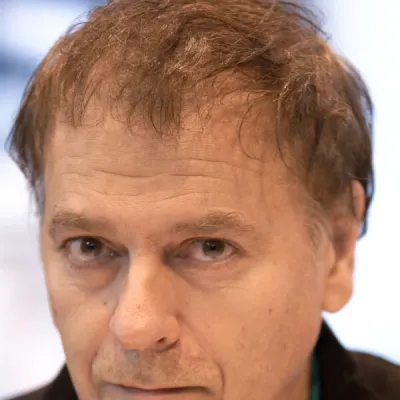
Enki Bilal
Human Design Chart
Biography
The Human Design of Enki Bilal: Generator 5/1
Generator 5/1 — Design at a Glance
Enki Bilal's design shows a tendency towards high endurance, but this is not initiated by his own actions; instead, it is triggered exclusively by external impulses. His inner motor – the sacral center – has a significant energy source, comparable to a powerful workhorse that only effectively uses its strength when given a clear reason to work. The central dynamic lies in waiting for and responding to signals from the environment rather than taking independent action.
This mechanism creates a clear distinction between fulfilling actions and energy-draining efforts. When Enki Bilal reacts to an inner 'yes' – the feeling of his sacral center wanting to start something – deep satisfaction and sustained productivity result. Conversely, ignoring this impulse or constantly initiating without external triggers leads to frustration and energy loss. The risk lies in getting lost in tasks that do not resonate internally, potentially leading to long-term exhaustion over time. Similarly problematic is being prevented from pursuing a heart project despite having the strength to continue it. His design therefore does not require passive waiting in terms of inactivity but rather conscious responding: first receive the signal, then act with full force. Only this way can his intrinsic creative power flow without risk of burnout and lead to material results.
Emotional Authority
Enki Bilal's design shows a tendency never to make decisions based on current emotional wave movements. It appears as an imperative necessity to maintain a time gap – ideally sleeping on the matter until calmness and clarity are achieved. This structure stems from his inner authority: Emotional Authority. Whenever the Emotional Center is activated, it functions as internal authority, independent of other defined centers in the chart. Any type except Reflectors can carry this authority.
People with this design are subject to an emotional wave that shows a permanent up and down of their feelings. The world is always colored by the current mood: one moment totally enthusiastic about something, the next completely negative about it. However, the feeling of the moment is merely a snapshot, a first impression that does not necessarily represent the truth yet. Quick, spontaneous decisions based on emotion can therefore have very negative consequences.
The more time Enki Bilal takes to let a decision mature, the deeper and broader he can see something. This requires patience and repeatedly sleeping over decisions. One should take their time here and ask themselves multiple times. Over time, intense feelings subside, emotional distance is gained, clarity and calmness set in. Only then have you gone through the process. This mechanism primarily applies to long-term decisions that significantly influence life's course. The emotional wave thus serves as a filter for perception: current mood is a snapshot, not the final truth.
The 5/1 Profile — Heretic / Investigator
Enki Bilal's design suggests an underlying tension: the inner drive for deep understanding against the outer role of problem solver. As Hero/Researcher (Profile 5/1), he showed dynamics where slow accumulation of experiential knowledge (Line 1) was coupled with almost magnetic attraction to others. This Line 5 acted like a master, offering collective solutions in crisis times and thereby 'enticing' resources to enable experiments.
The challenge lay in resource management. Through this natural charisma, Enki Bilal was unknowingly asked for expertise by his surroundings. Without clear boundaries, exhaustion could result from the expectations of others – comparable to an overburdened expert who is left exhausted after hours-long conferences while new requests pour in. Uncertainty about one's own depth could hinder action.
The key to balance lay in setting boundaries and learning to say 'no'. Only this way could the beneficial tension between private research (Line 1) and public problem-solving (Line 5) be maintained. This protected his energy from uncontrolled depletion and allowed him to bring deep processes outwards with targeted energy, rather than getting lost in the multitude of requests.
Split Definition — Defined & Open Centers
Enki Bilal's Human Design profile established a massive, constant energy foundation. Five defined centers – Heart, Sacral, Solar Plexus, Spleen, and Root – created an unbroken presence of willpower, vital endurance, emotional depth, intuitive protective instinct, and physical stress pressure. This meant an enormous inner source of power that could function without constant mental or identity structure.
While the Heart Center gave him the ability to determine his own life and keep promises, the Sacral Center provided a permanent motor for vital energy. His decisions were based on an immediate yes-no reaction rather than mental planning. The defined Solar Plexus Center made emotions the inner authority; he had to wait for the emotional wave to gain clarity instead of acting impulsively in the „now“. The Spleen Center ensured spontaneous intuition and health in the moment, while the Root Center provided the necessary pressure to move forward and existentially stay alive.
In contrast, Head, Ajna, Throat, and G Centers were open. Mental clarity, conceptual order, communicative manifestation, and a firm sense of identity were not constant but appeared only in resonance with the environment. Enki Bilal tended to be guided by external inspirations or opinions rather than having his own fixed concepts. He could easily succumb to the pressure to find answers or seek attention, although his design actually aimed at being a mirror for other people's thoughts and receiving identity through the right place and the right people. The challenge lay in using this immense inner power without losing oneself in situational dependence from outside for mental structure and expression.
Channels for logical clarity, intimacy and community.
Enki Bilal's Human Design profile established a tendency towards deep intimacy, analytical correction, and building structural community bonds. This configuration shows someone who seeks intense relationships, questions patterns, and closes fair agreements – yet always dependent on the right emotional timing and personal invitation.
The Pairing Channel 59-6 roots the person in sacral sexuality (Gate 59) and emotional friction (Gate 6). This connection creates a natural state of intimacy that allows easy entry into others' aura and eases confidentiality. However, since Gate 6 carries an emotional wave of pleasure and pain, Enki Bilal must wait for the Solar Plexus cycle to gain clarity about the quality of a connection. Without this patience, intensity can be misunderstood; with it, intimacy becomes healthy and fruitful.
Parallel to this, the Judgment Channel 58-18 works. It connects Gate of Liveliness (58) with Gate of Correcting (18). This generates an insatiable urge to question patterns and perfect them, serving the art of mastery. However, this energy is only effective when expressed upon invitation. Unasked criticism is felt as disruptive; requested correction brings solutions for the collective and restores peace by showing how things can work better.
The Community Channel 37-40 connects emotional clarity (Gate 37) with willpower (Gate 40). It enables building bridges between individuals and closing fair agreements in groups or partnerships. Enki Bilal waits here for a personal invitation to become part of an organization, as business cannot be spontaneous but must be carefully considered over time to benefit both sides.
Additionally, Gates like 48 (Pattern Recognition), 53 (Freedom/Cycles) and 21 (Control/Materials) contribute depth: they support the analysis of connections, the beginning of new developmental phases, and the direction of material resources in service of community. Gate 29 (Saying Yes/Persistence) emphasizes the need for a life-affirming approach, while Gate 57 (Intuitive Clarity) promotes awareness of the here and now.
Tribal Circuitry — Circuit Signature
Enki Bilal's Human Design profile showed a clear separation of two parallel, unconnected energetic fields. On one hand, there was the logical, future-oriented structure of the Mind Circuit; on the other, the traditional resource-oriented exchange in Ego and Protector context. This divided definition meant that these forces existed side by side without directly flowing into each other.
The Mind Circuit connected Enki Bilal's Spleen Center with his Root Center through the Judgment Channel (18-58). This created a capacity for focused, rational analysis and strategic planning free from emotional coloring. The energy served to improve structures through logical sharing of insights directed towards future developments.
Simultaneously, there was a separate field in Ego and Protector Circuits. Here, the Community Channel (37-40) connected his Heart Center with his Solar Plexus Center. This involved mutual exchange of resources and support within a group based on a give-and-take principle. Parallel to this, in the Protector Circuit, the Pairing Channel (59-6) linked Sacral and Solar Plexus Centers. This energy related to instinctive protection, care, and preserving one's genetics or family.
Since these circuits were not connected with each other, Enki Bilal experienced rational future shaping as separate from traditional bonds to community and familial protection. The tension lay between the emotionless ratio for improving the future and the necessary peace and mutual exchange within the tribe framework. None of these energies flowed directly into the other; they existed as independent, timeless potentials.
Left Angle Cross of Endeavour 2
Enki Bilals Design shows a tendency towards persistent striving and going through phases of effort. This is not a random characteristic but directly results from his configuration as the "left cross of effort 2". In Human-Design mechanics, such a cross denotes a structural pattern that shapes the background process of an individual's design and determines their fundamental life dynamics. For Enki Bilal, this manifested as a continuous inner drive, defining development not as a passive flow but as an often arduous struggle. The emphasis here is on the universal experience of "effort" as an integral part of the life path. There is no specific content orientation or set goal in this description; rather, the dynamics themselves are the feature. Enki Bilal thus revealed himself through a process characterized by continuous striving. This structure influenced his perception of progress and success: it was not the outcome that took precedence but the quality and intensity of engagement itself. The mechanics imply that growth for him was inseparable from the feeling of overcoming challenges. This created a lifestyle in which rest or effortless flow were more the exception than the rule. The left cross of effort 2 thus shaped the framework within which Enki Bilal experienced his reality – always in a state of becoming and tension, driven by a deeply rooted necessity to push through and develop.
Saturn Return · Uranus Opposition · Chiron Return · 2nd Saturn Return — Life Cycles
Enki Bilal's Human Design shows a tendency towards a cyclical turning point that acts as a moment of validation and bloom for the purpose of his incarnation. This process manifests in the form of the Chiron Return, a roughly 51-year cycle during which one’s deeper life task—assuming it is lived according to strategy and authority—becomes increasingly apparent and experiential in life. This is not about healing old wounds but rather an actualization process that makes sense and purpose concrete.
In 1998, at the age of 47, Enki Bilal received the Prix international de la Ville de Genève for his book *Le Sommeil du monstre*. This event served as a concrete example of this cycle's mechanics: The recognition marked a point where years of work and inner alignment became visible externally. The prize not only validated the work but also reflected the increasing manifestation of one’s own design. During this phase, what previously might have existed merely as potential or an internal impulse becomes tangible reality. Thus, the Chiron Return functions as a moment of validation in which the individual path is reinforced through external confirmation and the legitimacy of existence within the chosen field becomes clear.
Generator · Emotional Authority — Synthesis
A central red thread runs through the design: the deep connection between judgment (Gate 48, Channel 58-18) and sacral reaction. This combination manifests in a constant search for correctness and efficiency, fueled by the ability to recognize patterns and improve things – but only when the sacral energy is present (defined Sacral Center). The Profile as Hero/Researcher (5/1) amplifies this drive to accumulate knowledge and make it accessible to others, while the emotional center requires careful deliberation before decisions are made. This dynamic shapes a character that is both analytically sharp and mindful of inner truth.
The central paradox lies in the tension between the need for control and correction (Root-Spleen Circuit) and the inherent openness to influences from others (open G-, Head, and Throat Centers). While the defined Heart Center emphasizes the desire for self-determination, the person is simultaneously dependent on receiving input from outside to gain clarity. This tension generates a search for authenticity and meaning, which manifests in the willingness to collect new experiences and adapt continuously – as long as this aligns with one's own sacral authority.
3 Defined Channels
Incarnation Cross - Left Angle Cross of Endeavour 2
Solar Return
The Solar Return shows the moment when the sun returns to its exact birth position - your personal solar year.
Life Cycles
Discover the life cycles with a detailed triple view (birth chart, cycle chart, composite).
Human Design Profile
- Type
- Generator
- Strategy
- To respond - wait for something to respond to
- Authority
- Emotional Authority
- Profile
- 5/1 - Heretic / Investigator
- Definition
- Split Definition
- Incarnation Cross
- Left Angle Cross of Endeavour 2
- Date of Birth
- 07.10.1951 12:00
- Place of Birth
- Belgrade, Serbia
Frequently Asked Questions
What is Enki Bilal's Human Design type?
What Profile does Enki Bilal have in Human Design?
What authority does Enki Bilal possess?
Which incarnation cross is active for Enki Bilal?
When was Enki Bilal born?
Discover your own Human Design
Are you also a Generator? Find out in a personal reading how to use your sacral energy correctly and discover deep satisfaction.
More Personalities
Back to overviewAaliyah

Alexia

Angèle

Anne-Marie

Arcángel

Arno