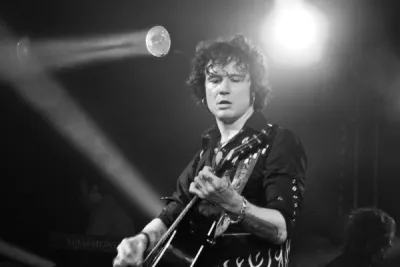
Photo: Wikimedia Commons
Enrique Bunbury
Human Design Chart
Biography
What does Generator 6/2 mean for Enrique Bunbury?
Generator 6/2 — Design at a Glance
Enrique Bunbury has shown himself to be someone whose strength is not derived from self-initiation but rather from reacting to external signals. His design as a Generator suggests that he possesses immense, enduring energy – comparable to a workhorse that remains strong as long as it has the right task. This energy, however, only becomes effective when he responds to impulses from his environment. The motto here is clear: not initiate, but react.
When Enrique Bunbury hears such a signal and his Sacral Center gives an inner "yes", he can respond with consistent action. In this state, he is unstoppable and is rewarded with a deep sense of satisfaction and fulfillment. The mechanics of his design, however, warn of two specific pitfalls. First, persistently doing things that do not interest him leads to energy waste and tends towards burnout, despite his high potential. Second, frustration arises when he is prevented from working on his heart project, even though he still has plenty of power to do so.
If he does not live by this principle – for example, by constantly initiating things himself instead of waiting – he will sooner or later encounter persistent frustration or a lack of energy. His path to strength therefore lies in the patience to wait for the right signal and the ability to then act from the gut.
Sacral Authority
Enrique Bunbury emerged as someone who made decisions not through intellectual analysis but through an immediate physical reaction. His design established Sacral Authority, meaning his inner truth is seated in the Sacral Center. This authority reacts to external stimuli with a clear "gut feeling" – often audible as grunting, humming, or a simple "mm-hmm" – as well as a palpable surge of energy. When this impulse occurs, Enrique Bunbury feels vital and energized; he can then immerse himself in activities with great enthusiasm and without obsessive purposefulness.
Especially relevant here is the support from the active Spleen Center. Since it is connected to the Sacral Center, it enables Enrique Bunbury to have quick, spontaneous reactions. He has direct access to his instinctive perception and physical well-being. These instincts are reliable and guide him in decision-making. Since the Emotional Center is open, the Sacral Authority remains the primary instance; it simplifies his process as he does not have to choose between conflicting inner voices but can trust the first, physically felt impulse. His path is marked by the ability to listen to these inner signals and be carried along by the resulting joy and energy, rather than swimming against the current.
The 6/2 Profile — Role Model / Hermit
Enrique Bunbury revealed himself in his early phase as someone who learned through intensive experimentation and trying out various roles. This pattern of trial-and-error dynamics, coupled with retreating after failures, marked his young years. His design marks him as a 6/2 Profile: Before the age of 30, the 3-line dominates, which relies on direct experience and adaptation through mistakes.
At the same time, he carried the tension of the 2-line within him, which demands a strong individuality and the need for self-defence against external interference. In childhood, this can lead to knowing early on what one wants, and encountering resistance because one's truth is perceived as disruptive. The survival of individuality is paramount here; tolerance of interference often has to be given up to protect one's identity.
With the return of Saturn, that is, after the 30th birthday, the 6-line switches on. The focus shifts from chaotic experimentation to deep introspection and distance. Enrique Bunbury shows a tendency to withdraw to reflect on and heal past experiences. This process leads to the development of a specific wisdom.
A central learning theme is the ability to share power and delegate. It is not about classical leadership, but about recognizing that everyone has their own role. Emerging from the cave of reflection, he eventually becomes someone who has learned to distribute responsibility and gives others the chance to take over their own leadership, rather than taking it over himself.
Split Definition — Defined & Open Centers
Enrique Bunbury is characterized by a persistent inner drive that manifests in a clear sense of self-identity and a deep sense of purpose. His defined G Center provides a reliable inner compass, while his defined Sacral Center supplies a vast reservoir of vital energy, which is only sustainably available through appropriate reactions, not through initiative. This combination fosters a stance of persistent endurance, provided he listens to the immediate responses of his body.
At the same time, his design is marked by a constant mental pressure. The definition between Head and Ajna Centers generates an unrelenting flow of inspiration, questions, and concepts. However, this mental noise is not directly actionable, as these centers do not have their own energy source. Instead, his defined Throat Center serves as a channel to articulate these thoughts, with the quality of communication depending on whether he accepts the mental pressure or tries to hastily resolve it. His defined Spleen Center acts as an intuitive protective instance, recognizing in the moment what is healthy and correct, thereby safeguarding him from the pitfalls of his own mind.
The challenges lie in the open centers. His open Heart Center often led him to feel the need to prove his worth through willpower or promises, despite not having the consistent energy to do so. This could result in a cycle of self-doubt and the attempt to do more than possible to gain recognition. Additionally, his open Solar Plexus absorbed the emotions of the environment, making him vulnerable to emotional waves that were not his own. The danger was in identifying with these foreign feelings or avoiding confrontations out of fear of rejection. His open Root Center also amplified external stress and adrenaline, leading to a tendency to try to rid himself of this uncomfortable pressure through overactivity, rather than recognizing and utilizing it as an external phenomenon. The wisdom of his design lies in observing mental inspiration, not personalizing emotional and stress-induced conditioning, and relying on sacral reactions and intuitive Spleen intuition to stay in the flow of life.
Channels for logical leadership, insight, care and abstraction.
Enrique Bunbury is someone who understands leadership not as absolute power, but as logical, collective responsibility. His design suggests that he can only be effective when invited by the majority to take on his role. This dynamic is reflected in the Alpha Animal Channel 7-31: Here, the Gate of the Role of Self (7) connects the logical structure with the Gate of Leading (31) in the Throat. It's about sharing leadership and representing the collective, as long as the community is ready to follow this logical guidance.
Parallel to this, a strong inner voice waited to be heard. The Channel of Structuring 43-23 connects the Ajna Center with the Throat through the Gate of Insight (43) and the Gate of Assimilation (23). This allowed Enrique Bunbury to formulate spontaneous breakthroughs and innovative perspectives. His challenge was to express these unique ideas clearly enough for others to adopt and understand them, rather than rejecting them as foreign.
Another defining element was his ability to care for and maintain. The Channel of Preservation 27-50 connects the Sacral Center with the Spleen, where the Gate of Care (27) and the Gate of Values (50) work together. This created a natural inclination to take responsibility and nourish and protect the tribe or community based on deeply rooted traditional values.
Furthermore, his consciousness was permeated by the Channel of Abstraction 64-47, which links the Head Center with the Ajna Center. Through the Gate of Confusion (64) and the Gate of Understanding (47), he constantly sought stories and connections behind experiences. This process of mental condensation led him to translate complex life events into a comprehensible, inspiring narrative that he could then communicate.
Collective Circuitry — Circuit Signature
Enrique Bunbury's design tends towards structured, emotional communication, paired with a deep, instinctive protective function. These separate energetic poles shaped his expression and actions.
The Knowledge Circuit connects his Ajna with his Throat Center. This allowed him to pour inner visions through the Channel of Structuring (Gates 43-23) into clear, audible forms. It was about walking his unique path and transforming new knowledge to bring about change. The energy was pulsating and acoustic, driven by the need to express his individuality.
Parallel to this, the Understanding Circuit, which connects his Throat with his Identity Center, shared logical, rational insights free from conditioning. Here, the focus was on sharing strategic knowledge to guide society towards a better future. This focused, visual energy complemented the emotional wave of the Knowledge Circuit through cool reason.
A third aspect was the Meaning Circuit, which connects his Head and Ajna Centers. The Channel of Abstraction (Gates 64-47) promoted reflecting on the past. It was about finding meaning behind past events and sharing these felt insights with the collective to learn together. The energy was cyclical and wave-like.
Finally, the Protector Circuit connects his Sacral with his Spleen Center. Through the Channel of Preservation (Gates 27-50), a primal energy of protection and preservation was at work. It was about nurturing, caring for, and defending the family and one's genetics. This timeless, instinctive force contrasted with the future-oriented circuits but formed the stable foundation for his existence.
Left Angle Cross of Masks 2
Enrique Bunbury revealed himself through a profound engagement with the question of how to maintain his true identity in a world of expectations. His design, the left cross of Masks 2, describes a path that is not defined by external recognition or the wearing of social roles. Instead, the focus is on inner integrity and the ability to stand behind the facade without being swallowed up by it.
This configuration requires constant, often silent work on oneself. It is not about presenting a perfect facade, but rather understanding when a mask is useful and when it becomes a burden. Enrique Bunbury navigates between the need for privacy and the necessity to move in social contexts without losing contact with his core.
The challenge is to avoid falling into cynicism or detachment, but to use masks as tools that enable the protection of the inner self. It is a process of differentiation: What truly belongs to me, and what is just a role I play? Through this clear separation, he gains freedom. He does not have to constantly prove who he is, but can simply be himself, protected by the conscious choice of his outer appearance. This gives him a certain calmness in dealing with public attention and private moments.
Saturn Return · Uranus Opposition · Chiron Return · 2nd Saturn Return — Life Cycles
Enrique Bunbury's design was marked by an intense phase of structural reorganization at the age of 29. This was not a random break, but the mechanical effect of the first Saturn return. In Human Design mechanics, this cycle marks the transition from experimental youth to the phase of substantial life architecture. What was previously seen as provisional or flexible is now tested for its durability and either reinforced or consciously dismantled to make room for a more mature identity.
In 1996, exactly at this age, Enrique Bunbury dissolved the band Héroes del Silencio. This event precisely illustrates the Saturn dynamics: It was not just an emotional crisis, but a necessary destruction of old structures. The Saturn return forces one to question the foundation of their own life. For Enrique Bunbury, this meant that the previous artistic and personal frameworks had lost their validity. The dissolution was the mechanical step to release the old form so that a more stable structure could form, appropriate to the new life circumstances. This process is typical for Saturn cycles: They serve the densification and dismantling of what no longer corresponds to the growing inner truth, to lay a solid foundation for the coming decades of life.
Generator · Sacral Authority — Synthesis
A central red thread in this design is the dynamic interaction between inner drive and the need for withdrawal. Sacral energy (Generator type) drives an indefatigable work ethic as long as the activity brings joy (sacral authority). At the same time, the profile points to a development where early experimental phases (6/2 line) transform into a phase of intense reflection and wisdom, which requires withdrawal and distance. This combination of enduring energy and the cyclical need for isolation shapes a character that is both active and contemplative, always searching for authentic fulfillment.
The central paradox lies in the tension between logical leadership style (Alpha Channel) and deep personal transformation (Knowledge Circuit). On the one hand, a natural authority and the urge to recognize and guide patterns seem to be given. On the other hand, the design is strongly oriented towards the development of individual knowledge and the expression of one's own identity, implying a deviation from conventions and the justification of new paths. This apparent discrepancy between collective leadership and individual innovation creates a creative tension that harbors the potential for profound changes.
4 Defined Channels
Incarnation Cross - Left Angle Cross of Masks 2
Solar Return
The Solar Return shows the moment when the sun returns to its exact birth position - your personal solar year.
Life Cycles
Discover the life cycles with a detailed triple view (birth chart, cycle chart, composite).
Human Design Profile
- Type
- Generator
- Strategy
- To respond - wait for something to respond to
- Authority
- Sacral Authority
- Profile
- 6/2 - Role Model / Hermit
- Definition
- Split Definition
- Incarnation Cross
- Left Angle Cross of Masks 2
- Date of Birth
- 11.08.1967 15:45
- Place of Birth
- Zaragoza, Spain
Frequently Asked Questions
What is Enrique Bunbury's Human Design type?
What Profile does Enrique Bunbury have in Human Design?
What Authority guides Enrique Bunbury?
What is Enrique Bunbury's incarnation cross?
When was Enrique Bunbury born?
Discover your own Human Design
Are you also a Generator? Find out in a personal reading how to use your sacral energy correctly and discover deep satisfaction.
More Personalities
Back to overviewAaliyah

Alexia

Alizée

Angèle

Anne-Marie

Arcángel