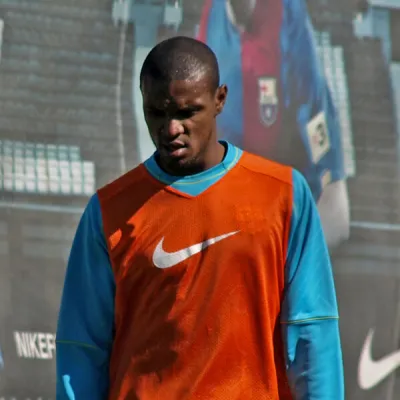
Éric Abidal
Human Design Chart
Biography
In his career he played mainly for Lyon and Barcelona, winning 21 major titles the two teams combined, including two Champions League trophies with the latter. His later career was marked by liver disease, resulting in a transplant.
A French international across nine years, Abidal represented the nation in two World Cups – finishing second in 2006 – and Euro 2008.
The Human Design of Éric Abidal: Projector 2/4
Projector 2/4 — Design at a Glance
Éric Abidals design shows a tendency towards a focusing aura that acts like a bright flashlight, immediately recognizing system errors. This configuration allowed him to quickly identify in his environment where processes were not functioning optimally or "operating in the dark." His natural ability was to bring light into the darkness for others and show them the way by identifying these weak points.
However, his design also revealed an important nuance in dealing with this awareness: If he addressed the errors directly, there was a risk of provoking resistance or anger from those around him – similar to shining a bright light directly into someone's face. Instead, it was more effective for him to attract others through his own harmony and presence. By demonstrating a functioning balance himself, he unconsciously invited others to ask about his solutions.
The central strategy of his design involved waiting for an honest and appreciative invitation from other people. This protected him from the typical trap of non-self: bitterness that arises when one acts without invitation and is not heard. By waiting for this confirmation, he could let his aura work pleasantly and was rewarded with success.
Additionally, Éric Abidal does not have a defined Sacral Center, meaning he did not have a constant source of life energy. Instead, he experienced phases of high activity followed by necessary rest periods to avoid burning out. His design required him to respect these rhythms and not move into structures that demand continuous energy output.
Emotional Authority
Éric Abidal's Human Design suggests a tendency towards emotional wave motion that significantly influenced his decision-making process. He appeared as someone who did not find inner clarity in the first impulse but gained it through patient waiting for initial emotional storms to pass. This attitude stems from his Emotional Authority: Since his Emotional Center is defined, he experiences constant ups and downs in moods. The world appears colored by his current state – sometimes enthusiastically, other times negatively – with each moment being only a temporary snapshot, not the deep truth.
Immediate reactions to these emotional highs or lows can therefore be misleading and have negative consequences. The mechanics of his design require him not to make decisions in the heat of the moment but to wait for the process of "ripening." By consciously delaying and reconsidering important questions multiple times, Éric Abidal gains emotional distance. Only when intense feelings subside does a calmness set in that is necessary for well-founded judgments. This strategy of patience serves to make long-term life decisions on a stable basis rather than being guided by passing moods. The inner authority here clearly lies in the Emotional Center; it dictates the rhythm through which truth becomes accessible – not through quick intuition but by going through emotional cycles until calmness is reached.
The 2/4 Profile — Hermit / Opportunist
Éric Abidal's Human Design shows a tendency towards a rhythmic alternation between deep withdrawal and active network engagement. His structure reveals someone who needs energy to condense knowledge in isolated phases before sharing it in social contexts. This dynamic arises from his Profile 2/4: Line 2 requires solitude for reflection, while Line 4 drives the desire for community and connection with familiar people. Without clear communication of these needs—“I need space” versus “I want company”—misunderstandings are likely to arise in his environment.
During the phase of withdrawal, Éric Abidal internalizes external impressions. Here, Solar energy at Gate 47 symbolizes ambition and the talent for realization. This line projects abilities outward but uses time to free itself from pressure and seek healing activity. It is a maturation process that moves from outer projection towards inner sanctity. Once this inner clarity is achieved, the system opens again for Line 4. At this level, focus is on direction-setting in a transpersonal context and using the network to make material actions beneficial. The ability to recognize advantageous opportunities and give an advantage to the “tribe”—that is, the community—becomes effective. This cycle of hermitism and networker roles allows him to develop brilliant ideas and apply them strategically.
Triple Split Definition — Defined & Open Centers
Éric Abidal's Human Design profile indicated a tendency towards constant, independent presence supported by defined centers in the Head, Ajna, Throat, G, Heart, Solar Plexus, and Spleen. This created a stable internal structure: mental inspiration and conceptual thinking were always active, connected to clear communication and a firm identity. His willpower and intuitive body awareness shaped strong self-esteem and spontaneous judgment in the present moment. At the same time, he was subject to emotional waves that he had to wait out to gain clarity.
In contrast, his Sacral and Root Centers remained open. These open centers did not provide continuous personal generative energy or stress processing. Instead, Éric Abidal tended to absorb environmental impulses and amplify them. The open Sacral Center made him vulnerable to conditioning regarding his vitality; he could easily overextend himself by taking on borrowed energy from others rather than trusting his own fluctuating rhythm. There was a risk of ignoring boundaries and working until exhaustion, driven by the thought that one must keep going instead of resting.
The open Root Center also absorbed external stress. Éric Abidal was exposed to the pressure of his environment, which he could not recognize as his own. This led him to try to get rid of this adrenalized pressure through hyperactivity or excessive engagement rather than simply observing it or walking away. The mechanics show a dynamic here: while defined centers gave him a reliable inner voice and direction, open centers challenged him not to fall into the trap of environmental expectations – neither in energy use nor stress management. His challenge was to utilize his stable internal structure to consciously steer situational influences rather than being overwhelmed by them.
Channels for inspiration, intuition, community and abstraction.
Éric Abidal's design indicated a tendency towards public presence as a role model. His impact did not come from explanations but through the brave living of his individual identity. The Channel of Inspiration 1-8 connects the G Center with the Throat Center via Gate of Self-expression (1) and Gate of Contribution (8). This requires authenticity and patience until recognition, as public attention must be earned by living as an individual and inspiring others to live their own uniqueness.
Simultaneously, there was a capacity for intuitive self-awareness in the present moment. The Channel Flash of Insight 57-20 connects the Spleen Center with the Throat Center through Gate of Intuitive Understanding (57) and Gate of Now (20). Here, inner survival intelligence was awakened in others by articulating piercing truths spontaneously from current intuition – the knowledge 'I know that I am living now'. This energy served to encourage others to awaken their own intuitive insight.
Additionally, other energetic streams were at work: The Channel Community 37-40 connected Solar Plexus and Heart via Gate of Friendship (37) and Gate of Solitude (40), emphasizing the need to enter an organization or relationship through personal invitation and fair agreements. The Channel Abstraction 64-47 linked Head and Ajna via Gate of Confusion (64) and Gate of Understanding (47), describing an active, experience-based mind that needed patience to develop clear perspectives or stories from mental unrest.
Individual Gates complemented this picture: Gate 22 promoted openness and mutation through calm listening; Gate 45 represented the expression of willpower and tribal level in the Throat Center; Gate 26 allowed for innovation acceptance within a conservative tribe. On the personality level, Gates 6 (Friction/Continuation) and 62 (Logic/Details) were at play, while on the design side, Gates 63 (Doubt/Safety Search), 23 (Communication/Mutation), and 31 (Leadership/Powers Transfer) had an influence. These configurations shaped Éric Abidal as someone who acted through authentic example and intuitive clarity in the present moment, always dependent on the right invitation and timing.
Individual Circuitry — Circuit Signature
Éric Abidal's design indicated a fragmented, non-integrated structure: Triple Definition. There were no continuous connections between the three isolated energy groups but separate clusters that were activated situationally. This generated behavior that shifted between introspective meaning-making, strategic cooperation, and impulsive expression depending on the environment.
The Knowledge Circuit in Éric Abidal connected Throat, Spleen, and Identity Centers. Through the Channel of Flash of Insight (20-57) and Inspiration (1-8), this configuration promoted new identity and creative expression. Here it was about walking one's unique path and bringing change into the world through a distinctive expression.
The Meaning Circuit connected Head with Ajna Center via the Channel of Abstraction (47-64). This energy dealt with past reflection and emotional cycles. In contrast to cool logic, here the wave-like, often inexplicable processing of experiences was in focus, aiming to learn together from the past.
The Ego Circuit linked Heart with Solar Plexus Center via the Channel of Community (37-40). This aimed at cooperation and balance between giving and taking. As there was no connection to the Sacral Center, this resource generation was intermittent; constant life force was lacking, so rest phases were necessary to regenerate energy for the tribe.
The ability to act did not arise from a flowing whole but through situational activation of these specific, separate clusters in response to external stimuli.
Right Angle Cross of Rulership 3
Éric Abidals Human-Design reveals a tendency towards instinctive, unreflective action. His inner mechanics favored the direct assertion of authority and structure, with actions often occurring faster than conscious deliberation. This corresponds to the dynamic of the right governing cross (Type 3). Here, spontaneity does not manifest as chaos but rather as a central instrument for maintaining control and order.
Instead of lengthy strategic planning or analytical assessment, this configuration relied on intuition. Éric Abidal was able to make decisions in the flow, driven by an inner compass that depended less on external data than on immediate perception. This form of governing does not require prior approval or detailed analysis; it acts from a position of natural authority. The structure emerges not through rigid rules defined beforehand but through spontaneous reactions to the situation at hand.
For Éric Abidal, this meant that his influence often grew when he did not wait for all information to be available. His design promoted an approach where action itself created clarity. It was less about calculating risks than trusting in his ability to point out and enforce the right direction in the moment. This mechanism allows him to exercise authority naturally through consistent, intuitive presence.
Saturn Return · Uranus Opposition — Life Cycles
Éric Abidals Human-Design shows a tendency towards structured anchoring when youth ends and full responsibility is assumed. This was evident in 2007: At age 28, he moved for €15 million to FC Barcelona. For his Human-Design, this was not just a career move but the first Saturn return cycle. It marks the transition into full adult responsibility and lays the foundation of long-term identity. The mechanics describe here the condensation of years of groundwork into a solid result that serves as a basis for future developments. His switch to the renowned team reflected this energetic consolidation: A position was taken that offered stability and clear direction, fitting the archetypal pattern of this life phase. It was an affirmation of his structure through external circumstances. The investment in this new context served to make his inner order visible and strengthen it outwardly. This moment shaped his subsequent career as a point of definitive arrival in adulthood, moving away from experimental phases towards a defined role with clear expectations and high standards.
Projector · Emotional Authority — Synthesis
Éric Abidal seems marked by a profound inner drive that manifests through his Human-Design: a combination of mental clarity (defined Head and Ajna Centers), emotional depth (emotional authority) and strong identity (defined G Center). These centers generate a focus on understanding, authenticity, and the ability to recognize patterns – both within himself and in his environment. The Community Channel (37-40), coupled with the defined Heart, points towards a natural inclination to nurture relationships and share resources within a group, where a clear exchange of giving and taking is essential. The capacity for abstraction (64-47) strengthens this process through analysis of experiences and finding new perspectives.
A central paradox lies in the tension between the need for community and solitude, conditioned by Profile 2/4. While he yearns to be part of a network and cultivate relationships, he also needs phases of isolation to gain inner clarity and process information from his environment. This is further emphasized by the open sacral definition, making him susceptible to external influences and requiring careful balancing of energy expenditure and rest periods.
4 Defined Channels
Incarnation Cross - Right Angle Cross of Rulership 3
Solar Return
The Solar Return shows the moment when the sun returns to its exact birth position - your personal solar year.
Life Cycles
Discover the life cycles with a detailed triple view (birth chart, cycle chart, composite).
Human Design Profile
- Type
- Projector
- Strategy
- Wait for the respectful invitation
- Authority
- Emotional Authority
- Profile
- 2/4 - Hermit / Opportunist
- Definition
- Triple Split
- Incarnation Cross
- Right Angle Cross of Rulership 3
- Date of Birth
- 11.09.1979 18:25
- Place of Birth
- Lyon, France
Frequently Asked Questions
What is Éric Abidal's Human Design type?
What Profile does Éric Abidal have in Human Design?
Which Authority guides Éric Abidal's decisions?
What incarnation cross is assigned to Éric Abidal?
When was Éric Abidal born?
Discover your own Human Design
Are you also a Projector? Find out in a personal reading how to unfold your leadership qualities and recognize the right invitations.
More Personalities
Back to overviewSissy Spacek

Alain-Fournier

Aldair
Anémone

Ann-Margret

Bourvil