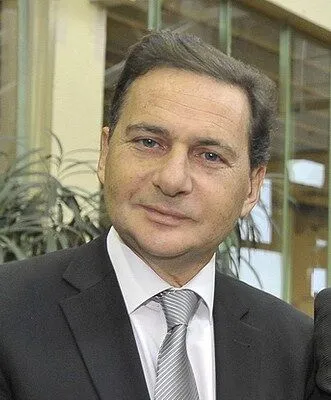
Éric Besson
Human Design Chart
Biography
He left the Socialist Party (PS) the day of the first round presidential elections in 2007 to found The Progressives, a social democratic affiliate party of Nicolas Sarkozy's Union for a Popular Movement (UMP). He has been Deputy Secretary-General of the UMP since 2009.
The Human Design of Éric Besson: Projector 3/5
Projector 3/5 — Design at a Glance
Éric Besson appeared with a focusing aura that immediately revealed system inefficiencies. His Human Design as a Projector compares this perception to a bright flashlight: It shines directly on dark spots in the environment and identifies error sources precisely. However, direct criticism of these weak points often met resistance because it felt like glaring light in someone else's face.
Éric Besson's effective strategy did not lie in active correction but rather in attracting others through his own harmony. By living functional patterns himself, he became magnetic; people then sought out his advice on their own initiative. This required waiting for an honest invitation to respect the natural authority of the Projector and avoid frustration.
Furthermore, his undefined Sacral Center shaped his energy profile: Éric Besson did not have a constant source of life energy. Instead of continuous performance, phases of high productivity were followed by necessary rest periods to prevent burnout. Ignoring these rhythms led to exhaustion; living according to this design—through patient waiting for invitations and respectful pauses—brought him success. Deviating from it resulted in bitterness as an expression of his non-self. His path therefore lay in subtle leadership through example, not direct intervention.
Splenic Authority
Éric Besson showed a tendency towards spontaneous survival intelligence as the primary decision-making basis. His design suggested that the first immediate impulse was always correct and served to protect health and well-being. This attitude stems from his authority in the Spleen Center. For the Spleen Center to be an inner authority, both the Emotional and Sacral Centers must be open; therefore, only Projectors or Manifestors possess this specific form of authority. The Spleen Center functions as a health and alarm system that provides excellent survival intelligence. This manifests as spontaneous internal knowledge about whether an environment, situation, or society is right. Instinct, intuition, and physical well-being were reliable indicators for Éric Besson. Decisions had to be made in the moment because this fine impulse only came once and could easily be drowned out by reflection or external influences. High vigilance was necessary to follow these signals. Since what was right became apparent only in the present moment, plans could change at short notice. Long-term commitments were difficult; instead, Éric Besson needed a lot of freedom and flexibility. This allowed him to rigorously distance himself from harmful influences and take good care of himself. The ability to act spontaneously rather than set things in stone significantly shaped his way of life.
The 3/5 Profile — Martyr / Heretic
Éric Besson exhibited a fundamental attitude of the skeptical experimenter who only gains authority after finding solutions through personal experimentation. His design (Profile 3/5) suggested that he did not accept anything at face value; instead, he learned from trial and error. This Line 3 component drove him to avoid dependencies and forge his own path so as not to fall into helplessness against superior forces.
At the same time, he carried the burden of the Hero role (Line 5). Once he had practical knowledge, others found him attractive because they wanted to share in his experiences. This created a tension: While Line 3 demanded autonomy, Line 5 drew him into public focus where he acted as a problem solver. The pain point of this design lay in public failure. Since he had to experiment before others to prove his authority, failures were not private but isolating.
The mechanics of Line 5 (alienation) meant that he often appeared as a lone fighter during crises. He solved problems intuitively within his own context but risked isolation in the process. For Éric Besson, it was difficult to separate himself from others to take on this Hero role, yet precisely this self-separation was necessary to bring about mutations through his isolated struggle. His appeal thus lay in the paradoxical interplay of a need for independence and the painful necessity of publicly failing or triumphing.
Split Definition — Defined & Open Centers
Éric Besson was characterized by a clear, confident identity and direct willpower. His design provided a foundation of defined G Center (Identity/Direction) and Heart Center (Will/Ego), connected with a defined Throat Center. This configuration allowed him to translate inner truth and intentions directly into the world without filters through intellect or emotions and take action accordingly. Communication was consistently from the "I want" and personal mission, creating a reliable form of expression.
Additionally, a defined Spleen Center acted as an intuitive protective instance for current well-being, while a defined Root Center provided constant inner pressure towards forward movement and survival. These defined areas formed the stable core structure of his mechanics.
At the same time, there was a tension field through several open centers: Head, Ajna (Mind), Sacral (vital energy), and Solar Plexus (emotions). As "windows," these areas absorbed inspiration, mental concepts, foreign vitality, and emotional moods from the environment. The danger lay in identifying borrowed energies as one's own – for example, through mental rumination in open Head/Ajna, exhaustion from taking on Sacral energy, or absorbing environmental stress in Solar Plexus. Éric Besson tended to lose himself in these fields if he did not trust his defined authority. The key was using the clear voice of the Throat and the Will of the Heart to reject foreign pressure and avoid sinking into the vulnerability of open centers.
Channels for reflection, instinctive devotion and meaningful struggle.
Éric Besson revealed himself as someone who collects stories to share thoughtfully later on. This attitude stems from the Lost Son Channel 13-33, which connects listening and withdrawal: He absorbs information, sorts it internally, and shares insights only after a maturation phase when the deeper truth becomes clear.
At the same time, he acted as an instinctive seller with entrepreneurial intuition. The channel of Devotion 44-26 links the Spleen Center (alertness) to the Heart Center (willpower). This allows him to intuitively grasp tribal needs and make convincing offers—often before the target audience knows what they need themselves. It is a mechanism of targeted influence for the benefit of the collective or team.
This communicative strength is reinforced by stubborn fight energy. The channel of Life Struggle 28-38 drives resistance against external distractions to maintain individual integrity. Éric Besson sought meaning in struggles and used adrenaline to assert his uniqueness and distance himself from conformity pressure.
Additionally, other aspects shaped his design: Gate 21 provided control in the material realm and a desire for respect; Gate 48 allowed deep pattern recognition and logical perfectionism, even if this could lead to frustration. Gate 39 supplied through provocation fuel for mutations and re-evaluation. On the personality side, Gate 19 sought security in resources and partnerships, while Gate 31 emphasized the transmission of leadership. In his design itself, Gate 15 reflected collective rhythms and adaptability.
Individual Circuitry — Circuit Signature
Éric Besson exhibited a fundamental stance that oscillated between the search for innovative identity and the need for traditional structure. His design connected two separate energetic poles: the Knowledge Circuit and the Ego Circuit. In the Knowledge Circuit, only the Life Struggle Channel (Gates 28-38) was active in him. This channel linked the Spleen Center to the Root Center, generating a pulsating, innovative energy – a constant drive for new knowledge and individual expression in the here and now.
Parallel to this, Éric Besson's Ego Circuit consisted of the Devotion Channel (Gates 26-44). This channel connected the Heart Center with the Spleen Center, promoting cooperation as well as resource management based on giving and taking. This energy was timeless, conservative, and required pauses for regeneration since there was no direct connection to the Sacral Center.
The Spleen served as a common interface: it filtered both the innovative impulses of the Knowledge Circuit and the cooperative demands of the Ego Circuit. Since Éric Besson had a Shared Definition, these energies did not flow in a single stream. Instead, they operated as two parallel, independent systems: on one hand, the creative, pulsating drive for self-discovery (Spleen-Root), and on the other hand, the structured, resource-oriented cooperation in social contexts (Heart-Spleen). This configuration shaped his experience through the simultaneous presence of innovative drive and the necessity of traditional support.
Right Angle Cross of Tension 1
Eric Besson was marked by an inner, often unconscious tension between the will for self-determination and the necessity to flow with life's currents. This constellation created a constant internal pressure that could be resolved through finding a personal rhythm and accepting uncertainty. It was about balancing control and surrender.
This dynamic is described as The Right Cross of Tension 1. It emphasized the continuous friction between the desire for individual freedom and the experience that some things lie beyond one's control. This tension shaped his entire life, leading to a deep understanding of the human condition of striving and letting go. The pressure did not arise from external expectations but rather from the internal mechanics required to align self-assertion with the natural flow of events. The solution lay less in asserting will than in learning when it was wiser to let things unfold. This helped Eric Besson navigate the complexity between personal claim and the reality of circumstances without losing his integrity or wearing himself out against unchangeable facts.
Saturn Return · Uranus Opposition · Chiron Return · 2nd Saturn Return — Life Cycles
Eric Bessons design points towards a tendency for becoming aware and integrating old identities. It showed as a cyclical process of letting go in favor of a more authentic, self-determined alignment. In Human Design, the Chiron Return (around 49-51 years) marks an achievement cycle: those who have lived according to their strategy and authority experience a bloom where the incarnation cross unfolds and purpose becomes tangible. It is not about healing wounds but completing one's own mission.
In 2007, at age 49, Eric Besson left the Socialist Party to found The Progressives. This event exemplified this phase: it was not just a shift but a concrete implementation of inner maturation. By leaving an established structure and building a new political project, his authority became visible. It was a moment of self-determination where old ties were severed to make room for a more authentic alignment. The Chiron Return acted here as a catalyst for this reorientation. Founding new structures served to carry the inner clarity outward. This cycle promoted the integration of personal power into tangible projects. Eric Besson used this time to redefine his political identity. The focus was on creating a space that aligned with his personal values. Through this action, the potential of the incarnation cross became active in public life. It was a step towards greater independence and responsibility for one's path.
Projector · Splenic Authority — Synthesis
Eric Bessons chart reveals a central red thread of mediation and recognizing patterns. As a projector with defined Throat, G, and Root Centers, he is destined to recognize the quality of others – errors in the system (Gate 21) or hidden potentials (Channel 48). This ability, combined with the Spleen authority for instinctive assessments, gives him fine perception and talent for identifying and mobilizing resources (Channel 26-44), to effect positive change. He is geared towards gaining insights through observation and reflection (Channel 38-28) and passing these on – a role manifesting in the ability to recognize patterns and draw conclusions for the collective.
A central paradox lies in the tension between the need for recognition (Gate 19) and the inner independence that arises from an open Sacral Center. He is geared towards contributing and mobilizing resources, but also needs space and flexibility not to be overwhelmed by others' energies. This dynamic leads to a constant balancing act between the desire for connection and the necessity of preserving one's own integrity – a continuous dance between giving and taking.
3 Defined Channels
Incarnation Cross - Right Angle Cross of Tension 1
Solar Return
The Solar Return shows the moment when the sun returns to its exact birth position - your personal solar year.
Life Cycles
Discover the life cycles with a detailed triple view (birth chart, cycle chart, composite).
Human Design Profile
- Type
- Projector
- Strategy
- Wait for the respectful invitation
- Authority
- Splenic Authority
- Profile
- 3/5 - Martyr / Heretic
- Definition
- Split Definition
- Incarnation Cross
- Right Angle Cross of Tension 1
- Date of Birth
- 02.04.1958 04:15
- Place of Birth
- Marrakech, Morocco
Frequently Asked Questions
What is Éric Besson's Human Design type?
What Profile does Éric Besson have?
What authority does Éric Besson have?
What incarnation cross does Éric Besson have?
Discover your own Human Design
Are you also a Projector? Find out in a personal reading how to unfold your leadership qualities and recognize the right invitations.
More Personalities
Back to overviewSissy Spacek

Alain-Fournier

Anémone

Ann-Margret

Bourvil
Hergé