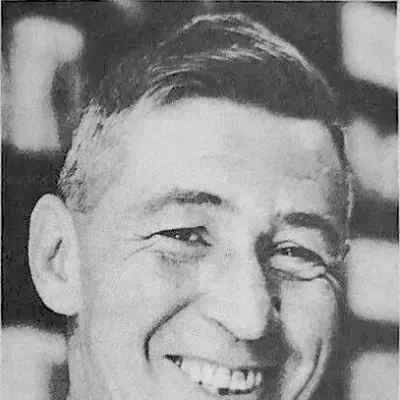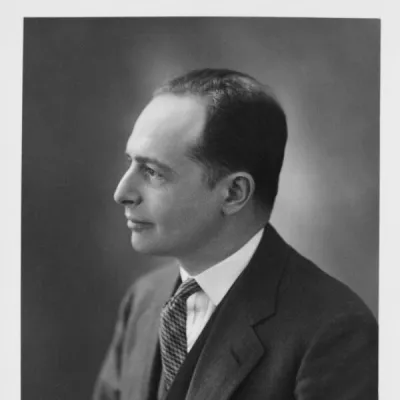
Erich Auerbach
Human Design Chart
Biography
He moved to the United States in 1947, and was appointed professor of Romance philology at Yale University in 1950, a position he held until his death on 13 October 1957 in Wallingford, Connecticut at age 64.
The Human Design of Erich Auerbach: Projector 6/2
Projector 6/2 — Design at a Glance
Erich Auerbach's Human Design suggests a tendency towards dense, focused perception. As a Projector, his aura acted like a bright flashlight that immediately identified system errors in others and shed light on the dark spots. However, this ability to directly identify weaknesses carried a risk: Direct confrontation would trigger resistance, similar to how bright light into someone’s face causes discomfort.
Therefore, the mechanics of his design required elegance rather than intrusion. Instead of openly addressing faults, it was more effective for him to shine as an example through his own actions. Others would then automatically come to him seeking advice, drawn by his clarity. The central strategy involved waiting for a sincere, appreciative invitation. This served as a protective mechanism against frustration and secured his recognition.
A crucial aspect was his undefined Sacral Center. It meant that Erich Auerbach did not have a constant intrinsic energy source. Instead, he experienced phases of high activity followed by an imperative need to rest. Without these regenerative phases, there was a risk of burnout since societal structures often do not accommodate this rhythmic need.
Living according to this principle – waiting for invitations and respecting his energetic balance – rewarded him with success. Ignoring this dynamic and acting out of personal initiative or without inclusion led sooner or later to bitterness as an expression of his non-self. His path was thus characterized by the balance between sharp diagnosis and patient waiting.
Emotional Authority
Erich Auerbach's Human Design suggests a tendency towards profound, time-intensive decision-making. He showed himself to be someone who gained inner clarity not through spontaneous impulses but through patient waiting. His inner authority lay in his defined Emotional Center. This meant that he was subject to a constant wave of emotions that colored his perception of the world: In one moment, he could be enthusiastic about something, and in the next, see the same thing negatively. However, his immediate feeling was only a snapshot, not an ultimate truth. Quick, spontaneous decisions from this emotional heat often had negative consequences for him. Instead, his mechanics required time and multiple 'overnights' to reflect on dilemmas. The longer he waited, the deeper he could understand. Through hesitation and questioning, intense feelings subsided, giving him emotional distance. Only then did calmness and clarity set in. This process was especially crucial for long-term decisions as they significantly influenced his life path. Emotional authority always took precedence over other defined centers; regardless of what else was activated in his chart, this emotional wave determined the path to inner truth.
The 6/2 Profile — Role Model / Hermit
Erich Auerbach's Human Design is characterized by a clear developmental line: The early stage of life was marked by experimental role changes, while later years were shaped by detached reflection and deep self-awareness. This structure resulted from his 6/2 configuration. Before his thirtieth birthday, the six acted as three; Erich Auerbach actively sought answers through trial and error during this phase, with retreats after failures being part of the necessary learning process.
With the activation of the sixth line around thirty years old, this attitude fundamentally changed. Instead of continuing to experiment blindly, Erich Auerbach metaphorically retreated into a 'cave' to look back on his previous experiences from a distance. This introspective phase served for healing and building genuine wisdom. His design suggested that true creativity and value assessment could only arise through this temporal mutation; he learned to distinguish subjective impulses from objective worth.
The second line also promoted tolerance towards boundaries as well as the understanding that misunderstandings often stem from incorrect timing, not lack of intelligence. Only after Erich Auerbach had gone through these inner processes did he re-emerge into exchange with others. His newly gained wisdom and ability for deep introspection became visible to his environment, allowing others to benefit from his clear, timely perspective.
Single Definition — Defined & Open Centers
Erich Auerbach's design inclined towards deep, time-bound reflection driven by constant inner tension. His defined Solar Plexus served as an emotional authority: truth was not revealed to him in the moment but only after traversing the emotional wave cycle. Impulsive action at the peaks or troughs of this wave led to chaos; waiting for clarity was essential for correct decisions. This patience enabled an intelligence with deep sensitivity, understanding things in their ever-changing emotional and spiritual dimensions.
Parallel to this, his defined Root Center provided physical, adrenalized pressure to maintain the life impulse. This existential stress ensured a constant energy for movement in the world. As long as Auerbach followed this pressure from inner calm, he remained grounded; otherwise, he tended to project excessive expectations onto others or become obsessive.
In contrast, Head, Ajna, Throat, G, Heart, Sacral and Spleen were open. These centers reflected their environment rather than possessing fixed patterns of their own. The open Head and Ajna Centers made him vulnerable to mental confusion or adopting foreign concepts as his truth. Without a constant identity (open G), he adapted situationally, which however carried the risk of internalizing „borrowed“ directions. The open Heart Center lacked the energy for willful competitive struggles; making promises to prove worth led only into spirals of failure. Similarly, the open Sacral Center was not designed for consistent vital performance but received „borrowed“ energy that could lead to exhaustion if boundaries were ignored. The open Spleen Center carried a fundamental survival fear and tended to cling to things that were not good for him in order to feel secure. Spontaneous decisions here were risky, often based on conditioned fear.
Channels for synthesis and the release of emotions.
Erich Auerbach's design was characterized by tension between tribal bonding and individual emotionality. This constellation shaped his inner experience as a dance between the need for secure belonging and the necessity of living one's moods authentically.
The Synthesis Channel 19-49 connected the Root Center with the Solar Plexus Center through Gate of Demands (19) and Gate of Principles (49). This connection functioned as tribal emotional glue, based on loyalty, honor, and mutual protection. Erich Auerbach was sensitive to his position within a community; he sought validation through belonging and feeling needed. This channel required a clear belief system and the protection of resources and territory. The emotional wave of this channel determined who belonged in the group and who did not, based on deep sensitivity for needs and principles that held everything together. Loyalty was here key to survival and satisfaction, always seeking a balance between feasibility and fairness.
Simultaneously, the Channel of Emotional Release 39-55 acted as a juxtaposition configuration, connecting the Root Center with the Solar Plexus Center through Gate of Provocation (39) and Gate of Spirit (55). This channel set in motion the pulsating wave of individual moods marked by highs and lows between joy and melancholy. For Erich Auerbach, it was crucial to act or engage only when he was in the right mood. This moodiness was not a weakness but a creative force for mutation and spiritual truth. Through provoking the spirit, he could gauge the nature of others and liberate their minds. The authenticity of these emotional waves prevented manipulation; instead, they enabled a deep, individual connection to his own truth and creativity as long as he did not go against his inner mood.
Individual Circuitry — Circuit Signature
Erich Auerbach's design set up tension between individual emotional transformation and tribal cooperation. As a Simple Definition with a single group consisting of Root and Solar Plexus Centers, he had a direct, continuous energetic flow. This connection anchored him physically and emotionally deeply in the here and now, translating inner waves directly into physical reality.
The Knowledge Circuit worked through him via the channel „Emotions Release“ (55-39). This channel connected the Solar Plexus Center with the Root Center. It enabled emotional impulses to be translated directly into physical action or expression, fostering a pulsating, creative identity. It was about one's own path and transformation through personal emotions.
Parallel to this, the Ego Circuit presented itself via the channel „Synthesis“ (49-19), also connecting Solar Plexus and Root Centers. This channel stood for tribal cooperation, resource conservation, and balance in giving and taking. It promoted a conservative, traditional approach to material goods and social structures.
Both circuits utilized the same energetic path between Solar Plexus and Root Center. This created an inner pulse: on one hand, the urge to establish new identity through emotional waves; on the other, the necessity of building stability in the collective through exchange. Erich Auerbach navigated between individual creativity and collective resource security, both forces drawing from the same physical-emotional base.
Left Angle Cross of Defiance 2
Erich Auerbach's design indicated a tendency towards existential challenges that structurally shaped his life path. This configuration was referred to as the 'Left Challenge Cross 2' and pointed toward a fateful dimension of trials. In Human Design, such a cross describes an archetypal framework for personal development in which difficulties are not seen as random obstacles but as central elements of the growth process. For Erich Auerbach, this meant that his life task was closely tied to overcoming and integrating these challenges. The mechanics of this cross underscored the necessity of maturing through resistance and pressure, with the difficulties themselves serving as catalysts for profound inner change. This was not about isolated crisis moments but a continuous pattern that shaped his development. The archetypal quality of this framework emphasized the importance of endurance and resilience in the face of trials. Erich Auerbach thus showed himself to be someone whose identity and maturity were significantly marked by his handling of these fateful dimensions, without specific external events being responsible for it. The structure itself bore the burden of the developmental task.
Saturn Return · Uranus Opposition · Chiron Return · 2nd Saturn Return — Life Cycles
Erich Auerbach's design was characterized by three distinct life phases, each influenced by specific astrological cycles. These cycles correlated with profound breaks in his career and identity, suggesting a structure that used external changes as catalysts for inner development.
In 1930, at the age of 38, he experienced the Uranus opposition. This cycle often represents sudden liberation or upheaval. For Erich Auerbach, this was marked by his appointment as an ordinary professor of Romance philology at Philipps University Marburg to succeed Leo Spitzer. It was a moment of professional establishment driven by the energetic dynamics of Uranus.
Ten years later in 1940, at age 48, he reached the Chiron return. In Human Design mechanics, this period marks a fulfillment cycle where the incarnation cross unfolds – provided the person lives according to their strategy and authority. For Erich Auerbach, this phase coincided with a severe crisis: his German citizenship was revoked. This external loss corresponded with the deep inner trial of the Chiron cycle, which makes experiential sense often through harsh confrontation with one's own limits.
The third significant point was the second Saturn return in 1950 at age 58. Saturn symbolizes structure, responsibility, and maturity. Erich Auerbach was appointed professor of Romance philology at Yale University that year. This appointment condensed years of groundwork into a new stable foundation typical for the saturnine cycle which favors stability and long-term achievements.
Projector · Emotional Authority — Synthesis
Erich Auerbach's life was marked by a deep sensitivity to the subtle vibrations of his environment, combined with an ability to recognize patterns and errors in complex systems (Gate 1, Root and Solar Plexus connection). This combination led to a constant oscillation between the need for inner clarity – he needed time to wait out emotional waves (emotional authority) – and simultaneous openness to the energies of others (open Sacral, G, and Spleen centers). He was an observer who defined himself through interaction with his environment, whose wisdom arose from collecting diverse experiences (Profile 6/2).
The central paradox in his design lay in the tension between this openness and the need for inner stability. While he absorbed the energies of others and recognized their patterns, he lacked a constant internal source for direction and identity. This led to a deep search for principles and values (Channel 19-49) to find meaning in the complex world while simultaneously preserving his own individuality – a process that was reinforced by the cyclical challenges of his life (Uranus opposition, Chiron return).
2 Defined Channels
Incarnation Cross - Left Angle Cross of Defiance 2
Solar Return
The Solar Return shows the moment when the sun returns to its exact birth position - your personal solar year.
Life Cycles
Discover the life cycles with a detailed triple view (birth chart, cycle chart, composite).
Human Design Profile
- Type
- Projector
- Strategy
- Wait for the respectful invitation
- Authority
- Emotional Authority
- Profile
- 6/2 - Role Model / Hermit
- Definition
- Single Definition
- Incarnation Cross
- Left Angle Cross of Defiance 2
- Date of Birth
- 09.11.1892 21:30
- Place of Birth
- Berlin, Germany
Frequently Asked Questions
What was the Human Design type of Erich Auerbach?
What Profile did Erich Auerbach have in Human Design?
What Authority guided Erich Auerbach?
What incarnation cross was assigned to Erich Auerbach?
When was Erich Auerbach born?
Discover your own Human Design
Are you also a Projector? Find out in a personal reading how to unfold your leadership qualities and recognize the right invitations.
More Personalities
Back to overviewSissy Spacek

Alain-Fournier

Anémone

Ann-Margret

Bourvil
Hergé