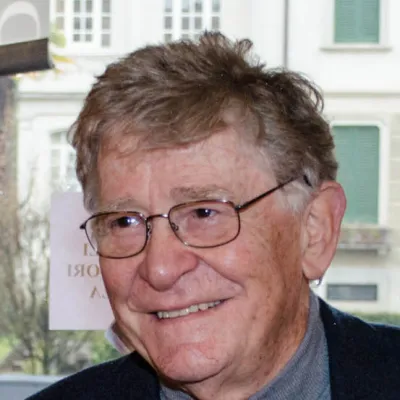
Ermanno Olmi
Human Design Chart
Biography
He was married to Loredana Detto, who played Antonietta Masetti in Il Posto, and they had three children. He died on 5 May 2018, aged 86, in Asiago, Italy.
Ermanno Olmi — Generator with Profile 5/1
Generator 5/1 — Design at a Glance
Ermanno Olmi was someone who channeled his strength not through spontaneous initiatives but by responding to inner signals. As a Generator, he had considerable sacral energy that endowed him with immense endurance – comparable to a workhorse that carries on as long as it burns for the task at hand. His design suggested that true efficiency and satisfaction only occurred when he waited for impulses from his environment and acted only once his inner self gave a clear “yes.” This strategy of responding rather than initiating was crucial: It prevented energy loss through forced actions or ignoring internal resistance. If he worked against his gut feelings or was held back from his heart project, frustration and burnout loomed. His path lay in utilizing this great inner reserve to advance projects with deep fulfillment by relying on the authentic response of his system. Thus, he could unleash his creative power without burning out because he learned to distinguish between what he had to do and what he wanted to respond to from within.
Emotional Authority
Ermanno Olmi’s design showed a tendency towards emotional penetration where inner clarity was only achievable through temporal distance. His inner authority carried the defined Emotions Center – a mechanism that always took precedence over all other defined centers, thus forming the primary decision-making instance. This configuration generated a constant wave of emotional ups and downs, coloring his perception of the world through the current mood filter. What appeared inspiring in one moment could seem negative in the next; these fluctuating impressions were merely snapshots, not yet the final truth. Quick, spontaneous decisions based on such emotions often risked negative consequences due to incomplete internal information. Instead, his system required patience: Decisions had to mature, be “slept on” multiple times and take their time. Only when intense feelings subsided and emotional distance was gained did calmness set in. This process of waiting served to gain deeper insights, especially for long-term life decisions with significant influence on his further path. Through enduring this emotional dynamics, Ermanno Olmi reached clarity that transcended superficial impulses and created a more authentic basis for his actions.
The 5/1 Profile — Heretic / Investigator
Ermanno Olmi was someone who used deep knowledge to offer solutions to others. His design carried the Profile 5/1 – Hero/Researcher. This configuration combined Line 1, which required a stable foundation and self-sufficiency, with Line 5, which had a magnetic effect and attracted others. People often sought his advice or answers because they sensed his inner treasures. However, this could quickly lead to exhaustion if clear boundaries were not set. Similar to a scientist who was drained after long conferences due to constant questioning, Ermanno Olmi had to learn to say no as well. Only in this way did he maintain the balance between his own research and problem-solving for others. His Gate 56 emphasized attention-grabbing through storytelling and unusualness. The world projected expectations on him that he be inspiring. At the same time, the first-line Gate 27 called for fundamental self-care without harming others. Jealousy or misfortune served as hints of necessary improvements to this foundation. Through these mechanisms, Ermanno Olmi learned to optimally utilize his gifts by prioritizing himself while simultaneously making his knowledge available without neglecting himself.
Split Definition — Defined & Open Centers
Ermanno Olmi was someone who constantly felt an internal pressure to ask questions and understand connections. This mental tension resulted from his defined configuration between the Head Center and Ajna Center. He had a firm way of thinking, but it wasn't directly actionable because these centers do not have their own energy source. Instead, his mind served to inspire or put others under pressure by raising issues that were yet unresolved. The challenge lay in accepting this mental pressure without wanting to release it through hasty actions, which would often lead to frustration.
As a Generator with a defined Sacral Center, Olmi had an enormous reservoir of vital energy. His design required him not to initiate himself but to wait for stimuli from the environment before making his power available. Only through an affirming response from his gut could he release his full energy for activities that brought him satisfaction. Attempts to make mental decisions over this sacral reaction would have driven him into resistance and exhaustion.
At the same time, his Solar Plexus Center was defined, establishing emotional clarity as inner authority. He had to learn to wait out the waves of his feelings before making decisions to avoid impulsive reactions based on the highs or lows of these waves.
In contrast, his G-, Heart, and Spleen Centers were open. His open G-Center meant that he did not carry a fixed identity but reflected in relationships and environments; he was dependent on others initiating him to find the right direction. His open Heart Center made him vulnerable to the pressure of having to prove his worth, even though he wasn't designed to be willfully competitive. The open Spleen Center gave him sensitivity towards health and well-being in his environment, where spontaneous decisions were often risky as they were guided by conditioned fears rather than instinct.
Channels for deep intimacy and rational clarity.
Ermanno Olmi sought deep intimacy but truly experienced it only when he patiently waited for his emotional wave. This attitude resulted from the Pairing Channel 59-6, which connected sacral sexuality with emotional friction. For him, it was crucial to nurture friendships before intimacy; otherwise, confusion or misunderstanding could arise that he was flirting where only closeness was intended. His emotional clarity did not come immediately but in waves that controlled attraction and repulsion.
Parallel to this, his mind searched for hidden truth to convey to others. The Awareness Channel 61-24 connected spontaneous inspiration with rational understanding. Olmi did not control his thinking; knowledge appeared as sudden insight when mental silence allowed it. He had to wait until this mutation occurred to distinguish between valuable and irrelevant knowledge.
Additionally, Gate 56 shaped his ability to translate mental processes into visual narratives while Gate 27 radiated genetic care for the tribe. Gate 28 challenged him to consciously take or reject risks in the here and now based on inner listening. In personality aspects, Gate 17 worked with logical teaching for the future, Gate 34 as a powerful energy source that needed leadership, and Gate 4 developed formulas for security. Gate 36 in his design reminded of cyclical crises that enabled development. Olmi's design threw him into a tension arc between intuitive intimacy and rational recognition, where patience was key to avoiding misinterpretations.
Individual Circuitry — Circuit Signature
Ermanno Olmi was marked by a split definition that formed two independent energetic strands. One area connected the Head Center with the Ajna Center through the Knowledge Circuit. Here, Channel 24-61 (Awareness) worked for innovative flashes of insight and creative impulses. This energy promoted the ability to recognize new connections and go individual paths without being directly linked to other body parts.
Parallel to this, a second isolated current existed in the Shielding Circuit. This connected the Sacral Center with the Solar Plexus Center through Channel 59-6 (Pairing). This configuration emphasized instinctive needs for protection, care, and the preservation of one's environment. It was about the primal energy of sustenance, nurturing, and ensuring survival. Since both groups were not interconnected, these creative intellectual streams and emotional survival impulses experienced as separate, adjacent forces. They did not flow into each other but shaped Ermanno Olmi's design as two distinct, independent fields of experience: on one hand, mental innovation, on the other hand, physical and emotional basic sustenance.
Left Angle Cross of Distraction 1
Ermanno Olmi's Human-Design profile indicated a tendency toward inner disintegration, often manifesting as a search for clarity amidst distractions. This configuration is known in the Human Design system as the left cross of distraction. It does not describe an external inability to concentrate but rather a specific energetic process: consciousness tended to focus on many different aspects simultaneously, which frequently led to feelings of being overwhelmed or lost. For Ermanno Olmi, true strength did not lie in immediate action but in the patience required to allow these inner disturbances and accept them as necessary parts of a larger learning process.
The mechanics of this cross work such that through apparent distractions, individuals actually gain deep insights. What appeared to be distraction was often an attempt by the system to integrate various pieces of information. Ermanno Olmi thus showed himself to be someone who did not rush directly towards his goal but whose path was marked by many detours and what seemed like dead ends. These detours were far from useless; they served to sharpen one's authority and teach when to act and when to pause. The challenge lay in not falling into frustration over this fragmentation, but rather using it as a source for an all-encompassing, multi-layered perspective. By accepting this dynamic, Ermanno Olmi was able to develop a unique, holistic viewpoint from what seemed like chaos, often hidden from superficial observers.
Saturn Return · Uranus Opposition · Chiron Return · 2nd Saturn Return — Life Cycles
Ermanno Olmi's Human-Design profile showed a tendency towards cyclical peaks of recognition marked by external events. This structure became visible in 1971 when he won the Golden Palm at Cannes with "The Shoemaker’s Cricket". This success fell during his Uranus opposition, a phase often characterized by unexpected breakthroughs or sudden changes that reorder previous life and open up new levels of visibility.
Ten years later, in 1981, the same film received a César for best foreign film. Olmi was then 48 years old, marking the beginning of his Chiron Return. In Human-Design mechanics, this cycle is not a process of wound healing but rather a phase of bloom and fulfillment. Here it shows how one's life purpose increasingly manifests in daily life and becomes experientially meaningful if one follows their strategy. The international recognition underscored this deepening of his purpose.
Another milestone occurred in 1988 when Olmi won the Golden Lion at Venice with "The Legend of the Holy Drinker". At age 57, he was in his second Saturn Return. This cycle often demands a redefinition of one's structure and responsibility. The success here not only confirmed his ability but also the maturity of his artistic vision now standing on a stable long-term foundation. His career followed thus a pattern where external validation mirrored internal developmental phases.
Generator · Emotional Authority — Synthesis
He was a Generator whose life was deeply influenced by sacral energy and the need to work on something that truly fulfilled him. The connection between his defined Head Center and the Sacral Center (Channel Pairing) points to a deep inspirational source that wanted to be awakened through concrete action. However, this potential was modulated by emotional waves (emotional authority), giving him time for clarity before committing to a task—a process leading him repeatedly into deeper layers of knowledge (Profile 5/1). The repeated successes correlated with significant cycles speak to his ability to achieve lasting impact through creative work.
A central paradox lay in the tension between his need for deep engagement and the pressure to provide solutions for others (Profile 5/1). His defined Head Center created a constant mental drive, while emotional authority compelled him not to make hasty decisions. This likely led to an inner disintegration between the desire for free exploration and the responsibility of making knowledge accessible to others—a dynamic that both fueled and burdened his creative process.
2 Defined Channels
Incarnation Cross - Left Angle Cross of Distraction 1
Solar Return
The Solar Return shows the moment when the sun returns to its exact birth position - your personal solar year.
Life Cycles
Discover the life cycles with a detailed triple view (birth chart, cycle chart, composite).
Human Design Profile
- Type
- Generator
- Strategy
- To respond - wait for something to respond to
- Authority
- Emotional Authority
- Profile
- 5/1 - Heretic / Investigator
- Definition
- Split Definition
- Incarnation Cross
- Left Angle Cross of Distraction 1
- Date of Birth
- 24.07.1931 19:30
- Place of Birth
- Bergamo, Italy
Frequently Asked Questions
What was Ermanno Olmi's Human Design type?
Which Profile did Ermanno Olmi have in Human Design?
What was Ermanno Olmi's Authority?
What incarnation cross did Ermanno Olmi have?
When was Ermanno Olmi born?
Discover your own Human Design
Are you also a Generator? Find out in a personal reading how to use your sacral energy correctly and discover deep satisfaction.
More Personalities
Back to overviewAaliyah

Alexia

Angèle

Anne-Marie

Arcángel

Arno