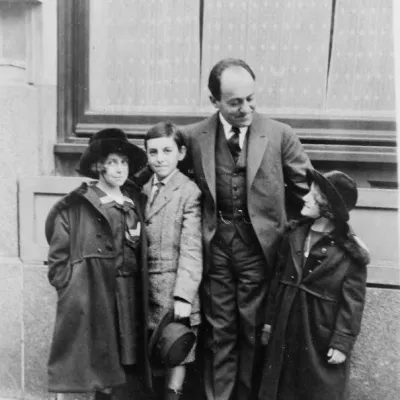
Ernest Bloch
Human Design Chart
Biography
Bloch’s music reflects many post-Romantic influences, among them the styles of Claude Debussy, Gustav Mahler, and Richard Strauss. His interest in the chromatic sonorities of Debussy and Maurice Ravel is evident in the tone poem Hiver-Printemps (1905; Winter-Spring). Bloch composed a significant group of works on Jewish themes, among them the Israel Symphony (1916), Trois poèmes juifs for orchestra (1913; Three Jewish Poems), the tone poem Schelomo for cello and orchestra (1916; Solomon), and the suite Baal Shem for violin and piano(1923). His sacred service Avodath Hakodesh for baritone, chorus, and orchestra (1930–33) represents the full maturity of his use of music appropriate to Jewish themes and liturgy. Many of Bloch’s works show a strong neoclassical trend, combining musical forms of the past with 20th-century techniques.
He died on 15 July 1959 in Portland, Oregon, of cancer at the age of 78.
Ernest Bloch — Generator with Profile 6/2
Generator 6/2 — Design at a Glance
Ernest Bloch possessed immense endurance and a high level of sacral energy, which classified him as a Generator in Human Design. This design endowed him with the strength of a workhorse: strong and dependable so long as he had energy for his tasks. His fundamental strategy did not involve initiating himself but rather responding to signals from life. When his sacral center gave a clear 'yes', he responded through action.
This mechanism was crucial for his well-being. If Ernest Bloch used his energy in harmony with this response, it led to deep satisfaction and fulfillment. The opposite - ignoring this design by constantly initiating or compulsively engaging in tasks without inner joy - resulted in frustration, energy depletion, and burnout. Two stumbling blocks characterized this dynamic: first, the waste of energy on things that did not bring him joy, leading to exhaustion despite his high potential for productivity. Second, holding back from his heart's project while wanting to continue working with full power.
The materialization of his ideas worked differently than for other types; it occurred through responding to impulses. The most successful approach was waiting for a life signal and then, when the inner center called out: 'Let's get started!', becoming active. If Ernest Bloch lived according to this design, nothing could stop him. Deviating from it, especially by over-initiating, led to persistent frustration and an energy shortage. His path to fulfillment thus lay in his ability to react instinctively to life rather than forcefully directing it.
Emotional Authority
Ernest Bloch showed a decision-making stance that required time and patience: spontaneous reactions were unreliable for him. His design carried emotional authority, supported by the defined solar plexus center. This meant that his inner guidance was always influenced by waves of feelings - a constant up-and-down that colored his perception of the world momentarily. What appeared inspiring in one phase could seem negative in the next moment. These emotional waves did not produce immediate clarity but only initial impressions, which had yet to align with his deepest truth.
Therefore, it was crucial for Ernest Bloch not to make decisions impulsively. Instead of being led by current moods, he took time to let a choice mature. This often happened through the conscious 'sleeping on' of a situation. As time passed, intense feelings subsided, emotional distance grew, and calmness set in. Only then, after going through this process, did he gain clarity for long-term steps that influenced his life path. Emotional authority always took precedence over other defined centers; it was the central mechanism determining when a decision truly came from him and was not just a passing emotion.
The 6/2 Profile — Role Model / Hermit
Ernest Bloch's design established a clear two-phase life path. Before his 30th year, Line 2 of his Profile 6/2, 'Natural Talent', dominated this phase. It was characterized by experimentation and promising projections, often without recognizing the strength of his own influence. This was a time of learning through trial and error, with care and dependence as central themes.
After turning 30, Line 6, 'Role Model', activated. Ernest Bloch metaphorically withdrew to reflect intensively on his earlier experiences. This withdrawal served for deep reflection and healing. The mechanics required here were delicacy and a review of trust versus suspicion. Only through this inner work could he learn that life unfolds differently than expected.
From this phase of self-awareness emerged later wisdom. Ernest Bloch no longer appeared as an experimenting youth but as someone who had learned from his mistakes. His role was to make this acquired insight accessible to others. Line 6 demands that ideas be lived out to inspire others. Thus, he became a model guiding people to practice deep introspection and develop authentic strength from their life experiences.
Split Definition — Defined & Open Centers
Ernest Bloch's energy architecture was characterized by four defined centers: Heart, Sacral, Solar Plexus, and Root. This created a massive, constant presence in the areas of Will, physical endurance, emotional processing, and survival pressure. The defined Heart Center gave him the ability to determine his own life and control resources; he knew his worth and kept promises, which built trust. Combined with the defined Sacral Center, he possessed an enormous vital energy source, a 'sacral motor' that generated daily energy. However, his capacity for action was based not on initiation but on reaction: He waited for questions or offers to check through an internal yes-no response whether energy was available.
This power was filtered by the defined Solar Plexus Center, his emotional authority. Here, there is no truth in 'now'. Ernest Bloch had to wait for the emotional wave before decisions were ripe; impulsiveness led to chaos, while patience brought deep clarity and spiritual fullness. The defined Root Center provided constant pressure to handle stress and move forward in the material world, often linked with existential or emotional intelligence.
In contrast, his open centers: Head, Ajna, Throat, G, and Spleen were undefined. Without consistent mental clarity, he tended to be distracted by doubts or others' questions rather than forcing his own answers. The open Ajna Center allowed a flexible mind that took in ideas without claiming them as absolute truth. Communication (open Throat) happened spontaneously through invitations from the environment; he did not need to actively seek attention. His open G Center meant no fixed identity or direction; these crystallized only in correct environments and relationships. The open Spleen Center made him vulnerable to survival fears, which were alleviated by healthy well-being in the right environment rather than through spontaneous, impulsive decisions.
Channels for evolutionary change and communal liberation.
Ernest Bloch's design tended towards evolutionary change often marked by a pulsating, melancholic energy. This structure required patience with inner limitations and trust in a new beginning even if the direction remained unclear initially. The Channel of Mutation 60-3 connected the pressure of the Root Center with the generative power of the Sacral Center. Gate 60 stood for accepting constraints as prerequisites for change, while Gate 3 represented the principle of order after new beginnings. This combination generated a powerful but unpredictable frequency that brought melancholy and could not be rationalized; it was integrated only through waiting attention.
Parallel to this, the Channel of Community 37-40 emphasized emotional clarity and fair agreements. This channel connected the Solar Plexus Center with the Heart Center and stressed the need for direct personal invitations for stable bonds. Gate 37 sought recognition in the whole, while Gate 40 was ready to work but needed rewards and breaks. For Ernest Bloch, this meant that community formation did not happen spontaneously but had to be carefully formulated to benefit all sides. It was about closing a 'good deal' where everyone found an honorable place.
The prioritized gates added further layers: Gate 56 allowed mental stimulation and storytelling by translating abstract processes into figurative representations. Gate 27 brought genetic care and self-preservation, enriching activities with warm support. Gate 28 stood for risk-taking decisions in the here-and-now based on listening to one's own authority. Together with subordinate gates like Gate 21 (control of material things) and Gate 59 (genetic binding strategy), a complex pattern emerged that had to balance inner tension between melancholic change and the need for stable, fair community. Ernest Bloch navigated these tensions through patient waiting for the right reaction and direct personal interaction.
Individual Circuitry — Circuit Signature
Ernest Bloch's design tended towards two parallel, not directly connected energetic dynamics. The Split Definition meant he operated with separate energy fields that required integration rather than functioning as a single flow.
One field was the Knowledge Circuit, which in Ernest Bloch connected the Sacral and Root Centers. Through the Channel of Mutation (Gates 3-60), this connection propelled individual transformation forward. It was about expressing new identity through emotional waves from the Solar Plexus – here primarily through the mutational energy of the Root Center seeking deviation from the known. This pulsating power promoted creativity and expression of one's own individuality, often accompanied by melancholic or acoustically marked impulses for change.
The second field formed the Ego Circuit, which connected Heart and Solar Plexus Centers. This circuit belonged to the Clan Dynamics and focused on cooperation as well as shared resource building. The Channel Community (Gates 37-40) regulated the give-and-take relationship: mutual support in a rhythm of 'today I give, tomorrow you give'. Since this circuit did not have a direct connection to the Sacral Center, it lacked constant life force. Instead, this rhythmic energy required necessary rest pauses for resource regeneration for the clan. The tension lay in balancing the pulsating drive towards individual mutation in the Knowledge Circuit and the conservative traditional need for pauses and reciprocity in the Ego Circuit. Ernest Bloch had to integrate these different energies without experiencing them as a single stream.
Left Angle Cross of Distraction 1
Ernest Bloch's Human Design configuration included the left cross of distraction. This structure established a specific psychological dynamic where internal impulses or external circumstances tended to divert focus from central life questions. Instead of concentrating directly on the essence of a situation, his system showed a tendency to channel energy into side paths. This did not operate as a conscious deception but rather as an inherent property of his design: attention was often diverted by trivialities or seemingly urgent yet less relevant matters.
The mechanics of this cross describe a process where clarity is temporarily clouded because consciousness is drawn away from the actual task at hand. For Ernest Bloch, this meant that moments of decisive action or insight were often delayed due to internal fragmentation or external distractions. His energy did not always flow directly towards its goal but sought circuitous routes, leading to some degree of vagueness in direction. This configuration shaped his experiential world by requiring him to distinguish between signaling stimuli and mere distraction. The structure challenged him to consciously steer the source of his attention so as not to get lost in the maze of side issues. It was a dynamic tension between the desire for clarity and the mechanical tendency towards diversion that significantly defined his inner experience.
Saturn Return · Uranus Opposition · Chiron Return · 2nd Saturn Return — Life Cycles
Ernest Bloch's life followed a rhythm of identity testing and artistic validation. His first Saturn Return marked 1910 as a crisis: The premiere of his opera *Macbeth* in Paris failed. This cycle, which often demands structure and responsibility, put him to the test regarding external recognition. Ten years later, at age forty, the Uranus Opposition broke this stagnation. In 1920 he was appointed music director at the Cleveland Institute of Music. This turning point signaled a necessary realignment and opened new paths in his career.
The Chiron Return around the age of 49 is an achievement cycle where one's inner sense increasingly unfolds. For Bloch, this manifested concretely in 1929: He won the Victor Company prize worth $25,000 for his work *Helvetia*. This success confirmed his artistic substance and was a peak moment of his flowering period. The second Saturn Return finally brought about a fundamental life change in 1939 at age fifty-nine. Bloch returned to the United States and settled in Oregon. This step repositioned him, concluding a long phase of searching for belonging by providing a firm foundation for further work.
Generator · Emotional Authority — Synthesis
Ernest Bloch lived a life marked by the dynamic interplay between inner depth and outer expression. His design as a Generator with emotional authority points to someone who drew from a deep well of sacral energy but only found clarity for action after waiting out emotional waves. This combination formed a character that was both powerful and enduring (Sacral Center) while also being marked by an ongoing internal process of evaluation and reflection (emotional center). The recurring theme of format energy, particularly through channels 58-52 and 3-60, underscores a cyclical nature where phases of intense activity were replaced by moments of stillness and realignment. This points to someone who did not progress linearly but learned and grew through repeated patterns of experimentation, refinement, and letting go.
Bloch's design reveals a central paradox: the tension between the need for inner clarity (emotional center) and the drive towards outer manifestation (sacral center). His open G Center indicates a flexible identity that oriented strongly to its environment, while his defined Heart Center signaled a strong desire for self-determination and willpower. This field of tension was reflected in his life as an interplay between seeking recognition and retreating into inner worlds, between the wish for community and the necessity of forging one's own path. The recurring crises and successes that correlate with planetary cycles mirror this internal rhythm – moments of departure followed by phases of consolidation and reassessment.
2 Defined Channels
Incarnation Cross - Left Angle Cross of Distraction 1
Solar Return
The Solar Return shows the moment when the sun returns to its exact birth position - your personal solar year.
Life Cycles
Discover the life cycles with a detailed triple view (birth chart, cycle chart, composite).
Human Design Profile
- Type
- Generator
- Strategy
- To respond - wait for something to respond to
- Authority
- Emotional Authority
- Profile
- 6/2 - Role Model / Hermit
- Definition
- Split Definition
- Incarnation Cross
- Left Angle Cross of Distraction 1
- Date of Birth
- 24.07.1880 10:00
- Place of Birth
- Geneva, Switzerland
Frequently Asked Questions
What was Ernest Bloch's Human Design type?
Which Profiles did Ernest Bloch have?
What Authority did Ernest Bloch possess?
What incarnation cross did Ernest Bloch have?
When was Ernest Bloch born?
Discover your own Human Design
Are you also a Generator? Find out in a personal reading how to use your sacral energy correctly and discover deep satisfaction.
More Personalities
Back to overviewAaliyah

Alexia

Alizée

Angèle

Anne-Marie

Arcángel