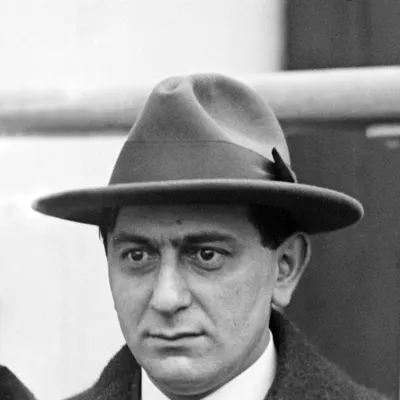
Ernst Lubitsch
Human Design Chart
Biography
Lubitsch left Germany for Hollywood in 1922, contracted as a director by Mary Pickford. His urbane comedies of manners gave him the reputation of being Hollywood's most elegant and sophisticated director; as his prestige grew, his films were promoted as having "the Lubitsch touch."
In 1947 he received an Honorary Academy Award for his distinguished contributions to the art of the motion picture, and he was nominated three times for Best Director.
He died on 30 November 1947 at age 55 in Hollywood of a heart attack, his sixth.
What does Projector 2/4 mean for Ernst Lubitsch?
Projector 2/4 — Design at a Glance
Ernst Lubitsch appeared as someone who had an intense and focused presence. As a projector, he did not have a constant internal energy source but acted like a bright flashlight: He directed his light specifically to places in his environment that were dark or malfunctioning. His nature was to immediately recognize errors in other people's systems.
This ability could quickly be perceived as unpleasant when he addressed these deficiencies directly – comparable to shining a light directly into someone's face and openly pointing out their problems. Such direct confrontation led the person to feel attacked, causing the interaction to fail.
The more effective expression of his design was simply to glow pleasantly by radiating harmony himself. Through this radiant presence, he automatically became attractive to other people who then approached him on their own initiative and asked for his insights. His strategy was therefore to wait for a respectful and sincerely meant invitation rather than taking the initiative or speaking up himself.
Since his Sacral Center was undefined, he did not have continuous life energy. Instead, he experienced phases of high activity followed by necessary rest periods for regeneration. Continuous work without these pauses inevitably led to burnout. If Ernst Lubitsch lived according to this principle of invitation and growth, he was rewarded with success. Ignoring his design and acting out of personal drive or compulsion eventually resulted in the feeling of bitterness as an expression of not being himself.
Self-Projected Authority
Ernst Lubitsch appeared as a projector with rare authority within himself. This configuration shaped extreme openness that made him vulnerable to distraction by external motoric energies. The greatest danger was losing oneself in this receptivity and constantly seeking external energy. His inner truth, however, lay firmly in his identity. He made decisions through self-dialogues or dialogues with others if invited. Crucial was listening to his own inner voice and recognizing spontaneously expressed thoughts as an expression of his true essence, rather than the reflective mind. This authentic self-expression made his uniqueness visible to others. Alternatively, he followed a physical feeling that drew him geographically or thematically in a certain direction. By remaining loyal to this inner attraction and recognizing his own life path, he could become a guide for others. There lay his specific potential for success. This mechanism emphasized the need to distinguish the spontaneous voice of self from analytical thinking to avoid falling into the trap of chasing energy.
The 2/4 Profile — Hermit / Opportunist
Ernst Lubitsch appeared as someone who oscillated between a deep desire for withdrawal and the wish for community. His design inclined him towards withdrawing to gain clarity in inner silence before seeking contact again. This tension arose from his Profile 2/4: Line 2 as an
Single Definition — Defined & Open Centers
Ernst Lubitsch revealed himself as someone whose inner compass needle was firmly set: His defined G Center gave him a steady sense of self-identity and a clear sense of direction. He knew who he was, and could radiate this security without being dependent on others. This stable identity flowed directly into his way of expression. Through his defined Throat Center, which is connected to the Ajna, he consistently spoke out what his mind conceptualized. His thinking – shaped by the also defined Ajna Center – ran on a trustworthy, specific path. He processed data and creativity in exactly the same way, allowing him to create concepts and mentally inspire or pressure others. Thus, his voice was a direct echo of his conceptual processes; he did not communicate impulsively but articulated thought-through theories and opinions.
This firm inner life contrasted strongly with the sensitivity of his open centers. His open Head Center lacked consistent inspiration; instead, he tended to pick up mental stress from the environment or get entangled in questions that were not his own. Without internal triggers, he might have sought external impulses to fill his inner monologue, making him vulnerable to confusion when he succumbed to these pressures. Similarly, his open Heart Center lacked a consistent willpower or energy for competition. He easily fell into the trap of promising more than he could deliver in order to prove his worth, only to fail later due to lacking the continuous strength to keep those commitments. This often led to cycles of self-doubt when he tried to legitimize himself through performance.
His open Sacral Center also made him susceptible to energetic overload. He absorbed the vital energy from his environment, leading him to operate on borrowed power and overextend himself without clear boundaries. His open Solar Plexus amplified foreign emotions; he took in the emotional climate around him like a barometer, making him vulnerable to moods that were not his own. Finally, his open Root Center absorbed external stress and adrenaline, putting pressure on him to be constantly active despite this pressure not being part of his nature. His challenge lay in delineating his firm mental and identity structure (G/Ajna/Throat) from the conditioning forces of his open centers without getting lost in spirals of proof-seeking, emotional entanglement, or energetic depletion.
Channels for inspired expression and structured insight.
Ernst Lubitsch showed himself as someone who through his mere presence and authentic presence encouraged others to live their unique individuality. This effect stems from the Channel of Inspiration 1-8, which connects the G Center with the Throat Center. Through Gate 1 of Self-expression and Gate 8 of Contribution, he did not primarily influence by explanations but rather by demonstrating his own direction. As a role model, he inspired his surroundings to be brave by drawing attention to himself – a co-creation from his dedication to individuality and recognition by others.
Parallel to this, Ernst Lubitsch had the ability to transform complex connections into efficient, clear forms. The Channel of Structuring 23-43 connected his Ajna Center with the Throat Center. Here, spontaneous insights (Gate 43) flowed into an assimilated, understandable expression form (Gate 23). His thinking often worked light-years ahead; he developed techniques and concepts that promoted efficiency and mutated collective understanding. Crucial was timing: Only when his innovative perspectives were expressed at the right moment did they find resonance instead of rejection.
This structural clarity was subject to a process of mental renewal (Gate 24), while his actions were characterized by deep dedication to the physical body and the here-and-now (Gate 46). He sought resources and security in his environment (Gate 19) and used withdrawal phases for reflection, processing experiences (Gate 33). Awareness and receptiveness (Gate 44) enabled him to undergo transformations through interaction. His collective experimentation with skills (Gate 16) rounded off a design aimed at setting new standards through exemplary living and precise communication.
Individual Circuitry — Circuit Signature
Ernst Lubitsch's Design showed a tendency towards structuring and inspiration. His Human-Design revealed him as someone who walked new paths and brought unique identity into the world through creative knowledge. This configuration arose from the Knowledge Circuit, which promoted his innate path.
As Ernst Lubitsch had a Simple Definition, his energies were clearly connected. The group of G Center, Throat Center, and Ajna formed a direct flow. The circuit actually connected these centers, allowing him to express emotional waves through the Throat Center and initiate change.
The active channels were Structuring (Gates 43-23) and Inspiration (Gates 8-1). Channel 43-23 contributed to strengthening his individuality, while Channel 8-1 promoted acoustic creativity and melancholy. This combination generated pulsating form-energy in the present moment. Ernst Lubitsch used this mechanism to transform and express new knowledge. His unique identity was reinforced through these mutations. The emotional wave from the Solar Plexus Center flowed into this process, although the Solar Plexus Center was not directly connected with the others. Instead, it acted as background energy for his expression style. Thus, Ernst Lubitsch appeared as a carrier of clear, structured creativity based on inspiration and expressed to the world through his voice or work.
Right Angle Cross of the Four Ways 4
Ernst Lubitsch's design carried the signature of the right cross of the four paths, a configuration that pointed him toward a specific evolutionary pillar. This structure determined his inner orientation less through external circumstances than through a deeply rooted, almost fateful life mission. In Human-Design, this cross marks an archetypal path of human development; it is not random but a defined channel in the energetic system that brings certain themes and challenges to the forefront. For him, this meant that his life was marked by a fundamental search for meaning and direction, which did not always follow a linear or simple explanation.
The four paths within this cross represent different aspects of human existence – whether in the realm of creativity, relationships, authority, or self-expression. Since Ernst Lubitsch's right cross was active, his energy manifested in a specific combination of these areas. He did not merely live any life but followed a pattern seen by ancient wisdom as necessary for human evolution. This gave his existence a particular weight: His decisions and experiences ultimately illustrated this archetypal path. It was less an individual struggle against the world than the embodiment of a prescribed energetic trajectory that guided him through various life phases and significantly shaped who he was.
Saturn Return · Uranus Opposition · Chiron Return — Life Cycles
Ernst Lubitsch's design inclined towards strategic adaptations that were marked by clear career phases. In 1920, at the age of 28, he switched film material and alternately directed historical costume dramas as well as comedies. This marked his first Saturn Return, a cycle in which years of groundwork often condenses into a solid result and strengthens one's structure.
Later, in 1934 at the age of 42, he was loaned out by Louis B. Mayer and Irving Thalberg to produce "The Merry Widow." This fell during his Uranus Opposition, a phase of sudden change and detachment from the familiar, often opening up new, unexpected possibilities.
His Chiron Return occurred in 1942 when he was 50 years old and directed "To Be or Not To Be," his most famous film today. This fulfillment cycle describes a period of blooming where one's incarnation cross unfolds and meaning becomes experiential. Lubitsch did not use this phase for healing old wounds but rather for the full realization of his purpose. His career thus illustrated the transition from structural consolidation through disruptive change to deep personal fulfillment.
Projector · Self-Projected Authority — Synthesis
Ernst Lubitsch was a Projector whose design was meant to bring "light into the dark" for others and to recognize flaws in the system (Design View). This ability to see and name patterns combined with an inner authority that manifested in self-talk and spontaneous expression of his truth (Authority). He lived this tension between observation and authentic being by repeatedly switching between different creative directions – alternating between historical material and comedies (Saturn Return 1) while always exploring new paths (Knowledge Circuit).
A central paradox shaped his work: the need for withdrawal and the simultaneous desire for community (Profile 2/4). This inner conflict was reflected in how he channeled his inspiration – through the expression of individual creativity and bold self-expression (Channel 1-8) – while also seeking moments of isolation to gain clarity. This interplay between public presence and inner reflection accompanied him throughout his career and contributed to his success (Chiron Return).
2 Defined Channels
Incarnation Cross - Right Angle Cross of the Four Ways 4
Solar Return
The Solar Return shows the moment when the sun returns to its exact birth position - your personal solar year.
Life Cycles
Discover the life cycles with a detailed triple view (birth chart, cycle chart, composite).
Human Design Profile
- Type
- Projector
- Strategy
- Wait for the respectful invitation
- Authority
- Self-Projected Authority
- Profile
- 2/4 - Hermit / Opportunist
- Definition
- Single Definition
- Incarnation Cross
- Right Angle Cross of the Four Ways 4
- Date of Birth
- 29.01.1892 07:00
- Place of Birth
- Berlin, Germany
Frequently Asked Questions
What was Ernst Lubitsch's Human Design type?
Which Profile did Ernst Lubitsch have?
What Authority guided Ernst Lubitsch?
What incarnation cross did Ernst Lubitsch have?
When was Ernst Lubitsch born?
Discover your own Human Design
Are you also a Projector? Find out in a personal reading how to unfold your leadership qualities and recognize the right invitations.
More Personalities
Back to overviewSissy Spacek

Alain-Fournier

Anémone

Ann-Margret

Arletty

Arno