
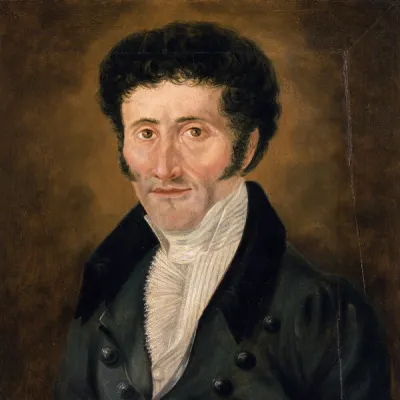
E.T.A. Hoffmann
Human Design Chart
Biography
Human Design Analysis: E.T.A. Hoffmann as Manifesting Generator 3/5
Manifesting Generator 3/5 — Design at a Glance
E.T.A. Hoffmann's design featured a tendency towards hybrid energy: He had the constant power of a Generator but also the ability to quickly jump into his life and skip steps. This configuration described an Manifesting Generator – a person who does not initiate, but reacts to impulses, yet shows manifesting qualities through direct connections from the Motor Center to the Throat.
This speed brought two specific risks with it. First, E.T.A. Hoffmann could act too quickly and overlook important stages, forcing him to backtrack and fill in gaps—a process that quickly led to frustration, a theme of non-self for this type. Second, he tended to pursue multiple projects simultaneously, driven by different impulses. Without strict adherence to his strategy—the waiting for the "yes" from the sacral center before any action—this creative enthusiasm easily turned into exhaustion.
However, with correct application, when he responded to life impulses and regularly checked whether his inner authority still affirmed his path, E.T.A. Hoffmann drew deep satisfaction from his work. For him, working through individual tasks one after another was hindering; instead, he needed variety and a playful mode to maintain his energy. His productivity depended on maintaining the balance between quick implementation and resonance-based selection.
Sacral Authority
E.T.A. Hoffmann's design inclined towards an immediate physical reaction to external stimuli. As a Generator, he possessed sacral authority, which simplified his decision-making process: strategy and inner guidance merged into one. This mechanism is not evident in the Head Center but manifests as a direct gut feeling or surge of energy – audible as grunts, hums, or a confirming "Mhm". Such signals marked moments when his sacral motor kicked in, providing him with inexhaustible energy and enthusiasm. He was born to dissolve himself completely into activities without having to submit them to external purpose; the joy of doing sufficed.
Additionally, his activated Spleen Center served as supporting authority. Linked to the Sacral Center, this enabled quick, spontaneous decisions and immediate access to instinctive perception of his physical well-being. This connection allowed him to reliably be guided by these deep bodily impulses. His open Emotional Center acted as a necessary prerequisite, ensuring that sacral authority could clearly function without being overlaid by emotional waves. E.T.A. Hoffmann lived out this configuration by trusting in these inner signals and deploying his energy where it responded spontaneously and vitally.
The 3/5 Profile — Martyr / Heretic
E.T.A. Hoffmann's design set a tendency towards an experimental and often painful hero role. As a 3/5 "Explorer/Hero", he primarily learned through his own experimentation and failure to generate practical knowledge for others. This configuration combined Line 3 of the Adventurer with Line 5 of the Hero: He initially believed little in given truths, instead seeking proof in direct action. Gate 41 in his line emphasized efficiency as a learning process through adaptation and experience, driven by Saturn's discipline and material ambition. Yet this individual path was no mere privilege; it served to initiate collective processes. At the same time, Gate 28 in the fifth line introduced the question of the value of life struggle. Here, the tension field between trust and manipulation became apparent: Alliances could be intuitively dissolved to join stronger alliances, which often acted as provocation in the collective. Hoffmann's attractiveness to his surroundings arose precisely from this rich trove of practical experiences he presented to others. Yet the hero role flattered him only so long as it worked; when he failed publicly, this was deeply painful. His design challenged him to advance through trial and error, where sharing resources—especially under unfavorable Moon influences—reduced the likelihood of success. He was programmed to solve other people's problems with self-learned knowledge but had to pay the price of public failure for it.
Single Definition — Defined & Open Centers
E.T.A. Hoffmann's design inclined towards clear, identity-defining communication, fueled by a deep inner vitality and intuition. His defined G Center gave him reliable self-awareness and a sense of personal direction; he knew where he came from and where it was leading him. This inner security flowed into his defined Throat Center, making his voice not only convey information but also transmit authentic messages of love and identity.
As a Generator with a defined Sacral Center, he possessed an enormous source of life energy. However, his drive was reactive: He needed external impulses to respond and productively use his strength. Simultaneously, his defined Spleen Center acted as an intuitive instance for health and well-being; it signaled in the moment what served or harmed him. The pressure from his defined Root Center propelled him forward, often tied with existential survival questions or the necessity of correcting material structures.
At the same time, he was vulnerable to conditioning through several open centers. His open Head and Ajna Centers allowed him to absorb mental inspirations from the environment; he tended to get entangled in questions that were not his own, or interpret concepts as personal truth, which could lead to confusion. His open Heart Center lacked consistent willpower; he was challenged not to prove his worth through promises or competition, as this led to frustration. Additionally, his open Solar Plexus absorbed the emotions of others. He had to learn to recognize these received moods as foreign and not personalize them to remain emotionally stable and retain his own authority.
Channels for logical leadership, experiments, care and life struggle.
E.T.A. Hoffmann's design inclined towards logical, collective leadership based on trust and recognized patterns. The Alpha Animal Channel 7-31 connected the G Center with the Throat Center; Gate 7 provided the rational role behind the scenes, while Gate 31 acted as a collective voice. This configuration required his authority to be invited by the majority rather than imposed – a process of perfecting to navigate societal trends safely.
Parallel to this, his design showed a deep connection between intuitive insight and technical mastery. The Wave Channel 48-16 linked the Spleen Center with the Throat Center: Gate 48 sought life-critical, hidden information, while Gate 16 transformed skill through repeated experimentation into talent. Here it was about gradually refining a skill to excellence driven by the need to obtain resources and recognition for this perfection.
His survival drive was strongly connected with care and preservation of traditional values. The Preservation Channel 27-50 linked his Sacral Center with his Spleen Center; Gate 27 brought selfless provision, while Gate 50 guarded the laws of the tribe. This created an aura that attracted trust and took responsibility for weaker individuals – yet only sustainably if he first tended to his own energy.
Simultaneously, the Life Struggle Channel 38-28 drove him, connecting Root Center with Spleen Center. Gate 38 exerted pressure to maintain individual integrity against external forces, while Gate 28 evaluated which struggles made sense. This channel gave him the resolve to stand for personal meaning even if it challenged the status quo and generated inner tension.
Additionally, Gates like that of evolutionary development (41), fostering collective progress through reflection (13), as well as that of skillful power application (14) shaped his attitude. Gate 5 supported building stable rhythms here, while Gate 45 symbolized the summation of energy on tribal levels.
Collective Circuitry — Circuit Signature
E.T.A. Hoffmann's design combined logical structure with instinctive alertness. As a simple definition, his energies flowed as an interconnected stream through Throat, Identity, Spleen, and Sacral Centers. This created a direct connection between rational expression and physical life force.
In the Understanding Circuit, he connected Throat, Identity, and Spleen Centers. Here, rational insight directly flowed into the voice, supported by intuitive foresight (Channel 16-48) and strategic focus (Channel 31-7). He could articulate complex connections clearly, free from emotional distortion.
Parallel to this, the Knowledge Circuit worked through Spleen and Root Centers. The Life Struggle Channel (28-38) propelled him to venture new paths and implement changes, often accompanied by internal pressure or melancholy. This energy did not flow directly into the rational expression side but formed its own pulsating source of power for innovation.
The Protector Circuit connected Sacral and Spleen Centers via Preservation Channel (27-50). This gave him a primal ability to protect and preserve what was essential, rooted in his life force. Overall, he showed a person who combined rational clarity with instinctive depth, always ready to strategically apply their knowledge while simultaneously preserving the foundation of their existence.
Right Angle Cross of the Unexpected 4
E.T.A. Hoffmann’s design set a specific disposition towards unexpected turns and surprising insights that often emerged from seemingly chaotic or unpredictable situations. This configuration was referred to as the Right Cross of the Unexpected 4. It described more than mere randomness; it indicated a structural inclination to receive clarifying impulses in moments of confusion or failure, radically altering his previous path. For him, the unforeseen was not an obstacle but a crucial part of his inner logic and creative process.
The mechanics of this cross were evident when traditional expectations or linear planning were often disrupted to make way for deeper, though initially shocking, truths. It wasn’t about arbitrary events but a dynamic force that urged him to embrace openness. Rather than striving for stability and predictability, he found his direction precisely in unpredictability. This attitude shaped his entire experience: What began as crisis or misstep often revealed itself later as a necessary step towards greater clarity. The energy of this design challenged him not to avoid the unexpected but to accept it as a source of new insight. Thus, the unforeseen became the central driving force of his development and expression.
Saturn Return · Uranus Opposition — Life Cycles
E.T.A. Hoffmann’s design set a tendency toward cyclical condensations in which inner structures emerged outwardly. This dynamic was evident in 1804, at age 28, when the score for the singspiel “Die lustigen Musikanten” appeared under his name. For his chart, this was a typical moment of the first Saturn return: A period where years of groundwork and inner maturation often condensed into a tangible, visible result. The publication marked here the transition from latent development to concrete form.
Later, in 1816 at age 40, another shift occurred: Hoffmann was appointed as a chamber court judge and his opera “Undine” premiered. This fell into the phase of Uranus opposition. In Human Design mechanics, this aspect describes a point of breaking free from old bonds towards new autonomy. The double confirmation – in legal office as well as artistic work – underscores how this mechanical opening showed itself as success and new positioning. Both events illustrate how the specific planetary cycles in Hoffmann’s design imprinted concrete life stations, turning inner potentials into outer realities.
Manifesting Generator · Sacral Authority — Synthesis
He was a Manifesting Generator whose life was marked by a steady flow of sacral energy (Design View). This energy discharged itself in an unrelenting search for new experiences (Profile: Experimenter/Hero and Saviour), where he rarely shied away from trying things out. Through the connection of his Sacral Center with the Throat Center (Centers, Channels) he could quickly implement ideas – sometimes too hastily (Design View). The Alpha Animal Channel (Channels/Gates) points to a natural inclination towards leadership, where his voice and knowledge exerted a collective influence. Thus, he acted as someone who gained insights through personal experimentation and then shared them, always driven by inner vitality and a desire to set things in motion.
Simultaneously, a central paradox revealed itself: His ability for quick action (Manifesting Generator) stood in tension with the necessity not to skip steps (Design View). This led to an internal dynamic between the desire for innovation and the realization that deeper processes require time. The knowledge of his own individuality (Switch Circuits: Knowledge Switch Circuit) clashed with expectations of a collective leadership role (Alpha Animal Channel), leading to a search for authentic expression within societal structures. The documented successes in certain cycles (Cycles) showed that he could navigate this tension successfully.
4 Defined Channels
Incarnation Cross - Right Angle Cross of the Unexpected 4
Solar Return
The Solar Return shows the moment when the sun returns to its exact birth position - your personal solar year.
Life Cycles
Discover the life cycles with a detailed triple view (birth chart, cycle chart, composite).
Human Design Profile
- Strategy
- To respond - wait for something to respond to
- Authority
- Sacral Authority
- Profile
- 3/5 - Martyr / Heretic
- Definition
- Single Definition
- Incarnation Cross
- Right Angle Cross of the Unexpected 4
- Date of Birth
- 24.01.1776 10:20
- Place of Birth
- Königsberg (Ostpreußen), Germany
Frequently Asked Questions
What was E.T.A. Hoffmann's Human Design type?
Which Profile did E.T.A. Hoffmann have?
What Authority did E.T.A. Hoffmann have?
What incarnation cross did E.T.A. Hoffmann have?
When was E.T.A. Hoffmann born?
Discover your own Human Design
Are you also a Manifesting Generator? Find out in a personal reading how to unfold your multi-talents and direct your energy wisely.
More Personalities
Back to overviewAaliyah

Aldair

Alexia

Alizée

Angèle

Angeli
