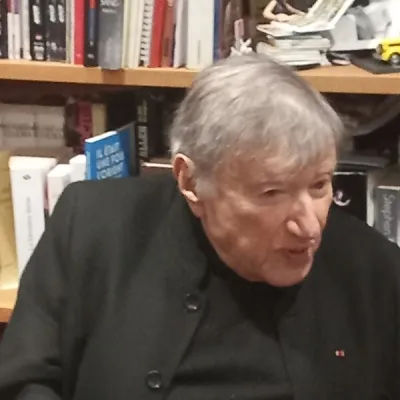
Étienne-Émile Baulieu
Human Design Chart
Biography
Baulieu was the oldest of three children born to Jewish physician Leon Blum, a pioneer in independent medical research in the treatment of diabetes who became one of the first doctors to conduct clinical trials in insulin. His mother, Therese Lion, was a conservatory-trained classical pianist who held advanced degrees in English and law. Prior to her marriage to Blum, Lion was an activist in the fight for women's suffrage in England.
Baulieu spent his early years in Strasbourg until after his father's untimely death in 1930 when mother Therese moved with her four-year-old son and two daughters to Paris. After the Germans invaded France in World War II, the Blum family fled Paris to live in Grenoble, an area which was not occupied by the Germans, where Baulieu resumed his studies at the Lycee Champollion. He became active in a Communist-controlled group and when the Gestapo began to close in, the family moved again to Annency in Haute-Savoie. In 1942, an attempt by Baulieu to deflect German attention from himself and his family and to hide the fact that his father was Jewish, Baulieu acquired false identification papers on which his surname appeared as Baulieu, a name he chose himself and the name he has used ever since.
Returning to Paris when the war ended in 1945, Baulieu formally began his study of medicine at the Faculty of Medicine, October 1944, registering under his pseudonym. As Strasbourg was still occupied, he could not use his true name.
Human Design Analysis: Étienne-Émile Baulieu as Generator 3/5
Generator 3/5 — Design at a Glance
Étienne-Émile Baulieu revealed himself as someone with remarkable inner endurance. His design as a Generator endowed him with a powerful sacral energy source, making him a strong and steady "workhorse" – robust and persistent as long as he had the energy for his task. This strength did not manifest through spontaneous initiatives but rather in response to impulses from the outside world. The central mechanics of his design lay in waiting for signals and only then acting when his inner self gave a clear “yes.”
This strategy of reacting instead of initiating was crucial for his satisfaction. When Étienne-Émile Baulieu listened to this inner confirmation, he felt deeply fulfilled and no one could stop him. However, if he lived against this principle – such as by doing things that did not bring him joy or when he was prevented from pursuing his heart’s project – he found himself in danger. His two major pitfalls were energy depletion through unwanted activities, which could lead to burnout, and suppressing his natural urges despite having the power.
If he did not live according to this pattern, especially if he constantly initiated actions on his own instead of reacting, he would eventually encounter persistent frustration and a noticeable lack of energy. His path to effectiveness therefore consisted in making gut decisions and only taking action when there was an inner resonance. This was the key to tapping into his full potential without becoming exhausted.
Sacral Authority
Étienne-Émile Baulieus decision-making process relied on a direct, physical resonance rather than logical analysis. As a Generator with defined Sacral Authority, his strategy was inseparably linked to this inner guidance: He waited for an external trigger and listened to the subsequent physiological response. This "gut feeling" served as an immediate compass. Signals such as grunting, humming, or a sense of vitality indicated that his instincts knew the path was right.
This mechanism allowed him to act with enthusiasm and joy in the process without being necessarily fixated on an external goal. When his sacral motor kicked in, he had an inexhaustible energy source and completed his tasks with great satisfaction. With the Emotional Center open, this clear physical response could not be distorted by transient emotional waves. The Sacral Authority thus offered him a simplified, reliable method to navigate life: He followed the inner "yes" that manifested as a powerful impulse and let himself be guided by this instinctive sense of well-being rather than getting stuck in analytical deliberations.
The 3/5 Profile — Martyr / Heretic
Étienne-Émile Baulieu revealed himself through his Profile 3/5 as someone who did not accept knowledge passively but actively tested it. His Line 3 pushed him to test everything himself – including failures – to develop practical wisdom from these experiences. This was not a passive stance, but rather a process of learning through trial and error, where rejection and failure served as necessary steps in overcoming his own vulnerability.
These personally gathered experiences formed the basis for his role in Line 5: the rescuer or hero. In times of crisis, he offered solutions based on his own resilience. Since this knowledge stemmed from direct practice, it was attractive and authoritative to others; people sought his support because they saw his ability to transform chaos into manageable insights.
The challenge lay in dealing with failure in public view. Étienne-Émile Baulieu had to learn that his worth did not depend on immediate success but rather on the ability to provide meaningful answers even after setbacks. Thus, his authority was not built through theoretical doctrines but through the authentic demonstration of how personal experiences can be drawn upon to offer collective benefit and practical guidance in difficult moments.
Single Definition — Defined & Open Centers
Étienne-Émile Baulieu had a firmly anchored G Center, which gave him a clear inner identity and life direction. He knew who he was and where his path led without imposing this on others. This stability went hand in hand with a defined Sacral Center: a constant source of vital energy. His design required patience; he had to wait for life to call before responding correctly. Only then did full power become available to him, without exhausting himself.
This stable foundation contrasted strongly with his six open centers: Head, Ajna, Throat, Heart, Solar Plexus and Spleen as well as the Root Center. This openness made him vulnerable to external conditioning. In the Head and Ajna Centers, he tended to get caught up in foreign mental confusion or the pressure to find answers that were not his own. He learned to observe these thoughts as transient phenomena rather than accepting them as his own truth.
His open Heart Center led him often to seek validation or try to prove his worth through achievement – a mechanism that could draw him into spirals of promise and disappointment. The wisdom lay in not entering commitments to prove something to others. Similarly, the open Solar Plexus Center absorbed emotions from the environment; he felt the moods of others intensely but had to learn not to personalize this as his own instability.
The undefined Spleen Center brought fears about health and security, while the open Root Center took on external stress. Rather than giving in to these pressures or acting spontaneously to avoid fear, it was crucial for him to stay with his sacral strategy: wait, respond, and use energy only where there was inner consent. In this way, he transformed potential overextension into sustainable capability.
Channels for the rhythm of power.
Étienne-Émile Baulieu revealed himself as someone who initiated new directions not through planned pursuit but through authentic trust in his generative power. His design laid a tendency to catalyze innovation by simply following his inner reaction, even when the goal was unclear.
This mechanism was primarily shaped by the Channel of Beats 14-2. This connects Gate 14, skillfully handling power, with Gate 2 of higher knowledge. While Gate 14 focused on the availability of material resources to drive mutation, Gate 2 acted as a driver directing movement through space and time. Together they created a pulsating energy that allowed Étienne-Émile Baulieu access to essential means as a "key holder". He brought innovative perspectives into his environment without consciously leading or persuading; his healthy aura was enough to inspire others towards their own direction.
Additional facets of his energy were revealed in the prioritized gates. Gate 45 represented the tribal level and gathered energy, with the attraction of like forces being beneficial. Gate 47 helped recognize meaning from past experiences and create clarity. The weak ego of Gate 26 in the Heart Center allowed him to move a conservative tribe towards accepting innovations. Gate 22 promoted openness and calm listening, while Gate 34 as a powerful Sacral gate provided much energy that should serve the common good. On the personality level, Gate 27 with its caring warmth for preservation worked alongside Gate 59 which pursued a genetic strategy of binding. Gate 13 collected experiences for collective memory, and Gate 29 stood for persistent affirmation of life.
Individual Circuitry — Circuit Signature
Étienne-Émile Baulieu’s Human Design reveals a tendency towards a pulsating, rhythmic form of expression. His identity was closely linked to the ability to bring new insights into the world – not as abstract theory, but as living, acoustic or creative power.
This structure resulted from the Knowledge Circuit that in him was active through Channel 2-14 ("The Beat") in the Sacral Center. This channel connected his Identity Center directly with his Sacral Center. Since both centers lie within the same energetic group, energy flowed continuously between them: The inherent rhythmic life force of the Sacral served as a motor for the expression of his individual identity.
Although the Knowledge Circuit generally also includes mutations (Channel 3-60), creative flashes of inspiration (Channels 20-57 and 24-61) as well as inspiration (Channel 1-8), in Étienne-Émile Baulieu only Channel 2-14 was active. Centers like the Solar Plexus or Throat Center, mentioned in the general description of the circuit, were not connected through their own channels within this specific configuration. Therefore, his mechanics primarily manifested as a driving, rhythmic force in the realm of identity and life energy, less so as an emotional wave pattern or direct verbal expression through the Throat Center. His energy was focused on the inherent path, driven by the constant, pulsating quality of "The Beat".
Right Angle Cross of Rulership 4
Étienne-Émile Baulieu had the right authority cross in Human Design. This configuration shaped a fundamental stance where leadership was not seen as mere control or dominance over others but rather as a serving responsibility. For him, authority was not a status for self-validation but a tool to bring structure and clarity to his environment. The challenge always lay in balancing his own will for order with the necessity of allowing others the space they needed for their own development.
This cross describes a specific kind of influence: it works most effectively when it is not based on coercion, but arises through integrity and clear dedication to a higher purpose. Étienne-Émile Baulieu experienced power as legitimate only when it served the well-being of the community. The paradox of this energy was that true leadership often became visible in stepping back and enabling others rather than in dominant advancement. His authority thus arose from his ability to take responsibility without restricting the autonomy of those around him. It was an art of finding balance between the natural urge for shaping power and the respectful distance that enables genuine development.
Saturn Return · Uranus Opposition · Chiron Return · 2nd Saturn Return — Life Cycles
Étienne-Émile Baulieu’s development followed a clear structural line marked by three central planetary cycles. His first Saturn Return signalled the phase of academic foundation: in 1955, at age 29, he earned his medical doctorate. This cycle condensed years of preparatory work into a solid professional base that served as the foundation for his later scientific career.
The subsequent Uranus Opposition ushered in a period of profound scientific deepening. In 1963, at age 37, Baulieu attained the title "Docteur ès sciences". This transition not only marked an academic advancement but also signalled an expansion of his horizon towards natural science questions that went beyond pure clinical practice.
His second Saturn Return finally brought public validation for his groundbreaking work. In 1982, at age 56, Baulieu presented his discovery of the morning-after pill in the rooms of INSERM in Paris. This moment represented the maturation and recognition of his life’s work: years of research culminated in a concrete, socially relevant application that solidified his scientific reputation and made his discoveries accessible to a broader audience.
Generator · Sacral Authority — Synthesis
Étienne-Émile Baulieu was a Generator whose life was marked by a deep, sacral-driven energy. His definition as an Experimenter and Hero (3/5 Profile) points to someone who learns through personal experimentation and makes this knowledge accessible to others – a dynamic that is reflected in his pursuit of innovation. The connection between the Sacral and G Center via Channel 14-2 underscores his ability to venture into new directions and utilize material resources for transformative processes. The open Heart, Root, and Ajna Centers reinforce this tendency towards external influence absorption, making him an agent of change who was always dependent on the reaction of his Sacral.
A central paradox in Baulieu’s design lies in the interplay between initiation and reaction. As a Generator, he is destined to respond to impulses, yet his open centers indicate a constant intake of external energies. This created a tension between the need for internal drive through the Sacral and conditioning by the environment in which he found himself – an interplay that led him to continually explore new paths while simultaneously embracing the challenges of a world often expecting stability.
1 Defined Channel
Incarnation Cross - Right Angle Cross of Rulership 4
Solar Return
The Solar Return shows the moment when the sun returns to its exact birth position - your personal solar year.
Life Cycles
Discover the life cycles with a detailed triple view (birth chart, cycle chart, composite).
Human Design Profile
- Type
- Generator
- Strategy
- To respond - wait for something to respond to
- Authority
- Sacral Authority
- Profile
- 3/5 - Martyr / Heretic
- Definition
- Single Definition
- Incarnation Cross
- Right Angle Cross of Rulership 4
- Date of Birth
- 12.12.1926 04:30
- Place of Birth
- Strasbourg, France
Frequently Asked Questions
What was Étienne-Émile Baulieu's Human Design type?
What profile did Étienne-Émile Baulieu have?
What authority did Étienne-Émile Baulieu have?
What incarnation cross did Étienne-\u00c9mile Baulieu have?
When was Étienne-\u00c9mile Baulieu born?
Discover your own Human Design
Are you also a Generator? Find out in a personal reading how to use your sacral energy correctly and discover deep satisfaction.
More Personalities
Back to overviewAaliyah

Alexia

Angèle

Anne-Marie

Arcángel

Arno