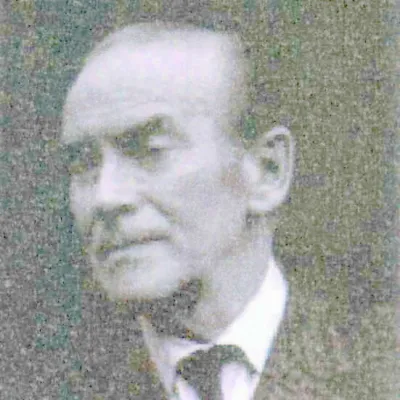
Eugène Canseliet
Human Design Chart
Biography
He was the only student of the mysterious alchemist known as Fulcanelli, and may have been Fulcanelli himself. He wrote the preface for each of his alleged master's books (Le mystère des cathédrales and Les demeures philosophales).
He died on 17 April 1982 in Savignies.
What does Generator 5/1 mean for Eugène Canseliet?
Generator 5/1 — Design at a Glance
Eugène Canseliet had a vast, enduring source of energy that served as a motor for long-term ventures. As a Generator, he had a strong sacral center, which made him robust and resilient, akin to a workhorse, as long as he had energy for his tasks. However, his design required a specific approach: it was not active initiation but responding to environmental signals that was the key to his effectiveness.
This mechanism created two clear pitfalls. When Eugène Canseliet did things that did not bring him inner joy, he wasted his energy and tended to become exhausted. Conversely, it led to frustration when he was prevented from pursuing his heart project, even though his inner self was still full of drive. His strategy was to wait for impulses and then act only when his gut feeling gave a clear "yes."
Living by this principle, he responded with concrete action to life's signals. This rewarded him with a deep sense of fulfillment and satisfaction. Ignoring this inner guidance and instead trying to force or initiate things without responding led to a persistent feeling of frustration and a lack of energy. His strength, therefore, lay in patiently waiting for the right moment and then responding with full force.
Sacral Authority
Eugène Canseliet proved to be someone who did not make his decisions in his Head Center, but rather through a direct physical resonance. His design featured sacral authority, an inner guidance unique to the Generator type. This greatly simplified his decision-making process, as strategy and inner authority merged into a single mechanism.
The prerequisite for this clear leadership was his open Emotional Center, ensuring that he was not driven by short-term emotional waves. Instead, Eugène Canseliet reacted to external stimuli with an immediate gut feeling. This manifested in physical sounds like grunting or a confirming "Mhm" when his inner motor kicked in. When he felt this vital energy and enthusiasm, he knew he was on the right path. He lived to dissolve himself in activities with joy and satisfaction, without an external goal dictating his motivation.
Additionally, his activated Spleen Center served as a supportive instance. In conjunction with the Sacral Center, this allowed for quick, spontaneous reactions. Eugène Canseliet thus had immediate access to his instinctive perception and physical well-being. He reliably followed these deep, physical signals, which allowed him to remain action-ready in the present moment, rather than getting stuck in analytical deliberations.
The 5/1 Profile — Heretic / Investigator
Eugène Canseliet showed himself to be someone who initially developed his profound insights in secrecy before making them available to others. His design as a 5/1 Profile combined the intense, private research of Line 1 with the later, almost magnetic emanation of Line 5, which drew others to his treasure trove of knowledge. Line 1 fostered a dedication in secrecy, where experience in the here and now and creative effort were at the forefront, even without immediate recognition. This created a solid foundation on which he could utilize his potential.
However, Line 5 brought the challenge of positive projection: Others often sought him out for solutions to their problems, which could lead to a great burden if no clear boundaries were set. Similar to a scientist who is exhausted after long conferences because he constantly answers questions, Eugène Canseliet had to learn to say no to preserve his energy. The philosophy of Line 5 emphasized that ideas are only accepted if they are valuable to the general public, and often protected this by writing books and avoiding direct, exhausting contacts. Thus, he could maintain the balance between his private research and problem-solving for others by optimally using his gifts without exhausting himself.
Single Definition — Defined & Open Centers
Eugène Canseliet was someone with a deeply rooted, unshakable self-identity and a clear sense of his life direction. His defined G Center gave him the ability to love himself and show this stability to others without being dependent on their confirmation. He possessed a natural authority that allowed him to show new paths without needing to push others.
This inner strength was supported by his defined Heart Center, which gave him willpower and control over his resources. Canseliet could keep promises and worked best autonomously, setting his own rhythm. His energy source came from his defined Sacral Center, which provided a constant, vital force. However, this energy only became effective when he responded to external impulses and not when he initiated them; a positive response from his gut area ensured him the necessary endurance and satisfaction. Additionally, he had a defined Spleen Center, which gave him spontaneous, intuitive body intelligence. He could perceive in the present moment what was healthy and correct, and trusted these subtle warning and confirmation signals of his immune system and instincts.
At the same time, Canseliet was exposed to constant conditioning through his open centers. His open Head Center made him vulnerable to mental pressure waves and confusion when he tried to find answers that did not come from him. He tended to get entangled in questions that belonged to others and sought inspiration to relieve this pressure. His open Ajna Center allowed him to be flexible with concepts but made him feel unsure when he did not have clear, logical answers.
His open Solar Plexus absorbed the emotions of his environment, leading him to experience foreign moods as his own and to avoid confrontation out of fear of rejection. He had to learn not to personalize these emotional waves. Finally, his open Root Center took on the stress and adrenalized pressure from the environment. This could lead to a feeling of restlessness and an attempt to release this pressure through hyperactivity, even though it did not originate from him. Canseliet had to recognize that this pressure was not his own to avoid falling into a cycle of exhaustion.
Channels for self-acceptance, instinctive strength and caring values.
Eugène Canseliet showed a fundamental orientation based on deep self-acceptance and the ability to live his unique qualities without external validation. This alignment came from the Channel of Exploration 34-10, connecting the Sacral Center with the G Center. Gate 34 provided the inner strength to hold onto personal convictions, while Gate 10 initiated behavior from the deepest inner self to honor himself. This allowed Eugène Canseliet to react authentically and through this reaction, encourage others to find their own self-love rather than imposing his values.
At the same time, he had a sharp sense of what the community or the 'tribe' was missing. The Channel of Devotion 44-26 connected the instinctive Spleen Center with the willful Heart Center. Through Gate 44 (Awareness) and Gate 26 (Egoist), he could intuitively recognize which products, ideas, or ideologies represented an improvement and convey them persuasively. He acted not only out of altruism but also with the clear expectation of being rewarded, using his willpower to move the tribe to his benefit.
This entrepreneurial and instinctive side was complemented by the Channel of Preservation 27-50, connecting the Sacral Center with the Spleen Center. Gate 27 (Care) and Gate 50 (Values) created an aura of trust that attracted others for support. Eugène Canseliet naturally understood that true care begins with taking care of oneself correctly before helping others. He took responsibility for maintaining and nurturing values and structures, always mindful that only the healthy and strong can effectively nourish others.
Additionally, prioritized gates shaped his essence: Gate 46 emphasized dedication to the process and the care of the body as a temple, while Gate 25 promoted mystical innocence and individualization. Gate 11 helped with a harmonious assessment of the situation before acting, and Gate 12 brought a transformative, poetic quality to communication. On the personality side, Gate 9 with its love for detail work and perfection, and Gate 14, which skillfully handled power and direction to maintain influence and wealth, were influential.
Tribal Circuitry — Circuit Signature
Eugène Canseliet was someone who radiated a deep, inner strength and individuality. His design was marked by a simple definition that connected all defined centers – G Center, Sacral, Spleen, and Heart Centers – in a single, continuous energetic flow. This created a coherent, unbroken experience of himself.
The Centering Circuit worked through the Channel of Exploration (10-34). It connected the Sacral Center directly with the Identity Center. This connection gave him a pulsating, creative energy and fostered a strong self-esteem and firm convictions. Since the Throat Center was missing, these inner certainties often remained unspoken but strongly influenced his inner self.
Parallel to this, energy flowed in the Ego Circuit. Here, the Channel of Devotion (26-44) connected the Heart with the Spleen Center. This supported him in cooperation and the joint creation of resources. It was about mutual support and a good balance between giving and taking, with the absence of the Sacral Center in this specific circuit requiring periods of rest for resource regeneration.
The Protector Circuit completed the picture. Through the Channel of Preservation (27-50), it connected the Sacral with the Spleen Center. This brought instinctive, primordial energies into play, oriented towards protection, preservation, and care for one's own genetics. Together, these three circuits formed a network that united individuality, cooperative resource creation, and instinctive protection in a single, continuous life energy.
Left Angle Cross of Education 2
Eugene Canseliet revealed himself through his design as someone who found his role as a teacher or mentor, with his focus on the transmission of knowledge and the shaping of others. This orientation stemmed from the structure of the left educational cross, a configuration that implies a deep connection to the process of learning and teaching. For Eugene Canseliet, this meant that his life energy often flowed in the direction where he not only understood content himself but also structured and made it comprehensible to others. It was not just about information, but a transformative transmission aimed at expanding the consciousness or abilities of the other. His way of expressing or acting was marked by the intention to bring order to complex matters and make them accessible to others. This created a dynamic relationship between him and his environment, in which he acted as a source of clarity and guidance. The mechanics of this cross emphasized the importance of method and didactic approach, which led Eugene Canseliet to always seek ways to transmit knowledge as effectively as possible. His work was thus closely tied to the idea of education and personal development through targeted guidance, making him a figure who found their natural expression in the role of educator or advisor.
Saturn Return · Uranus Opposition · Chiron Return · 2nd Saturn Return — Life Cycles
Eugene Canseliet lived a life marked by recurring, structural cycles where inner maturation met outer upheavals. His design showed a sequence of phases that combined stability with sudden changes. The first Saturn return marked a turning point for him, where early impulses crystallized into concrete, sustainable structures. This was not just a transition, but a condensation of his identity, allowing him to take responsibility for his path.
Later came the Uranus opposition, a phase often felt as crisis, in which, however, old bonds and habits were questioned. For Eugene Canseliet, this meant a necessary release from what limited him to give space to new freedoms. This unrest was not a mistake, but an integral part of his growth, forcing him to reorient himself.
The Chiron return around the age of 50 marked the bloom of his incarnation purpose. Here it was shown that his life path gained meaning; the previously gathered experiences wove into a coherent whole. It was the time when he fully experienced his true purpose in life, if he had followed his inner authority. The second Saturn return crowned this development. It confirmed the achievements of the previous decades and gave his life a final, stable form. Eugene Canseliet did not passively go through these cycles, but they shaped the architecture of his existence, offering him new foundations for his existence again and again.
Generator · Sacral Authority — Synthesis
Eugene Canseliet lived deeply rooted in his sacral drive (Generator type, Sacral Authority), which carried him through life as long as he pursued activities that truly fulfilled him. The connection of Sacral Center and G Center through the Channel of Exploration (34/10) points to a deep inner strength that drove him to understand himself and find his own direction. This understanding was reinforced by the Line 5/1 in his Profile, making him a knowledge gatherer and problem solver for others – a hero who always sought new challenges to deepen his knowledge.
A central paradox in his design lay in the tension between this inner driving force and the need to set boundaries. The ability to guide others and offer solutions carried the risk of getting lost in endless explanations and demands (5/1 Profile), while the open Emotional Center made him vulnerable to external influences. Thus, there was a play between the need to share his energy and self-care to maintain inner balance and not lose his defined identity (defined G Center).
3 Defined Channels
Incarnation Cross - Left Angle Cross of Education 2
Solar Return
The Solar Return shows the moment when the sun returns to its exact birth position - your personal solar year.
Life Cycles
Discover the life cycles with a detailed triple view (birth chart, cycle chart, composite).
Human Design Profile
- Type
- Generator
- Strategy
- To respond - wait for something to respond to
- Authority
- Sacral Authority
- Profile
- 5/1 - Heretic / Investigator
- Definition
- Single Definition
- Incarnation Cross
- Left Angle Cross of Education 2
- Date of Birth
- 18.12.1899 20:00
- Place of Birth
- Sarcelles, France
Frequently Asked Questions
What is the Human Design type of Eugéne Canseliet?
What profile did Eugéne Canseliet have?
What authority did Eugéne Canseliet have?
What incarnation cross did Eugéne Canseliet have?
When was Eugéne Canseliet born?
Discover your own Human Design
Are you also a Generator? Find out in a personal reading how to use your sacral energy correctly and discover deep satisfaction.
More Personalities
Back to overviewAaliyah

Alexia

Angèle

Anne-Marie

Arcángel

Arno