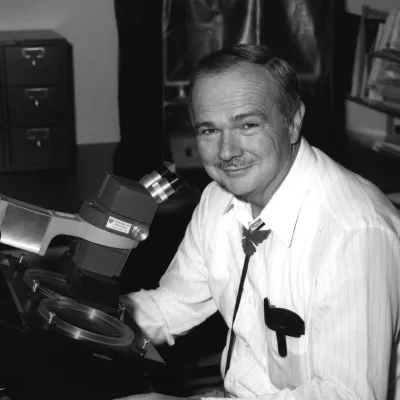
Eugene Shoemaker
Human Design Chart
Biography
Shoemaker was well known for his studies of terrestrial craters, such as Barringer Meteor Crater in Arizona. Shoemaker was also the first director of the United States Geological Survey's Astrogeology Research Program.
He has the distinction of being the first person to have a lunar burial as his ashes were aboard NASA's Lunar Prospector which crashed into the earth's Moon on 31 July 1999 at 04:52 AM CDT at a speed of approximately 3,800 mph. He had always wanted to make a space shot with the astronauts but died in a car accident on 18 July 1997 in Alice Springs, Australia, aged 69.
Human Design Analysis: Eugene Shoemaker as Generator 1/3
Generator 1/3 — Design at a Glance
Eugene Shoemaker revealed himself as someone who did not release his power through spontaneous initiatives but rather through patient waiting for inner signals. As a Generator, he had an enormous, sacral energy base that enabled him to have great endurance – comparable to a workhorse that only effectively uses its strength when it has a clear direction. His life strategy involved not taking the first step himself but reacting to impulses from the outside world. Only when his inner self signaled a clear "yes" did he act. This gut reaction was the key to his effectiveness.
If he initiated something on his own or pursued tasks that did not resonate internally, he fell into the typical trap of frustration and wasted energy. His design was set up to experience deep satisfaction through consistent reactions to life's offerings. However, when he was prevented from pursuing his heart's project, even though his inner energy was still present, he suffered. The balance between endurance and listening to the sacral signal determined his success. Only in harmony with this reactive pattern did he avoid burnout and find the consistent fulfillment that is reserved for his energy type.
Sacral Authority
Eugene Shoemaker revealed himself as a Generator, whose decision-making was marked by Sacral Authority. This inner guidance was not just a strategy for him, but the central instance that determined his daily life. His authority carried the defined Sacral Center, which functioned as a motor and responded to external stimuli with immediate physical signals. These reactions manifested as an inner voice or a noticeable surge of energy, often audible as grunts, hums, or a confirming "Mhm." Such signals marked the moment when he felt vital and energized, ready to dive into his tasks with great enthusiasm.
Especially relevant was the support from the Spleen Center. As this center was activated and connected to the Sacral Center, Eugene Shoemaker possessed a quick, instinctive perception. This allowed him spontaneous reactions and decisions that directly stemmed from his physical well-being and intuition. He reliably followed these inner impulses, enabling him to act without compulsive purposefulness. The combination of powerful Sacral Authority and quick Spleen intuition created a lifestyle in which he immersed himself in his tasks through joy and satisfaction, driven by an apparently inexhaustible energy source that showed itself as soon as he encountered the right topic.
The 1/3 Profile — Investigator / Martyr
Eugene Shoemaker revealed himself as someone who felt compelled to validate theoretical knowledge through practical experience. His design as a 1/3 Profile – the Researcher and Experimenter – established that his life revolved around a cycle of learning, trial, and error. Line 1 drove him to critically examine and question inspirations, wondering if they were truly new or merely repeating old patterns. This often created a tension: he wanted to distinguish himself and provide individually vetted insights, yet he sometimes feared taking the step to implement them until he felt he knew enough.
At the same time, Line 3 demanded experimentation. For him, errors were not failures but essential teachers. Only through this practical testing could he judge whether something was truly "right." His judgment was then considered absolutely trustworthy, as it was both intellectually and empirically secured.
Additionally, the energy of the third line of Gate 19 influenced him. It brought a natural sensitivity to relationship and resource questions. For Eugene Shoemaker, it was important to observe the productivity and contribution of people in his environment. It was not about superficial contacts but about mutual dependence and the question of who truly contributed to the common good of the "tribe." His vigilance thus extended to both the quality of his own ideas and the reliability of his allies.
Triple Split Definition — Defined & Open Centers
Eugene Shoemaker revealed himself as someone with a deeply rooted, reliable identity and a clear inner compass. His defined G Center gave him a stable self-worth and the ability to love others without being dependent on them. This inner security contrasted with his open mental structure: The undefined Head and Ajna Centers made him susceptible to external inspirations and mental confusion. He tended to lose himself in the thoughts of others or solve false problems instead of trusting his own direction.
His energy source was the defined Sacral Center, which provided him with a constant, vital force. As a Generator, his strategy was not to initiate but to react to life. Only through an affirming sacral response could he correctly deploy his energy; initiating on his own risked frustration and resistance. This responsiveness was supported by his defined Heart Center, which gave him willpower and the ability to keep promises and seek recognition for his work. He preferred to be his own boss to maintain his inner rhythms between work and rest.
The connection between Root and Spleen Centers fostered a strong survival awareness and the ability to transform existential pressure into spontaneous, healthy decisions. His defined Throat Center served as a pivot point to translate these inner energies – whether from the Heart, Spleen, or Sacral – into clear communication and action. However, he was vulnerable emotionally due to the open Solar Plexus Center. It absorbed the moods of the environment, which led him to avoid emotional confrontations out of fear of rejection. His challenge was not to personalize the absorbed emotions as his own but to view them as external weather, while relying on his sacral authority and his inner direction in the G Center.
Channels for clarity, instinctive strength and mature growth.
Eugene Shoemaker revealed himself through a deep connection to life cycles and the process of maturation. His design indicated that he did not view experiences in isolation but rather as part of an ongoing process that generated wisdom through reflection. This was marked by the maturation channel 42-53, which connected the Root Center with the Sacral Center. This connection drove him to begin new cycles, complete them fully, and then reflect on the insights gained to draw lessons for the future.
At the same time, he possessed an instinctive awareness and the ability to recognize the needs of his environment before they became consciously known. The channel of devotion 44-26 connected his Spleen Center with the Heart Center. This gave him a sense of what resonated with the "tribe" or his target audience, as well as the willpower to deliver solutions that were perceived as improvements. He used this intuitive intelligence to present his messages or products persuasively.
Another defining aspect was his ability to be present in the moment and radiate clarity through his own behavior. The channel of awakening 10-20 connected the G Center with the Throat Center. He spoke for himself and expressed an inner self-love and acceptance that inspired others to be themselves as well. Through this authentic presence, he avoided resistance and created genuine connections.
Additionally, gates like 24 (mental mutation and renewal) and 19 (resources and territory) influenced him, suggesting a process of constant transformation and a search for security. Gate 33 further promoted the need for withdrawal to reflect on experiences. These configurations together formed a person who worked through cyclical learning, instinctive selling, and authentic presence.
Individual Circuitry — Circuit Signature
Eugene Shoemaker's Human Design profile established a tendency towards separate, parallel operating energy fields. As a Triple-Defined individual, he had three independent energy streams that did not merge but existed alongside each other.
The first stream, the Purpose Circuit, connected the Sacral Center to the Root Center through Channel 14/22. This generated a cyclical emotional wave that focused on the past. Instead of cool logic, it was about reflecting on past experiences to learn collectively. The energy rose and fell in waves, driven by the need to share felt insights.
Parallel to this, the Ego Circuit connected the Heart Center to the Spleen Center. Channel 17/22 promoted cooperation and the joint creation of resources. Since this circuit did not connect to the Sacral Center, it lacked a constant life force; instead, it required pauses for regeneration to maintain material support and mutual aid within the collective.
The third field was Integration, which linked the Throat Center to the Identity Center. Channel 2/3 allowed drawing power from reactions to life and directing it through intuitive knowledge in the present moment. This served to secure one's survival through the highest individuality and self-empowerment.
These three separate systems – emotional processing of the past, cooperative resource creation, and individual self-preservation – shaped Eugene Shoemaker's experiential world as distinct, non-overlapping forces.
Right Angle Cross of the Four Ways 1
Eugene Shoemakers Design was marked by the imprint of the right cross of the four paths. This configuration described a fundamental attitude that was characterized by a deep, often unspoken connection with life itself. It was not about actively seeking meaning, but rather an inner certainty that acted as a constant companion.
The right cross of the four paths is a rare geometric structure in the Human Design system. It arises from the connection of specific gates and channels, touching on themes such as love, death, and the acceptance of the life cycle. In the right cross, the focus lies on experiencing life as a gift. This energy promoted an attitude of gratitude and trust in the natural flow of things. It helped to see difficulties not as personal attacks, but as part of a larger, unchangeable pattern.
For Eugene Shoemaker, this meant an inner stability that worked independently of external circumstances. The configuration supported the ability to accept life in its entirety without constantly evaluating or changing it. It was a quiet force that helped him experience his own existence as part of a larger whole. This imprint acted as an inner compass, guiding him to a state of calmness and empathy. It anchored him in the present and allowed him to feel the beauty and challenges of existence with equal intensity.
Saturn Return · Uranus Opposition · Chiron Return · 2nd Saturn Return — Life Cycles
Eugene Shoemaker showed himself to be someone who, in phases of intense change and later confirmation, strengthened his role. In 1969, at the age of 41, he was the chief scientist of the Apollo-11 mission. This fell during his Uranus opposition, an aspect often associated with sudden turns or breaking through old structures. For his design, this moment marked a peak where innovative energy crystallized into concrete, visible results. The opposition to Uranus often demands adapting to new, unexpected circumstances; here this dynamic manifested as professional success.
A defining chapter began in 1980, when he was elected to the National Academy of Sciences at the age of 52. This coincided with his Chiron return, a cycle of fulfillment and bloom. In Human Design mechanics, this return point signals not healing, but the maturation of individual purpose. If one's strategy and authority are lived, the meaning of the incarnation cross becomes experiential. Shoemaker's acceptance into the Academy highlighted this phase: what he had built over years now found institutional recognition and confirmation. It was the moment when his life's work reached its full significance and proved meaningful, without any talk of overcoming suffering, but rather of realizing potential.
Generator · Sacral Authority — Synthesis
Eugene Shoemaker was a Generator whose life was marked by an unstoppable drive for experience and the resulting understanding. His sacral center and the associated authority (sacral authority) drove him to listen to his inner reactions and find energy for tasks that truly fulfilled him. This ability to listen to the body and surrender to the vital life force corresponded with his profile as a researcher and experimenter (1/3), who constantly sought new insights and verified them through practical application. The awakening channel (Gate 10/20) indicates that he fully savored the present moment and translated principles into action.
A central tension field in his design lay in the combination of the open emotional center and the perception circuit. While he felt into things through his sacral reaction, he was also able to reflect on past experiences and draw meaning from them (meaning-making circuit). This ability to live in the here and now as well as process the past led to a cyclical dynamic in which he learned from experiences and shared these insights – a pattern that was evident in documented successes.
3 Defined Channels
Incarnation Cross - Right Angle Cross of the Four Ways 1
Solar Return
The Solar Return shows the moment when the sun returns to its exact birth position - your personal solar year.
Life Cycles
Discover the life cycles with a detailed triple view (birth chart, cycle chart, composite).
Human Design Profile
- Type
- Generator
- Strategy
- To respond - wait for something to respond to
- Authority
- Sacral Authority
- Profile
- 1/3 - Investigator / Martyr
- Definition
- Triple Split
- Incarnation Cross
- Right Angle Cross of the Four Ways 1
- Date of Birth
- 28.04.1928 11:56
- Place of Birth
- Los Angeles, CA, United States
Frequently Asked Questions
What was Eugene Shoemaker's Human Design type?
What Profile did Eugene Shoemaker have in Human Design?
Which Authority guided Eugene Shoemaker?
What incarnation cross did Eugene Shoemaker have?
When was Eugene Shoemaker born?
Discover your own Human Design
Are you also a Generator? Find out in a personal reading how to use your sacral energy correctly and discover deep satisfaction.
More Personalities
Back to overviewAaliyah

Alexia

Angèle

Anne-Marie

Arcángel

Arno