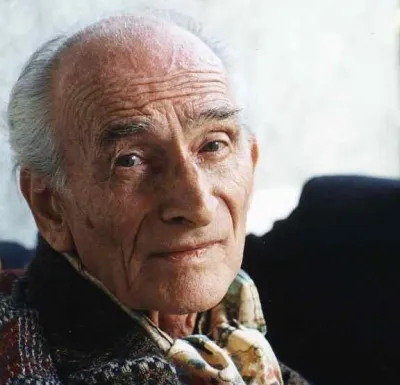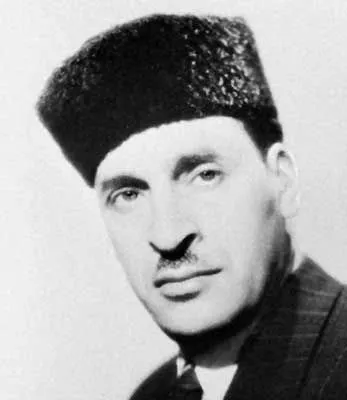
Ferhat Abbas
Human Design Chart
Biography
An influential figure in the Young Algerians, Abbas initially advocated for equal political rights for Algerian Muslims in France and for the granting of French citizenship for Algerian Muslims. Over time, he became a revolutionary Algerian nationalist.
Ferhat enjoyed soccer, horseback riding, and reading, in particular, Victor Hugo and Sophocles. He married Marcelle Stöetzel, an Algerian-born French national on 17 September 1945. Halim was their only child, a son. He died on 24 December 1985 at age 86 in Algiers.
What does Manifesting Generator 2/4 mean for Ferhat Abbas?
Manifesting Generator 2/4 — Design at a Glance
Ferhat Abbas showed himself to be someone who possessed a hybrid energy structure: the constant power of a Generator paired with the lightning-fast execution speed of a Manifestor. His design suggested that he could skip steps and work on multiple projects simultaneously, giving him a unique pace. This ability only felt satisfying when it was based on clear inner consent.
As a Manifesting Generator, Ferhat Abbas had a defined Sacral Center that provided him with steady energy. The crucial mechanism involved not initiating himself but responding to external impulses. Only when his Sacral Center responded with a clear "Yes" should he act. This strategy was essential to avoid frustration – the central theme of his non-self. Without this alignment, his speed tended to skip important stages or drive him into chaotic multitasking, quickly leading to exhaustion.
However, when Ferhat Abbas reacted to impulses and sought confirmation from his inner authority, he entered a productive play mode. Then parallel working was not an obstacle but a source of deep satisfaction. His design challenged him to channel his immense speed through conscious reaction rather than acting blindly. This way, he could use his creative power without being overwhelmed by his own efficiency. The balance lay in being fast only where life actually queried him and he responded with enthusiasm.
Sacral Authority
Ferhat Abbas exhibited a basic attitude based on physical resonance: He did not react through logical planning but allowed himself to be guided by inner signals. His design cast him as a Generator with defined Sacral Authority – the only type where strategy and internal decision-making are identical, greatly simplifying his process. A prerequisite for this was an open Emotional Center, meaning he did not make immediate emotional judgments but waited for clear physical responses.
This response appeared as a "gut feeling" or surge of energy triggered by external stimuli. Ferhat Abbas learned to pay attention to sounds like grunts, hums, or an affirming "mm-hm." When his Sacral Motor engaged, he felt vital and alive; he had virtually inexhaustible energy at his disposal. He tackled his tasks with great enthusiasm and immersed himself in them without the need for a specific purpose.
This instance was supported by his activated Spleen Center. This connection allowed for quick, spontaneous reactions and decisions. Ferhat Abbas had immediate access to his physical well-being and instinctive perception. He reliably followed this inner compass rather than falling into analytical deliberations. The joy in the act itself, detached from external goals, characterized how he moved through life.
The 2/4 Profile — Hermit / Opportunist
Ferhat Abbas showed himself to be someone whose life rhythm was marked by a clear alternation between withdrawal and connection. His design laid an inner tension: On the one hand, there was a strong need for solitude to find peace; on the other hand, he longed for intimacy with familiar people. This dynamic stemmed from his Profile 2/4, the natural talent and networker.
Line 2, the Hermit Line, brought natural shyness and the building of protective walls. Ferhat Abbas needed these withdrawal spaces to process internal processes and gain clarity. Without this space, he could not act effectively. Only when this need for isolation was satisfied did Line 4 come into play. This networker line pushed towards community and exchange with his personal environment.
The challenge for him lay in transparently communicating this alternation: "Now I am here" versus "I need space." When he clearly signalled this, misunderstandings were avoided. In the subsequent solitude, he reflected on the knowledge from his network. This process of condensation in silence allowed him to develop brilliant ideas and later share them with others again. Thus, the initial reticence through Channel 59-2 transformed into a focused, powerful presence as soon as the inner call for connection arose.
Single Definition — Defined & Open Centers
Ferhat Abbas was characterized by a design based on inner reliability and reactive power. His defined G Center gave him a firm identity and a clear sense of direction in life; he knew who he was and where it led him, without needing external confirmation. This inner security was fueled by his defined Sacral Center, an inexhaustible energy source that only worked effectively when responding to external stimuli rather than initiating action on its own. His actions and voice, guided by the defined Throat Center, were thus expressions of this sacral validation and intuitive Spleen definition, allowing him to distinguish between healthy and harmful in the moment.
This stable inner structure contrasted with his open centers: Head, Ajna, Heart, Solar Plexus, and Root were undefined. Here lay his vulnerability to conditioning. Without constant mental inspiration or emotional waves of his own, he tended to absorb mental pressure and uncertainties from his environment. He could get entangled in issues that weren't his concern or experience foreign emotions as his own, leading to inner confusion. The stress of others also directly affected him since he lacked a Root Center's own pressure but absorbed it from the surroundings. The challenge was not to fall into external patterns of haste or emotional ups and downs but to use his intuitive Spleen knowledge and reactive Sacral power as filters. Thus, he could remain what he was: someone with a clear voice and identity who didn't need to prove himself through willpower or mental control but by authentically reacting to life.
Channels for authentic action, charisma and caring preservation.
Ferhat Abbas showed himself as someone whose mere presence inspired others. His design tended towards natural leadership that did not rely on persuasion, but rather the ability to simply be himself. This aura protected him from resistance and invited genuine invitations from others due to their perception of his inner clarity.
This dynamic resulted from the Awakening Channel 10-20, connecting the G Center with the Throat Center. Through the Presence Gate (10) and Now Gate (20), he expressed wisdom that self-love and self-confidence are pillars of an awakened life. By accepting and embracing each moment, he lived a subconscious behavioral code helping him interact successfully with others. His existence as 'I am!' was so powerful it encouraged others to live their own authenticity often without his conscious effort.
Additionally, the Exploration Channel 34-10 shaped his attitude by connecting the Sacral Center (Power Gate 34) with the G Center (Self Behavior Gate 10). This configuration reinforced him following his convictions and not being distracted by external conditioning. His sacral reaction allowed him to express this independence in satisfying ways. Through his authentic life, he demonstrated the advantage of completed self-love and encouraged others to connect with their own beliefs.
The Charisma Channel 34-20 complemented this by channeling the generative power from Gate 34 directly into expression in the Now (Gate 20). This gave him charismatic energy enabling prolonged activity as long as he listened to his inner guidance and wasn't led by the mind.
Finally, the Preservation Channel 27-50 connected the Sacral Center (Care Gate 27) with the Spleen Center (Values Gate 50), giving him the ability to take responsibility and nourish others based on his own sacral reaction. He intuitively understood that care starts by properly taking care of oneself – a form of 'enlightened selfishness' keeping him healthy and strong to support others.
Individual Circuitry — Circuit Signature
Ferhat Abbas acted through deep inner firmness and a strong desire to protect his environment. His design connected the Sacral Center with the Identity Center (Channel 10-34) in the Centering Circuit, creating pulsating, individualistic energy: 'I am as I am'. Since this circuit did not connect to his Throat Center, these strong inner convictions often remained unspoken; they showed through presence rather than words.
Parallel to this, the Protector Circuit connected the Sacral Center with the Spleen Center (Channel 27-50), adding primordial instincts: protection, care, and preservation of family or genetics. The energy was less outwardly communicative but worked by creating a protected space for himself and loved ones.
Additionally, he integrated power from reactions to life (Gate 34) with proper behavior (Gate 10) and intuitive knowledge (Gate 57), realizing these in the Now (Gate 20) – connected through channels to the Throat Center. This integration strengthened his self-validation and highest individuality. Together, these circuits shaped a person radiating courage and strong convictions but channeling their power primarily into securing the inner world and protecting genetic lineage rather than verbal exchange with the outside world.
Right Angle Cross of the Sleeping Phoenix 3
Ferhat Abbas had the Human-Design configuration of the right cross of the sleeping Phoenix. This established an internal structure that did not rely on constant linear activity but rather on the ability to start anew from deep crises or breakdowns. His design contained archetypal potential for cyclical renewal and rebirth – often in a state of latency or waiting.
The power of this pattern lay not in continuous action, but in profound transformation after the 'death' of old structures. Ferhat Abbas was marked by energy phases that could be interrupted by periods of rest or failure, which were necessary to generate new impulses. This dynamic required that the old had to be completely dismantled before something new could emerge. This mechanism meant that his life force often only fully unfolded after difficult turning points or setbacks. The 'sleeping' in this configuration's name refers to the fact that this potential was not always visibly active but lay deep and only awakened at certain times. Ferhat Abbas thus lived with an internal rhythm that required pauses and new beginnings as integral parts of his development, rather than a steady flow.
Saturn Return · Uranus Opposition · Chiron Return · 2nd Saturn Return — Life Cycles
In 1956, at age 57, Ferhat Abbas showed himself to be someone who redefined his position within established structures. His transition to the National Liberation Front (FLN) marked the peak of his second Saturn Return phase. This cycle no longer just tested personal discipline but the ability to anchor responsibility in larger collective systems.
The mechanics of this period demanded a maturity test: The lessons of the youth phase were integrated into a stable, long-term stance. It was about whether one blindly submitted or found a mature definition of duty. Ferhat Abbas chose the path of institutional anchoring through active engagement for higher collective order. His design suggested that structure and responsibility fulfillment should be understood not as compulsion but as an answer to the Saturn lesson. The step towards FLN was thus not just a career change, but the concrete formulation of his inner authority in dealing with power and community. He no longer sought isolated truth but binding order that carried his mature view on responsibility. This moment condensed years of groundwork into sustainable political action based on seeking stability and meaning within a larger whole.
Manifesting Generator · Sacral Authority — Synthesis
Ferhat Abbas' design reveals a central thread of dynamic self-confirmation. As an Manifesting Generator with defined G-Center and Sacral Authority, he lived a life powered by constant energy that responded to external stimuli (Sacral), but was also marked by strong inner direction and identity (G-Center). The connection through the Awakening Channel indicates that his consciousness and ability to be present in the now were central elements of his personality. This combination of reactive energy and inner guidance allowed him to act authentically and express his convictions powerfully – a dynamic visible in his engagement for social change.
A central paradox in Ferhat Abbas' chart lies in the tension between the need for solitude and connection with community (Profile 2/4). While he sought moments of internal reflection and withdrawal through Line 2, Line 4 drew him to active participation in social life and exchange with others. This interplay between isolation and connectedness shaped his character and required a constant balancing of different needs. The ability to think independently as well as integrate into networks was thus a defining characteristic of his life path.
4 Defined Channels
Incarnation Cross - Right Angle Cross of the Sleeping Phoenix 3
Solar Return
The Solar Return shows the moment when the sun returns to its exact birth position - your personal solar year.
Life Cycles
Discover the life cycles with a detailed triple view (birth chart, cycle chart, composite).
Human Design Profile
- Strategy
- To respond - wait for something to respond to
- Authority
- Sacral Authority
- Profile
- 2/4 - Hermit / Opportunist
- Definition
- Single Definition
- Incarnation Cross
- Right Angle Cross of the Sleeping Phoenix 3
- Date of Birth
- 24.08.1899 16:00
- Place of Birth
- Taher, Algeria
Frequently Asked Questions
What is Ferhat Abbas' Human Design type?
What profile did Ferhat Abbas have in Human Design?
What authority did Ferhat Abbas have?
What incarnation cross was assigned to Ferhat Abbas?
When was Ferhat Abbas born?
Discover your own Human Design
Are you also a Manifesting Generator? Find out in a personal reading how to unfold your multi-talents and direct your energy wisely.
More Personalities
Back to overviewAldair

Alizée

Angeli

Arletty

Artus

Balthus