
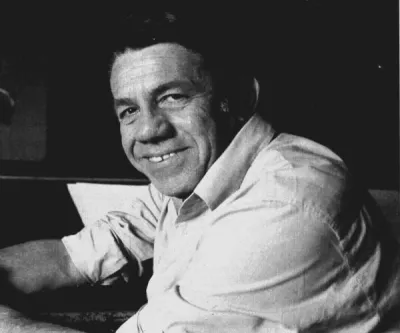
Ferruccio Amendola
Human Design Chart
Biography
Son of the actors, Federico Amendola and Amelia Ricci, and nephew of director/screenwriter Mario Amendola, he started in films with Gian Burrasca directed by Sergio Tofano and soon began working as a voice-over actor. After years of theater magazines, cinema and TV, in 1968 he began devoting most of his time to voice-over acting.
Amendola is best known as the Italian voice of famous American actors including Al Pacino, Sylvester Stallone, Dustin Hoffman and Robert De Niro in movies as well as Bill Cosby in the television series "The Cosby Show." In addition, he has done voice-over work in commercials and TV dramas with great success.
Married to female voice-over actress Rita Savagnone, he has a son Claudio, who is also an actor.
What does Manifesting Generator 3/5 mean for Ferruccio Amendola?
Manifesting Generator 3/5 — Design at a Glance
Ferruccio Amendola's Design features a hybrid nature: the lightning-fast action capability of a Manifestor combined with the constant energy source of a Generator. This configuration allowed him to skip steps and quickly draw results into his life. Yet, this speed carried a specific risk. If he moved too fast or skipped important stages, he found himself having to backtrack and fill in gaps – an experience that often led to frustration, which is the central non-self theme for this type.
Furthermore, his Design tended to respond simultaneously to numerous impulses and start multiple projects at once. Without inner consent, this multitasking ability could quickly lead to exhaustion. Ferruccio Amendola's strategy therefore did not lie in initiating but rather in responding: He waited for an internal impulse and checked whether his Sacral Center responded with a clear "yes". Only when this inner authority gave its approval would his energy become effective.
Under these conditions, he found access to deep satisfaction in creation. Rather than limiting himself to one task that might bore him, he thrived in a "play mode." Variety and the joy of the process were essential for him to maintain his creative power. Thus, his Design showed: Successful action did not arise from rigid planning but through playful, impulse-led navigation between various interests, as long as inner resonance was maintained.
Emotional Authority
Ferruccio Amendola's Human Design profile established a decision-making ability that suffered under emotional waves and required strategic hesitation. His inner authority was Emotional Authority, carried by the defined Emotional Center. In Human Design mechanics: If this center is activated, it always functions as an authority, independent of other definitions in the chart.
This center was subject to constant emotional waves with continuous ups and downs of feelings. The world appeared to Ferruccio Amendola always colored by his current mood. One moment could totally inspire him, while the next made the same thing seem negative. His feeling in the moment was however only a snapshot, not an absolute truth picture. Quick, spontaneous decisions based on this emotion often had negative consequences.
The mechanics required patience and consciously taking time as protection against impulsive mistakes. The more Ferruccio Amendola took his time, the deeper he could see. This meant sleeping over decisions multiple times and letting himself be properly cautious. Over time, intense feelings subsided, emotional distance gained strength, clarity and calmness set in. Only then was the decision-making process complete. This mechanism was particularly relevant for long-term, life-defining decisions, as it ensured that not just the temporary mood but the deeper emotional truth guided the way.
The 3/5 Profile — Martyr / Heretic
Ferruccio Amendola's Design was characterized by the dynamism of Profile 3/5, the "Experimenting Hero". His basic attitude was marked by radical skepticism: he believed nothing until he had experienced and tested it himself. This line of experimentation drove him to acquire knowledge not theoretically but through personal trial – and the associated errors.
This process of adaptation through trial and error was essential for him to achieve self-sufficiency. Only after this intensive phase of learning from failures could his Design utilize the acquired knowledge to offer solutions to others. Line 5 projected an attractive, heroic presence onto him; those around him saw in him a rescuer or storyteller with practical answers.
This projection flattered his nature but also created a specific tension. As he experimented publicly, failure before others' eyes was an integral, though painful, part of his learning process. The expectation of immediate solutions from others often clashed with his own timing for experience gathering. Ferruccio Amendola lived this dialectic: he had to first distance himself and prove himself independently before he could share his wisdom. His charisma did not stem from perfect planning but from the authenticity of a person who found practical truth through their own mistakes. This made him approachable for others seeking knowledge, as they saw in his experiences an opportunity to order their own confusion.
Split Definition — Defined & Open Centers
Ferruccio Amendola revealed himself as someone with a massive, defined energy foundation. His truth lay in reacting to life rather than initiating it. The defined Sacral Center gave him constant vitality; he had a daily supply of energy that he used through affirmative responses. Parallel to this, the defined Root Center determined his way of dealing with stress and provided physical pressure for him to move forward.
His expression was clear and reliable, carried by the defined Throat Center. This allowed him to put inner processes into the world as long as he did not make promises from his open Heart Center or try to prove his worth. The open Heart Center made him vulnerable to the pressure of legitimizing himself through willpower; if he tended to do more than necessary to find recognition, he fell into a cycle of failure and low self-esteem.
Emotionally, Ferruccio Amendola was deeply rooted. The defined Solar Plexus Center functioned as an inner authority: He had to wait for the emotional wave to pass before clarity emerged. Impulsive decisions at the highs or lows of this wave led to confusion. Additionally, the defined Spleen Center provided intuitive knowledge in the present moment; it delivered spontaneous judgments about health and well-being that he needed to trust to stay protected.
The open centers G, Ajna, and Head indicated that identity, mental concept, and inspiration were situational. The open G Center meant no fixed direction; he adapted to his environment and often sought a "borrowed" identity or the right place to find love. The open Ajna and Head Centers allowed him to be mentally flexible but also made him vulnerable to confusion and doubt when trying to answer others' questions or prove himself intellectually rather than trusting his inner authority.
Channels for change, care, finding meaning and emotional expression.
Ferruccio Amendola revealed himself as a storyteller who translated complex mental processes into vivid stories. This ability to inspire and stimulate stemmed from his Personality Sun in Gate 56. It was the so-called "Stop Code," which allowed him to structure abstract thoughts and make collective narratives tangible through voice and presentation. This dominant filter shaped how he carried the deeper subconscious energies of his design outward.
His design contained four defined channels that formed the backdrop for this storytelling power. The Mutation Channel 60-3 connected the Root Center with the Sacral Center. It brought a melancholic, mutative energy that urged evolutionary change. Ferruccio Amendola had to learn to accept limitations and move beyond the confusion of new beginnings in order to make this pulsating on/off energy effective.
The Preservation Channel 27-50 linked the Sacral Center with the Spleen Center. It gave him a strong instinct for caring for his tribe. Through the Gate of Care (27) and the Gate of Values (50), he ensured that traditional structures were protected and the community was provided for. His aura automatically drew trust, as he was ready to take responsibility for others.
The Life Struggle Channel 38-28 connected the Root Center with the Spleen Center. It drove him to find meaning in life through a stubborn fight for individual integrity. Ferruccio Amendola sought battles worth fighting to defend his uniqueness against external distractions.
The Impermanence Channel 35-36 linked the Solar Plexus Center and the Throat Center. It generated an emotional need for new experiences and acceptance of change. Through the Gate of Change (35) and the Gate of Crisis (36), he often moved against restrictive patterns to gain wisdom through direct experience, even if this came with emotional instability.
Individual Circuitry — Circuit Signature
Ferruccio Amendola's Human Design presents two separate, parallel energetic blocks. The Knowledge Circuit connected the Sacral, Root, and Spleen Centers. This configuration generated a pulsing, acoustic energy aimed at mutation and innovation. It drove him to follow his unique path and transform new things, supported by the Channels of Mutation (3-60) and Life Struggle (28-38). In contrast stood the Guardian Circuit, which connected the Sacral and Spleen Centers. Here a timeless, probing energy focused on primal family protection, conservation, and genetics through the Channel of Conservation (27-50). The tension lay between the urge for individual change and the instinctual duty to preserve.
A third, isolated block formed the Meaning Circuit, connecting the Throat Center with the Solar Plexus. Through the Channel of Transience (35-36), this allowed a cyclical, wave-like processing of emotions and past experiences. Ferruccio Amendola used this connection to reflect felt insights from the past and express them through his Throat Center. Since there was no direct link between these three circuits, innovation, protection, and emotional meaning existed as separate, parallel forces in his system.
Right Angle Cross of Laws 2
Ferruccio Amendolas Design was shaped by the energetic structure of the right cross of Laws 2. This configuration placed him in an archetypal framework that relied less on individual whim and more on a deep, structural order. His Human-Design pointed towards alignment with the fundamental principles governing human existence and its development. It was not merely an intellectual concept but a living, energetic reality within his system.
The right cross of Laws 2 represents in Human-Design mechanics the connection between Law and Structure on a very specific level. This indicates that Ferruccio Amendola was destined to embody the laws of life as an integral part of his own existence, not just observe them. His inner architecture followed a pattern emphasizing stability and continuity. This meant constant engagement with what is enduring and unchanging versus what appears fleeting and superficial.
This archetypal structure endowed his design with a certain gravity and seriousness. It called upon him to orient himself along the great lines of human experience. It was an energy seeking clarity and constancy, far from arbitrary decisions or short-term impulses. Thus, Ferruccio Amendola moved within a field defined by clear rules and profound connections, profoundly influencing his entire life path and inner experience.
Saturn Return · Uranus Opposition · Chiron Return · 2nd Saturn Return — Life Cycles
Ferruccio Amendola's career was marked by clear, cyclical turning points that correlated with astrological transits. His design suggested a structure where external planetary influences triggered concrete professional realignments. In 1958, at the age of 28, he experienced his first Saturn return. This transit often marks the time when early efforts crystallize into stable results. For Ferruccio Amendola, this was evident in his participation in television productions "Il gallo canta a mezzanotte" and "L'ultima faccia di Medusa"—a step that solidified his presence in the medium of television.
Ten years later, in 1968 at age 38, the Uranus opposition hit his design. This transit traditionally signifies sudden changes and a need for new freedom or specialization. For Ferruccio Amendola, this energy was expressed through a radical shift: he dedicated himself almost exclusively to synchronization. This was not a gradual transition but a clear focus on a specific skill within his field. The mechanics here show how transits do not just describe internal states but can act as catalysts for external, biographically documented decisions. Ferruccio Amendola responded to the pressure of the Uranus opposition with a clear narrowing of his professional scope, which redefined his career identity in this phase of life.
Manifesting Generator · Emotional Authority — Synthesis
Ferruccio Amendola lived a life marked by an inner dynamic between creative energy and the need for authentic expression. The combination of manifesting generator strategy and emotional authority points to someone who could quickly perceive impulses (Sacral Center), but also needed time to filter these through their emotional wave and direct them into a clear path. This ability to react and then deepen his focus shaped his journey, as he acted spontaneously yet carefully weighed which projects truly aligned with his inner truth. The recurring theme of adaptation (Line 3) and experimentation, coupled with the need to share knowledge (Line 5), indicates a life path characterized by constant development and sharing experiences – a process amplified by the connection between Root Center and Sacral Center.
Central to Ferruccio Amendola's design is the tension field between the drive for individuality and the necessity of defining oneself through relationships. The open G Center signals a lack of fixed identity, making him vulnerable to others' influences while also forcing him to constantly seek validation and direction. At the same time, the defined Root Center points to a strong will to maintain his own integrity and separate from external forces – a paradox that likely repeatedly challenged him to remain authentic without losing connection with others.
4 Defined Channels
Incarnation Cross - Right Angle Cross of Laws 2
Solar Return
The Solar Return shows the moment when the sun returns to its exact birth position - your personal solar year.
Life Cycles
Discover the life cycles with a detailed triple view (birth chart, cycle chart, composite).
Human Design Profile
- Strategy
- To respond - wait for something to respond to
- Authority
- Emotional Authority
- Profile
- 3/5 - Martyr / Heretic
- Definition
- Split Definition
- Incarnation Cross
- Right Angle Cross of Laws 2
- Date of Birth
- 22.07.1930 10:10
- Place of Birth
- Turin, Italy
Frequently Asked Questions
What was Ferruccio Amendola's Human Design type?
What profile did Ferruccio Amendola have?
What authority did Ferruccio Amendola have?
What incarnation cross did Ferruccio Amendola have?
When was Ferruccio Amendola born?
Discover your own Human Design
Are you also a Manifesting Generator? Find out in a personal reading how to unfold your multi-talents and direct your energy wisely.
More Personalities
Back to overviewSissy Spacek

Aldair

Alizée

Anémone

Angeli

Ann-Margret
