
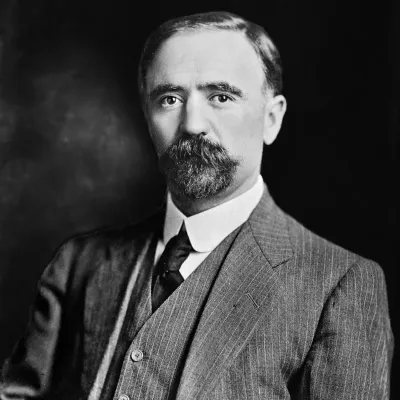
Francisco I. Madero
Human Design Chart
Biography
What does Generator 6/2 mean for Francisco I. Madero?
Generator 6/2 — Design at a Glance
Francisco I. Madero was someone who possessed enormous, enduring strength, comparable to a workhorse ready to tackle tasks. His design as a Generator meant that this energy was released not through spontaneous initiation but through reacting to external impulses. His strength lay in responding to life's signals as soon as his inner center—the sacral center—gave a clear "yes."
This mechanism meant that he was not the one to start projects out of thin air but rather the one who responded to incentives with full power. If he lived in harmony with this strategy by listening to his inner resonance, it led to a deep sense of fulfillment. However, if he was prevented from working on his heart projects or forced to do things he had no interest in, he risked burnout or persistent frustration. The danger always lay in wasting energy on tasks that did not align with his inner truth. His path was marked by the necessity of reacting from the gut rather than initiating. Only in this way could he effectively utilize his intrinsic creative power without falling into a state of exhaustion or energy depletion. This dynamic significantly determined his capacity for action and his well-being.
Emotional Authority
Francisco I. Madero's Human Design configuration indicated a tendency towards emotional wave movements that significantly shaped his perception and decision-making. As a carrier of Emotional Authority, he was subject to constant emotional ups and downs, causing the world to appear through the lens of his current mood. What seemed inspiring in one moment could appear negative in the next. This configuration meant that an immediate emotional impression was only a snapshot, not the final truth.
The mechanics of his inner authority, carried by the defined Emotional Center, required patience. Since the Emotional Center was Francisco I. Madero's authority center, it always took precedence over all other defined centers, regardless of further configurations in his chart. Quick, spontaneous decisions based on current emotions carried the risk of negative consequences. Instead, his design required time to let decisions mature. By repeatedly sleeping on questions and waiting for intense feelings to subside, he gained emotional distance. Only then did clarity and calmness set in. This process was particularly important for long-term decisions that had a lasting impact on his life course. Thus, Francisco I. Madero was someone who found his true inner response by enduring through the emotional wave.
The 6/2 Profile — Role Model / Hermit
Francisco I. Madero's Human Design profile featured a 6/2 line, which described a development from experimental action towards profound wisdom. In his youth, before the Saturn return, this configuration appeared as a 3-line. During this phase, Francisco I. Madero was marked by trial and error. He accumulated diverse life experiences, with retreats following failures serving as a driving principle to learn from his actions.
With the entry into the 6-line phase, around age 30, this dynamic fundamentally changed. Francisco I. Madero metaphorically retreated into a "cave" to look back at his earlier experiments with distance. This period of intense reflection served for healing and fostered deep self-awareness. From this introspective phase, he later emerged as a wise person whose insights attracted others to partake in his life wisdom.
Additionally, the 6-line from Gate 28, which thematised glory and extreme risks, was influential. Francisco I. Madero was prepared to take on great dangers to test whether life was worth it. For him, every risk was a high-stakes gamble where the prize was worth any price. Parallel to this, the 2-line from Gate 33 radiated the ability to reflect. This required withdrawal to process experiences and build future success. Through dedication to higher forces, Francisco I. Madero developed his inner strength, with reflections often forced by external circumstances.
Split Definition — Defined & Open Centers
Francisco I. Madero was characterized by a persistent, specific mental function. His defined Ajna Center ensured that he created concepts and theories in the same way every time, giving him a trustworthy, independent tendency to make decisions based on his intellect. This mental energy flowed directly into his defined Throat Center, allowing him to reliably articulate what he thought. His communication was thus not a spontaneous reaction but the articulation of his conceptual processes.
At the same time, Francisco I. Madero had a fixed sense of self through his defined G Center. He knew who he was and had a sense of direction without being dependent on others. This inner security contrasted with his openness in the Head Center. Since this center was open, he had no consistent way to process inspiration and tended to engage with doubts and questions that were not his own. He could absorb mental pressure from others and get entangled in their confusion rather than trusting his own inner authority.
His Heart Center was also open. Francisco I. Madero was not designed to be willfully strong in the sense of competitive assertiveness. He tended to question whether he was worthy enough and tried to prove it through promises he often could not keep due to a lack of consistent energy. This led to a cycle of self-disapproval when he failed. In contrast, he possessed immense vital energy through his defined Sacral Center. As a Generator, he relied on responding to questions rather than initiating to avoid overextending his energy. His defined Solar Plexus Center also required him to wait out emotional waves before acting to gain clarity. His defined Spleen Center gave him intuitive warning signals in the present, while his defined Root Center provided a consistent pressure to move forward and thrive materially.
Channels for change, meaning, intimacy, power and clarity.
Francisco I. Madero's design inclined him towards deep, pulsating renewal, coupled with a drive to pave new directions for the collective. This configuration described a life task marked by the Channel of the Beat 14-2: Here, the ability to handle material resources skillfully (Gate 14) was combined with higher knowledge (Gate 2) to direct innovative, mutative impulses into a concrete direction. Madero was capable of radiating an empowering aura through his authentic response from the Sacral Center, encouraging others to rediscover their own identity and life purpose.
This energetic foundation was reinforced by the Channel of Mutation 60-3, which promoted evolutionary change through the acceptance of limitation (Gate 60) and the principle of order (Gate 3). This channel brought a melancholic yet powerful frequency, causing unexpected changes and driving Madero to transcend confusion to realize new possibilities. Simultaneously, the Channel of Pairing 59-6 brought intimacy and emotional depth through the connection of sexuality (Gate 59) and emotional friction (Gate 6) in relationships. This allowed him to create fruitful connections through closeness and trust, though clarity required patience.
Furthermore, the Channel of Structuring 43-23 shaped his way of thinking and expression: Spontaneous insights (Gate 43) were translated into understandable concepts through assimilation (Gate 23), promoting efficiency and new perspectives. Finally, the Channel of the Life Struggle 38-28 gave him the determination to fight for his individual integrity (Gate 38) while intuitively recognizing the value and appropriateness of every conflict (Gate 28). This combination of mutative energy, strategic struggle, and clear communication formed his essence as someone who catalyzed change in his environment through authentic action and deep feeling.
Individual Circuitry — Circuit Signature
Francisco I. Madero's design inclined him towards parallel, non-directly connected energetic streams. As a person with split definition, he was characterized by two separate energy fields: one linking identity, life force, and instinct, and another connecting thought and expression. This separation meant that the energetic resources did not automatically flow into each other but rather acted as independent, coexisting forces.
The Knowledge Circuit shaped Francisco I. Madero's approach to change and self-expression. Through the Channels of 'Mutation' (3-60) and 'Structuring' (43-23), he connected the Ajna with the Throat Center. This promoted the ability to pour innovative ideas into concrete structures and articulate them verbally. Simultaneously, the Channels of 'The Beat' (2-14) and 'The Life Struggle' (28-38) linked the Identity, Sacral, Root, and Spleen Centers. This group generated a pulsating, instinctive energy aimed at individual authenticity and overcoming resistance. However, both parts of the circuit existed separately from each other.
Another aspect was the Archer Circuit. Here, the Channel of 'Pairing' (59-6) connected the Sacral with the Solar Plexus Center. This connection underscored a primal, emotional life force directed at protection, care, and the preservation of one's environment. It operated timelessly and instinctively, independent of the cognitive processes in the other part of the design. Francisco I. Madero thus moved within a tension field between rational structuring, instinctive authenticity, and emotional care, with these areas energetically separated from one another.
Left Angle Cross of Alignment 2
Francisco I. Maderos design pointed towards an inner orientation and clarity. He was someone who did not take steps arbitrarily but followed a deep inner compass. This attitude stemmed from the so-called left orientation cross of orientation 2. In Human Design mechanics, this configuration describes a process where external circumstances or challenges serve to sharpen the inner direction. It was not about passive waiting but an active search for the right positioning in life. Francisco I. Madero often had to recognize his true place through experience and confrontation with reality. The mechanics of this cross emphasized that orientation is not a static state but develops through continuous adaptation to the given situation. For him, this meant that decisions were always made in the context of the current orientation. It was about not swimming against the current but finding his own path through clear self-observation. This structure shaped his actions by constantly readjusting to align with his inner truth. Orientation 2 demanded that the outer world served as a mirror to check and strengthen inner clarity. Thus, a pattern emerged where each life phase contributed to refining and stabilizing his personal orientation.
Saturn Return — Life Cycles
Francisco I. Maderos design pointed towards an inner consolidation and the acceptance of responsibility, which became particularly evident in the life phase of the first Saturn return. This cycle, typically occurring between the ages of 28 and 30, marks in Human Design the transition from experimental youth to a stable, sustainable structure. In this phase, Francisco I. Madero was someone who poured the previously gathered experiences and impulses into concrete, long-term forms.
The first Saturn return acts like an inner test that serves to harden the foundation of character. It is a period in which illusions dissolve and the real sustainability of one's own strategies and authorities becomes visible. For Francisco I. Madero, this meant that he no longer just reacted but took a clear, binding stance that set the framework for his future life decisions. This mechanism described a process of maturation, in which the original impulses of the design were translated into a sustainable, resilient lifestyle. It was a time of consolidation, in which the basis for future actions was laid by learning to use his energy purposefully and sustainably, rather than spreading it over short-lived projects.
Generator · Emotional Authority — Synthesis
Francisco I. Madero was a Generator whose life was marked by a deep rhythm between activity and withdrawal. The sacral energy (Sacral Center) drove him to plunge into projects, especially when material resources and the possibility of change (Gate 14/2) were present. However, this energy only found its full expression when it matured through the emotional wave (Emotional Authority) – a process that required time and patience. This led to a lifestyle in which he moved between engagement for new things and the need for reflection, a pattern that was reinforced by the profile as a role model/natural talent (6/2): experimenting in youth, followed by a phase of deep self-awareness and wisdom.
A central paradox in his design lay in the tension between the drive for innovation (Knowledge Circuit) and the necessity to digest decisions emotionally. He was able to develop concepts and inspire others (defined Ajna Center), yet the validity of these concepts depended on the emotional clarity he achieved through waiting for the emotional wave. This led to an inner dynamic in which creative impulses and strategic thinking coexisted with the need to understand and integrate his own feelings.
5 Defined Channels
Incarnation Cross - Left Angle Cross of Alignment 2
Solar Return
The Solar Return shows the moment when the sun returns to its exact birth position - your personal solar year.
Life Cycles
Discover the life cycles with a detailed triple view (birth chart, cycle chart, composite).
Human Design Profile
- Type
- Generator
- Strategy
- To respond - wait for something to respond to
- Authority
- Emotional Authority
- Profile
- 6/2 - Role Model / Hermit
- Definition
- Split Definition
- Incarnation Cross
- Left Angle Cross of Alignment 2
- Date of Birth
- 30.10.1873 11:30
- Place of Birth
- Parras de la Fuente, Mexico
Frequently Asked Questions
What was Francisco I. Madero's Human Design type?
What Profile did Francisco I. Madero have in Human Design?
What Authority determined Francisco I. Madero's decisions?
What incarnation cross was Francisco I. Madero assigned to?
When was Francisco I. Madero born?
Discover your own Human Design
Are you also a Generator? Find out in a personal reading how to use your sacral energy correctly and discover deep satisfaction.
More Personalities
Back to overviewAaliyah

Alexia

Angèle

Anne-Marie

Arcángel

Arno
