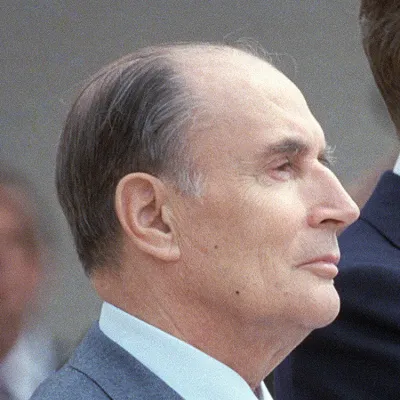
François Mitterrand
Human Design Chart
Biography
He became the longest-serving French head of state since World War II. During his 14-year tenure as President, he was credited with being an architect of European unity. Enigmatic, paradoxical, and apparently politically flexible, Mitterand’s politics morphed from right-wing sympathizer to Resistance fighter to Socialist Party leader.
Born in the Cognac region of southwestern France, Mitterrand was one of eight children born to a railroad stationmaster and his wife. Raised in a conservative, bourgeois and Catholic household, he belonged to a far-right Catholic youth movement, took part in at least two extreme-right student demonstrations and wrote for a conservative journal.
In 1934, he arrived in Paris to study law. After he received his degree, he was drafted into the French army at the time that Europe was moving into World War II. In 1941, he escaped a German prison during WW II and became a civil servant in the Vichy regime, which collaborated with the Nazi occupiers in France. At some point, he switched sides and became one of the greatest of the Resistance leaders. This all left him with less of a black-and-white viewpoint of the Nazi occupation.
He went on, after the war, to be a bureaucrat in postwar France. He held posts in 11 of the 23 governments of the Fourth Republic, between 1947 and 1967. He was minister of the interior in 1954, and minister of justice from 1956-1957. He was accused of leaking secrets to the Communist Party in 1954, and in Paris, in 1959, there was an attempt to kill him.
He was viewed as someone who was ready to adjust to events rather than control them.
François Mitterrand — Generator with Profile 1/3
Generator 1/3 — Design at a Glance
François Mitterrand as a Generator possessed immense sacral endurance that made him a powerful carrier of tasks. However, his energy did not function through spontaneous initiatives but exclusively in response to external impulses. This design required passive waiting for environmental signals before he acted; only then could his full power be effective.
The central dynamic of his character lay in this paradox: Maximum strength arose only from reacting 'from the gut'. If he ignored his inner signal or forced himself into actions without this impulse, he wasted energy and risked frustration as well as burnout. Conversely, suppressing his inner 'yes' - that is, holding back on projects where he was full of zeal - led to a feeling of blockage.
His strategy consisted in waiting for life signals and then consistently responding when his sacral center signaled approval. Living in harmony with this mechanism by reacting rather than initiating rewarded him with a deep sense of fulfillment. Deviations from it, especially constant initiative-taking against his inner rhythm, inevitably led to energy loss and persistent dissatisfaction. His endurance was thus not an unlimited resource but a conditional power that could only be released through correct reaction.
Sacral Authority
François Mitterrand reacted to external stimuli with immediate physical resonance. As a Generator, his design allowed decision-making that did not take place in the head but was steered by sacral authority. This inner guidance manifested as a 'gut feeling' or a noticeable surge of energy whenever he encountered something that appealed to him.
A prerequisite for this pure form of authority was his open emotional center. This protected the clarity of his sacral response from emotional clouding. When his sacral motor kicked in, François Mitterrand felt vital and alive. He seemed to have inexhaustible energy and tackled his tasks with great enthusiasm. His life was not driven by purpose but lived out of joy in the activity itself.
Furthermore, a Militia activation as an auxiliary instance gave him the ability for quick, instinctive reactions. He had immediate access to his physical well-being and intuitive perception. This combination allowed him to reliably be guided by these inner signals. The Generator's strategy - waiting for the right stimulus - was here identical with authority itself. Thus, he simplified his process: He did not act out of planning but as a direct response to life that addressed him.
The 1/3 Profile — Investigator / Martyr
François Mitterrand showed himself as someone who held judgments only after intensive theoretical examination and practical testing trustworthy. His design tended towards oscillating between meticulous preparation and the necessary experimentation. As a 1/3 profile (Researcher/Experimentor), he was naturally programmed to first deeply acquire knowledge before acting. Line 1 with Gate 28 demanded precise risk assessment and detailed work; intuition helped him test plans for feasibility. Without this thorough analysis, unrealistic expectations could arise. At the same time, line 3 with Gate 31 urged him to learn through trial and error, especially in leadership questions. Here, discernment was crucial: It mattered less about the number of followers than their quality. Mitterrand had to learn which influences he allowed and how he categorized complex situations, similar to politicians with opinion polls. The tension between the desire for complete security (line 1) and the necessity to make mistakes in order to grow (line 3), shaped his path. When he finally decided on something, he had thoroughly examined it both intellectually and practically. His judgment thus rested on a synthesis of theory and experience, which gave him special credibility.
Single Definition — Defined & Open Centers
François Mitterrands Human Design suggests a tendency towards immense internal stability and persistence. His defined Sacral, Spleen, and Root centers formed a massive foundation of vital energy, existential intuition, and physical survival pressure. This created a natural, mechanical reaction mechanism: his decisions were not mentally or emotionally driven but purely physical and instinctive. The Sacral energy provided a constant source for endurance that was only activated through correct reactions.
At the same time, Head, Ajna, Throat, G, Heart, and Solar Plexus centers were open. These open centers did not belong to his core identity but reflected the environment situationally. Mitterrand tended to be distracted by mental noise or emotional waves from others rather than trusting his sacral response and spleen intuition. The tension between the unshakable inner mechanical truth and vulnerability to external conditioning shaped his experience. While the lower centers offered constant presence, he was open in the mental and emotional realm for influences, which brought the challenge of not falling into other people's thought streams but maintaining the authority of the body over the mind.
Channels for intuitive power and evolutionary change.
François Mitterrands Human Design indicated a strong impulse towards radical change that was filtered through a highly sensitive, instinctive defense stance against threats. His energy was not linear but occurred in sudden pulses, with intuition deciding when this power could be safely used.
The Channel of Mutation 60-3 connected the Root Center to the Sacral Center via Gate 60 (Limitation) and Gate 3 (Order). This brought evolutionary change through an unpredictable, melancholic, and pulsing on/off energy. The potential depended on the ability to accept limitation and move beyond the confusion of a new beginning. This powerful frequency permeated his way of living out his design and also conditioned his environment.
Simultaneously, Channel 57-34 (Power) gave him extreme intuitive alertness. It connected the Spleen Center via Gate 57 (Intuitive Insight) to the Sacral Center and there to Gate 34 (Power). This created a defensive survival intelligence that protected him through selective listening and acoustic attention. The generative life force strengthened his existential consciousness, which was permanently attuned to danger. This mix of intuition and sacral power allowed him to react spontaneously to vibrations free from the temporal constraints of mental thinking.
Additional influences came from Gate 28 (Decision in Here and Now), Gate 41 (evolutionary development through crisis), and Gate 27 (care). Gate 31 concerned the transmission of powers, while Gate 32 sought continuity. Gate 52 promoted concentration on pattern correction, and Gate 39 delivered adrenaline through provocation to trigger mutation. This configuration shaped a person who brought change but only acted after inner confirmation of their safety.
Individual Circuitry — Circuit Signature
François Mitterrands Human Design indicated a tendency towards independent, mutating expression. His simple definition connected Sacral, Root, and Spleen centers in a continuous energetic flow, giving him clear action power coming from within.
In the Knowledge Circuit, Channel 3-60 (Mutation) was active for him. This connected the Sacral to the Root Center and promoted deviation from the existing. It was about walking one's own path and expressing new knowledge through emotional waves from the Solar Plexus – even though the Solar Plexus did not lie directly in his own channel, it served as an emotional background for this transformation. The energy pulsing and acoustically, drove forward the creation of entirely new knowledge.
Parallel to this, the Integration Circuit worked via Channel 34-57 (Power). This connected the Sacral with the Spleen Center. Here it was about gaining strength from reacting to life and directing this through intuitive knowing in the present moment. It was self-reinforcement and highest individuality, where correct intuition (Spleen) guided action power (Sacral).
Both circuits worked side by side: on one hand, bold deviation and transformation through expression, on the other hand, intuitive letting oneself be led into the right moment for securing survival. François Mitterrand thus showed himself as someone who embarked on new paths supported by inner intuition and the drive to initiate change.
Right Angle Cross of the Unexpected 3
François Mitterrand exhibited a life dynamics characterized by unpredictable turns and the ability to handle surprises. His design suggested that his life was not structured through linear planning but rather through reactions to the unexpected. The challenge lay in accepting these sudden changes not as disruptions, but as necessary impulses from which to derive new directions.
This imprinting resulted from the "Right Cross of the Unexpected 3". This configuration describes a fundamental attitude where the experience of the unforeseen was a constant companion. It involved the ability to find stability in chaos or during abrupt changes. Instead of clinging to rigid forecasts, the system responded to external shocks and used them as catalysts for further development. The mechanics indicated that stability was not achieved by avoiding risks but through the flexible adaptability to changing circumstances. François Mitterrand thus lived in a context that constantly challenged him to deal constructively with the unexpected. This dynamic shaped his way of evaluating situations and making decisions, emphasizing the need to remain open to unforeseen developments rather than rejecting them.
Saturn Return · Uranus Opposition · Chiron Return · 2nd Saturn Return — Life Cycles
François Mitterrand's political career followed a clear structure of four distinct astrological cycles that served as necessary initiations and power transitions. Each of these time points correlated with a concrete career advancement. In 1942, at the age of 26, his first Saturn return occurred. This cycle often demands structuring and responsibility; François Mitterrand took on work for the Vichy regime in managing prisoners of war. It was a period where years of groundwork condensed into a solid, though controversial, result.
The Uranus opposition in 1956 broke with convention and demanded new roles. At age 40, François Mitterrand became Minister of Justice. This shift marked a clear break in his previous career path, driven by the impulse for change that this cycle initiates.
Around his 49th year, the Chiron return is a fulfillment cycle where one's purpose unfolds. In 1965, François Mitterrand ran for president and lost to de Gaulle in the runoff. This moment was not failure in the traditional sense but a phase of bloom, during which his political identity gained painful yet necessary clarity.
Finally, his second Saturn return in 1971 brought ultimate anchoring. At age 55, François Mitterrand was elected First Secretary of the newly founded Socialist Party. This cycle cemented his position and laid the structural foundation for his later presidency by translating earlier experiences into a stable leadership role.
Generator · Sacral Authority — Synthesis
He was a Generator whose life was shaped by a deep drive towards activity and the need to invest energy into tasks that truly resonated with him (defined Sacral Center). This sacral authority, an immediate bodily reaction to external stimuli, led him to always be aware of the vitality of a task – an inner "yes" or "no", guiding his path. The Profile as a Researcher and Experimenter (1/3) reinforced this process by adding an unceasing urge to learn and practically test knowledge. Thus, he lived a lifestyle based on experimentation, always striving to form valid judgments through personal experience.
A central paradox lay in the combination of this investigative nature and the Channel of Mutation (3-60). On one hand, he sought new paths and insights, open to the unexpected. On the other hand, accepting limitations and the accompanying melancholy created an internal tension, as the confusion of a fresh start always clashed with his desire for clarity (Knowledge Circuit). This dynamic was evident in key moments of his career, where he both ventured innovative routes and faced the consequences of change.
2 Defined Channels
Incarnation Cross - Right Angle Cross of the Unexpected 3
Solar Return
The Solar Return shows the moment when the sun returns to its exact birth position - your personal solar year.
Life Cycles
Discover the life cycles with a detailed triple view (birth chart, cycle chart, composite).
Human Design Profile
- Type
- Generator
- Strategy
- To respond - wait for something to respond to
- Authority
- Sacral Authority
- Profile
- 1/3 - Investigator / Martyr
- Definition
- Single Definition
- Incarnation Cross
- Right Angle Cross of the Unexpected 3
- Date of Birth
- 26.10.1916 04:00
- Place of Birth
- Jarnac, France
Frequently Asked Questions
What was François Mitterrand's Human Design type?
Which Profile did François Mitterrand have?
What Authority guided François Mitterrand?
What incarnation cross did Francois Mitterand have?
When was Francois Mitterand born?
Discover your own Human Design
Are you also a Generator? Find out in a personal reading how to use your sacral energy correctly and discover deep satisfaction.
More Personalities
Back to overviewAaliyah

Alexia

Angèle

Anne-Marie

Arcángel

Arno