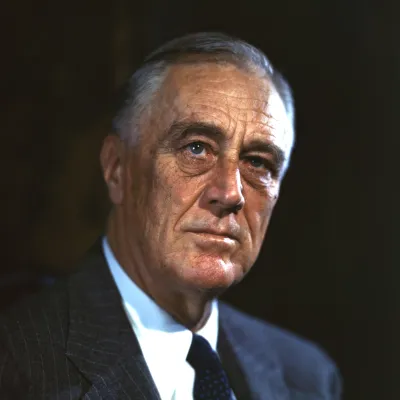
Franklin D. Roosevelt
Human Design Chart
Biography
In 1902, he was a senior at Harvard, handsome and personable when he began courting his fifth cousin, Eleanor. He proposed the following year and they married on 17 March 1905, New York City. In the next 11 years they had six kids, Anna (1906); James (1907); Franklin Jr. (1909), who died in infancy; Elliott (1910); another Franklin Jr. (1914); and John (1916).
By the time their youngest was born, Franklin was a rising Democratic politician, first representing his home district of Hyde Park in the New York State Assembly and then serving as assistant secretary of the Navy.
In 1918, Eleanor found that Franklin was having an affair with her secretary, Lucy Mercer. Their marriage survived, but in name only; they occupied separate bedrooms and lived separate lives.
On 11 August 1921, while at Campabello, he swung his legs over the side of the bed to get up and found himself paralyzed from the waist down by polio. Through sheer force of will, he pushed himself through years of rehab, with hours of exercise and hours immersed in water. He did regain most of his bodily functions but could never again walk unaided, and wore heavy braces on his legs. A sympathetic press aided him in his concealment of his handicap during his governorship and presidency.
Roosevelt's grace under pressure helped ease, if not heal, the fracture between himself and his wife, winning her admiration for his courage under great adversity. Running for public office, he was elected Governor of New York in 1928, and he attained the presidency in 1932.
What does Generator 4/6 mean for Franklin D. Roosevelt?
Generator 4/6 — Design at a Glance
Franklin D. Roosevelt possessed immense endurance and was rich in sacral energy, making him a powerful force of work. His design suggested that he was most effective when responding to signals from his environment rather than initiating actions independently. This reactive ability contrasted with pure initiation; his inner engine only started through external impulses.
As a Generator, his energy was comparable to that of a working horse: strong and steady but dependent on the right task. When engaging in activities he had no internal desire for, he risked wasting this valuable power and burning out. Equally frustrating was being prevented from continuing work on heart projects when still full of drive.
His strategy involved waiting for a life signal and then acting once his inner self gave a clear “yes.” This allowed him to materialize his goals. Living in harmony with this response brought deep satisfaction and fulfillment. Initiating without this internal impulse or being hindered in his plans led to prolonged frustration and a noticeable energy drain. His success thus directly depended on whether he responded from the gut.
Emotional Authority
Franklin D. Roosevelt lived with an inner authority that demanded him to take his time and not act impulsively. His design carried emotional authority, meaning his defined Solar Plexus Center guided his decisions – regardless of which other centers were also defined. This configuration produced a constant emotional wave: His feelings swung strongly between enthusiasm and skepticism, coloring the world through the filter of his current mood.
An immediate impression was no reliable truth but merely a snapshot. Quick reactions from intense emotions often had negative consequences as they were based on fleeting moods. Instead, clarity required patience and conscious waiting for the emotional cycle to complete. He needed to let decisions mature, hesitate, and sleep on them multiple times to distance himself from initial fluctuations.
Only when the strong feelings subsided did calmness set in and allow him a comprehensive understanding. This process was especially crucial for long-term decision-making as he could only recognize the deep truth of a situation after the wave had abated. His strength lay not in the speed of judgment but in his ability to filter out emotional noise and find a stable, clear position through consistent waiting.
The 4/6 Profile — Opportunist / Role Model
Franklin D. Roosevelt lived a dynamic marked by a profound tension between the need for close community and later seeking spiritual distance. In his first half of life, before age 30, he was someone who intensely experimented and relied on quick resonance in relationships. This phase was determined by the energy of Gate 19, which attracts mutual dependence and teamwork; here, his power only worked effectively if his environment kept up. He expected a certain sensitivity to boundaries to strengthen this reciprocal bond.
With the activation of Line 6 later in life, this focus shifted towards potential reserve and detachment from the mundane. Franklin D. Roosevelt now faced an internal conflict between the heart seeking belonging and the head questioning higher purpose. This development could lead to intolerance or arrogance if high spiritual standards were not met. He was expected to function as a wise role model through cooperation. At the same time, his large heart had to learn to be cautious to avoid opening up to the wrong people and getting hurt. His life thus moved in constant balance between early fixation on team work and later necessity of recognizing a spiritual ego and taking new directions.
Split Definition — Defined & Open Centers
Franklin D. Roosevelt possessed a consistent, independent mental structure and the ability to reliably translate thoughts into speech or action. His defined Ajna Center provided continuous conceptualization; he was always in a mental process, hardly influenced by external opinions. These inner images flowed directly into his defined Throat Center, which served as a pivot point to carry messages from the mind outward with reliability. Thus, his communication relied on a clear yet limited form of expression that did not depend on momentary moods.
The driving force of his design came from his defined Sacral Center, providing immense vital energy. However, this energy was reactive: It was only fully available when he waited for questions or offers and responded to them. Initiatives without such sacral approval led to resistance and exhaustion, while approving reactions allowed persistence and satisfaction. Simultaneously, his defined Root Center generated a constant pressure for progress and stress management, propelling him forward in the material world. His emotional authority lay in his defined Solar Plexus Center; he gained clarity not through immediate decisions but by waiting out waves of feelings until a deeper truth emerged.
In contrast, his open centers reflected their environment. His open Head Center tended to absorb inspiration or doubts from others, making him vulnerable to mental overload through non-self questions. His open G Center meant no fixed identity; he adapted situatively and sought the right place and people to find direction rather than asserting it himself. His open Heart Center led to a lack of consistent willpower, risking promises given or value proven under scrutiny, often ending in frustration. Finally, his open Spleen Center was sensitive to well-being; it tended to absorb fears or health conditions from others instead of relying on stable intuition.
Channels for drive, focus and structured insight.
Franklin D. Roosevelt exhibited a basic disposition characterized by intense, calm concentration combined with a unique, often anticipatory mental perspective. His design suggested that he perfected details while simultaneously seeking new ways to see and think about things.
This tension arose through the Channel of Concentration 52-9. This channel connected the Root Center with the Sacral Center via the Gate of Non-action (52) and the Gate of Focusing (9). It created a calm pressure to stay still and avoid distractions, allowing him to fully immerse in facts and patterns. Roosevelt used this energy to step through logical processes and wait for reactions before acting. This enabled him to precisely assess complex situations and live with perfectionism in his focus.
Simultaneously, the Channel of Structuring 23-43 worked. It connected the Ajna Center with the Throat Center via the Gate of Assimilation (23) and the Gate of Insight (43). This channel promoted mutative, innovative perspectives that were hard to communicate. Roosevelt had to learn to clearly express his unique knowledge so it would be accepted by others. Often he felt like an outsider waiting for the right timing to make his insights effective. When acceptance came, this led to evolutionary change; with wrong timing, rejection.
The solar focus in Gate 19 directed these energies into areas of resource management, territorial security, and spiritual community bonding. This gate emphasized the need for a safe environment and supported his ability to focus on communal well-being. Through the combination of logical focusing and innovative insight, Roosevelt created dynamics that promoted both stability and change.
Collective Circuitry — Circuit Signature
Franklin D. Roosevelt moved between two separate energy systems that did not flow directly into each other. On one side was cool, future-oriented logic; on the other, he processed emotional waves from the past for personal meaning-making. This 'Split Definition' meant that rational planning and creative expression existed as parallel, non-integrated forces.
The Understanding Circuit provided constant strategy. Through Channel 9-52 (Concentration), it connected the Sacral Center with the Root Center. This created a focused energy for logical structures and societal improvement, free from emotional influence – a rational basis for future action.
Simultaneously, the right system worked on identity and expression. The Knowledge Circuit linked via Channel 43-23 (Structuring) the Ajna Center to the Throat Center. Here individual mind was brought into concrete form of expression driven by the need to go one's own way. Parallel to this, in the Meaning-Making Circuit energy flowed through Channel 30-41 (Recognizing) from Solar Plexus to Root Center. This processed past experiences in cyclical emotional waves to derive insights for the collective.
Roosevelts design thus showed a tension field: The left side offered stable, visual strategy for the future; the right and upper side generated pulsating, acoustic creativity and melancholic reflection on the past. He switched between this focused ratio and wave-like emotional meaning-making without both systems forming an ongoing unity.
Right Angle Cross of the Four Ways 4
Franklin D. Roosevelt carried the right cross of the four paths 4 in his design. This configuration shaped a fundamental attitude that aimed at direct, unambiguous communication and clear intentions for action. In Human Design, this cross describes an energy that takes no detours but breaks through with simple, often concise expressions or actions. It is an energetic impulse prioritizing efficiency and immediacy, where the outer form may sometimes be felt as rough or minimally adorned. For Roosevelt, this meant an inner alignment to the essential: He did not seek complex explanations but rather the core of a matter. This structure promoted behavior characterized by direct address and a desire for immediate clarity. The energy of this cross acts like a hammer that breaks through material to reach content, rather than artfully packaging it. Thus, Roosevelt showed a tendency to convey information and demands in such a way that their impact unfolds through their directness, regardless of social etiquette or rhetorical embellishment. This was not a conscious stylistic break but the natural result of his energetic configuration, which placed simple truth above elegant form.
Saturn Return · Uranus Opposition · Chiron Return · 2nd Saturn Return — Life Cycles
Franklin D. Roosevelt's life followed a clear structure of four marked astrological cycles, shaping phases of political ascent, physical crisis, and renewed affirmation. The first Saturn return around age 28 marked the beginning of his political career: In 1910 he became a member of the New York Senate. This cycle condensed early efforts into a solid professional foundation.
The Uranus opposition at age 39 brought a profound turning point. In 1921, Roosevelt likely contracted polio, leading to near-total paralysis below the waist. This pivotal moment demanded radical adaptation and questioned his previous life path.
The Chiron return around ages 48-51 served as an achievement cycle in which his inner purpose unfolded. This was evident in 1930 when Roosevelt was re-elected governor of New York – a sign that he continued to pursue his destiny after the crisis, gaining significance.
The second Saturn return around age 57 brought further challenges. In 1939, news about the Hitler-Stalin Pact informed him of a new geopolitical threat. This cycle underscored the burden of responsibility in an intensifying global crisis, while he maintained his position despite external uncertainties.
Generator · Emotional Authority — Synthesis
He was a Generator whose life was marked by a deeply rooted ability for endurance and energy production (Sacral Center). However, this power always unfolded within the loops of emotional waves (Emotional Authority), complicating quick decisions and requiring thorough deliberation. The profile as Networker/Role Model points to a life path shaped by the inner tension between the desire for community (Line 4) and the need for introspective reflection (Line 6) – an interplay that intensified in later years. The defined mental landscape (Ajna Center) provided the ability to shape concepts and influence others through conviction, while the Channel of Concentration (52/9) supplied formative energy to grasp details and structure knowledge.
A central paradox lay in how he dealt with crises. On one hand, there was a recurring pattern of career successes confirmed by Saturn returns (1910, 1939) – affirming his path. On the other hand, these successes were repeatedly overshadowed by deep personal crises such as illness (Uranus opposition, 1921), and later global conflicts (1939). This constellation points to a person who, despite or precisely because of their vulnerability, was capable of unleashing transformative power.
3 Defined Channels
Incarnation Cross - Right Angle Cross of the Four Ways 4
Solar Return
The Solar Return shows the moment when the sun returns to its exact birth position - your personal solar year.
Life Cycles
Discover the life cycles with a detailed triple view (birth chart, cycle chart, composite).
Human Design Profile
- Type
- Generator
- Strategy
- To respond - wait for something to respond to
- Authority
- Emotional Authority
- Profile
- 4/6 - Opportunist / Role Model
- Definition
- Split Definition
- Incarnation Cross
- Right Angle Cross of the Four Ways 4
- Date of Birth
- 30.01.1882 20:45
- Place of Birth
- Hyde Park (Dutchess County), NY, United States
Frequently Asked Questions
What was Franklin D. Roosevelt's Human Design type?
What Profile did Franklin D. Roosevelt have?
Which Authority guided Franklin D. Roosevelt?
What incarnation cross did Franklin D. Roosevelt have?
When was Franklin D. Roosevelt born?
Discover your own Human Design
Are you also a Generator? Find out in a personal reading how to use your sacral energy correctly and discover deep satisfaction.
More Personalities
Back to overviewAaliyah

Alexia

Angèle

Anne-Marie

Arcángel

Arno