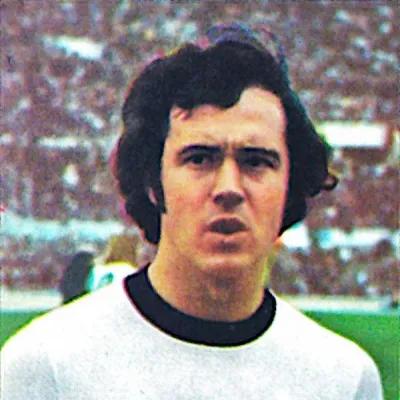
Franz Beckenbauer
Human Design Chart
Biography
Human Design Analysis: Franz Beckenbauer as Projector 2/4
Projector 2/4 — Design at a Glance
Franz Beckenbauer appeared as a Projector with a dense, focused aura. He had the ability to immediately recognize system errors in his environment, much like a bright flashlight shining directly into darkness. This characteristic allowed him to quickly identify weaknesses in others. However, pointing out these flaws would often provoke resistance, as if shining light directly into someone's face. Instead, his strength lay in attracting others through his own harmony. When he followed functioning paths himself, people sought him out for advice. His strategy thus involved waiting for an honest invitation rather than intervening recklessly.
This approach was essential to his energy management. With his Sacral Center open, Franz Beckenbauer did not have a constant intrinsic energy source. He experienced phases of high productivity followed by mandatory rest periods to prevent burnout. Ignoring this rhythm would have driven him into bitterness, his non-self theme. Living according to this design rewarded him with success. His impact was based not on constant presence or output but on precise, inviting leadership that only became effective when requested and appreciated from the outside. This dynamic shaped his interaction with his environment and secured his long-term effectiveness without self-exploitation.
Splenic Authority
Franz Beckenbauer demonstrated decision-making based on immediate 'now'. His design inclined towards intuitive spontaneity driven by the Spleen Authority. This inner leadership functioned as a fine health and alarm system, providing spontaneous insight into whether a situation or environment was right for him.
For Franz Beckenbauer, the first impulse was always correct. This direct reflex served his immediate health needs and enabled him to rigorously distance himself from harmful influences. However, since this Spleen impulse was very fine and only occurred once in the moment, its use required high vigilance. He had to follow these signals immediately before they were drowned out by other thoughts.
This mechanism shaped his life through flexibility. Long-term commitments often conflicted with his nature as plans could change at short notice when an inner impulse demanded it. Franz Beckenbauer needed much freedom to follow this survival intelligence. His strength lay in not binding himself prematurely but acting situational and spontaneously, ensuring he always chose what was healthiest for him, even if it appeared unpredictable to external observers. The Spleen Authority required him to decide in the moment what was right rather than relying on abstract future plans.
The 2/4 Profile — Hermit / Opportunist
Franz Beckenbauer oscillated between two fundamental needs: the urge to withdraw and the desire for connection. His design inclined towards retreating when internally pressured or uncertain, seeking clarity – a process often experienced in his 'cave'. There he reflected intensively before re-emerging to invest energy into the network.
This dynamic stemmed from Profile 2/4 (Natural Talent / Networker). Line 2, marked by Gate 47 (Ambition), projected ability outward but offered little internal security during crises. Instead, Beckenbauer sought healing activity to free himself from pressure. This retreat was not a sign of weakness but necessary for his maturation process. Only when this need was fulfilled did he emerge and use Line 4 (Gate 45) for direction in the transpersonal context. Here he searched for complementary partnerships to create advantages for the 'tribe'.
Clear communication of this interplay was crucial: Beckenbauer had to make it clear when he needed company and when solitude was required. Only then could he effectively process his network's knowledge during solitary times, developing brilliant ideas from it. His effectiveness depended on respecting these boundaries – both for himself and others. Without this rhythm of solitude and community, his ability to orient in the social field would have been weakened.
Single Definition — Defined & Open Centers
Franz Beckenbauer's design indicated a tendency towards existential presence: He relied on spontaneous, non-rationalizable intuition in the here and now. This mechanism came from his defined Spleen Center, which served as personal authority. It provided a trustworthy, physical judgment for health and well-being that did not require or allow logical justification. At the same time, his defined Root Center propelled him forward. This center generated a constant, physical survival pressure that kept him in motion and stabilized him materially and physically. This inner stress was no burden in a negative sense but rather the driving force for his growth and endurance.
In contrast, Franz Beckenbauer was characterized by a variety of open centers that made him susceptible to absorbing external energies. His open Head Center meant he did not have constant mental inspiration; instead, he tended to be distracted by doubts and questions from his environment when he did not listen to his inner authority. Similarly, his open Ajna Center lacked a firm conceptual framework, which made him flexible in thinking but also vulnerable to adopting others' opinions.
Additionally, his Heart, Sacral, and Solar Plexus centers were open. His open Heart Center meant he did not have a constant will for assertion and was at risk of proving himself through promises to find value. His open Sacral Center lacked consistent vital energy; instead, he absorbed the life force of others, which could lead to exhaustion if he did not pause. Finally, his open Solar Plexus absorbed emotions from the environment without generating them itself, making him emotionally vulnerable to the climate of his social surroundings. This combination of firm body awareness and open mental and emotional fields shaped his specific way of dealing with pressure and intuition.
Channels for logical analysis and provable truth.
Franz Beckenbauer showed a deeply rooted tendency towards perfectionism and correction of patterns. His design drove him to identify imbalances and develop logical solutions that should lead the collective into a more harmonious structure. This attitude stems from Channel 58-18, which connects the Root Center with the Spleen Center.
This channel links Gate 58, representing life energy and constancy, with Gate 18, the sentry of correction. While Gate 58 provides an insatiable impulse for 'better and more', Gate 18 critically assesses what is healthy or in balance. The mechanism demands that logic prove it has the best answers. Beckenbauer's ability to control was not mere will but a logical process: he questioned existing structures to optimize them.
The energy of this channel unfolds constructively only when asked for a solution. Without invitation, the system tends to generate penetrating dissatisfaction or uninvited criticism perceived as an endless stream of data about errors. Beckenbauer lived this dynamic by using his gifts to check patterns and find applicable solutions for society. His goal was not individual correctness but ensuring everyone found satisfaction in a perfect pattern.
Alongside this central structure, other gates were at work: Gate 22 promoted openness and calm listening; Gate 26 connected innovation with the ability to convince the tribe; Gate 47 sought meaning connections in past experiences; Gate 45 represented tribal energy and hierarchy; Gate 53 allowed him as a pioneer to start new cycles; Gate 39 used provocation for analysis; and Gate 52 demanded concentrated pause for pattern correction. Together, they formed a profile oriented towards logical clarity and collective optimization.
Collective Circuitry — Circuit Signature
Franz Beckenbauer showed a clear inclination towards visual thinking and strategic structuring. His design connected the Spleen Center with the Root Center, giving him the ability to focus precise logical conclusions. This configuration served not emotional evaluation but pure rational analysis - an 'emotionless ratio' aimed at improving things and leading society into a better future.
The Mind Circuit he activated channeled this energy through the Judgment Channel (Gates 18 and 58). This allowed him to quickly grasp complex connections and strategically categorize them. A central motive of this mechanism was sharing rational insights, ideally free from any conditioning or emotional distortion. Through this connection, Franz Beckenbauer could focus his format-energy to develop clear, future-oriented solutions.
Given he had a simple definition, these energies formed a coherent flow within his system. The link between Spleen (intuitive perception) and Root Center (pressure and endurance) ensured that his strategic insights did not remain theoretical but were implemented with specific intensity and endurance. This shaped his approach to solving problems through clear logic and structured planning, always with an eye on long-term improvements.
Right Angle Cross of Rulership 3
Franz Beckenbauer's Human Design reveals a tendency towards strategic authority coupled with the ability to lead through personal intuition. He was known for making clear decisions in complex situations and inspiring others to follow his vision. This approach stems from the right-hand cross of Governing 3, which presupposes deep trust in one's inner compass. Rather than relying on external validation or logical analysis, he oriented himself based on an intuitive certainty about what is right. This allowed him to maintain a calm, commanding presence even under pressure and inspire others through his clarity without needing to force them. The mechanics of this cross describe a natural authority that arises from the authenticity of one's actions rather than being imposed. Franz Beckenbauer lived out this strategy by relying on his inner truth and moving others with it. His leadership was based on knowing what needed to be done and embodying this knowledge with such conviction that it resonated with those around him. It wasn't arbitrary commands but a resonance emanating from the connection with his own intuition, creating spaces where others could find their clarity driven by his unwavering inner security.
Saturn Return · Uranus Opposition · Chiron Return · 2nd Saturn Return — Life Cycles
Franz Beckenbauer's life path followed a clear structure of building up, testing, and realignment. His design showed phases demanding responsibility, followed by breaks forcing reorientation.
The first Saturn Return marked the transition to full maturity. In 1972 at age 27, Beckenbauer led Germany to the European Championship title and won the Ballon d’Or. This success condensed years of work into a solid result and established his authority at the peak of his sporting career.
The Uranus Opposition brought an essential break. In 1986 at age 41, Beckenbauer was fined for illegal tax arrangements amounting to 1.8 million D-Mark. This crisis shattered old structures and forced him to confront the consequences of earlier decisions, a typical moment of destabilization before a new phase.
The Chiron Return ushered in the bloom period where meaning and leadership unfolded. In 1994 at age 49, Beckenbauer became president of FC Bayern Munich. Here he demonstrated the ability to take on a leading role based on past experiences not as healing a wound but fulfilling his purpose through responsibility.
The second Saturn Return confirmed this new positioning. In 2005 at age 60, he announced his candidacy for UEFA presidency. This was the logical continuation of his development: after crisis and realignment, he once again took on a top function now on an international level supported by previously acquired wisdom and stability.
Projector · Splenic Authority — Synthesis
Franz Beckenbauer's design reveals a thread of recognizing and correcting. The combination of defined Spleen Center and Judgment Channel (Gate 18/58) points to an innate ability to identify errors in the system – not just in others but also within the structure itself. This perception was reinforced by his open configuration of many centers, allowing him to absorb patterns and imbalances without being overwhelmed by them. This enabled him to act as a pioneer for change by questioning existing systems and pointing out new paths. The repeated evidence of success and crises in his cycles reflects this dynamic: moments of ascent through innovative approaches followed by necessary corrections and adaptations.
A central paradox lies in the tension between his ability for objective assessment (Spleen Center) and undefined Heart and Solar Plexus Centers. While he instinctively knew what was correct, he lacked an internal, consistent source for willpower and emotional stability. This led to a dependence on external influences and a constant need for validation to confirm his own judgments. Thus, he was an observer with the potential for leadership but also reliant on others' energy to bring his visions into reality.
1 Defined Channel
Incarnation Cross - Right Angle Cross of Rulership 3
Solar Return
The Solar Return shows the moment when the sun returns to its exact birth position - your personal solar year.
Life Cycles
Discover the life cycles with a detailed triple view (birth chart, cycle chart, composite).
Human Design Profile
- Type
- Projector
- Strategy
- Wait for the respectful invitation
- Authority
- Splenic Authority
- Profile
- 2/4 - Hermit / Opportunist
- Definition
- Single Definition
- Incarnation Cross
- Right Angle Cross of Rulership 3
- Date of Birth
- 11.09.1945 23:45
- Place of Birth
- München, Germany
Frequently Asked Questions
What was Franz Beckenbauer's Human Design type?
Which Profile did Franz Beckenbauer have?
What Authority did Franz Beckenbauer have?
What incarnation cross did Franz Beckenbauer have?
When was Franz Beckenbauer born?
Discover your own Human Design
Are you also a Projector? Find out in a personal reading how to unfold your leadership qualities and recognize the right invitations.
More Personalities
Back to overviewSissy Spacek

Alain-Fournier

Aldair

Anémone

Ann-Margret

Bourvil