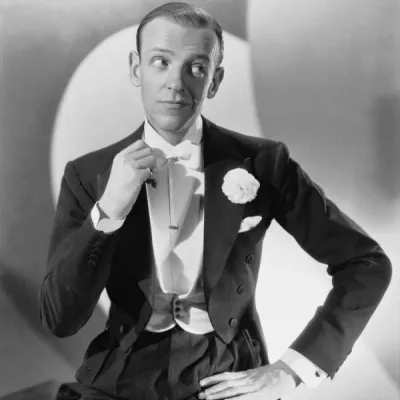
Fred Astaire
Human Design Chart
Biography
As a dancer, he was known for his uncanny sense of rhythm, creativity, effortless presentation, and tireless perfectionism, which was sometimes a burden to co-workers. His dancing showed elegance, grace, originality, and precision. He drew influences from many sources, including tap, classical dance, and the elevated style of Vernon and Irene Castle. His trademark style greatly influenced the American Smooth style of ballroom dance. He called his eclectic approach "outlaw style", a following of an unpredictable and instinctive muse. His motion was economical, yet endlessly nuanced.
Astaire's most memorable dancing partnership was with Ginger Rogers, with whom he co-starred in ten Hollywood musicals during the classic age of Hollywood cinema, including Top Hat (1935), Swing Time (1936), and Shall We Dance (1937). Astaire's fame grew in films like Holiday Inn (1942), Easter Parade (1948), The Band Wagon (1953), Funny Face (1957), and Silk Stockings (1957).
Fred Astaire — Generator with Profile 2/4
Generator 2/4 — Design at a Glance
Fred Astaire's Design indicates a tendency towards high endurance and energy efficiency, which was effective only in response to external impulses rather than through his own initiative. As a Generator, he had abundant sacral energy, comparable to the strength and consistency of a workhorse – provided it has energy for its task. This energy primarily released when he responded to life's signals instead of taking the first step himself. The central mechanism involved waiting for an internal signal before acting.
This fundamental principle of "Reacting rather than Initiating" served as the source of deep satisfaction and energy efficiency. When Fred Astaire lived in alignment with this Design, acting upon his sacral center’s clear “Yes!”, it led to a profound sense of fulfillment. In contrast, ignoring this principle – such as by constantly initiating or working on things without inner desire – resulted in frustration and energy loss. Two specific pitfalls marked his Profile: wasting energy on disliked tasks, which tended towards burnout, and holding back from heart projects despite having full power. His successful strategy was to wait for impulses and then respond from the gut, making it impossible for anyone to stop him.
Emotional Authority
Fred Astaire showed a decision-making approach that required time: spontaneous reactions were unreliable, and true clarity emerged only after emotional waves subsided. This resulted from his emotional authority, carried by the defined Solar Plexus Center. In Human Design mechanics, this authority always takes precedence over all other defined centers, regardless of additional configurations in the chart.
This center was subject to constant ups and downs of feelings. Fred Astaire saw the world colored by his current mood; a moment of enthusiasm could quickly turn into negative evaluation. The immediate feeling was only a snapshot, not necessarily the deeper truth. Quick decisions made purely from emotion thus had potential for negative consequences.
The strategy involved taking time and letting decisions "ripen overnight" multiple times. Through this hesitation and repeated questioning, intense feelings subsided. Only with this emotional distance did calmness set in and inner truth become visible. This process was especially essential for long-term, life-defining decisions, as it helped distinguish momentary moods from lasting inner guidance.
The 2/4 Profile — Hermit / Opportunist
Fred Astaire showed a constant interplay between the desire for deep withdrawal and the longing for connection. His design as a 2/4 Presence created tension: on one hand, the desire to be alone (Line 2), on the other, the necessity to spend time with familiar people (Line 4). This required clear communication of his boundaries. He had to make it clear when he sought company and when he wanted to remain undisturbed.
In this dynamic, Line 2 was central to his individuality. It protected his innermost self from interference, as the survival of his own identity was threatened by external disturbances. At the same time, Line 4 carried a program outward seeking support and striving for revolutionary changes.
Fred Astaire used his alone time effectively for reflection. In this "cave," he processed knowledge from his network, evaluated it, and developed new ideas from it. Only when this inner need was satisfied did he re-enter the community. This rhythm of isolation and exchange shaped his work style. He created a safe environment to integrate these two poles without suppressing either need.
Triple Split Definition — Defined & Open Centers
Fred Astaire's design established a tendency towards constant mental structure and strong-willed presence. His defined Ajna Center ensured consistent conceptual thinking, while the connected Throat Center reliably translated these concepts into communication. This mechanism meant that he always thought and spoke; his mind was perpetually active, making meditation difficult but providing intellectual stimulation.
Additionally, he had a defined Heart Center, which gave him willpower and a desire for self-determination. He preferred to control his resources himself and kept promises to strengthen his self-esteem. His defined Sacral Motor also generated enormous vital energy that was released in response to external stimuli – not through initiatives from the mind.
Emotionally, he worked with a defined Solar Plexus Authority: He had to wait for emotional clarity before deciding; impulsive actions during emotional highs or lows led to chaos; patience was key to truth. His defined Spleen Center provided spontaneous intuition in the present moment for health and well-being, while his Root Center supplied constant pressure to move forward.
In contrast, Head and G Centers were open. The open Head Center made him vulnerable to mental stress and others' questions; he tended to engage with problems that weren't his own rather than waiting for inspiration. His open G Center had no fixed identity or direction. Instead, it reflected the environment: He felt lost in wrong places but bloomed in right ones. His identity crystallized only in correct relationships and environments where he learned to be initiated by others instead of seeking direction himself.
Channels for clarity, focus, principles and devotion.
Fred Astaire displayed a fundamental approach aimed at translating complex insights into clear, efficient concepts. His design featured the Channel of Structuring 23-43, which connected spontaneous breakthroughs from Ajna Center (Gate 43) with the assimilating digestive power of Throat Center (Gate 23). This created a mutative process: Innovative thinking wasn't immediately accepted as truth but had to be integrated through clear formulation and patience for others to understand. The challenge lay in letting go of control and waiting for the right timing so these unique perspectives could promote efficiency rather than being perceived as foreign.
This ability for clear structuring worked together with the Channel of Concentration 52-9. This format channel linked the passive pressure of Root Center (Gate 52) with the focused detail vision of Sacral Center (Gate 9). It allowed Fred Astaire to focus intensively on patterns and facts by holding still and excluding distractions. This calm tension helped him select precise details for his expression logically before communicating them.
Furthermore, the Channel of Devotion 26-44 shaped his interactive potential. By connecting instinctive awareness (Gate 44) in Spleen Center with Heart Center's willpower (Gate 26), he had a sense of what appealed to the group or audience at any given moment. This supported him in presenting his structured ideas intuitively understood and accepted. The combination of structural clarity, focused precision, and instinctive adaptability defined how he effectively contributed knowledge.
Tribal Circuitry — Circuit Signature
Fred Astaire's design established a tendency towards three isolated energetic focal points that were not directly connected to each other. As a Triple Defined individual, his strength was distributed across separate groups: rational strategy, acoustic expression, and resource-oriented cooperation. This division required situational activation through external resonance since no internal flow existed between the areas.
The Understanding Circuit linked his Sacral with Root Center. This created focused, rational energy for structure and logical planning – an 'emotionless ratio' oriented towards future and visual clarity. Parallel to this, the Knowledge Circuit formed a direct connection between Ajna and Throat Centers. Here, pulsating acoustic creativity aimed at realizing new insights and individual paths through expression.
A third independent block consisted of the Ego Circuit. This included two separate segments: one linking Heart with Spleen Center (for resource management and differentiation), another connecting Solar Plexus with Root Center (for emotional waves). Since this circuit lacked a connection to Sacral Center, constant life force was missing. Thus, rest periods for regenerating energy were necessary for cooperation and mutual support. The integration of logical structure (Understanding) with individual creativity (Knowledge) as well as emotional dynamics (Ego) wasn't an automatic unity but required conscious effort to harmonize these parallel forces.
Right Angle Cross of Explanation 2
Fred Astaires design pointed towards a tendency for strategic clarity. He was someone who could unravel complex situations through logical analysis. This configuration described the ability to find solutions through structured thinking and precise communication.
The right cross of Explanation 2 focused precisely on this process: finding ways out of chaos through order. The mechanics of this cross emphasized the need to carefully sort information. Connections had to be clearly laid out to avoid misunderstandings and make effective decisions. It was not about spontaneous intuition but a methodical approach to problems. Fred Astaire lived up to this requirement by focusing on essentials and filtering out distractions. His energy was directed towards bringing clarity into unclear situations. This happened through a conscious structuring of his thought world. Only when the internal connections were logically sound could he act externally. The design challenged him to always maintain an overview and integrate details into a larger framework. Thus, analysis turned into actionable strategy. Precise communication served as the tool to make this internally created order understandable to others. Without this logical foundation, the impact would have failed. Fred Astaire used this structure to identify the right path in every situation and pursue it consistently.
Saturn Return · Uranus Opposition · Chiron Return · 2nd Saturn Return — Life Cycles
Fred Astaires design pointed towards cyclical patterns where inner clarity condensed through external action. The Chiron Return, a roughly twenty-year fulfillment cycle, marked for him the phase of blooming: Here his incarnation cross unfolds increasingly in life, provided strategy and authority are lived out. Meaning and purpose become experiential, not as healing old wounds but as realization of the deepest purpose.
This process was concretely visible in 1947. At age 48, Fred Astaire opened the Fred Astaire Dance Studios. This event stood at the core of his Chiron Return and confirmed its mechanics: Long-term groundwork found a stable form. It was not a sudden new beginning but the logical consequence of a life increasingly aligning with its design. Through this establishment, his influence became tangible; he structured his expertise in a format that extended beyond himself.
The opening of the studios served as proof of how the Chiron Return works: By institutionalizing his life purpose, Fred Astaire made his inner orientation visible externally. The cycle not only promoted personal fulfillment but created a platform for dissemination and structure. In this phase, his potential condensed into concrete results that linked his identity with his public role.
Generator · Emotional Authority — Synthesis
Fred Astaire lived a life marked by deep internal authority and the need for authentic expression. His defined Generator type, combined with emotional authority and a 2/4 profile, points to someone who generates energy through reactions to external impulses and channels this into creative work. The constant interaction between the need for alone time (Line 2) and the desire for community (Line 4) likely reflected phases of intense concentration coupled with those of interaction and sharing. His defined Root Center provided a steady pressure to carry this energy out into the world, while his Heart Center ensured that it stemmed from an inner conviction.
A central paradox in Astaires design lies in the tension between his need for reaction and his defined Ajna Center. On one hand, he was geared towards reacting to external stimuli and releasing his energy through action (Sacral). On the other hand, he possessed a strong, consistent thought process (Ajna), which likely inclined him towards analyzing and planning things. This combination suggests that Astaire was someone who could proceed both intuitively and intellectually, with the balance between these forces shaping his unique expression.
4 Defined Channels
Incarnation Cross - Right Angle Cross of Explanation 2
Solar Return
The Solar Return shows the moment when the sun returns to its exact birth position - your personal solar year.
Life Cycles
Discover the life cycles with a detailed triple view (birth chart, cycle chart, composite).
Human Design Profile
- Type
- Generator
- Strategy
- To respond - wait for something to respond to
- Authority
- Emotional Authority
- Profile
- 2/4 - Hermit / Opportunist
- Definition
- Triple Split
- Incarnation Cross
- Right Angle Cross of Explanation 2
- Date of Birth
- 10.05.1899 21:16
- Place of Birth
- Omaha, Nebraska, United States
Frequently Asked Questions
What was Fred Astaire's Human Design type?
What Profiles did Fred Astaire have?
What Authority did Fred Astaire possess?
What incarnation cross did Fred Astaire have?
When was Fred Astaire born?
Discover your own Human Design
Are you also a Generator? Find out in a personal reading how to use your sacral energy correctly and discover deep satisfaction.
More Personalities
Back to overviewAaliyah

Alexia

Alizée

Angèle

Anne-Marie

Arcángel