
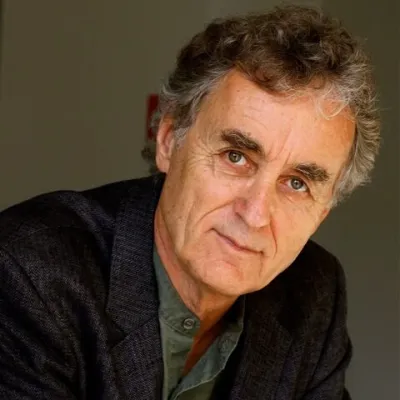
Fritjof Capra
Human Design Chart
Biography
Capra is the author of several books, including The Tao of Physics (1975), The Turning Point (1982), Uncommon Wisdom (1988), The Web of Life (1996), and The Hidden Connections (2002), and co-author of The Systems View of Life (2014).
Fritjof Capra as a Generator 5/1 in Human Design
Generator 5/1 — Design at a Glance
Fritjof Capra's design indicates a tendency towards great endurance, comparable to the strength of a workhorse. As a Generator, he had plenty of sacral energy, which was not released through initiated action but only as a reaction to impulses from life. The central strategy involved waiting until an inner signal—a gut feeling—clearly said "yes," and then responding with full force. This mechanism protected him from the typical misstep of Generators: wasting energy on tasks that do not resonate, which can quickly lead to frustration or burnout. Instead, his energy was used efficiently by only becoming active where there was an inner confirmation. When Fritjof Capra followed this strategy and reacted to signals rather than initiating himself, it led to a state of deep satisfaction and fulfillment. His design shows that his potential for materializing ideas was maximally effective when he left the leadership to external impulses and let his reactions arise from his sacral energy. This approach avoided the lack of energy that arises when working against one's own design or holding back on heart projects even though there is still power available.
Emotional Authority
Fritjof Capra's design indicated a tendency towards emotional depth and cyclical perception. His inner authority was Emotional Authority, carried by the defined Solar Plexus Center. In Human Design mechanics: When the Emotional Center is defined, it always takes charge in decision-making—regardless of which other Centers are also defined. This priority position is a central mechanism; it means that Fritjof Capra was constantly under the influence of waves of emotional ups and downs.
His worldview was always colored by his current mood. What appeared inspiring at one moment could seem negative the next. These feelings, however, were only snapshots, not ultimate truth. Quick, spontaneous decisions from such an emotional state would often have had negative consequences for him. Instead, his design required patience and time to gain clarity.
The process of decision-making meant that Fritjof Capra consciously delayed and let decisions "overnight" multiple times. Only when the intense feelings subsided and emotional distance was established did calmness set in. This period was crucial for recognizing the deeper, more comprehensive truth about a situation. Especially with long-term life decisions that significantly influenced his path, this waiting time was indispensable to avoid being guided by passing impulses.
The 5/1 Profile — Heretic / Investigator
Fritjof Capra's Design set a tendency to act as a hero: He used his deep knowledge base to provide solutions for others. This Profile 5/1 grants a magnetic presence; people seek answers from him, making him an authority figure. Yet without clear boundaries, exhaustion threatened, as the example of the Nobel laureate shows, who ends up drained in a hotel room after hours-long conferences and finds his inbox full of questions.
Line 1 in him promoted the urge to research and uncover hidden connections. Here: Creation follows its own laws and requires patience, independent of willpower or ego. Creativity must be allowed to unfold on its own. At the same time, Line 5 brought with it a need for readiness to sacrifice during crises – an aspect highly praised in traditional cultures. Yet if this readiness to sacrifice does not occur according to his strategy and authority, it can lead to blind sacrifices, exacerbated by emotional instability (Gate 49) or condescension (Jupiter in Fall).
The challenge for Fritjof Capra lay in maintaining the balance between the private research process (Line 1) and public problem-solving (Line 5). Only through learning to say no could he optimally utilize his gifts without sacrificing himself or sliding into a stance of condescension. His path was marked by the tension between the desire to share knowledge and the necessity of preserving his own energy for deep work.
Split Definition — Defined & Open Centers
Fritjof Capra's design tends towards consequent clarity of thought. His defined Ajna Center generates constant mental processes; he thinks continuously and processes data and creativity in a trustworthy manner. This inner authority flows directly into his defined Throat Center, allowing him to articulate what his mind conceptualizes. Thus, his communication is not spontaneous but the logical manifestation of his internal thought world.
At the same time, he has a fixed sense of self through his defined G Center. He knows who he is and has a sense of direction. This aligns with the immense power source of his defined Sacral Center. As a Generator, he possesses vital energy that only becomes available when responding to external stimuli – not by mental initiative. His strategy was to wait and respond to avoid frustration.
Among his defining open centers are Head, Heart, and Spleen. The open Head Center means he lacks constant inspiration; he tends to be distracted by doubts or questions from others if he does not trust his inner authority. His open Heart Center makes him vulnerable to the pressure of proving his worth through promises or competition – a trap of non-self as it lacks consistent willpower. Additionally, his Spleen Center being open makes him sensitive to the well-being of his surroundings but also prone to holding onto uncertain situations or making spontaneous decisions to avoid fears of survival issues. These opennesses challenge him not to act impulsively and not to get entangled in others' problems.
Channels for change, curiosity, synthesis and powerful expression.
Fritjof Capra's design tends towards impulsive direction changes driven by a deep curiosity about hidden connections. This configuration is someone who experiences innovation as an unplanned process, rather than a sudden, almost musical pulse – a moment of clarity followed by stillness and melancholic waiting.
The Beat channel 14-2 connects the Sacral Center with the G Center. It links power competence (Gate 14) with higher knowledge (Gate 2). This energy acts as a key custodian for material resources to drive mutation. It enables reinforcing innovative new directions by trusting the reaction from the Sacral without knowing the outcome. This channel is one of the tantric channels and brings uniqueness along with a powerful, fertile life force that redefines identity and direction.
Parallel to this, the Mutation channel 60-3 between Root and Sacral Centers works. It connects the Gate of Limitation (Gate 60) with the Gate of Order (Gate 3). Here evolutionary change arises through accepting limitation and navigating confusion at a new beginning. This energy is unpredictable, pulsing, and often accompanied by melancholy. It requires patience during phases when the pulse stands still as new possibilities develop underground. The pressure from the Root Center creates internal tension that can only be resolved through surrender to the natural rhythm of chaos and order.
The intellectual side is shaped by the Curiosity channel 11-56 between Ajna and Throat Centers. It links the Gate of Ideas (Gate 11) with the Gate of Inspiration (Gate 56). This creates a magical ability to weave ideas into stories that can teach or entertain others. The focus lies less on dry facts than on how stories illustrate life parables and stimulate imagination. This energy serves sharing insights through storytelling, where the search process itself is often more important than finding the final answer.
Additionally, the Synthesis channel 19-49 between Root and Solar Plexus Centers supports a need for belonging. It links the Gate of Claims (Gate 19) with the Gate of Principles (Gate 49). This creates an emotional frequency that determines who belongs to the tribe and deserves support. It is about loyalty, protecting resources, and having a clear understanding of shared belief systems to ensure cohesion and fairness within a community.
Individual Gates like Gate 33 (Reflection), Gate 1 (Uniqueness) or Gate 15 (Collective Behavior) complement this picture through moments of withdrawal, individual expression, and adaptation to natural rhythms but stand behind the dominant power of the mentioned channels.
Individual Circuitry — Circuit Signature
Fritjof Capra's design tends towards pulsing, acoustic creativity. The Knowledge Circuit connected his Identity, Sacral, and Root Centers directly in him. This created a steady rhythm: mutations from Channel 3-60 strengthened his unique individuality while the Beat (Channel 2-14) carried this energy into the world. As he has a shared definition, two independent energetic groups exist. The first includes Identity, Sacral, and Root; the second Ajna and Throat Centers. These are not directly connected but work parallel. In the second area, the Meaning Circuit shaped his perception. Here Channel 11-56 (Curiosity) linked Ajna with Throat Center. This allowed him to reflect visual insights and emotional waves from the past and share this experience further. The Ego Circuit rounded off his profile. Through Channel 49-19 (Synthesis), he connected Solar Plexus and Root Centers. This promoted cooperation and the joint creation of resources within a group based on a give-and-take relationship. Without direct Sacral connection in this circuit, rest periods were essential to regenerate the necessary energy for this collective support. Together these three circuits shaped his essence: pulsing individual creativity paired with the ability to visually and emotionally share past insights as well as resourcefully collaborate in communities while always balancing active synthesis with needed recovery.
Left Angle Cross of Refinement 2
Fritjof Capra's design shows a tendency towards precise differentiation and systematic processing. This corresponds to the pattern of the Left Refinement Cross, a configuration aimed at structuring complex information into clear, understandable forms. The energy of this cross supports the need to replace chaos or vagueness with careful analysis and order. It is not about merely collecting data but refining it – turning raw material into something refined, applicable, and sustainable. This attitude shapes how information is taken in, processed, and passed on: with a focus on precision, clarity, and long-term value. The underlying mechanics promote a deep understanding of how parts connect and can be optimized through targeted processing. It is a force of refinement aimed at increasing quality and distinguishing the essential from the non-essential. This creates a clear line between superficial information and profound knowledge. Fritjof Capra demonstrated this ability to systematically clarify complex connections, making them accessible and applicable.
Saturn Return · Uranus Opposition · Chiron Return · 2nd Saturn Return — Life Cycles
Fritjof Capra's design shows a tendency towards deep systemic shifts often accompanied by a sense of necessity to break old structures. This energy does not manifest as arbitrary rebellion but rather as powerful impulsivity that challenges established thought patterns and forces new perspectives. In Human Design, this dynamic is described through Uranus energy: it brings sudden insights and the drive for innovation, especially when in opposition to stabilizing forces.
In 1982, at age 43, Fritjof Capra published 'The Turning Point'. This event marks a classic Uranus Return moment: a cycle often associated with a career or public perception turning point. The publication was not an isolated act but the expression of a long-standing inner development now coming to light. The Uranus influence characterized this phase by focusing on the new and unexpected; it was about questioning existing paradigms and offering a different perspective on science and society. For his design, this was a moment of unfolding where the power of change became visible. The opposition in the chart suggests that this transformation often stems from or is intensified by conflict with the status quo – here, the energy does not manifest as destruction but as creating a new order built upon previous insights and radically reinterpreted.
Generator · Emotional Authority — Synthesis
A central red thread runs through the design: the deep connection between sacral energy (Generator type, Beat Channel) and the need for knowledge deepening (5/1 Profile, defined Ajna Center). This combination generates dynamic power aimed at continuous learning and applying this knowledge in practical action. The energy is fueled by inner authority but always filtered through emotional waves, requiring a process of maturation and careful consideration. The defined mental center strengthens this drive towards conceptualization and information processing, while the ability to inspire others (Gate 14) suggests that this knowledge is not only for personal understanding but also for the benefit of others.
A central paradox lies in the tension between the generative impulse – the constant readiness for work and mutation (Beat Channel) – and emotional authority needing time for reflection and maturation. The Line 5 in the Profile strengthens the call for problem-solving and knowledge exchange, yet it also carries the risk of overburdening and exhaustion if clear boundaries are lacking. This creates a field of tension between the urge to act and the need to temporarily withdraw to gain inner clarity and fully exploit the emotional wave.
4 Defined Channels
Incarnation Cross - Left Angle Cross of Refinement 2
Solar Return
The Solar Return shows the moment when the sun returns to its exact birth position - your personal solar year.
Life Cycles
Discover the life cycles with a detailed triple view (birth chart, cycle chart, composite).
Human Design Profile
- Type
- Generator
- Strategy
- To respond - wait for something to respond to
- Authority
- Emotional Authority
- Profile
- 5/1 - Heretic / Investigator
- Definition
- Split Definition
- Incarnation Cross
- Left Angle Cross of Refinement 2
- Date of Birth
- 01.02.1939 10:55
- Place of Birth
- Vienna, Austria
Frequently Asked Questions
What is Fritjof Capra's Human Design type?
Which Profile does Fritjof Capra have in Human Design?
What authority does Fritjof Capra have?
What is Fritjof Capra's incarnation cross?
When was Fritjof Capra born?
Discover your own Human Design
Are you also a Generator? Find out in a personal reading how to use your sacral energy correctly and discover deep satisfaction.
More Personalities
Back to overviewAaliyah

Alexia

Angèle

Anne-Marie

Arcángel

Arno
