
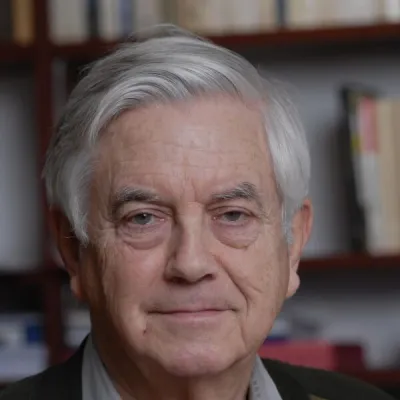
Frits Bolkestein
Human Design Chart
Biography
His father Dr. Nicolaas "Nico" Bolkestein (27 July 1910, Den Haag- 3 December 1993, Deventer) was a lawyer, after the war judge in Leeuwarden and Social Democratic major of Middelburg (1950-1957) and Deventer (1957-1975). His mother Anna Margaretha Meijjes was born in Semarang, Indonesia and became a housewife. They married in 4 March 1926 in Naarden and Frits was their third child.
His grandfather Gerrit Bolkestein (9 October 1871, Amsterdam – 8 September 1956, Den Haag) was Minister for Education, Art and Science from 1939 until 1945, and was part of the Dutch government-in-exile from 1940. Because of that, his father was arrested and kept prison as a hostage in St. Michielsgestel (1942-44). As the family had no income, it was a troublesome time.
He followed the Barlaeus Gymnasium in Amsterdam. He studied mathematics at the Oregon State College, USA from 1951-53. From 1955-59 he studied mathematics and physics, philosophy and Greek at the University of Amsterdam, in 1964 Economics in London and became in 1965 Master at Law at the University of Leiden.
He made from 1960 till 1976 an international career with Shell Group with posts in East Africa (1960-64), Honduras and El Salvador (1965-68), London (1968-70), Indonesia (1970-72) and Paris( 1973-76) as the Director of Shell Chimie, Paris. Thereafter he went into politics for the Liberal VVD (member since 1975).
From 16 January 1978 till 5 November 1982 he member of Parliament for the Liberal VVD party. From 5 November 1982 till 14 July 1986 he was Minister for Foreign Trade under Lubbers. From 3 June 1986 till 24 September 1988 he was again in Dutch Parliament, being Chairman Atlantic Commission of the Netherlands.
From 24 September 1988 till 7 November 1989 he was Minister of Defence under Lubbers II. From 14 September 1989 till 21 September 1999 he was member of parliament again. From 1 May 1990 till 30 July 1998, he was Chairman of the V.V.D.
Human Design Analysis: Frits Bolkestein as Generator 5/1
Generator 5/1 — Design at a Glance
Frits Bolkestein had enormous inner endurance and a high level of life energy. His design marked him as someone who was extremely resilient when engaged in suitable activities, comparable to a workhorse that provides strength for its task as long as it is intrinsically motivated. This energy, however, was not available to him without limits but followed a specific mechanism: It became effective when he reacted to impulses from his environment rather than taking independent initiatives.
The central strategy for Frits Bolkestein was to wait and then respond „from the gut“. When life sent a signal and his inner self confirmed with a clear yes, he could act and materialize things successfully. If he tried instead to fight against this nature – whether through constant initiative-taking or by suppressing his impulses – he fell into a state of frustration.
Two main dangers characterized this pattern. On the one hand, there was a risk of burnout if he expended energy on tasks that he actually had no interest in. On the other hand, he suffered when prevented from working on his heart project, even though he still had plenty of power left. If Frits Bolkestein lived in harmony with this reactive strategy, his design rewarded him with a deep sense of fulfillment and satisfaction. Deviations led inevitably to energy deficiency and the feeling of being blocked. His strength therefore lay not in leadership but in the powerful response to what confronted him.
Emotional Authority
Frits Bolkesteins design showed a tendency towards delayed decision-making: He was someone who consciously postponed spontaneous impulses to gain clarity. This attitude resulted from his emotional authority, carried by the defined Solar Plexus Center. In Human Design mechanics, this authority always takes precedence over other defined centers regardless of further configurations in the chart.
This center is subject to a permanent wave of emotional ups and downs. Perception is always colored by the current mood; something can appear inspiring at one moment but negative the next. Since this immediate feeling is merely a snapshot and not a secure knowledge base, quick emotional decisions carry the risk of negative consequences.
The strategy consists in taking time so that feelings can subside. By repeatedly „sleeping on“ an issue, Frits Bolkestein gains emotional distance. This process of distancing filters out the transient mood wave and allows deeper calmness as well as true insight to emerge. Only when this calm has set in is a decision seen as thoughtful and effective. Patience and conscious hesitation were thus not weaknesses but the necessary mechanism for making long-term life decisions without being guided by fleeting emotional impulses.
The 5/1 Profile — Heretic / Investigator
Frits Bolkesteins design showed a tendency towards a tension-filled dynamic: the necessity to appear as a magnetic problem solver for others while simultaneously protecting a deep, private research process. As a 5/1 (Hero/Researcher), he was someone who attracted those seeking solutions through his aura – a characteristic of Line 5. This attraction could quickly lead to exhaustion if clear boundaries were not set. The design therefore demanded strict crisis management through objectivity and impartiality to exclude emotional influence.
At the same time, Line 1 with its emphasis on secret alliances and hidden relationships was at work. Here lay power in discreet influence; revealing such networks weakened their impact. The challenge was to maintain balance: being available enough to be perceived as a hero but retreating enough not to deplete his own knowledge base or energy reserves through constant requests from the environment. Without this distinction, there was a risk of depletion through continuous demands from the surroundings. However, with the ability to say no, he could preserve the beneficial balance between private research and public problem-solving and optimally utilize his gifts without sacrificing his own integrity or energy.
Split Definition — Defined & Open Centers
Frits Bolkestein showed himself as a person with immense inner dynamism: a constant mental pressure towards inspiration and concept formation, paired with a constant source of vital energy. His design indicated a tendency for deep but often restless thinking, which could only fully unfold through reaction – not initiation.
This constellation resulted from defined Head and Ajna Centers, generating permanent mental pressure to ask questions and understand connections. This pressure was not an instruction to act but a source of inspiration available to others. Simultaneously, the defined Sacral Center provided immense vital energy, which was only accessible when Frits Bolkestein waited for external stimuli and reacted. Any initiative without prior questioning led to this energy drying up or causing frustration.
As an emotional authority, his defined Solar Plexus Center required patience to wait out waves of emotions before clarity emerged. Immediate decisions in emotional highs or lows were often misleading; true insight only arose after traversing the emotional cycle. This was complemented by the defined Spleen Center, offering spontaneous intuition in the present moment, and the defined Root Center, delivering a constant stress pressure to move forward and survive.
In contrast, his open centers showed high adaptability but also vulnerability. The open G Center meant no fixed identity or direction; Frits Bolkestein tended to blend with his environment and often sought orientation from others rather than determining it himself. The open Heart Center lacked consistent willpower; he was not designed to keep promises or compete, instead learning to let go of the pressure to prove himself. The open Throat Center led to situational and unpredictable communication – he spoke spontaneously when allowed by the environment but could not maintain a constant rhetorical line. This openness protected him from overexertion but made him dependent on the quality of his surroundings.
Channels for doubt, principles, ambition, growth and abstraction.
Frits Bolkestein showed through a complex interplay of analytical skepticism and deep tribal cohesion. His design indicated a tendency for rigorous pattern scrutiny, always flanked by emotional loyalties. The Logic Channel 63-4 connected the Gate of Doubt with the Gate of Formulation; this created a mind that constantly checked whether patterns were consistent before giving answers. It was healthy skepticism that rejected unfounded beliefs and only accepted what could be practically verified. Parallel to this, the Abstraction Channel 64-47 between the Gate of Confusion and the Gate of Understanding filtered every experience through mental images to recognize deeper stories or meanings behind things, even if it initially led to inner unrest.
This cognitive work served not just individuality but was strongly embedded in social structures. The Synthesis Channel 19-49 connected the Gate of Claims with the Gate of Principles and acted as an emotional glue for family or tribe. It ensured that belonging was defined through shared values and loyalty, where deviations from these ideals were rejected. This cohesion formed the basis for the Transformation Channel 54-32, linking the Gate of Ambition with the Gate of Continuity. Here a drive towards social advancement and recognition emerged, motivated by the desire to strengthen the tribe and secure his position.
The framework for these dynamics was set by the Maturation Channel 42-53 between the Gate of Growth and the Gate of Beginnings. It structured life into complete cycles: experiences had to be run through to completion and reflected upon to gain wisdom from them. Frits Bolkestein thus learned not through isolated facts but by completing processes and putting resulting patterns – tested through logic and abstraction – in service of tribal loyalty and personal advancement.
Collective Circuitry — Circuit Signature
Frits Bolkesteins design showed a clear split between rational future planning and emotional past processing. The Understanding Circuit connected his Head and Ajna Centers, describing the ability for logical strategy and focused insight generation – directed towards the future, free from emotional coloring. Parallel existed the Meaning Finding Circuit as a separate entity: Here two isolated segments flowed. The first reconnected Head and Ajna Centers (through Abstraction), the second Sacral and Root Centers (through Maturation). This created a cyclical, emotional depth for reflecting on the past that did not directly merge with rational logic. Instead, these forces stood side by side: cool ratio on one hand, wave-like emotional cycles on the other. The Ego Circuit rounded out the operational field and connected Spleen, Root, and Solar Plexus Centers. This promoted cooperation and resource management through exchange ("Giving and Taking") rather than individual endurance. As there was no connection to the Sacral Center, rest for regeneration was essential here. Frits Bolkestein thus acted in separate energetic blocks: strategic clarity for the new, emotional cycles for the old, and cooperative resource utilization in social fields – all parallel but not directly transitioning into one another.
Left Angle Cross of Endeavour 1
Frits Bolkesteins Design established a foundational disposition characterized by the 'Left Cross of Effort'. This described a path of active endeavor and striving for meaning or result. This configuration formed the overarching life context of his energetic alignment.
In Human Design, such a cross does not denote a specific behavioral mechanism like Gates or Channels but rather a deeper structural orientation. In Frits Bolkestein's case, this was an inner dynamic of effort. It was not superficial action but a sustained process of engagement towards a goal. This orientation shaped his experience of the world through the filter of effort and the desire for a meaningful response or tangible result.
The mechanics of the cross here act as a framework in which his life unfolds. They do not define the 'How' in detailed behavior, but rather the 'Why' behind energy application. For Frits Bolkestein, this context of effort was constitutive. He did not seek passive surrender but active shaping through commitment. This created a tension in his life that arose from striving itself. The significance lay less in mere success and more in the quality of effort and the search for meaning within this process. This energetic signature provided the backdrop for his entire existence, independent of external circumstances or specific events. It was the constant undercurrent of his personal architecture.
Saturn Return · Uranus Opposition · Chiron Return · 2nd Saturn Return — Life Cycles
Frits Bolkestein's political identity formed through clear, cyclical turning points. In 1975 at age 41, he joined the liberal VVD party. This step fell into the phase of Uranus opposition. In this astrological cycle, old structures clash with new impulses, often leading to a conscious break with previous patterns and reorientation. For Bolkestein, this marked his structural entry into organized political life.
Six years later in 1982 at age 48, he was appointed Minister for Foreign Trade under Lubbers. This occurred during the Chiron Return cycle. From a Human Design perspective, this is not a phase of healing but an achievement cycle: one's incarnation cross unfolds increasingly in life if strategy and authority are observed. Meaning and purpose become experiential. Bolkestein's appointment signaled the concrete realization of his political destiny into a key governmental position.
In 1990 at age 56, he was finally elected chairman of V.V.D. This fell during the second Saturn Return. While the first return often lays the groundwork, the second cycle consolidates the achieved position and anchors it long-term. It's about responsibility, authority, and institutional recognition confirming one's path. These three events show how astrological cycles for Bolkestein did not remain abstract phases but set concrete career milestones: from entry to ministerial responsibility to party leadership. Each step corresponded with the respective energetic quality of the cycle.
Generator · Emotional Authority — Synthesis
Frits Bolkestein seems to have been marked by a deep inner logic and the drive to recognize patterns (Channel 63-4) – an ability that manifested in his engagement for clear structures and understanding complex interconnections. This mental sharpness combined with a pronounced sense for the collective, the need to contribute through his work to the community (Ego Circuit). The connection between Head Center and Ajna Center points towards a persistent search for understanding, which was however always filtered by the necessity of practical application and proof. His energy seemed focused on collecting experiences and integrating them into a coherent system from which wisdom could be derived for others (Sensing Meaning Circuit).
A central tension field lies in the combination of his defined Root Center – generating constant pressure to act – with open centers for identity and emotions. Bolkestein was thus equipped with an inner driving force that propelled him towards achievement and influence (Gate 54), yet also vulnerable to external influences and conditioned to prove his worth through goal attainment. This discrepancy may have led to a continuous oscillation between the need for autonomy and the search for validation in the community.
5 Defined Channels
Incarnation Cross - Left Angle Cross of Endeavour 1
Solar Return
The Solar Return shows the moment when the sun returns to its exact birth position - your personal solar year.
Life Cycles
Discover the life cycles with a detailed triple view (birth chart, cycle chart, composite).
Human Design Profile
- Type
- Generator
- Strategy
- To respond - wait for something to respond to
- Authority
- Emotional Authority
- Profile
- 5/1 - Heretic / Investigator
- Definition
- Split Definition
- Incarnation Cross
- Left Angle Cross of Endeavour 1
- Date of Birth
- 04.04.1934 08:30
- Place of Birth
- Amsterdam, Netherlands
Frequently Asked Questions
What is Frits Bolkestein's Human Design type?
What Profile does Frits Bolkestein have in Human Design?
What Authority determines Frits Bolkestein's decisions?
What incarnation cross does Frits Bolkestein have?
When was Frits Bolkestein born?
Discover your own Human Design
Are you also a Generator? Find out in a personal reading how to use your sacral energy correctly and discover deep satisfaction.
More Personalities
Back to overviewAaliyah

Alexia

Angèle

Anne-Marie

Arcángel

Arno
