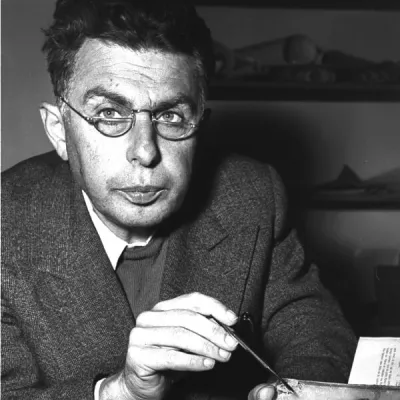
Fritz Brotzen
Human Design Chart
Biography
Brotzen dropped out of high school before graduating and went to Palestine as a convinced Zionist, where he stayed for seven years. In addition to his work, he collected fossils in the Carmel Mountains and published his findings and observations, including the first scientific mention of Misliya cave.
Returning to Germany, he attended natural science courses at the Friedrich Wilhelm University in Berlin for three years. In 1931 he obtained his doctoral degree at the University of Halle-Wittenberg.
As late as 1933, immediately after the seizure of power by the NSDAP (Nazi Party), Brotzen emigrated to Sweden, where he lived and researched until the end of his life. In 1954-1955 Brotzen worked in Israel on behalf of UNESCO.
Brotzen died on 4 August 1968 in Danderyd, Sweden, aged 66.
Fritz Brotzen as a Generator 5/2 in Human Design
Generator 5/2 — Design at a Glance
Fritz Brotzen's design points to a tendency for great endurance and inner drive. As a Generator, he had plenty of sacral energy, which made him work like a strong workhorse—provided he had the energy for his task. His Human Design pointed out two central pitfalls: first, doing things persistently without inner desire, which could lead to burnout, and second, holding back from his heart's project even though he still had plenty of power.
The mechanics of his design emphasized that his "manifesting" worked differently than it does for Manifestors. His energy became free mainly when he responded to impulses. The motto was not to initiate but to react. The most successful strategy for him involved waiting for a signal from life and then, when the sacral center said, "Yes! Let's get started!", responding with action.
If Fritz Brotzen lived in harmony with this design, nothing could stop him. He would be rewarded with deep satisfaction and a sense of profound fulfillment. However, if he did not follow his design—especially if he constantly initiated things himself—he likely encountered persistent frustration and a lack of energy sooner or later. His path was marked by reacting from the gut.
Emotional Authority
Fritz Brotzens inner authority was the defined Solar Plexus Center, making him an Emotional Authority. This configuration fundamentally determined his decision-making: He was subject to a wave-like emotional dynamics that manifested in constant ups and downs of his feelings. The world appeared colored by his current mood; at one moment he could be totally enthusiastic about something, only to see it negatively the next moment. His immediate feeling, however, was just a snapshot, a first impression that did not necessarily represent his truth yet. Quick, spontaneous decisions based on such emotions often had negative consequences.
The mechanics of his authority required patience and time. The longer he let a decision ripen, the deeper and more comprehensive he could perceive the situation. This involved consciously sleeping on decisions and hesitating to be asked multiple times. Over time, intense feelings subsided, he gained emotional distance, clarity emerged, and calmness set in. Only then had he gone through the process and could make an informed choice. This strategy was particularly important for long-term decisions with significant influence on his life course. Since the Solar Plexus Center was defined, this emotional authority always took precedence over other defined centers in his chart, regardless of their number or type. They shaped his inner orientation sustainably.
The 5/2 Profile — Heretic / Hermit
Fritz Brotzens design sets a tendency towards an internal conflict: the desire for recognition and admiration paired with a strong need for withdrawal and alone time. As a 5/2 (Hero/Natural Talent), he combined the public presence of Line 5 with the private introspection of Line 2. Unlike obvious hero archetypes, he often hid his gifts in his "cave". As long as the outside world did not discover him, he used this isolation to internally strengthen himself and work on himself.
However, this pattern carried risks: passive waiting for discovery could lead to bitterness and frustration since the hero role hardly functions in the "lone wolf" mode. The mechanics here showed a need for self-reflection regarding overly high expectations of oneself and others. The path led towards actively stepping onto the stage rather than waiting for it.
Gate 15 (Line 5) emphasized his ability to adapt during crisis times through extreme stances and growth via Jupiter energy, but warned against overcompensating Pluto tendencies that disrupted the natural flow. Simultaneously, Gate 17 (Line 2) projected his discernment outward. Here, the principle was: he who wishes to rule must be able to serve. Fritz Brotzens design challenged him to navigate this polarity of shyness and authority by setting clear boundaries and sharing his insights only when he was ready to take on a public role actively.
Split Definition — Defined & Open Centers
Fritz Brotzen's Human Design profile indicated a tendency towards a powerful yet patient lifestyle. As a Generator with a defined Sacral Center, he had an inner engine that generated vital energy – a source of endurance and satisfaction, but one that could only be properly utilized through reactions to external impulses. Initiating actions without prior invitation typically led to frustration and exhaustion in him, as the sacral power would then be lacking.
This energy was filtered through his defined Solar Plexus Center, which allowed emotional clarity only after processing the wave of feelings. Fritz Brotzen showed himself to be someone who did not make decisions impulsively but waited until the emotional wave revealed its truth. This gave depth and resonance to his judgments, though it required discipline to avoid falling into emotional impulsivity.
Additionally, his defined Spleen Center (intuitive survival consciousness in the present) and defined Root Center (persistent stress pressure for forward movement) shaped his physical presence and engagement. His instinct protected him from unwanted situations while the root pressure propelled him forward.
At the same time, Fritz Brotzen was vulnerable to conditioning through several open centers. The open Head Center made him easily distracted by foreign questions or mental pressure; he tended to question whether he needed inspiration rather than trusting his inner authority. His open Ajna Center made his mind flexible but also prone to adopting others' ideas as his own truth or pretending uncertainty.
The open G Center meant that he did not carry a fixed identity, instead reflecting in relationships and environments. He did not actively seek direction but waited to be led to the right place; wrong places immediately produced a feeling of misalignment for him. Finally, the open Heart Center resulted in his lacking consistent willpower. Attempts to prove himself through promises or competitive thinking often ended in self-doubt as he lacked the energy for such commitments. His strength lay in recognizing these pitfalls and instead trusting his sacral reaction and emotional clarity.
Channels for syncretic pressure and caring values.
Fritz Brotzen was deeply rooted in consciousness for cohesion and care. His design indicated a tendency to secure the stability of his environment through emotional bonding and practical provision. This attitude resulted from the interplay of two central channels in his chart.
The Synthesis Channel 19-49 connected his Root Center with the Solar Plexus. This mechanism created an intuitive sensitivity for the needs of the 'tribe' – whether family or close circle. Fritz Brotzen sought principles that held this community together. It was not about abstract logic but emotional glue from loyalty and mutual support. He wanted to be needed while ensuring his own basic needs for protection and territory were respected. This channel shaped his ability to balance feasibility and fairness, often showing himself through a sensitive reaction to the emotional wavelength of others.
Parallel to this, the Preservation Channel 27-50 connected his Sacral Center with the Spleen Center. Here, Fritz Brotzen showed himself as a natural provider. His aura attracted trust because he was willing to take responsibility for others – whether through direct care or preserving traditional values and laws that protected community well-being. However, this channel also taught him that true provision is only possible from one's own strength; he had to learn to preserve his own energy first to help others sustainably.
Additionally, Gates like Gate 10 (Integration and genetically fixed behavior) as well as Gate 37 (organic community structures) contributed to Fritz Brotzen often taking an integrative role in social frameworks. He understood the complex interplay between individual and group and sought ways to maintain this harmony. His life was thus shaped by a drive both emotionally and practically to create a safe and supportive environment.
Tribal Circuitry — Circuit Signature
Fritz Brotzen's design showed a tendency towards emotional synthesis, paired with a deeply rooted instinct for preservation. These separate forces worked in parallel as his Split Definition formed two independent groups: Root and Solar Plexus Center on one side, Sacral and Spleen Center on the other.
In the Ego Circuit, Channel 49-19 (Synthesis) connected the emotional center with that of instincts. This promoted the ability to process feelings into understandable contexts. Since this circuit did not connect to the Sacral Center, this emotional work required regular quiet pauses for regeneration.
Parallel to this, in the Protector Circuit, Channel 27-50 (Preservation) linked the constant life force of the Sacral Center with the intuitive knowledge of the Spleen. This configuration supported instinctive preservation and nurturing, a deep need for protection and care for one's environment.
Both circuits contributed to support but their energies did not flow into each other. Fritz Brotzen moved between processing emotional waves through synthesis and silent, instinctive conservation of resources. This duality shaped his inner world: on the one hand reflecting on the structured, on the other hand the primal power of protection.
Left Angle Cross of Prevention 1
Fritz Brotzen's design inclined him towards preventive action aimed at nipping potential problems in the bud. This foundational approach stemmed from the influence of his left cross, a configuration that combined strategic foresight with an ability to identify risks early on.
Instead of reacting to acute crises, his inner compass sought ways to secure stability through proactive measures. It was less about reactive problem-solving once damage had occurred and more about shaping conditions so that accidents or errors could not occur in the first place. This mechanism fostered a sense of responsibility and protection, both for himself and his environment.
The energy of this cross acted like a filter, identifying potential danger sources before they could spread. Thus, Fritz Brotzen was someone who valued safety and planning, not out of fear but from a desire to ensure long-term sustainability. Through this preventive orientation, he often avoided chaos by bringing structure and clarity into uncertain situations. His design supported him in taking the right steps at the right time to prevent negative developments.
Saturn Return · Uranus Opposition · Chiron Return · 2nd Saturn Return — Life Cycles
Fritz Brotzen's design inclined him towards structured, goal-oriented action that crystallized into clear milestones. He combined inner discipline with outer form – a pattern often leading to maturity during the first Saturn Return.
This cycle marks the transition from an experimental phase to binding structures. In Human Design, this does not merely mean aging but integrating earlier experiences into a sustainable life architecture. The first Saturn Return typically occurs between 28 and 30 years of age, challenging the individual to stabilize their identity on a new level.
Fritz Brotzen earned his doctorate at the University of Halle-Wittenberg in 1931 – at the age of 29. This event was no coincidence but precisely aligned with the rhythmic call of his design: years of academic groundwork culminated in formal recognition. The promotion marked both the end of a learning cycle and the start of a phase of greater responsibility.
For his design, this moment was particularly formative as it established a connection between personal development and public acknowledgment. The Saturn Return acted here as a catalyst, translating inner clarity into external validation. Fritz Brotzen used this energy not only for self-assertion but also to anchor his expertise in a broader community – a typical pattern for individuals with similar configurations.
Generator · Emotional Authority — Synthesis
Fritz Brotzen lived a life deeply influenced by an inner dynamism. As a Generator, he possessed immense endurance and the ability to generate energy – as long as it flowed into fulfilling activities (Sacral Center). However, this power source was always tied to his emotional wave (Emotional Authority), meaning that decisions required time to clarify and produce authentic reactions. The Profile of Hero/Natural Talent suggests both a desire to serve others and the need to withdraw and develop his gifts in peace. Channel Synthesis (19/49) amplified this tendency by combining a strong sense of belonging with high personal principles.
A central paradox in Fritz Brotzen's design lay in the interplay between energy readiness and emotional maturity. He was destined to be active and shape things, yet his decisions had to pass through the filter of the emotional wave – a process requiring time and patience. This tension between the urge for activity and the need for inner clarity shaped his path, particularly regarding professional goals like achieving a doctorate (Saturn Return), where it concerned the materialization of objectives.
2 Defined Channels
Incarnation Cross - Left Angle Cross of Prevention 1
Solar Return
The Solar Return shows the moment when the sun returns to its exact birth position - your personal solar year.
Life Cycles
Discover the life cycles with a detailed triple view (birth chart, cycle chart, composite).
Human Design Profile
- Type
- Generator
- Strategy
- To respond - wait for something to respond to
- Authority
- Emotional Authority
- Profile
- 5/2 - Heretic / Hermit
- Definition
- Split Definition
- Incarnation Cross
- Left Angle Cross of Prevention 1
- Date of Birth
- 25.06.1902 10:00
- Place of Birth
- Stettin, Germany
Frequently Asked Questions
What was Fritz Brotzen's Human Design type?
What profile did Fritz Brotzen have?
What authority did Fritz Brotzen have?
What incarnation cross did Fritz Brotzen have?
When was Fritz Brotzen born?
Discover your own Human Design
Are you also a Generator? Find out in a personal reading how to use your sacral energy correctly and discover deep satisfaction.
More Personalities
Back to overviewAaliyah

Alexia

Angèle

Anne-Marie

Arcángel

Arno