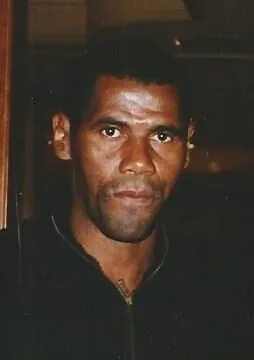
Photo: Wikimedia Commons
Fritz Walter
Human Design Chart
Biography
Fritz Walter was named an honorary captain of the German football squad in 1958.
He died 17 June 2002.
Fritz Walter as a Generator 1/3 in Human Design
Generator 1/3 — Design at a Glance
Fritz Walter revealed himself as someone with remarkable endurance and a fundamental tendency not to take the first step on his own but rather wait for external signals. His Generator design endowed him with a high capacity for continuous work; he was essentially an energy carrier, comparable to a working horse in strength and constancy – provided that he acted from inner consent. This structure also entailed specific risks: When Fritz Walter did things he didn't want to do, he wasted his energy and tended towards exhaustion. Conversely, he suffered when prevented from undertaking tasks where he was full of drive.
The key to maintaining his energy lay in the strategy of reacting rather than initiating. His energy became effective when the sacral center – often described as gut feeling – gave a clear “yes”. Instead of starting projects independently, he waited for impulses from life and then responded with action. If Fritz Walter lived by this pattern, it led to deep fulfillment. Initiating out of his own initiative or acting against his inner signal resulted in frustration and a lack of energy. His satisfaction thus depended directly on whether he followed this rhythmic response to life's impulses.
Sacral Authority
Fritz Walter oriented himself in his decisions based on an immediate, physical resonance. His design saw the Sacral Authority as the primary decision-making instance, meaning that he did not act through analysis or planning but reacted to external stimuli. This reaction manifested physically: A grunt, a hum, or a noticeable surge of energy signaled him the right direction.
As a Generator, Fritz Walter had direct access to inexhaustible energy and enthusiasm once his sacral motor was engaged. This vitality only appeared when he oriented himself towards this inner response. The strategy involved waiting for an external impulse and then awaiting this physical confirmation. This greatly simplified his process as authority aligned with his life strategy.
Important for his functioning was the open emotional center, preventing him from making decisions in emotional troughs where clarity was lacking. Instead, he learned to trust his “gut feeling”. When this resonance occurred, he approached matters with great satisfaction and joy without seeking an external purpose. His actions were marked by this inner confirmation, allowing him to dissolve into activities naturally and show a natural endurance. Physical vitality thus served as a reliable indicator of correct action rather than intellectual premeditation.
The 1/3 Profile — Investigator / Martyr
Fritz Walter showed himself as someone who not only gathered knowledge but tested it on his heart and conscience through personal actions. His design tended towards connecting theoretical foundations with practical experience, thereby lending credibility to his judgments. When he deemed something good, this was the result of double validation: grounded by study and confirmed by reality.
This attitude stemmed from his Profile 1/3, the Researcher and Experimenter. Line 1 drove him to always learn more and prepare theoretically. This could, however, lead to fear of not knowing enough to act. Simultaneously, Line 3 demanded testing and learning from mistakes. The inner conflict between the need for complete preparation and the impulse to act shaped his path. Only through this process of trial and error did self-earned, trustworthy insights emerge.
Additionally, specific dynamics in his chart influenced him. The energy of Gate 44 emphasized the necessity of clear agreements and hierarchies for economic success and harmony within a collective. Parallel to this, Line 3 (Gate 33) called for phases of withdrawal for reflection followed by stepping outwards to take responsibility and share insights with others. Fritz Walter lived this balance of withdrawing for processing and actively bringing tested truths into his environment. His design thus described a personality that developed expertise validated through personal experience while utilizing both structural clarity and personal adaptability.
Split Definition — Defined & Open Centers
Fritz Walter was revealed as a Generator with a powerful but reactive energy base. His design was characterized by a constant internal pressure to think and question, caused by the defined connection between Head and Ajna Center. This mental flow ran continuously, generating inspiration, yet lacking direct energy for implementation often led to frustration due to initial action. Instead, his strength lay in motivating others through these intellectual impulses.
At the same time, he possessed a reliable existential intuition. The defined Spleen Center gave him spontaneous body awareness of the 'now', helping him intuitively recognize health-promoting or harmful situations. This perception was supported by the also defined Root Center, which provided a constant adrenaline-driven pressure to maintain life impulse and survival instincts. Together with powerful sacral energy, these centers formed a solid foundation for endurance and vitality, assuming he responded to external stimuli rather than initiating action himself.
In contrast, his open centers were areas of receptivity. The open G Center meant that identity and direction were not fixed but situational, taken up from the environment; he tended to find himself in relationships or places offering missing clarity. The lack of a constant willpower in the open Heart Center made him vulnerable to the pressure of proving his worth through promises he could not keep. Additionally, his open Solar Plexus absorbed foreign emotions, causing him to oscillate between his own and adopted feelings. Finally, his communication in the open Throat Center was variable; he attracted attention without actively seeking it, speaking spontaneously when circumstances allowed rather than following a fixed plan.
Channels for life's meaning, mental images and focused detail depth.
Fritz Walter exhibited a calm, almost motionless physical presence that starkly contrasted with his inner combative dynamism. His design was marked by the Channel of Concentration 52-9, an identity energy between Root and Sacral Center. This connection of Gate 52 (Non-action) and Gate 9 (Focus) created a constant pressure for stillness. Fritz Walter had to remain still to evaluate details precisely; his physical body served as an anchor that kept distractions at bay so he could focus on perfecting patterns. This logical, step-by-step approach required patience and identification with a single formula or task.
Simultaneously, the Personality drove him through the Channel of Life Struggle 38-28. Here, Gate 38 (Fighter) connected with Gate 28 (Player), creating an adrenaline-driven will for individuation. Fritz Walter actively sought meaning in his struggles and stubbornly resisted external forces threatening his integrity. This channel prompted him to fight against poor odds to find individual significance, often acting as a mutative force challenging the status quo.
Mentally, he was shaped by the Channel of Abstraction 47-64 along with additional gates like 33 (Reflection) and 24 (mental mutation). The channel 47-64 connected Gate 64 (Confusion) to Gate 47 (Understanding), generating an active, experience-based mind. Fritz Walter filtered experiences through mental images, seeking stories and perspectives to impart meaning, even if this initially caused confusion. Only through patience did clarity emerge, which he then shared as inspiring narratives. Gate 33 promoted withdrawal for reflection while Gate 24 supported the process of renewal in the rhythm of the pulse. Additional influences like Gate 19 (Resources/Territory) and Gate 44 (Transformation through interaction) rounded out his profile, focusing on security in relationships and cellular memory.
Collective Circuitry — Circuit Signature
Fritz Walter was characterized by separate, parallel functioning energetic fields. His design did not contain continuous connections between all defined areas but rather isolated power blocks. The Knowledge Circuit connected Spleen and Root Center via Channel 28-38 (Life Struggle). This created a pulsing energy for individual transformation and new identity driven by the primal path. Parallel to this, the Understanding Circuit linked Sacral and Root Center through Channel 9-52 (Concentration). Here, cool logic and strategic structure aimed at improving the future prevailed without emotional influence. This rational focus contrasted with the impulsive drive of the Knowledge Circuit. A third independent field formed by the Meaning-Finding Circuit with Head and Ajna Center (Channel 64-47, Abstraction). This area processed emotional waves from the past, cyclically reflected experiences, and sought deeper meaning for collective learning. The tension between the creative mutation urge of the Spleen-Root connection, the strategic rationality of the Sacral-Root axis, and the emotional past reflection of the Head-Ajna domain shaped his operational dynamics. This divided definition meant that these forces did not act as a continuous flow but as separate, coexisting impulses activating Fritz Walter in different contexts.
Right Angle Cross of the Four Ways 3
Fritz Walter lived with a profound inner complexity that required him to synthesize four seemingly disparate existential paths into a coherent whole. His design indicated that identity was not a static state but an ongoing process of integration. The challenge lay in experiencing these four aspects of being and doing not as contradictory forces, but actively aligning them with one another. This necessitated constant inner work towards reconciliation and unification.
This configuration is known in Human Design as the 'Right Cross of Four Paths 3'. It does not describe a simple linear life path but rather the task of shaping various life domains—whether spiritual, material, emotional, or intellectual—into an integral identity. For Fritz Walter, this was both his central gift and ongoing test: forging a unified, coherent personality from the diversity of his experiences. The goal was not to choose one path and discard others, but to weave all four strands into a strong web. This synthesis defined his inner stance and how he positioned himself in the world—always striving for wholeness rather than unilateral specialization.
Saturn Return · Uranus Opposition · Chiron Return · 2nd Saturn Return — Life Cycles
Fritz Walter's life followed the structural turning points of classical astrological cycles that served as frameworks for maturation and identity shifts. The first Saturn return around age 28 marked a phase of consolidation and assuming responsibility. This was concretely seen in 1948 when Fritz Walter married Italia Bortoluzzi—a step signaling the establishment of a stable relationship framework.
The Uranus opposition around age 39 often brings a necessary break with established roles or identities to make way for new developmental phases. Fritz Walter experienced this turning point in 1959, ending his active football career with a farewell match. This step aligned with the archetypal pattern of the cycle: the end of a long-standing public role to facilitate transition into a new chapter of life.
The Chiron return, which in Human Design is seen as a fulfillment cycle where meaning and purpose become increasingly experiential, occurred around age 48. In 1968, Fritz Walter became Master of the Regionalliga Southwest. This success underscores the dynamics of the cycle: after letting go, a new form of effectiveness and validation emerged on another level.
Finally, the second Saturn return around age 55 often comes with societal recognition and consolidation of life's work. In 1975, Fritz Walter received the Grand Cross of the Order of Merit of the Federal Republic of Germany. This award reflects the cumulative effect of his previous paths and confirms the conclusion of a long phase of public responsibility and achievement.
Generator · Sacral Authority — Synthesis
Fritz Walter was a Generator whose life was marked by an unstoppable urge towards activity and a deep need to bring energy into the world. His sacral authority (the body's reaction to external stimuli) led him, when he connected with the right tasks, to seemingly inexhaustible vitality and joy in action. As a Researcher/Experimentator (Profile 1/3), he constantly sought new insights, thoroughly tested them, and was ready to learn from mistakes—a process amplified by his defined Mental Center, which created constant pressure for understanding and questioning. This focus on details and facts (Channel 52/9) enabled him to direct his energy purposefully and create formats.
A central paradox in his design lay in the interplay of sacral endurance and constant mental pressure. On one hand, he fully lived out Generator energy when working with enthusiasm (Sacral Center), on the other hand, continuous inspiration and the need for understanding (defined Head Center) led to inner restlessness and concern. The cycles showed that success and recognition often came with phases of upheaval and transformation—a sign that he was following his unique path through a combination of practical action and intellectual curiosity.
3 Defined Channels
Incarnation Cross - Right Angle Cross of the Four Ways 3
Solar Return
The Solar Return shows the moment when the sun returns to its exact birth position - your personal solar year.
Life Cycles
Discover the life cycles with a detailed triple view (birth chart, cycle chart, composite).
Human Design Profile
- Type
- Generator
- Strategy
- To respond - wait for something to respond to
- Authority
- Sacral Authority
- Profile
- 1/3 - Investigator / Martyr
- Definition
- Split Definition
- Incarnation Cross
- Right Angle Cross of the Four Ways 3
- Date of Birth
- 31.10.1920 21:15
- Place of Birth
- Kaiserslautern, GER
Frequently Asked Questions
What was Fritz Walter's Human Design type?
What Profile did Fritz Walter have in Human Design?
Which Authority guided Fritz Walter?
What incarnation cross did Fritz Walter have?
When was Fritz Walter born?
Discover your own Human Design
Are you also a Generator? Find out in a personal reading how to use your sacral energy correctly and discover deep satisfaction.
More Personalities
Back to overviewAaliyah

Aldair
Alexia
Angèle

Anne-Marie

Arcángel