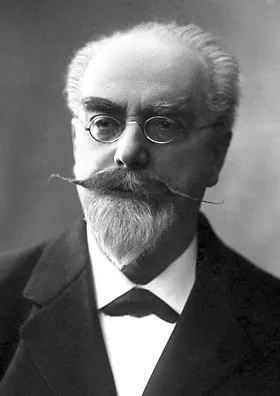
Gabriel Lippmann
Human Design Chart
Biography
In 1886, Lippmann's scientific interest turned to a method of fixing the colours of the solar spectrum on a photographic plate. By April 1892, he was able to report that he had succeeded in producing colour images of a stained glass window, a group of flags, a bowl of oranges topped by a red poppy and a multicoloured parrot. He presented his theory of colour photography using the interference method in two papers to the Academy of Sciences, one in 1894, the other in 1906.
Lippmann's process foreshadowed laser holography, which is also based on recording standing waves in a photographic medium. Denisyuk reflection holograms, often referred to as Lippmann-Bragg holograms, have similar laminar structures that preferentially reflect certain wavelengths.
Lippmann made several other important contributions to various branches of physics over the years, including the capillary electrometer, the converse piezoelectric effect, integral photography and the coelostat.
He died on 13 July 1921, aged 75, aboard the steamer France while en route from Canada.
Human Design Analysis: Gabriel Lippmann as Generator 6/2
Generator 6/2 — Design at a Glance
Gabriel Lippmann's design showed a tendency towards great endurance and inner drive. As a Generator, he had plenty of sacral energy that made him extremely strong and resilient – provided this power was used for tasks he actually enjoyed. His life force ignited mainly when he did not initiate himself but reacted to signals from his environment. The motto 'Do not initiate, react' was central: Only when the sacral center sent a clear 'Yes! Let's get started!', could he respond with action and effectively materialize his energy.
If Gabriel Lippmann lived in harmony with this strategy, his design rewarded him with a deep sense of fulfillment and satisfaction. No one could stop him when he acted from his gut feeling. However, if he went against his natural rhythm – for example by doing things that did not bring him joy or letting himself be held back from his heart project – danger loomed. Then frustration and a lack of energy up to burnout threatened as he wasted his intrinsic creative power. His success thus depended less on mere action than on the right reaction to inner impulses.
Emotional Authority
Gabriel Lippmann's inner authority was emotionally marked. His defined Emotional Center determined this leadership level – a mechanism that always took precedence over all other defined centers in the design, regardless of them. This configuration meant he did not make decisions based on a static rational state but moved in a constant wave of emotions. His perception was always colored by his current mood; a topic could inspire him one moment and appear negative the next.
For Gabriel Lippmann, however, this emotional reaction was only a temporary assessment, not yet his ultimate truth. Quick, spontaneous judgments from such an emotional state often led to false conclusions. Instead, his design required patience and time. He had to let decisions mature, sleep on them multiple times, and consider himself until the initial emotional intensity subsided. Only when these waves ebbed away and he gained emotional distance did clarity set in for him. This process of delay was not an obstacle but the necessary path to a calm, well-founded insight that profoundly shaped his life journey.
The 6/2 Profile — Role Model / Hermit
Gabriel Lippmann's design showed a tendency towards experimental learning that only later in life transformed into deep wisdom. As a 6/2 Profile, he acted like a Three Line before the age of thirty: He sought answers through trial and error, withdrew after failures, and gathered personal experiences. This early phase was followed around age thirty by a shift. The Six Line became active, prompting him to reflect on his past experiments from a distance. This period of intense reflection served for healing and deep self-knowledge.
From this inner work emerged eventually a role as an example and natural talent. His Line 2 at Gate 8 projected a signal for contributing to the collective, often unusual and selfless. He no longer lived only for his own answers but used his intuition to serve others. However, this individual contribution could end in crises or not always be recognized by group goals. Nevertheless, he emerged as a wise person from his metaphorical 'cave'. Others sought him out to partake in his life wisdom and learn the ability of deep introspection. His development was marked by patience and self-control that arose from repeatedly overstepping boundaries.
Triple Split Definition — Defined & Open Centers
Gabriel Lippmann's design showed a tendency towards consequent, conceptual clarity through his defined centers in the Ajna and Throat. He had a consistent mental function that processed concepts in an always uniform way; these thoughts flowed directly into his communication. His voice was not impulsive guessing but rather the expression of what his mind conceptualized. This gave him a reliable way to express himself without being easily influenced by external opinions.
At the same time, he had a defined G Center that gave him a firm self-identity and sense of direction. He knew who he was and could convey this inner security to others without needing to control their paths. This magnetic presence was fueled by his defined Sacral Center, the motor of his vital energy. As a Generator, he relied on responding to questions or invitations rather than initiating himself. Only then did he have the necessary strength to carry tasks through to completion and avoid frustration.
His emotional realm was marked by a defined Solar Plexus Center. Here lay his inner authority: He had to wait out the waves of his feelings before making decisions. Immediate action in emotional highs or lows led him to chaos; clarity only emerged afterward. His Root Center was also defined, providing a constant, adrenalized pressure that propelled him forward and helped him deal with existential stress.
In contrast, his open Head Center revealed an openness to mental confusion. Without a consistent source of inspiration, he tended to get entangled in questions that were not his own or overwhelmed by doubts when trying to understand everything immediately. His open Heart Center made him vulnerable to the pressure of proving his worth through promises – a cycle leading only to disappointment without trust in his inner authority. Furthermore, his Spleen Center was open, triggering deep survival fears and the risk of impulsive decisions to feel temporarily secure. These open centers challenged him not to act spontaneously or cling to unhealthy attachments but to develop wisdom through patience and reaction.
Channels for structure, rhythm and mystical synthesis.
Gabriel Lippmann's design showed a tendency towards innovative direction-setting paired with a profound sensitivity for tribal connection. This configuration was evident in the Beat Channel 14-2, connecting his Sacral Center with his G Center. Gate 14 focused on making material resources available to drive mutation, while Gate 2 as Driver directed higher knowledge and movement through space and time. This gave him a powerful resource for creative life force that reinforced directional change. He was capable of bringing new directions by trusting the reaction from his Sacral, even without foreseeing where it would lead.
At the same time, emotional waves of belonging were shaped by the Synthesis Channel 19-49 between Root and Solar Plexus Centers. Gate 19 pushed for manifestation of togetherness while Gate 49 rejected everything incompatible with highest ideals. This formed the tribal foundation for connection; Lippmann sought balance between feasibility and fairness within his community. His gift lay in being recognized as someone who always strengthened cohesion.
On a mental level, the Structuring Channel 23-43 between Ajna and Throat Centers worked. Gate 43 received spontaneous insights that were assimilated and expressed through Gate 23. This allowed him to communicate unique perspectives clearly and promote efficiency. His thinking often felt forward-looking; recognition came when his statements occurred at the right time.
Individual Gates complemented this picture: Gate 4 developed formulas for clarifying suspicious patterns for future security. Gate 8 promoted individual contribution and identity expression as a creative role model. Gate 24 transformed knowledge in the rhythm of the pulse, while Gate 17 organized logical teaching and succession. Gate 47 created clarity from collective past, Gate 30 recognized feelings and fate, Gate 13 collected experiences for continuity, and Gate 42 enabled process completion through sacral power.
Individual Circuitry — Circuit Signature
Gabriel Lippmann's design showed a tendency towards separate, parallel operating energy fields. As a Triple-Defined individual, he possessed three independent energy blocks that did not flow directly into one another but existed as distinct focal points in his life.
The Knowledge Circuit formed two isolated segments: Once the Channel 43-23 connected Ajna Center with Throat Center. This allowed for clear structuring of thoughts and their precise expression. Parallel to this, the Channel 7-14 linked Identity and Sacral Centers. Here a rhythmic 'beat' was shown that shaped his individual expression through internal pulsations. These two strands – intellectual clarity and bodily rhythm – were energetically separate but existed alongside each other as firm pillars of his personality.
The second field came from the Ego Circuit. Here, Channel 49-19 connected Solar Plexus Center with Root Center. This connection generated a synthesis-like energy that translated emotional waves into concrete action impulses. Since this center pair was not linked to the other two groups, this emotional dynamics operated independently of his intellectual structuring or rhythmic sense. Gabriel Lippmann thus moved always in the tension field of these three separate but equally valid energetic realities without them melting into a single continuous flow.
Left Angle Cross of Revolution 2
Gabriel Lippmann's design indicated a tendency towards radical and systematic upheaval. He was someone whose internal compass pointed not towards gradual adaptation but towards the complete dismantling of old structures. This attitude stemmed from the configuration of the left cross of Revolution 2: an energetic pressure to question existing orders and replace them with new, often unconventional paths.
For his system, this meant that familiar patterns or established norms did not appear stable but rather as obstacles for a deeper truth. The mechanics of this cross promoted the willingness to re-found the basis of something anew instead of merely repairing it. It was not about arbitrary destruction but a necessary process of renewal where old had to give way for new to emerge.
Lippmann lived with this internal logic: the path to resolution often led through negation of the known. His energy sought points where the existing no longer held, initiating revolutionary change there. This shaped his approach to problems – less through compromise but by creating a new foundation on which everything could function differently than previously thought.
Saturn Return · Uranus Opposition · Chiron Return · 2nd Saturn Return — Life Cycles
Gabriel Lippmann's design indicated a tendency towards profound and cyclical transformation processes. This dynamic was particularly evident in his career: In 1886, at the age of 41, he became Professor for Experimental Physics at the Sorbonne. This timing coincided with the Uranus Opposition, a phase often initiating structural upheavals and new professional positions when old conditions no longer fit.
Later, in 1891 at the age of 46, Lippmann introduced the Lippmann process for color photography. This marked his Chiron Return, an achievement cycle between ages 49 to 51 (here slightly displaced or as a precursor), where one's incarnation task increasingly unfolds. Those who live according to their strategy and authority experience a flourishing in this phase: The inner sense becomes tangible and visible. Lippmann's introduction of the process was not an isolated success but the expression of a mature life phase, where years of work condensed into coherent results. His design thus fostered no fleeting achievements but a deep, time-bound unfolding of his purpose that showed its full effect in late middle age.
Generator · Emotional Authority — Synthesis
Gabriel Lippmann was a Generator whose life was marked by a profound interaction between sacral energy and emotional depth. The ability to generate energy through work processes (Sacral Center) seemed inseparable from the necessity not to rush decisions but let them ripen within an emotional wave (Emotional Authority). This interplay led to an internal dynamic that drove him to engage intensively with topics and tread new paths through perseverance – a process accompanied by youthful experimentation (6/2 Profile) followed by deep reflection in later life. The connection from the Sacral Center via the Beat channel points towards a talent for innovation and implementing new ideas.
A central paradox lay in Lippmann's pursuit of knowledge and transformation (Knowledge Circuit) always being accompanied by emotional filtering. While the defined Mental Center was oriented toward consistent conceptual thinking, his emotional authority required a patient engagement with feelings to discern true direction. The documented events – taking over the professorship and presenting the color photography process – showed that success came not through quick action but through maturing ideas in harmony with his inner truth.
3 Defined Channels
Incarnation Cross - Left Angle Cross of Revolution 2
Solar Return
The Solar Return shows the moment when the sun returns to its exact birth position - your personal solar year.
Life Cycles
Discover the life cycles with a detailed triple view (birth chart, cycle chart, composite).
Human Design Profile
- Type
- Generator
- Strategy
- To respond - wait for something to respond to
- Authority
- Emotional Authority
- Profile
- 6/2 - Role Model / Hermit
- Definition
- Triple Split
- Incarnation Cross
- Left Angle Cross of Revolution 2
- Date of Birth
- 16.08.1845 18:00
- Place of Birth
- Luxembourg, Luxembourg
Frequently Asked Questions
What is Gabriel Lippmann's Human Design type?
What profile did Gabriel Lippmann have in Human Design?
Which authority guided Gabriel Lippmann's decisions?
What incarnation cross was decisive for Gabriel Lippmann?
When was Gabriel Lippmann born?
Discover your own Human Design
Are you also a Generator? Find out in a personal reading how to use your sacral energy correctly and discover deep satisfaction.
More Personalities
Back to overviewAaliyah

Alexia

Angèle

Anne-Marie

Arcángel

Arno