
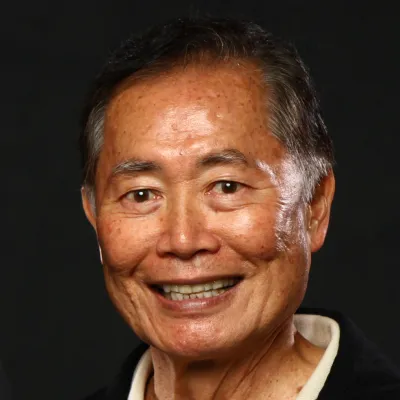
George Takei
Human Design Chart
Biography
Takei's Facebook page has over 8 million likes since he joined in 2011. He frequently shares photos with original humorous commentary, and has been called "the funniest guy on Facebook."
Takei came out publicly as gay in October 2005. He and his partner Brad Altman married on 14 September 2008 in Los Angeles. Takei is a proponent of LGBT rights and active in state and local politics. He has won several awards and accolades for his work on human rights and Japanese-American relations, including his work with the Japanese American National Museum.
Human Design Analysis: George Takei as Manifesting Generator 4/6
Manifesting Generator 4/6 — Design at a Glance
George Takei's Human Design profile indicates a tendency towards quick, hybrid action capability. As an Manifesting Generator, he had constant sacral energy that served as his engine, combined with the ability to skip steps and quickly pull things into his life. This configuration described someone who not only reacted but actively shaped their environment – yet under strict conditions.
The mechanics warn of two pitfalls here: The danger of skipping important stages due to excessive speed, requiring a return later on, and the tendency to juggle multiple projects simultaneously. For George Takei, this meant that frustration threatened if he did not wait for his sacral center's "yes" or ignored his inner authority. His strategy involved initially responding to impulses but only proceeding once clear internal approval was felt.
By correctly applying this strategy – constantly checking whether the project still brought joy and maintained energy – he could draw deep satisfaction from his work. Rather than limiting himself to one thing, he benefited from variety and a playful mode. His creative power was strongest when working on different things simultaneously, as long as he remained in alignment with his inner resonance. This defined him as someone who needed movement and diversity to avoid frustration and remain satisfied.
Emotional Authority
George Takei's Human Design shows a tendency towards emotional intensity and fluctuating moods. He appeared as someone whose perception of the world was strongly influenced by his current emotional state: at one moment he could be enthusiastic about something, only to negatively evaluate the same situation moments later. This configuration arises from the emotional authority that is always present when the Solar Plexus Center is defined—regardless of which other centers are also active. A defined Solar Plexus Center brings this inner authority and constant emotional ups and downs.
Since his feelings in the moment were just a snapshot and not an ultimate truth, quick, spontaneous decisions based on emotion could have negative consequences for George Takei. The mechanics of his inner authority required patience: the more time he took to let a decision mature, the deeper and broader his understanding of the situation became. This involved consciously sleeping on decisions and hesitating at first impulses. Over time, intense feelings subsided, he gained emotional distance, clarity emerged, and calmness set in. This process was particularly crucial for long-term life decisions, as they significantly influenced his life path. By waiting until he emotionally calmed down, George Takei found the right direction instead of being led by passing moods.
The 4/6 Profile — Opportunist / Role Model
George Takei's Human Design shows a tendency towards a profound transformation: from an experimental networker in the first three decades of his life to someone expected later on to be a wise role model. This development reflects Profile 4/6. In youth, Line 6 acts similarly to Line 3; George Takei thus appeared as someone who enjoyed and frequently experimented with relationships and friendships. Once Line 6 became active, an inner conflict emerged: the desire for community (Line 4) clashed with the need to withdraw and reflect on the meaning of life (Line 6). This tension between heart and head shaped his internal stance.
Line 4 brings a magnetic attraction that aims at transpersonal guidance – the ability to create order out of confusion by integrating external forces. At the same time, Line 6 demands unwavering strictness. Accepting limitations here was not a weakness but a prerequisite for profound mutations. Uranus enhanced intuitive judgment to apply rigor correctly. George Takei had to learn to accept without compromise, often the result of long phases of stubbornness and waiting. His design challenged him to meet the high standards of being a role model, always carefully choosing whom to open up to in order to avoid injuries from false connections.
Single Definition — Defined & Open Centers
George Takei's Human Design profile indicated a tendency towards constant mental pressure coupled with the ability to bring this inspiration into the world through vital energy. The definition between Head Center and Ajna Center created a perpetual drive to question and understand connections – a process that led to implementation without direct motoric energy. Instead, it acted as a catalyst: His aura pressured others to think while his defined Throat Center took on the role of translator. Here, mental concepts were transformed into clear communication and action based on correct resonance.
This expression was fueled by his defined Sacral Center, which provided an enormous source of generative vitality. The strategy 'Respond' was crucial: Only when he responded to external initiatives and received a confirming sacral response did the energy become available to pursue projects with persistence. Without this reaction, frustration and exhaustion threatened as mental decisions alone could not release sacral power.
Simultaneously, his open G Center shaped his relationship to self-image. George Takei lacked a fixed identity or direction in traditional terms; he relied on being initiated by his environment. This led him to find himself in various roles and contexts to crystallize where he truly belonged. His open Heart Center amplified this dynamic: He was not designed to use willpower or promises as proof of his worth. Instead, he learned not to need to prove himself and to perceive the vibrations of others' egos without getting caught up in competition and self-doubt. His strength lay in connecting mental clarity with sacral endurance while letting his identity emerge through correct environments and relationships.
Channels for inner truth, change, seeking and expression.
George Takei's Human Design profile indicated a tendency towards sudden, profound transformation processes. The Mutation Channel 60-3 connected the Root Center to the Sacral Center and generated pulsing energy that united melancholy with evolutionary potential. This configuration demanded patience: Change did not occur through willful action but as a reaction to inner impulses when the pulse was active.
At the same time, there was a strong inclination towards storytelling and sharing experiences. The Curiosity Channel 11-56 connected Ajna Center to Throat Center and drove him to clothe ideas in narrative form. This energy served not just for factual recounting but for emotional stimulation through stories that prompted others to reflect.
Social interactions were characterized by emotional openness. The Openness Channel 22-12 linked Solar Plexus with Throat Center, enabling the creation of emotional resonance through voice and timing. Success depended on waiting for one's own emotional wave; forced contacts often led to misunderstandings or withdrawal.
Charismatic presence arose from the connection between sacral power and immediate action capability. The Charisma Channel 34-20 connected Sacral Center with Throat Center, generating a drive to act in the moment. This energy was self-reinforcing and inspiring when it emerged from inner reaction rather than being steered by external expectations.
Mental clarity appeared as spontaneous insight. The Awareness Channel 61-24 linked Head Center with Ajna Center, enabling sudden moments of knowledge that were not reached through logical thinking but appeared as intuitive glimpses.
Additionally, the Preservation Channel 27-50 promoted a natural need for care and responsibility towards others while the Abstraction Channel 64-47 contributed to transforming experiences into complex mental images to recognize meaning.
Individual Circuitry — Circuit Signature
George Takei's Human Design profile showed an uninterrupted, integrated energy. All his defined centers – Head, Ajna, Throat, Solar Plexus, Sacral, Root and Spleen – were connected in a single group. This created a unified flow from inspiration through thinking and feeling to action and instinct, without internal breaks or separate focuses.
The Knowledge Circuit worked here tripartite: Head and Ajna linked inspiration with innovative flashes of insight; Throat and Solar Plexus allowed the emotional expression of new insights; Sacral and Root brought in the power for mutations. Parallel to this, the Meaning Circuit connected Head, Ajna, and Throat, making abstract thoughts and curious questions directly into words to reflect on past experiences and share them.
The Protector Circuit linked George Takei's Sacral and Spleen Centers through the Preservation Channel. This anchored life force in instinctive knowledge about what is necessary for protection and preservation. Additionally, the Integration Channel connected Throat and Sacral Centers, creating charisma through the connection of expressive ability and vital energy.
Together, these structures shaped a personality that embarked on new paths, connecting emotions and intuition to communicate insights while always standing on the ground of one's own life force and instinctive protection. The unity of all centers ensured that thinking, feeling, and acting were experienced as an interconnected process.
Right Angle Cross of Laws 1
George Takeis Design shows a tendency towards a profound, almost fateful connection to the concept of justice and order. His inner compass was oriented toward recognizing the invisible laws that structure human coexistence and not just understanding these principles theoretically but experiencing them as living reality. This configuration describes a life task in which the search for truth is inseparable from the pursuit of ethical clarity. It is less about rigid rulebooks than it is about intuitively grasping what is fair and right, and the drive to bring this insight into the world. The energy of this cross acts like an inner anchor that creates stability through the recognition of universal principles. George Takei thus showed himself as someone who strongly linked his identity with understanding and defending these fundamental order principles. This attitude shaped his actions and perception by giving him a clear standard to distinguish between right and wrong. The mechanics behind this pattern emphasize the importance of not just acknowledging but actively integrating these laws into one's own life and interactions with others, thereby creating a sense of meaning and belonging.
Saturn Return · Uranus Opposition · Chiron Return · 2nd Saturn Return — Life Cycles
George Takeis Design shows a tendency towards strategic career leaps that often condensed in phases of maturation. In 1965, at age 28, he was cast as Lieutenant Hikaru Sulu – a classic first Saturn return moment when years of groundwork lead to a solid result. This cycle marks the transition into a more stable life phase where earlier efforts bear fruit.
Later another dynamic emerged: in 1979, at age 42, he co-wrote the novel “Mirror Friend, Mirror Foe”. This fell during his Uranus opposition, a period often marked by unexpected turns or breaking old patterns. Here a creative reorientation took place that did not follow previous logic but embarked on new paths.
The second Saturn return around 1994 (age 57) brought the publication of his autobiography “To the Stars”. This cycle serves to integrate and reflect upon the path already lived. For George Takei, this was a time when his life experiences condensed into a coherent narrative form. The mechanics here are clear: Saturn cycles structure life through consolidation and meaning-making, while Uranus impulses cause surprising creative outbursts. This sequence shaped his journey from professional establishment over experimental phases to reflective balancing.
Manifesting Generator · Emotional Authority — Synthesis
A central red thread runs through the design: the dynamic tension between the drive to initiate and set something in motion (Manifesting Generator with defined Motor Centers) and the necessity to wait for a sacral impulse before implementing it. This combination of apparent spontaneity and deeply rooted reaction shapes an energy that can both act quickly and think thoroughly – a pattern shown in the ability to forge new paths (Channel of Mutation) while being guided by an emotional wave requiring maturation. The defined Head Center strengthens this process further, providing a constant source for questions and inspiration but which must be filtered through emotional clarity.
The central paradox lies in the entanglement of inner emotional depth and the need for external expression and recognition. The profile as Networker/Role Model points to the desire to be part of a community and serve others (Line 4), while Line 6 implies a longing for individuality and reflection on the meaning of life. This tension between connection and distancing is reinforced by the emotional center, which allows deep insights but also requires time for processing – an interplay that leads to a complex personality that can be both inspiring and melancholic.
7 Defined Channels
Incarnation Cross - Right Angle Cross of Laws 1
Solar Return
The Solar Return shows the moment when the sun returns to its exact birth position - your personal solar year.
Life Cycles
Discover the life cycles with a detailed triple view (birth chart, cycle chart, composite).
Human Design Profile
- Strategy
- To respond - wait for something to respond to
- Authority
- Emotional Authority
- Profile
- 4/6 - Opportunist / Role Model
- Definition
- Single Definition
- Incarnation Cross
- Right Angle Cross of Laws 1
- Date of Birth
- 20.04.1937 02:10
- Place of Birth
- Los Angeles, CA, United States
Frequently Asked Questions
What is George Takei's Human Design type?
What Profile does George Takei have in Human Design?
What Authority does George Takei have?
What incarnation cross does George Takei have?
When was George Takei born?
Discover your own Human Design
Are you also a Manifesting Generator? Find out in a personal reading how to unfold your multi-talents and direct your energy wisely.
More Personalities
Back to overviewSissy Spacek

Aldair

Alizée

Anémone

Angeli

Ann-Margret
