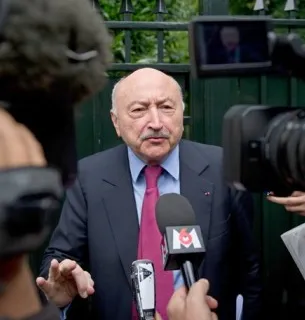
Georges Kiejman
Human Design Chart
Biography
Human Design Analysis: Georges Kiejman as Generator 2/4
Generator 2/4 — Design at a Glance
Georges Kiejman's design indicated a tendency towards great endurance and inner strength. As a Generator, he had plenty of sacral energy, which made him extremely strong and resilient – similar to a workhorse – provided this energy was used for tasks that truly mattered to his heart. His chart pointed out two specific risks: Firstly, burnout threatened if he continuously worked on things without genuine internal enthusiasm, wasting his strength. Secondly, frustration arose when prevented from working on his heart project, even though his inner self still wanted to continue with full power.
The mechanics of his design showed that the release of this energy primarily occurred when responding to impulses from his environment rather than initiating action himself. The motto was clear: not start but respond. His most successful strategy involved waiting for signals from life and then acting only when his sacral center gave a clear “yes”. If Georges Kiejman lived in harmony with this gut reaction, the design rewarded him with deep satisfaction and fulfillment. Ignoring this rhythm and instead trying to push things forward through self-initiative led to persistent frustration and a noticeable lack of energy.
Emotional Authority
Georges Kiejman's design indicated an emotional turbulence that significantly influenced his decision-making process. He appeared as someone suffering under a constant wave of emotional ups and downs; his perception of the world was always colored by current mood swings. What seemed inspiring in one moment could turn negative in the next. These fleeting impressions were not final truths but mere snapshots. Quick, spontaneous decisions made from this emotional heat often had negative effects on him.
This pattern resulted from his inner authority: Emotional Authority. With the Emotional Center defined, it served as the central instance for all important life decisions – regardless of whether other centers were also defined. This priority rule meant that no other internal voice took precedence over the emotional process. The mechanics required patience and conscious reflection on decisions. Only when intense feelings subsided over time and an emotional distance was gained did clarity set in for Georges Kiejman. This ripening process was essential for long-term direction changes, as only then would deeper truths become visible, not just surface mood reactions.
The 2/4 Profile — Hermit / Opportunist
Georges Kiejman's design highlighted a clear tension between the need for withdrawal and the drive towards community. As a 2/4 profile, he constantly oscillated between Line 2, which preferred solitude and inner reflection, and Line 4, which sought time with chosen people. This configuration required clear communication: Georges Kiejman had to signal when he wanted company and when he needed to be left alone. During his “me-time”, he immersed himself in internal processes to gain clarity. Only after satisfying this need did he emerge from his “cave” to maintain his network.
Line 2 promoted tolerance and acceptance of boundaries, where timing was crucial; incorrect response times often led to misunderstandings. Simultaneously, Line 4 brought transpersonal processes dependent on interactions. As a 'knowledge junkie', Georges Kiejman tried to influence through his network, which could lead to isolation or paranoia upon failure. The risk lay in the network not understanding his individual expression, causing fear. Through synthesizing these lines, however, he could reflect on his network's knowledge during alone time and develop brilliant ideas from it. His design shaped a rhythm of withdrawal and connection, with the ability to communicate these needs outward being central to his well-being.
Split Definition — Defined & Open Centers
Georges Kiejman's Human Design shows a tendency towards continuous mental activity and vital endurance. His defined Ajna Center provided constant conceptual thinking; he processed data and concepts in a trustworthy manner without being easily influenced from the outside. This mental clarity flowed directly into his defined Throat Center, allowing him to express what he thought. His voice served as a focal point for transforming internal processes into external communication and action.
The driving force behind this expression was his defined Sacral Center. As a Generator, Georges Kiejman had an enormous source of vital energy that felt like a constant hum. His strategy involved not initiating but waiting on questions or circumstances before responding with a yes or no answer. Once he responded, this enduring power became available to him for pursuing tasks until mastery was achieved. This energy was complemented by his defined Root Center, which provided steady pressure to move forward in the world and master existential challenges. Additionally, he possessed an emotional authority through his defined Solar Plexus Center; he had to wait out the waves of his feelings to gain clarity before making important decisions.
At the same time, Georges Kiejman was susceptible to certain vulnerabilities. His open Head Center meant that he did not have a constant mental pressure but could easily absorb inspiration or confusion from others. He tended to engage with questions that were not his own if he did not stay on his inner authority. His open G Center led him to lack a fixed identity, adapting himself to the environment and people around him; his sense of direction crystallized only in correct relationships. The open Heart Center made him vulnerable to the pressure of proving his worth or making promises he could not keep due to lacking constant energy for it. Finally, his open Spleen Center was sensitive to health and well-being; he could easily become dependent on others' security or make spontaneous decisions to dispel fears, often leading to unhealthy attachments.
Channels for change, intimacy, insight and maturation.
Georges Kiejman's Human Design shows a tendency towards evolutionary change and deep intimacy. He appeared as someone who brought new perspectives into the world with powerful, pulsating energy, connected to the need for merging relationships. This configuration described a life task: uncovering hidden connections and furthering them through personal connection.
The Channel of Mutation 60-3 linked his Root Center with the Sacral Center. Through the Gate of Limitation (60) and the Gate of Order (3), there was potential for unpredictable change, dependent on accepting limitation and moving beyond the confusion of a new beginning. This melancholic, generative energy permeated his way of living out his unique design and deeply influenced everyone around him. He had to learn to patiently wait until a new mutation set through him rather than arguing or forcing it.
Parallel to this, the Channel of Pairing 59-6 between Sacral Center and Solar Plexus Center was active. Through the Gate of Sexuality (59) and the Gate of Friction (6), he was rooted in powerful quantum sacral and emotional energy described as intimacy. This urge towards merging allowed him to quickly penetrate into others' aura and ease confidentiality. His emotional wave determined the timing of each release of intimate feelings; by waiting, he reached clarity about whether a deep connection could arise or not.
The Channel of Manifestation 43-23 linked his Ajna Center with the Throat Center. The Gate of Insight (43) received spontaneous breakthroughs that were processed and expressed through the Gate of Assimilation (23). This formed a unique perspective that promoted efficiency and made people see differently. His challenge was to let go of control and allow his mind to process knowledge at its own pace, explaining it clearly and simply so that his innovative thinking would be accepted by the collective.
The Channel of Ripening 53-42 closed the loop between Root and Sacral Centers. The Gate of Beginnings (53) and the Gate of Growth (42) drove him to fully experience and reflect on experiences to gain wisdom. This cyclical process required going into new situations without expectations to avoid frustration and make lessons from experiences useful for others.
Additionally, Gates like the Gate of Formulation (4) contributed to logical future security while the Gate of Revolution (49) promoted sensitive reaction to principles. The Gate of Openness (22) supported calm listening, and the Gate of Understanding (47) helped draw meaning from past experiences.
Individual Circuitry — Circuit Signature
Georges Kiejman's Human Design shows a tendency towards parallel energetic fields not directly connected with each other. His split definition separated the areas of emotional and instinctive life force from those of mental structuring and expression. These two groups existed alongside as independent forces without forming a continuous flow between mind and emotion.
The Knowledge Circuit shaped his identity through two separate segments. On one hand, the Channel of Mutation linked the Sacral with the Root Center, creating a driving force for deviation from the known and new paths. On the other hand, the Channel of Manifestation connected the Ajna with the Throat Center. This allowed him to encapsulate mental concepts into clear structures and carry them outward through expression. Both aspects served in developing a unique individuality but remained energetically separate.
In the Sense-making Circuit, the energy of ripening was at work. It also linked the Sacral with the Root Center and promoted the process of learning from past experiences. This cyclical movement helped to process emotions and share insights with others to collectively benefit from the past.
The Protector Circuit brought in primordial energies. Through the Channel of Pairing connecting Sacral and Solar Plexus Centers, the theme of protection and preservation of genetics was activated. This involved care for family and community as well as instinctive defense of what was deemed important. Overall, Georges Kiejman showed himself in a design that oscillated between mental clarity, emotional processing, and instinctive protection without merging these areas into one homogeneous experience.
Right Angle Cross of Explanation 3
Georges Kiejman's Human Design was characterized by a profound inclination towards intellectual clarity and logical structuring. His inner nature was designed to unravel complex connections and articulate these insights in ways that were understandable and applicable for others. This orientation stemmed from the configuration of his right cross at Manifestation 3, a pattern that combines sharp analytical acuity with a drive not only to find truth but also to articulate it precisely.
For Georges Kiejman, this meant that his mind was always striving to look beyond the surface of phenomena. He had a natural ability to distinguish the essential from the inessential and adopt a clear, often sober perspective. This energy propelled him to seek answers to fundamental questions and support them with logical arguments. His way of thinking was less emotionally colored and more guided by strict rationality aimed at clarifying misunderstandings.
In his life, this manifested as an ongoing process of gaining insight. Georges Kiejman used his mental resources to penetrate systems and ideas, always focusing on the correct representation of facts. This mechanical interpretation of his design often led others in his environment to perceive him as someone who worked precisely with words and concepts to make complex realities accessible. His presence was marked by seeking order in the chaos of the unknown.
Saturn Return · Uranus Opposition · Chiron Return · 2nd Saturn Return — Life Cycles
Georges Kiejman's Human Design laid a tendency towards structured building and later social responsibility. This imprinting was evident in his career path: In 1959, at age 27 during his first Saturn Return, he opened his first law firm with a colleague. This cycle often marked the point where years of groundwork condensed into sustainable professional structures.
During the Uranus Opposition, which questions inner maturity and relationship dynamics, Kiejman married journalist Claude Schwab in 1973 at age 41. This event underscored the typical search for new balance in partnerships during this phase.
The Chiron Return around age 49 is a fulfillment cycle where one's incarnation cross unfolds and meaning becomes tangible – provided strategy and authority are observed. In 1981, Kiejman actively entered the political arena: He supported François Mitterrand's presidential candidacy and was appointed to the commission for revising the penal code. This was a moment of flourishing where his professional expertise aligned with broader societal purpose.
Finally, in his second Saturn Return (around age 58), there was another deepening of responsibility. From October 1990 to May 1991, Kiejman served as deputy minister for justice. This cycle crowned his career with a position of highest authority and structuring power, reflecting the long-term developmental line of his design from individual law firm to state level.
Generator · Emotional Authority — Synthesis
Georges Kiejman lived as a Generator with emotional authority, deeply influenced by sacral energy and the need for inner maturity. The ability to develop and implement concepts (defined Ajna Center) seemed to constantly propel him towards new paths – especially in conjunction with the pulsating energy of the Mutation Channel (3/60). This combination fostered the creation of innovative knowledge and transformative ideas, which he filtered through emotional ups and downs before bringing them into the world. The cycles showed that significant steps in his career often coincided with phases of deep inner reflection before deciding to take new paths.
A central tension lay in the interplay between his natural drive for active shaping and the need to withdraw (Profile 2/4). The desire for solitude to gain clarity clashed with the wish for community and exchange. This paradox led him to oscillate between phases of intense work and melancholic withdrawal moments, where the limitation through Gate 60 played a crucial role in accepting changes. The emotional wave intensified this dynamic by giving him time to let decisions mature and find his inner truth.
4 Defined Channels
Incarnation Cross - Right Angle Cross of Explanation 3
Solar Return
The Solar Return shows the moment when the sun returns to its exact birth position - your personal solar year.
Life Cycles
Discover the life cycles with a detailed triple view (birth chart, cycle chart, composite).
Human Design Profile
- Type
- Generator
- Strategy
- To respond - wait for something to respond to
- Authority
- Emotional Authority
- Profile
- 2/4 - Hermit / Opportunist
- Definition
- Split Definition
- Incarnation Cross
- Right Angle Cross of Explanation 3
- Date of Birth
- 12.08.1932 21:00
- Place of Birth
- Paris, France
Frequently Asked Questions
What is Georges Kiejman's Human Design type?
Which Profile did Georges Kiejman have?
What Authority did Georges Kiejman have?
What incarnation cross did Georges Kiejman have?
When was Georges Kiejman born?
Discover your own Human Design
Are you also a Generator? Find out in a personal reading how to use your sacral energy correctly and discover deep satisfaction.
More Personalities
Back to overviewAaliyah

Alexia

Angèle

Anne-Marie

Arcángel

Arno