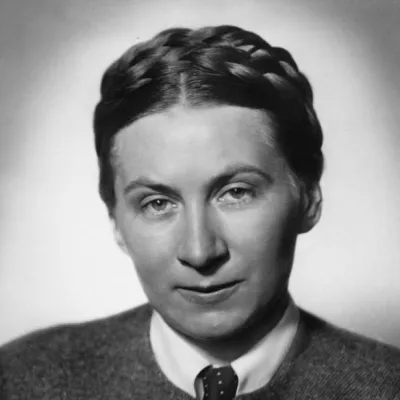
Gertrud Scholtz-Klink
Human Design Chart
Biography
Blonde and slender with classic features, at the age of 18 she married a postal worker and had six children, two of whom died. She was later widowed.
After the war, she hid out for three years. She was finally arrested and given an 18-month prison term; however, she was acquitted of war crimes. She died on March 24, 1999 in Bebenhausen, Germany.
The Human Design of Gertrud Scholtz-Klink: Generator 1/4
Generator 1/4 — Design at a Glance
Gertrud Scholtz-Klink possessed immense physical endurance and a high degree of inner strength, which she had as a Generator type. Her design suggested that her energy was most effectively utilized not through spontaneous initiatives but by reacting to external impulses. As the 'workhorse' of her system, she could carry enormous loads and materialize projects if she responded to signals from her environment that confirmed her sacral center with a clear yes. This strategy of waiting and responding was crucial for her long-term energy balance.
If a Generator goes against this mechanism – for example, by constantly initiating without inner confirmation or by completing tasks that do not resonate – frustration and an energetic collapse are imminent. Gertrud Scholtz-Klink's potential for deep fulfillment thus unfolded where she directed her great capacity for endurance to areas offered from the outside and responded spontaneously to them. If she was prevented from working on matters of the heart, or forced to do things that did not find inner approval, her system fell into conflict. Her strength lay therefore not in pushing forward against resistance but in the powerful, enduring response to what presented itself as life-relevant.
Sacral Authority
Gertrud Scholtz-Klink had a direct, physical decision-making process. As a Generator, her strategy was identical with her inner authority: sacral authority. This greatly simplified her process since she did not oscillate between external action and internal guidance. Her orientation happened through a 'gut feeling' or a noticeable surge of energy as a reaction to external stimuli. She learned to pay attention to physical signals such as grunting, humming, or an affirming 'mm-hm'. When her sacral motor kicked in, she felt vital and alive. Then, almost inexhaustible energy was at her disposal, allowing her to engage enthusiastically in activities – without these needing a specific purpose. She was born to act through joy and satisfaction. Additionally, supportive authority from the activated spleen center came into play. This connection enabled quick, spontaneous reactions. Gertrud Scholtz-Klink had immediate access to her physical well-being and instinctive perception. She reliably followed these impulses, which strengthened her ability for rapid decision-making in the moment.
The 1/4 Profile — Investigator / Opportunist
Gertrud Scholtz-Klink appeared as someone who sought deep knowledge to anchor within a familiar network. Her design as a 1/4 'Researcher / Networker' indicated a tendency to thoroughly explore things (Line 1) and share this understanding through relationships (Line 4). This, however, also created the fear of not knowing enough in front of her trusted ones and being exposed. A secure space was therefore essential for her authority in matters of the heart to be effective.
Her Gate 49 brought with it 'The Law of Necessity' – a revolutionary force that needed support from within her tribe before acting outwardly. Without waiting for this emotional wave, it threatened to produce ghastly results. Simultaneously, Gate 73 shaped her way of knowledge transmission: she was transpersonally fixated on deep understanding but had difficulties effectively conveying this verbally. This rigidity in dissemination could make understanding by others more difficult. Only when she learned to adapt her language did her effectiveness become visible. The combination of revolutionary drive and the need for a deeper trust base significantly determined her interactions.
Triple Split Definition — Defined & Open Centers
Gertrud Scholtz-Klink revealed herself as a person with a constant inner orientation and a clear, unchanging identity. Her defined G Center gave her stable self-worth and a firm sense of direction in life, independent of external expectations. This inner security allowed her to lead others without needing their approval; she knew where she stood, even if not everyone could understand her path.
Her communication was marked by a defined Throat Center, closely connected with the mental Ajna Center. She spoke from a consistent conceptual mind that was constantly active and generated theories as well as opinions. This mental engine ran non-stop; she couldn’t simply “stop thinking,” which often made her statements appear direct and intellectually grounded. The connection between Ajna and throat meant that she articulated what her mind conceptualized – a reliable, though sometimes stubborn form of expression.
As a Generator, Gertrud Scholtz-Klink had a defined Sacral Center, an immense source of vital energy. However, her strength was not unleashed through initiatives but rather by reacting to external stimuli. Only when asked or invited could her Sacral Center respond with a clear “yes” and provide the endurance needed for long-term tasks. Initiated actions without this sacral confirmation led to frustration and energy loss in her, as the connection to the powerful source was broken.
At the same time, she was vulnerable to external conditioning due to open centers. Her open Head Center made her susceptible to mental pressure and questions from her environment; she tended to engage with problems that were not hers and sought inspiration externally to quell internal doubts. The lack of consistent willpower in her egoistic sense due to an open Heart Center meant she was not geared towards keeping promises or proving her worth through competition, which could make her vulnerable to self-doubt when trying to assert herself against others. Additionally, her open Solar Plexus absorbed the emotions of others, causing her to fluctuate between joy and depression depending on the emotional climate of her environment, without always recognizing these feelings as foreign.
Channels for rhythm, structured insight and meaningful struggle.
Gertrud Scholtz-Klink revealed herself through a deep rooting in the biological flow of life, connected with the ability to structure complex social patterns and translate them into fights for individual integrity. Her design placed strong emphasis on the Channel of Rhythm 5-15. This connects the Sacral Center with the G Center and anchored her in firm habits (Gate 5), while she simultaneously integrated the diversity of society through a universal, impersonal attraction (Gate 15). She acted as a magnetic force that drew others into a continuous energy flow, where her timing was determined by inner reactions rather than intellect.
Parallel to this, she shaped communication through the Channel of Structuring 23-43. Here, she processed spontaneous insights (Gate 43) from the Ajna Center and transformed them into clear, efficient expression forms (Gate 23) in the Throat Center. This allowed her to communicate innovative perspectives that mutated collective thinking, provided she waited for the right moment of confirmation. Her actions were also driven by the Channel of Life Struggle 28-38. This connected the adrenalized pressure of the Root Center (Gate 38) with the intuitive assessment of the Spleen (Gate 28). She actively sought fights that had a deep meaning and stubbornly resisted external forces threatening her individual integrity.
Additionally, isolated Gates influenced her: Gate 49 brought a sensitive reaction to upheavals in tribal structures, while Gate 4 developed logical formulas for future security. In personality traits, Gates like 27 (caring warmth) and 60 (acceptance of limitations as a path to transcendence) contributed to her attitude. In the design, Gates such as 1 (creative uniqueness), 2 (receptivity to new directions), 10 (complex integration in the G Center), 58 (joy of experimentation under pressure), 11 (visual memory and analysis), and 45 (tribal hierarchy and willpower) complemented her energetic profile. This constellation created a person who united rhythm, structure, and meaningful struggle to guide and transform the energy flow of their environment.
Individual Circuitry — Circuit Signature
Gertrud Scholtz-Klink's Human Design presents three separate, parallel operating energy fields. In the Knowledge Circuit, she connects Ajna Center with Throat Center, showing a tendency towards structured articulation of thoughts. Parallel to this, energy flows between Spleen and Root Centers, emphasizing an instinctive focus on necessary life struggles and survival strategies. These two segments remain energetically isolated from each other; the ability for verbal expression does not directly exchange with instinct-driven readiness for action.
A third, completely independent field forms in the Understanding Circuit. Here she connects Identity Center with Sacral Center through Channel of Rhythm. This creates an autonomous source for logical and rational strategies that operate free from emotional influence. This energy serves to improve things through focus and intellect or to steer societal structures towards a better future. Since this connection lies separate from the other two fields, her rational planning power exists as an independent resource that does not automatically merge with her emotional creativity or instinctive survival drive. The triple definition thus means not a continuous flow but rather the simultaneous presence of these three distinct operating modes: structured communication, instinctive struggle, and rational strategy, which coexist alongside each other.
Right Angle Cross of Explanation 1
Gertrud Scholtz-Klink's Human Design profile was marked by the 'right cross of Manifestation 1'. This configuration signalled an inner drive to question and redefine existing structures and traditions. It wasn't about destructive withdrawal, but rather the impulse to dissolve outdated patterns to make way for a clearer, more authentic expression.
In Human Design, this Cross describes the tension between the need for individual truth and the necessity of integrating it into an existing system. The focus was on 'Manifestation' – the ability to articulate complex inner states or new insights in such a way that they could be understood and accepted by others. It was about creating a new language or framework that replaced old dogmas.
Gertrud Scholtz-Klink demonstrated her use of this dynamic force to break established norms. Her design suggested she didn't simply follow but actively participated in the reinterpretation of roles and expectations. The energy of this Cross pushed towards making the invisible visible, articulating it into words that sparked change in collective consciousness. She acted as a catalyst for this redefinition by combining her personal truth with a clear, explanatory power that prompted others to reconsider their assumptions. This was a central aspect of her energetic signature: transformation through clear articulation and breaking old templates for new definitions.
Saturn Return · Uranus Opposition · Chiron Return · 2nd Saturn Return — Life Cycles
Gertrud Scholtz-Klink's design showed a structure where cyclical turning points were linked to existential crises. Her first Saturn Return around the age of 28 marked not stabilization, but loss: in 1930 her marriage ended with Eugen Klinks death. This cycle, often associated with responsibility consolidation, appeared here as a deep personal crisis and shaped her early phase through sudden sole responsibility rather than continuous build-up.
The opposition to Uranus around the age of 38 brought an abrupt realignment in her relationships. In 1940 she married August Heißmeyer. This configuration signalled a break with the past and the search for new stability through commitment, which was concretely shown by this quick remarriage following earlier loss.
The Chiron Return around ages 48 to 50, a period in Human Design considered the flowering of one's purpose, unfolded for her as a severe test. In 1950 she was sentenced to two and a half years of internment and lost her civil rights. Instead of being able to unfold her incarnation cross freely during this phase of potential fulfillment, she experienced it as forced isolation and social exclusion. The design thus reveals a pattern where natural developmental cycles led not to confirmation but confrontation with external power structures.
Generator · Sacral Authority — Synthesis
Gertrud Scholtz-Klink lived a lifestyle deeply influenced by her sacral authority (Authority) and Generator type (Design View). Her energy flowed strongest when she immersed herself in activities arising from inner consent – a state signalled by the activation of the Sacral Center (Centers). The profile as Researcher and Networker (Profile Role) indicates that she not only deeply researched but also integrated this knowledge into relationships with others. The Rhythm Channel (Channels/Gates) reinforced this tendency by creating a connection between inner drive and the flow of life. Through definition in the mental center (Centers), she could develop concepts and inspire others.
A central paradox in her design lay in the combination of deep thirst for knowledge (Line 1 in Profile) and need for validation through community (Line 4). This led to a tension between the desire to independently acquire knowledge and fear of exposure or rejection. The crises in cycles – loss of marriage, sentencing (Cycles) – could be expressions of this inner dynamic, showing that while she researched and built networks, she also struggled with the consequences of her decisions and perception by others.
3 Defined Channels
Incarnation Cross - Right Angle Cross of Explanation 1
Solar Return
The Solar Return shows the moment when the sun returns to its exact birth position - your personal solar year.
Life Cycles
Discover the life cycles with a detailed triple view (birth chart, cycle chart, composite).
Human Design Profile
- Type
- Generator
- Strategy
- To respond - wait for something to respond to
- Authority
- Sacral Authority
- Profile
- 1/4 - Investigator / Opportunist
- Definition
- Triple Split
- Incarnation Cross
- Right Angle Cross of Explanation 1
- Date of Birth
- 09.02.1902 10:00
- Place of Birth
- Adelsheim, GER
Frequently Asked Questions
What is Gertrud Scholtz-Klink's Human Design type?
Which Profile did Gertrud Scholtz-Klink have in Human Design?
What Authority did Gertrud Scholtz-Klink have?
What incarnation cross did Gertrud Scholtz-Klink carry?
When was Gertrud Scholtz-Klink born?
Discover your own Human Design
Are you also a Generator? Find out in a personal reading how to use your sacral energy correctly and discover deep satisfaction.
More Personalities
Back to overviewAaliyah

Alexia

Angèle

Anne-Marie

Arcángel

Arno