
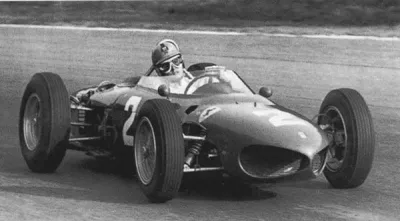
Giancarlo Baghetti
Human Design Chart
Biography
After he retired, Baghetti became a photographer and journalist, directing the weekly magazine, "Auto Oggi."
He was diagnosed with cancer in September 1995 and died on 27 November 1995, Milan.
Giancarlo Baghetti as a Generator 6/2 in Human Design
Generator 6/2 — Design at a Glance
Giancarlo Baghetti possessed enormous endurance and a high level of sacral energy. His design characterized him as someone who had immense strength, but he used it not through self-initiative, but by reacting to external impulses. As a Generator, he was designed to respond to signals from his environment and only act when his Sacral Center – often perceived as intuition or inner confirmation – gave a clear "Yes".
This mechanism carried two significant risks for his energy balance. On the one hand, frustration and exhaustion threatened if he plunged into tasks that internally repelled him and wasted his strength. On the other hand, there was the danger of being distracted from his true heart project while still full of drive. The correct application of his nature – reacting instead of initiating – led to deep satisfaction and a sense of fulfillment. If he lived against this principle by constantly taking the first step without waiting for a signal, it resulted in persistent frustration and a noticeable energy deficit. His strength thus lay in waiting for the right moments and then responding with full force.
Emotional Authority
Giancarlo Baghetti demonstrated a decision-making approach that required time and emotional distance; spontaneous impulses were unreliable in his design. This stemmed from his Emotional Authority, carried by the defined Solar Plexus Center. In Human Design mechanics, this authority is always active once this center is defined – regardless of other configurations in the chart.
Baghetti was subject to a wave dynamics of emotions that manifested as a constant up and down of his feelings. The world appeared colored by his current mood: enthusiastic about a project one moment, negatively impacted by it the next. His immediate feeling was only a snapshot, not a guaranteed truth value. Quick, spontaneous decisions from this emotional heat carried the risk of negative consequences.
The mechanics of his authority demanded patience: he had to let himself be delayed and reconsider decisions multiple times. The longer he waited, the deeper he could perceive the situation. Over time, intense feelings subsided, an emotional distance set in, followed by clarity and calmness. Only then was the process complete. This strategy was particularly important for long-term decisions with significant influence on his life course. By enduring through the emotional wave, Baghetti gained the necessary distance to act not from passing mood but from mature insight.
The 6/2 Profile — Role Model / Hermit
Giancarlo Baghetti showed a tendency towards intense experimentation in his youth, shaped by the principle of trial and error. Before his 30th year, the energy of Line 6 of his profile acted like a Three: he gathered diverse life experiences, learned from mistakes, and withdrew after failures to start anew. This phase served the building of a broad personal foundation through direct confrontation with reality.
Around thirty years in, his focus shifted fundamentally. The specific mechanics of Line 6 now became effective, marked by a deep withdrawal into a metaphorical "cave". Here Giancarlo Baghetti sought distance from earlier experiences to view them from a new perspective. This time of isolation was not an escape but a process of intense reflection and healing. He analyzed his past actions with great breadth, leading to the development of deeper self-awareness.
Later in life, he emerged as a wise mentor. The previously gathered experiences and introspection enabled him to convey authentic life wisdoms to others. His role as a role model was not based on theoretical knowledge but on the integrated experience of his own journey from youthful inadequacy to mature authenticity. Others sought his advice to learn the ability for deep self-reflection and understanding complex human dynamics.
Split Definition — Defined & Open Centers
Giancarlo Baghetti revealed himself through a constant, mechanical presence in the realms of thinking, acting, and feeling. His design was marked by defined Head, Ajna, and Throat Centers, generating a persistent mental pressure to question and form concepts. This energy flowed directly into his communication, giving him a clear yet limited way of expression. His vital force came from the defined Sacral Center, which provided an immense source of energy that could only be properly utilized in reaction to external impulses. Simultaneously, his defined Solar Plexus and Root Centers served as sources for emotional waves and physical stress pressure, which he had to learn to wait out and channel rather than act impulsively.
In contrast, his G Center, Heart, and Spleen Centers were open. This meant that identity, willpower, and intuition did not come from within him but were initiated by the environment. Giancarlo Baghetti tended to lose himself in relationships or environments due to a lack of inner direction. He was prone to making promises he could not keep because he lacked the constant energy of the Heart Center. Additionally, his intuition and health awareness through the open Spleen Center made him susceptible to conditioning; he had to learn to avoid spontaneous decisions and not accept fears as personal truth. The challenge lay in not using defined energies for initiation but waiting on reactions while learning in the open areas to be initiated by the environment without taking on promises or identities.
Channels for change, logic, mysticism and mental abstraction.
Giancarlo Baghetti revealed himself as someone whose inner dynamics were marked by a constant, often melancholic pulse of change. This energy of Mutation Channel 60-3 connected the Root Center with the Sacral Center and required accepting limitation (Gate 60) to move beyond the confusion of new beginnings (Gate 3). It was an unpredictable force that permeated evolutionary change but only became effective when one did not try to rationalize inner moods, instead patiently waiting for the next impulse.
Parallel to this, his mind organized information with strict logic. The Acceptance Channel 17-62 connected Ajna Center with Throat Center and allowed him to translate visual patterns (Gate 17) into detailed language. Anything he could not mentally integrate in his system remained incomprehensible; this created a foundation for clear communication and teaching, provided he spoke at the right time.
Emotionally, Giancarlo Baghetti sought tribal belonging. The Synthesis Channel 19-49 connected Root Center with Solar Plexus Center and drove him to bind himself through principles (Gate 49) and pressure towards cohesion (Gate 19). This was not a logical process but an emotional frequency of acceptance or rejection that demanded loyalty and protection of his territory.
Mentally, he permeated experiences with the Abstraction Channel 64-47 between Head Center and Ajna Center. He sought meaning behind confusion (Gate 64) and tried to understand life as a story (Gate 47). His reward was clarity that only showed itself in hindsight.
Additionally, prioritized gates were active: Gate 10 brought complexity and genetically determined behavioral rules. Gate 15 promoted collective flow through humility and adaptation to natural rhythms. Gate 18 stood for correction and the protection of human rights, often conflicting with authorities. On a personality level, Gates 4 (formulation of formulas for future security) and 38 (pressure and struggle for integrity) added further layers. In his design, Gates 33 (reflection through withdrawal) and 35 (change through interaction) supported this process of constant adaptation and meaning-making.
Collective Circuitry — Circuit Signature
Giancarlo Baghetti's design laid a tendency towards separate, parallel functioning energetic blocks. Through the Split Definition, there existed two independent energy fields: one from Sacral, Root, and Solar Plexus Centers, the other from Ajna, Throat, and Head Centers. These groups were not directly connected but coexisted as distinct experiential areas.
The Knowledge Circuit in him linked Sacral and Root Centers through the Mutation Channel (3-60). This created a pulsing energy aimed at deviation from the known and individual transformation. Parallel to this, the Understanding Circuit (Ajna-Throat via Channel 17-62) and the Meaning-Finding Circuit (Head-Ajna via Channel 64-47) were active in the second block. The first promoted logical, future-oriented structuring; the second reflected past experiences cyclically. Both flowed through Ajna Center but did not form a bridge to the emotional or sacral realm.
Additionally, the Ego Circuit was active, connecting Solar Plexus and Root Centers (Channel 49-19). This involved resource creation through cooperation and balance of giving and taking. As there was no direct channel to Sacral Center, this energy required rhythmic pauses for regeneration. Baghetti thus moved between an impulsive search for new knowledge in the lower block and analytical sense-making as well as strategic cooperation in the upper area – always as two distinct, non-fusing streams.
Left Angle Cross of Prevention 2
Giancarlo Baghetti was marked by the design of the left cross of prevention, which established a deeply rooted tendency towards precaution as a central life motive. His inner drive lay in recognizing and neutralizing potential problems or damage before they could even arise. This configuration described not just a passive interest in safety but an active, preventive approach to life: Giancarlo Baghetti sought out weaknesses in systems, relationships, or situations to proactively strengthen them.
The mechanics of this design emphasized the importance of foresight. It was about averting disaster by nipping it in the bud. For him, action often stemmed from an internal signal that something wasn't right or was at risk. This inner drive towards damage prevention shaped his way of dealing with challenges – less through combating already occurring crises than through their consequent avoidance beforehand. His design suggested he worked best where he functioned as a guardian or protector, identifying and eliminating risks before they manifested. It was a life task to maintain stability through early intervention and thus prevent suffering or loss.
Saturn Return · Uranus Opposition · Chiron Return · 2nd Saturn Return — Life Cycles
Giancarlo Baghetti revealed himself in his late teens as someone who strengthened his inner structure through external trials. His design indicated a tendency towards consolidation, with the first Saturn return around age 27 serving as a decisive phase. During this period, reality confronted him with a serious test of his identity and self-conception. It wasn't just about growth but stabilizing and structuring the existing foundation.
This process of solidification became tangible in 1961. At 27 years old, Giancarlo Baghetti won the Gran Premio di Siracusa. Although this victory did not count towards a world championship, it marked an important milestone in his development. The success served as confirmation for the internal work initiated by the Saturn return. It showed that the self-image restructuring triggered by the Saturn return was viable and could be validated in the external world. This moment highlighted how external successes can contribute to securing one's foundation and solidifying identity before new challenges arise.
Generator · Emotional Authority — Synthesis
Giancarlo Baghetti was a Generator whose life was marked by a deep inner urge to respond to impulses and release energy through action. However, this natural impulse was modulated by an emotional authority that compelled him not to rush into decisions but to wait until clarity crystallized from the emotional wave. This combination of reactive energy and the need for internal deliberation formed a red thread throughout his being – a capacity to powerfully step into the world when inner consent was given. His definition in the Root Center points to a steady force moving forward and embracing challenges, while an open Heart Center made him sensitive to others' needs and fostered a deep connection with the collective.
A central paradox in Giancarlo Baghetti's design lay in the tension between the need for action and the necessity of emotional maturity. As a Generator, he was designed to respond to external impulses, yet his emotional authority demanded patience and waiting for the internal wave. This dynamic led to an ongoing interplay between the urge to start something and the wisdom to wait until the time was ripe – a tension field that forced him to consciously deploy his energy and make authentic decisions.
4 Defined Channels
Incarnation Cross - Left Angle Cross of Prevention 2
Solar Return
The Solar Return shows the moment when the sun returns to its exact birth position - your personal solar year.
Life Cycles
Discover the life cycles with a detailed triple view (birth chart, cycle chart, composite).
Human Design Profile
- Type
- Generator
- Strategy
- To respond - wait for something to respond to
- Authority
- Emotional Authority
- Profile
- 6/2 - Role Model / Hermit
- Definition
- Split Definition
- Incarnation Cross
- Left Angle Cross of Prevention 2
- Date of Birth
- 25.12.1934 12:00
- Place of Birth
- Milan, Italy
Frequently Asked Questions
What was Giancarlo Baghetti's Human Design type?
What Profiles did Giancarlo Baghetti have?
What Authority did Giancarlo Baghetti have?
What incarnation cross did Giancarlo Baghetti have?
When was Giancarlo Baghetti born?
Discover your own Human Design
Are you also a Generator? Find out in a personal reading how to use your sacral energy correctly and discover deep satisfaction.
More Personalities
Back to overviewAaliyah

Aldair

Alexia

Angèle

Anne-Marie

Arcángel
