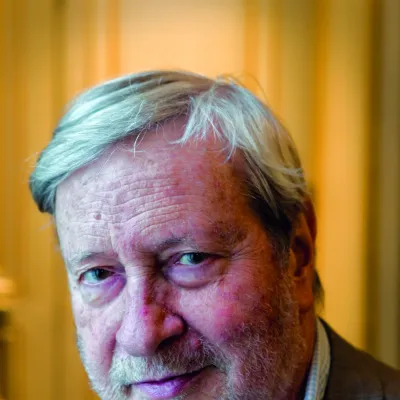
Gianni Vattimo
Human Design Chart
Biography
After being active in the Partito Radicale, the short-lived Alleanza per Torino, and the Democrats of the Left, Vattimo joined the Party of Italian Communists. He was elected a member of the European Parliament first in 1999 and for a second mandate in 2009.
Vattimo was staunchly pro-Hamas and anti-Israeli, and once apologized to an Israeli newspaper (Haaretz) for his anti-semitism.
He was openly gay and a nihilist who embraced Nietzsche's idea of God's death. He died on 19 September 2023 at age 87 in Turin.
Human Design Analysis: Gianni Vattimo as Generator 4/6
Generator 4/6 — Design at a Glance
Gianni Vattimo revealed himself as someone who unleashed his strength not through constant initiatives but by responding to internal signals. As a Generator, he possessed a large sacral energy source that gave him endurance and high creative potential – comparable to a strong workhorse that only efficiently uses its power when it truly burns for the task at hand. His design suggested that he was most effective where he could respond to impulses from his environment rather than taking the first step himself. The strategy of 'reacting instead of initiating' was key to his effectiveness: When his Sacral Center gave a clear 'yes', a powerful action followed, leading to deep fulfillment. Conversely, frustration or energy loss threatened if he acted against this inner signal – whether by forcing tasks without enthusiasm or interrupting work on things that truly moved him. This dynamic shaped his lifestyle: His energy was not a steady stream but a pulsating potential that only unfolded in the moment of proper reaction and allowed him to shape things sustainably as long as he followed this rhythm.
Emotional Authority
Gianni Vattimo revealed himself as someone who did not make decisions impulsively, but consciously let them rest until emotional clarity emerged. His design carried Emotional Authority, meaning that his defined Solar Plexus Center formed his inner decision-making instance. In Human Design mechanics, this configuration is unique: Once the Emotional Center is activated, it takes charge – regardless of which other centers are also defined. This priority rule applies to every type except Reflectors and ensures that the emotional wave determines the process.
Vattimo was constantly swayed by emotions; his perception was colored by current moods. What appeared inspiring in one moment could seem negative in the next. Since this first impression, however, was only a snapshot and not yet the truth, spontaneous judgments were often misleading. His strategy involved taking time to let decisions mature overnight. Through this patience, intense feelings subsided, he gained emotional distance, and eventually reached calmness. This process of delay was essential for long-term life decisions, as only then could the deeper truth emerge through the emotional ups and downs.
The 4/6 Profile — Opportunist / Role Model
Gianni Vattimo revealed himself as someone who throughout his life oscillated between a deep need for belonging and the urge to distant reflection. His Human Design Profile 4/6 laid out this tension: Line 4 anchored him in social fabric, while line 6 directed his gaze towards wide horizons and abstract questions of meaning. In his first three decades, he acted more experimental and intensely sought connections, similar to a profile with two lines of experience. Later, as the energy of line 6 unfolded, the internal conflict between heart and head became clear. He had to learn that his big heart needed to be cautious not to get hurt by false alliances. At the same time, he carried the burden of being expected to set an example for others as a wise role model. This role required cooperation, not isolated genius. His task was to share deep inspirations in such a way that they could be collectively developed further. By giving patterns to his environment, he confirmed their value and found clarity himself. Aggressive resistance would have hindered this process; instead, trust and the analysis of opposites promoted his development. Thus, he became a networker who found his place in the community through relationships and the exchange of deep insights without losing the necessary distance for reflection.
Split Definition — Defined & Open Centers
Gianni Vattimo was someone whose thinking and actions were characterized by a constant, trustworthy mental structure. His defined Ajna Center ensured that he consistently created concepts in the same manner; he was not easily influenced by others present and used his mind to process data and appear as an external authority figure. This mental activity was permanently 'on', which gave him a stubborn tendency to make decisions based on intellectual reasoning alone. His thoughts flowed directly into his communication: The defined Throat Center transformed these mental processes into speech and action. He spoke what his mind conceptualized, making his messages clear but limited.
In addition to this intellectual clarity, Vattimo possessed strong willpower through his defined Heart Center. He liked to determine his life himself, keep promises, and strive for recognition of his contributions. This ego strength was carried by immense vitality: The defined Sacral Center generated daily energy that he used in reaction to external impulses. Initiating actions without prior questioning led to resistance and exhaustion, as his sacral power was only available for affirmative responses. Furthermore, he had a deep emotional authority in the Solar Plexus; he learned to wait out the emotional wave before making decisions to ensure clarity rather than impulsiveness. His defined Spleen Center provided spontaneous, intuitive warning signals in 'the now', while the defined Root Center supplied the necessary pressure for material survival and progress.
In contrast, his open Head Center revealed a vulnerability to mental stress and confusion. He tended to engage with questions that were not his own or be overwhelmed by others' doubts. The open G Center also meant he did not have a fixed identity; he adapted to his environment and gathered directions through interaction. Instead of setting a firm direction himself, he relied on being initiated by life to find the correct place and appropriate relationship. This openness made him vulnerable to false environments but also capable of adopting various perspectives without clinging to a rigid self-image.
Channels for change, insight, meaning, community and emotion.
Gianni Vattimo was deeply rooted in the currents of change. His energy did not follow linear planning, but rather a pulsating rhythm of stillness and sudden movement. This was marked by the Channel of Mutation 60-3: a connection between Root and Sacral Centers enabling evolutionary change through accepting limitation (Gate 60) and organizing new possibilities (Gate 3). This energy was melancholic and unpredictable; it required patience until the next impulse emerged from beneath, rather than forcing it.
Parallel to this, he had the ability to translate complex connections into clear, innovative concepts. The Channel of Structuring 23-43 connected his Ajna Center with Throat Center. Here spontaneous insights (Gate 43) met assimilation and expression (Gate 23). His thinking often felt light-years ahead, yet only through clear, metaphorical communication could this knowledge be received by others without being perceived as odd.
Another core aspect was his stubborn fight for individual integrity and life meaning. The Channel of Life Struggle 38-28 connected Root with Spleen Centers. He sought not just survival but a deeper purpose in struggles (Gate 38) and intuitively knew which confrontations were worth pursuing (Gate 28). This energy propelled him to resist distractions and assert his uniqueness.
In interpersonal relationships, he searched for authentic connection. The Channel of Community 37-40 linked Solar Plexus with Heart Center. He needed time to gain emotional clarity about agreements (Gate 40) and sought recognition within a whole (Gate 37). His interactions were marked by an emotional wave determined by the Channel of Emotion Release 39-55. This channel between Root and Solar Plexus used provocation (Gate 39) to touch others' minds and authentically express his own emotional depths and moods, rather than rationalizing them.
Additionally, Gates like Gate 48 with its deep pattern recognition and Gate 56 which translates mental processes into vivid narratives influenced how he grasped connections not only logically but also narratively and intuitively.
Individual Circuitry — Circuit Signature
Gianni Vattimo was characterized by a split definition that created two energetically isolated power fields. One field connected the Sacral, Root, Spleen, and Solar Plexus Centers with Heart Center; here constant life force, instinct, and emotional resonance worked together. The second, separate field linked Ajna and Throat Centers, allowing thought and expression to flow directly but without connection to other centers.
In the Knowledge Circuit, two distinct segments shaped his actions. The connection from Ajna to Throat Center enabled immediate verbal formulation of intellectual concepts. Parallel to this, Channels 3-60 (Mutation), 28-38 (Life Struggle), and 55-39 (Emotion Release) linked Sacral, Root, Solar Plexus, and Spleen Centers. This generated a pulsating energy focused on deviation from the known, emotional waves, and the urge for transformation – yet without direct coupling to verbal expression in Throat Center.
The Ego Circuit operated through Channel 37-40 (Community), linking Heart and Solar Plexus Centers. This promoted a give-and-take relationship as well as mutual support within groups. Since this circuit lacked connection to the Sacral Center, rest was necessary for resource regeneration. Vattimo's design thus clearly separated intuitive, emotional community building (Heart-Solar Plexus) from intellectual expressiveness (Ajna-Throat), while the driving force for change and mutation worked in the lower energy centers.
Right Angle Cross of Tension 4
Gianni Vattimo revealed himself through an internal conflict arising from the tension between a desire for individual affirmation and the urge to social adaptation. His design featured the right cross of tension 4, often interpreted as 'the hero's path' or the search for identity within society. This mechanism described an inner conflict: on one hand, there was a strong need to find oneself and raise his own voice (Gate 13), while on the other, there was pressure to be recognized by others and integrated into existing structures (Gate 28).
This contradiction shaped his life stance. He sought ways to reconcile personal autonomy with social belonging. The tension between living one's truth and adapting to societal norms created a dynamic force that drove him not just to endure but actively think through these contradictions and incorporate them into his thinking. It was not a static state, but an ongoing process of negotiation between self and others. This configuration suggested that his intellectual paths often resulted from aligning the two poles—the individual and the collective—without entirely abandoning either. The tension itself became the driving force for his intellectual development.
Saturn Return · Uranus Opposition · Chiron Return · 2nd Saturn Return — Life Cycles
Gianni Vattimo showed himself as someone whose intellectual development was marked by clear structuring phases. His design tended to not just accumulate knowledge but pour it into stable institutional forms. This was particularly visible during his first Saturn Return in 1964, at age 28, when he became a professor of aesthetics at the University of Turin. This cycle often marks the transition from theoretical interest to binding responsibility; here, years of groundwork condensed into a stable academic position.
Later, during the Chiron Return cycle around 1982 (age 46), there was another deepening: Vattimo took over the chair for Theoretical Philosophy. In Human Design mechanics, this period is not about healing old wounds but rather a phase of blooming and fulfilling the incarnation purpose; if strategy and authority are respected, the core task of the design increasingly unfolds in life. Vattimo's shift to Theoretical Philosophy signaled this deepening of his intellectual mission.
The second Saturn Return in 1992 (age 56) brought another consolidation: he received the Max Planck Research Prize jointly with Wolfgang Welsch. This cycle often confirms the long-term relevance of previously chosen paths; for Vattimo, it was not just an honor but recognition of a decades-long structured thought process that now showed its full structural integrity and public impact.
Generator · Emotional Authority — Synthesis
He was a Generator whose life was marked by deep sacral energy. This power, combined with emotional authority, led him through a complex inner landscape of rising and falling emotions. Decisions matured slowly, were mulled over repeatedly to recognize the true essence—a process that shaped his thinking (defined Ajna Center) and allowed him to continuously form concepts. The Channel of Mutation (3-60) points towards an aptitude for evolutionary change, coupled with acceptance of limitations and courage to take new paths, evident in professional shifts (1964, 1982, 1992).
A central paradox lay in the tension between his need for community (Line 4 in Profile) and the urge to stand above as an independent role model (Line 6). This interplay between heart and head created an inner dynamic that drove him to constantly develop new perspectives and share them with others. The pulsating format energy of the Knowledge Circuit amplified his ability to transform knowledge and initiate changes, while he was simultaneously accompanied by melancholy—a sign of deep emotional processing fueling his creative process.
5 Defined Channels
Incarnation Cross - Right Angle Cross of Tension 4
Solar Return
The Solar Return shows the moment when the sun returns to its exact birth position - your personal solar year.
Life Cycles
Discover the life cycles with a detailed triple view (birth chart, cycle chart, composite).
Human Design Profile
- Type
- Generator
- Strategy
- To respond - wait for something to respond to
- Authority
- Emotional Authority
- Profile
- 4/6 - Opportunist / Role Model
- Definition
- Split Definition
- Incarnation Cross
- Right Angle Cross of Tension 4
- Date of Birth
- 04.01.1936 14:30
- Place of Birth
- Turin, Italy
Frequently Asked Questions
What was Gianni Vattimo's Human Design type?
What profile did Gianni Vattimo have?
What authority did Gianni Vattimo possess?
What incarnation cross did Gianni Vattimo have?
When was Gianni Vattimo born?
Discover your own Human Design
Are you also a Generator? Find out in a personal reading how to use your sacral energy correctly and discover deep satisfaction.
More Personalities
Back to overviewAaliyah

Alexia
Angèle

Anne-Marie

Arcángel

Arno