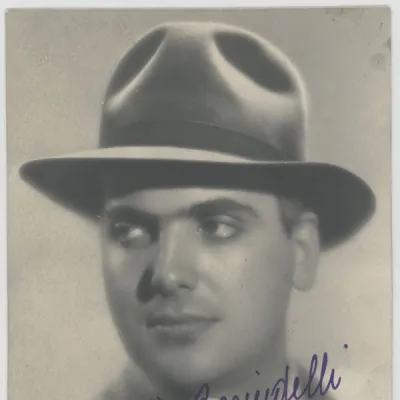
Gino Bechi
Human Design Chart
Biography
Died on 2 February 1993, Florence, Italy.
Gino Bechi as a Manifestor 2/4 in Human Design
Manifestor 2/4 — Design at a Glance
Gino Bechi was a Manifestor. His design established him as a pioneer and visionary whose task it was to lead the world into new directions. This profile worked similarly to that of a Roman emperor: Gino Bechi had the great vision but left the concrete execution to others. He often thought further ahead than his surroundings, which inevitably led to polarization. While some people loved his dreams and followed him, he encountered rejection or hatred from others. The central pain point of this design was being misunderstood due to this superior perspective.
To resolve this conflict, his system required a clear strategy: he had to inform. By communicating his intentions and visions early and precisely, Gino Bechi could find the right followers – those people willing to follow him. This information served not as a request for permission but as orientation for others. If he followed this strategy and relied on his inner authority, his design rewarded him with a sense of inner peace. Living against this mechanism, however, led to persistent, deep anger. His path to balance therefore did not lie in withdrawal but in clear communication of his intentions to mobilize the necessary support and minimize resistance.
Emotional Authority
Gino Bechi's inner compass demanded emotional clarity; spontaneous judgments proved misleading for him. His inner authority lay in the defined Emotional Center, meaning he was constantly under a wave of emotions. The world appeared colored by his current mood: at one moment, he could be enthusiastic about something, only to see it negatively in the next. This immediate feeling was merely a snapshot and not a secure foundation for decisions. Quick reactions from emotion often led to negative consequences as they were not based on his true truth.
The mechanics of his design dictated a process of waiting. The more time he took, the deeper he could perceive. This required patience and conscious 'sleeping over' of decisions. He should take his time and ask questions multiple times. Over time, intense feelings subsided, emotional distance and clarity as well as calmness set in. Only then was the process complete. This strategy was particularly important for long-term decision-making that significantly influenced his life course. By waiting until his emotional waves calmed down, he reached decisions that truly fit him rather than becoming a victim of passing moods.
The 2/4 Profile — Hermit / Opportunist
Gino Bechi was marked by constant oscillation between the need for community and the necessity of withdrawal. His design as a 2/4 profile ("Natural Talent / Networker") created an inner tension: Line 4 drew him to his favorite people, while Line 2 pulled him back into his 'cave' to rest and find clarity. For Gino Bechi, it was crucial to clearly communicate these two poles externally – when he sought company and when he wanted solitude. This transparency prevented frustration and allowed him to effectively reflect the knowledge of his network during alone time. Line 2 brought themes like control and projection; without maturity, this could lead to strain as external projection often went astray. Simultaneously, the fourth line demanded asceticism and time for inner processes. It waited for the right moment to express details harmoniously and simply. If Gino Bechi was pulled out of this phase too early, he risked corrections or uncertainties. Only when he had organized the details could he develop brilliant ideas that emerged from the synthesis of network input and internal processing. His path lay in respecting these rhythms: withdrawal for condensation, then shared insights with the community.
Single Definition — Defined & Open Centers
Gino Bechi's Human Design reveals a tendency towards a consistent, reliable way of expression coupled with the need to achieve emotional clarity through patience. His defined Throat Center served as a stable anchor point for communication and manifestation; it shaped a mode of speaking and acting that was limited yet constant. This structure allowed him to make information from various sources in the world effective without wasting impulsive energy, provided he trusted his inner authority.
This inner authority stemmed from his defined Solar Plexus Center. Here lay the mechanics of emotional truth-finding: Gino Bechi was designed to wait out the ups and downs of the emotional wave before making decisions. Truth did not reveal itself in the immediate moment for him but developed over time. By practicing patience and experiencing the full spectrum of his feelings without haste, he achieved a deeper emotional clarity that avoided spontaneous errors. This ability to use his emotional energy patiently gave him a strategic advantage in interactions as others were often drawn to the warmth and depth of his defined emotions.
In contrast stood the fleeting nature of his open centers: Head, Ajna, G, Heart, Sacral, Spleen, and Root were undefined. This openness made him vulnerable to environmental impulses. His open Head Center tended to succumb to mental pressure and doubts from the environment, while the open Ajna Center absorbed ideas that did not necessarily reflect his own truth. The open G Center led him to often adopt or seek identity and direction from others rather than consistently possessing it himself. His open Heart Center occasionally drove him to promise in order to prove value, despite lacking constant willpower for this. The open Sacral Center caused him to take on foreign vitality and overextend without a consistent inner signal of 'enough.' Finally, his open Root Center absorbed external stress, leading to feelings of pressure that did not belong to him. The challenge was recognizing these conditioning patterns and instead trusting the calmness of Solar Plexus and clarity of Throat.
Channels for emotional expressiveness despite transience.
Gino Bechi emerged as someone driven by a restless yearning for new, profound experiences. His design inclined towards circumventing logical caution and restrictive patterns to set things in motion – often through conscious or unconscious creation of crisis situations. This dynamism originated from the Transience Channel 36-35, connecting Solar Plexus and Throat. The Crisis Gate (36) perceived unfamiliarity as inadequacy, driving the search for newness, while the Change Gate (35) articulated the desire: 'I was there – what's next?'
This configuration made Gino Bechi an emotional manifestor. His energy was unstable, marked by the wave movement of his emotions. He learned wisdom not through theoretical deliberation but through fully living and accepting this transience. If an experience did not meet expectations, disappointment could ensue; yet over time, this emotional depth matured into personal truth. His advice to others always rested on lived experience: seizing the moment and committing wholeheartedly to any correct undertaking.
Alongside this driving force, other aspects influenced his design. Gate 32 brought a consciousness of continuity and clan material success but scrutinized current situations for values before making radical changes only when necessary. In the realm of processing, Gate 42 represented the necessity of completing processes to take on new commitments; indecision here led to blockages. The logical side was embodied by Gate 62, which demanded patience and detail precision in pattern recognition as well as Gate 61, seeking inner truth and silence to make individual knowledge accessible through spontaneous mutation. On a personality level, Gate 45 with its clan-related hierarchy and attraction and Gate 56, translating mental processes into pictorial narratives, were influential. In the design itself, Gate 16 contributed through experimental mastery and Gate 23 through communication and assimilation skills, while Gate 6 served as an elemental building block for friction and biological evolution.
Collective Circuitry — Circuit Signature
Gino Bechi was marked by a cyclical processing of emotional experiences that he not only carried individually but shared with others. His design linked the Throat Center and Solar Plexus Center directly through the Transience Channel (Gates 35/36). This connection formed the core of the Sense-making Circuit.
While other circuits often emphasize cool logic or future-oriented planning, Gino Bechi's energy focused on the past and emotional experience. The Solar Plexus provided wave-like feeling currents – with a beginning, middle, and end – that were translated into visual, shared insights in the Throat Center. This mechanism required patience: emotions for him were not a constant but naturally fluctuated. Only when an emotional wave reached its peak or subsided could the underlying truth be clearly articulated.
The central theme was reflecting on past events to grasp their meaning. Gino Bechi used this ability to learn from the past and pass this collective knowledge forward. Given his Simple Definition, these connected centers formed a coherent, direct flow without internal tensions between separate systems. His way of seeing the world was thus always marked by the necessity of pouring emotional experiences into understandable, visual forms that the collective could embrace. This did not happen through rational analysis but through intuitive grasping of the emotional content of past events and their dissemination as shared learning.
Right Angle Cross of Maya 3
Gino Bechis Design carried the archetypal imprint of the Mayan Cross 3. This configuration established a specific energetic alignment that was less characterized by individual whimsy and more by its embedding in larger, collective patterns. In the Human-Design context, this cross describes a structure designed to function as part of a whole, reflecting certain universal principles or rhythms.
Without specific data on Gates or Channels, the analysis remained limited to this overarching symbolism. The mechanics of this cross indicated that Gino Bechis' life path and energetic expression were strongly marked by the idea of "right" or correct alignment within a system. This was not an isolated personality trait but rather a deeper structural tendency to position oneself in relation to external orders.
This archetypal mechanism served as a background framework for his entire existence. It created a context within which other design elements could unfold their effects. The emphasis lay on the general symbolism and the resulting energetic stance. Thus, Gino Bechi lived in a dynamic that connected him with broader, often invisible forces without this connection being defined in detail by specific channels. His design showed itself as an instance of this larger order.
Saturn Return · Uranus Opposition · Chiron Return · 2nd Saturn Return — Life Cycles
Gino Bechi revealed himself in his biography as someone whose identity and professional path were structured by existential turning points. His design suggested that structural breaks should not be seen as disturbances, but rather as necessary catalysts for finding one's role. This became visible in 1940: At the age of 27, during his first Saturn return, he took on *Cavalleria rusticana*. This cycle often marks the transition from experimental searching to anchoring in a viable structure; here, his artistic identity condensed through a concrete public performance.
Ten years later, in 1950 at the age of 37, the Uranus opposition became active. His first visit to England after the war fell precisely into this phase of radical reorientation. While Saturn creates structure, this cycle demands expansion and breaking old boundaries – a step that opened his career internationally and freed him from established patterns.
The most profound change occurred in 1965 at the age of 52 during his Chiron return. Gino Bechi stepped back from stage life. In Human Design mechanics, this cycle is not an end in the sense of loss but a fulfillment: The incarnation cross unfolds its full meaning. His withdrawal was no crisis in a negative sense, but rather the logical consequence of a life that had fulfilled its specific task. External activity gave way to inner completion; his design showed that true identity finding often only reaches its conclusion when one steps away from the public stage.
Manifestor · Emotional Authority — Synthesis
Gino Bechi moved through life as someone who possessed both the visions of a pioneer (Manifestor) and was deeply rooted in his emotions (emotional authority). This combination shaped a personality that designed grand plans and initiated them, but always accompanied by an inner emotional ups and downs. The undefined design in important centers like Head, G Center, Heart, and Root suggests he was strongly influenced by his environment, making him a mirror for the energies of others – a skill that helped him recognize patterns and adapt, but also made him vulnerable to conditioning. His internal journey thus became a constant swing between the desire for autonomy and the need to connect with others to find meaning and direction.
A central paradox in Gino Bechi’s design lies in the tension between his manifesting impulse towards initiation and his emotional wave. He could develop visions and spark actions, but needed time to gain emotional clarity for decisions. This dynamic often put him in a situation where he wanted to start something, yet still wasn’t sure if it was truly right for him. The undefined Root Center amplified this ambivalence, as he was vulnerable to external pressure and had difficulty setting his own boundaries – an ongoing struggle between the urge towards activity and the need for rest and self-reflection.
1 Defined Channel
Incarnation Cross - Right Angle Cross of Maya 3
Solar Return
The Solar Return shows the moment when the sun returns to its exact birth position - your personal solar year.
Life Cycles
Discover the life cycles with a detailed triple view (birth chart, cycle chart, composite).
Human Design Profile
- Type
- Manifestor
- Strategy
- To inform others before acting
- Authority
- Emotional Authority
- Profile
- 2/4 - Hermit / Opportunist
- Definition
- Single Definition
- Incarnation Cross
- Right Angle Cross of Maya 3
- Date of Birth
- 16.10.1913 05:20
- Place of Birth
- Florence, Italy
Frequently Asked Questions
What was Gino Bechi's Human Design type?
What profile did Gino Bechi have?
Which authority guided Gino Bechi?
Which incarnation cross was active for Gino Bechi?
When was Gino Bechi born?
Discover your own Human Design
Are you also a Manifestor? Find out in a personal reading how to use your initiation power peacefully and dissolve resistance.
More Personalities
Back to overviewAaliyah

Alexia

Alizée

Angèle

Anne-Marie

Arcángel