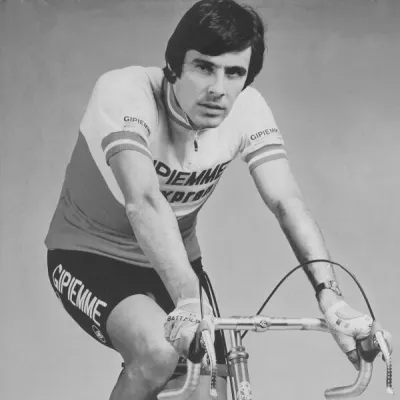
Giovanni Battaglin
Human Design Chart
Biography
The Human Design of Giovanni Battaglin: Generator 3/5
Generator 3/5 — Design at a Glance
Giovanni Battaglin's design revealed immense physical endurance and high levels of sacral energy. He was shown to be someone with the strength of a workhorse: strong and steady as long as he had tasks that engaged him internally. However, this configuration carried two specific risks. If Giovanni Battaglin did things he didn't want to do, it led to wasted energy and burnout. Conversely, frustration arose when external forces hindered his ability to continue working on projects close to his heart, even though his inner drive remained intact.
The key to utilizing this strength lay not in initiating but in reacting. His energy became effective by waiting for signals from his environment and responding accordingly. When his inner self gave a clear “yes,” the action followed. This strategy of waiting and reacting was crucial. Living in harmony with this pattern resulted in deep feelings of fulfillment and satisfaction. Ignoring this mechanism and instead trying to start things on his own or suppressing his inner impulse led to persistent frustration. His design rewarded him with vitality and success precisely when he did not anticipate but reacted instinctively to what life offered.
Emotional Authority
Giovanni Battaglin's design set a tendency towards emotional wave movement, coloring every decision through the filter of current mood. His defined Solar Plexus Center carried inner authority and thus had precedence over all other defined centers in his chart. This mechanism meant that his immediate feelings were always just snapshots – first impressions not necessarily reflecting deep truth. In one moment he could be enthusiastic about something, in the next view the same situation negatively.
Quick, spontaneous actions from this emotional heat often had negative consequences. The mechanics of his design required mandatory waiting time and sleep phase as protection against impulsive action. Only through multiple “sleeping on” a decision did intense feelings subside, allowing him to gain emotional distance. This process of patience enabled him to find clarity and calm before making decisions. Giovanni Battaglin thus showed himself to be someone who had to take his time to distinguish between temporary mood swings and his true inner truth. This strategy was particularly crucial for long-term life decisions, as only then did the emotional wave subside and a grounded understanding could take hold.
The 3/5 Profile — Martyr / Heretic
Giovanni Battaglin's design set a tendency towards a lively, experimental basic attitude. He showed himself to be someone who learned through personal experimentation and distilled practical knowledge that he offered others as solutions or inspiration. This configuration corresponds to Profile 3/5, the experimenter and hero.
Line 3 in the lower body area described a process of learning through trial and error. Giovanni Battaglin had to experience things firsthand to understand them; theoretical knowledge was not enough. This adaptation process could be associated with alienation if bonds were dissolved or ideas rejected. The challenge lay in adapting without losing his own identity.
Line 5 in the upper body area carried the expectation of creating practical solutions from confusion. Here a tension worked: while Line 3 needed time for mistakes, the environment often projected the role of immediate hero onto him. This projection could be painful when experiments failed before others. Giovanni Battaglin's attractiveness arose precisely from this treasure trove of lived experience. His design called on him not to view confusion and failure as personal defeat but as a necessary step towards wisdom. The mutation had its own timing; the pressure for immediate results often led to aversion. Instead, the task was to create order out of his own mistakes and courageously share these insights, even if others initially responded with confusion.
Triple Split Definition — Defined & Open Centers
Giovanni Battaglin's Human Design shows a tendency towards constant internal drive fueled by a rare combination of mental inspiration, strong-willed self-determination, and vital energy. His defined Head Center and Ajna Center created a continuous pressure to question and form concepts – a process that did not lead to immediate implementation but served as an inspirational source for others. This mental flow was reinforced by his defined Heart Center with clear willpower; he lived life autonomously and kept promises he made.
The real power source came from his defined Sacral Center, which gave him enormous, constant vitality. However, this energy was only available in response to external requests, not through initiated actions. His decisions were also filtered by his emotional authority in the Solar Plexus Center: Giovanni Battaglin had to wait for an emotional wave to gain clarity rather than act impulsively. His defined Spleen and Root Centers added intuitive spontaneity and a steady, adrenaline-driven pressure that propelled him forward in the material world and ensured his survival.
In contrast, his open centers showed areas of situational adaptation. His open G Center meant the absence of a fixed identity or direction; he tended to blend with his environment and did not actively seek a firm path but waited to be initiated. Similarly, his open Throat Center: He had no constant communication style and naturally attracted attention without having to force it. The non-self pattern here would be trying to gain recognition through constant talking or performances, which only created stress. Giovanni Battaglin's mechanism thus required patience: waiting for emotional clarity and sacral confirmation while using his mental and willful energy to inspire at the right moment rather than fighting against the world's resistance.
Channels for logic, community, change and preservation.
Giovanni Battaglin was marked by a pulsating, often melancholic energy that demanded inner limitation with patience. This dynamic came from Channel of Mutation 60-3, connecting Root and Sacral Centers: He carried potential for evolutionary change but had to learn to accept the confusion of new beginnings (Gate 3) and wait for the rhythmic pulse of this power rather than forcing it through arguments.
His mind constantly filtered patterns via Channel of Logic 63-4, linking Head with Ajna Center. Here logical doubt (Gate 63) served not as a barrier but as an essential tool to check consistency; only when a pattern practically worked and was verifiable did he consider it true. This skeptical mind served the collective good by asking questions until a well-founded answer could be formulated (Gate 4).
In care, Giovanni Battaglin acted instinctively through Channel of Preservation 27-50 between Sacral and Spleen Centers. His aura attracted trust as he was ready to take responsibility for others – whether through sustenance or upholding traditional values (Gate 50). Yet this selfless provision strictly relied on his sacral reaction (Gate 27); intuitively, he knew when his energy was available and that he could only healthily care for others after properly caring for himself.
Community did not arise spontaneously but through fair agreements in Channel of Community 37-40, linking Solar Plexus with Heart. He sought his place within the whole (Gate 37) and worked to provide for those he loved while needing his reward and breaks (Gate 40). A successful connection required emotional clarity about time and a personal invitation; only then could a deal be closed that was beneficial for both sides, creating loyalty in a group larger than the individual.
Tribal Circuitry — Circuit Signature
Giovanni Battaglin showed as a Triple Defined without constant format energy. His nature was shaped by two connected circuits: The Knowledge Circuit linked Sacral Center with Root Center via Channel of Mutation (3-60). This created a pulsating, acoustic presence driven by the urge to follow one's own path and transform new knowledge. Parallel to this, the Archer Circuit worked, connecting Sacral and Spleen through Preservation Channel (27-50). This connection emphasized instinctive protection, care, and preservation of genetics – an ancient power for defending the family.
In contrast stood isolated groups without life force connection. The Mind Circuit linked Head and Ajna Centers via Logic Channel (63-4). Here rational strategy and focused thinking dominated but were separate from emotional or energetic foundation. Similarly, Heart and Solar Plexus Centers formed a closed unit in Ego Circuit via Community Channel (40-37). This regulated resource management and cooperation based on the principle of give-and-take, also without direct access to sacral energy.
Battaglin's design thus consisted of separate power fields: a strong, instinctive basis for individuality and protection as well as independent spheres for logic and social resources. Strategy and action emerged situationally from these parallel streams, not from a single continuous flow.
Right Angle Cross of Laws 2
Giovanni Battaglin's Human Design profile established an archetypal framework characterized by the right cross of Laws 2. This configuration acts as a fundamental structure that significantly shapes his inner alignment and life dynamics. It is not a fleeting state but a deeper foundational plan that favors certain energetic patterns and postures.
In Human Design mechanics, Cross configurations represent the totality of activated Gates and Channels in a specific geometric arrangement. The right cross of Laws 2 forms a particular archetypal type. It describes not individual actions but the underlying form through which Giovanni Battaglin's energy flowed and impacted his environment. This framework served as a constant backdrop for all his experiences and decisions.
The emphasis here is on this structural alignment itself. It defines the space within which his design could unfold. It concerns the archetypal quality of this specific cross, representing his unique signature in the Human Design system. Giovanni Battaglin always moved within the parameters of this design, which endowed him with a certain perspective and mode of being. The mechanics here do not show individual events but rather the stable, recurring form of his energetic presence.
Saturn Return · Uranus Opposition · Chiron Return · 2nd Saturn Return — Life Cycles
Giovanni Battaglin's Human Design profile showed a tendency towards structural affirmation, especially during phases marked by long-term cycles. This was evident in 1981: at age 30, he won both the Vuelta a España and the Giro d'Italia. For his Human Design, this was a typical moment of the first Saturn return. This cycle occurs around the 30th year of life and functions as a phase of structuring and affirmation. What previously appeared as potential development or unconfirmed effort now solidifies into a sustainable result. The Saturn return forces one to confront their own limits and resources; it filters out the essential from the trivial. Giovanni Battaglin effectively utilized this energetic condensation. His successes were not merely luck but visible results of an inner maturation triggered by this astronomical cycle. The mechanics describe here the transition from experimental phase to established form. During this time, the design demands clarity about one's position and the ability to maintain structures that have been worked out. The double victory marked the point where his internal architecture became visibly stable and confirmed what his chart had already contained as potential, now translated into concrete reality through time and discipline of the Saturn cycle.
Generator · Emotional Authority — Synthesis
Giovanni Battaglin's Human Design reveals a profound thread of adaptability and the pursuit of authenticity. The combination of sacral energy, emotional authority, and an Explorer/Hero Profile points to a personality that learns by doing and is constantly in motion. A defined Root and Solar Plexus signal an inner drive and ability to handle stress, while the open G Center hints at a deep need for connection and finding one's place in the world – always shaped by experiences gathered through action. The numerous Channels connecting knowledge and understanding reinforce this process of continuous development and adaptation to new circumstances.
Central to Giovanni Battaglin's design is the paradox between the desire for authentic expression (fostered by sacral energy and emotional clarity) and the ability to adapt and respond to the environment (open G Center). This tension manifests in a constant interplay between inner guidance and external influence. While his design invites him to walk his own path and generate knowledge, it also demands flexibility and openness to new experiences – a balance crucial for his fulfillment.
4 Defined Channels
Incarnation Cross - Right Angle Cross of Laws 2
Solar Return
The Solar Return shows the moment when the sun returns to its exact birth position - your personal solar year.
Life Cycles
Discover the life cycles with a detailed triple view (birth chart, cycle chart, composite).
Human Design Profile
- Type
- Generator
- Strategy
- To respond - wait for something to respond to
- Authority
- Emotional Authority
- Profile
- 3/5 - Martyr / Heretic
- Definition
- Triple Split
- Incarnation Cross
- Right Angle Cross of Laws 2
- Date of Birth
- 22.07.1951 07:00
- Place of Birth
- Marostica, Italy
Frequently Asked Questions
What is Giovanni Battaglin's Human Design type?
What profile does Giovanni Battaglin have in Human Design?
What authority does Giovanni Battaglin possess?
What is Giovanni Battaglin's incarnation cross?
When was Giovanni Battaglin born?
Discover your own Human Design
Are you also a Generator? Find out in a personal reading how to use your sacral energy correctly and discover deep satisfaction.
More Personalities
Back to overviewAaliyah

Aldair

Alexia

Angèle

Anne-Marie

Arcángel