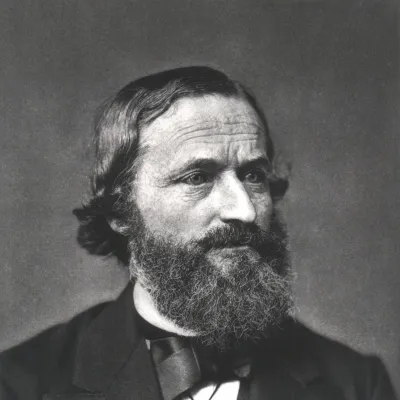
Gustav Kirchhoff
Human Design Chart
Biography
Gustav Kirchhoff — Manifestor with Profile 6/2
Manifestor 6/2 — Design at a Glance
Gustav Kirchhoff revealed himself as a pioneer and visionary destined to lead the world in a new direction. His design contained the energy of an emperor in ancient Rome: He had the vision of a grand whole but did not wage the necessary wars himself. Instead, he sent others to conquer foreign lands for him. This configuration brought with it a specific challenge. Not everyone liked his plans, leading to misunderstandings and polarization. Because he often thought ahead of his environment, some loved and followed him while others hated or rejected him precisely because of his vast visions. To find the right followers, it was crucial for him to inform others about his intentions in good time and accurately. This strategy of informing served to preempt resistance and create clarity. If he lived according to this principle and followed his inner authority, he was rewarded with a sense of inner peace. However, if he acted against his design, he felt an enduring, deep-seated anger within him. His path lay in exercising his pioneering role through clear communication without getting lost in the details.
Emotional Authority
Gustav Kirchhoff displayed a basic attitude marked by emotional waves: His perception of the world constantly shifted between enthusiasm and criticism depending on his current mood. These fluctuations originated from his defined Emotional Center, which also carried his inner authority. In Human Design mechanics, this authority always takes precedence over all other defined centers – regardless of what else is active in the chart.
His feelings served as initial impulses, but they were only snapshots, not final truth. Spontaneous decisions arising directly from such emotional peaks often proved problematic because they could not grasp the full context. Instead, Gustav Kirchhoff needed time to gain clarity. He let decisions mature, slept on them multiple times and allowed himself to be adorned by them. Only when the initial emotional heat subsided and calmness set in did deep insight emerge for him. This process of patience was especially crucial for long-term life decisions as it helped him distinguish superficial mood swings from his true inner direction. Through this waiting period, he gained emotional distance and acted not out of impulsive heat but from a stable, well-thought-out stance.
The 6/2 Profile — Role Model / Hermit
Gustav Kirchhoff's design laid the groundwork for experimental learning in early years followed by a phase of deep withdrawal and reflection. As a 6/2 profile ("Role Model/Natural Talent"), he acted through trial and error before his thirtieth year; mistakes served as corrective measures for future steps. Around thirty, the sixth line activated, prompting intense introspection – a time of healing and self-discovery in isolated contemplation. From this "cave," he later emerged as a wise advisor whose life wisdom attracted others.
This development was based on Gate 22 (Line 6), which represents maturity, metamorphosis, and the alignment of form and content. It fostered leadership qualities through social interaction and contributed nonconformist openness and material foundations for transformation. Simultaneously, Gate 11 (Line 2) dealt with themes like inflexibility, rigor, and ideation. Boredom arose when ideas were not brought to the outside or selective people did not call forth their concepts. Neptune played a role in obscuring and achieving recognition of attained values through imagination. Those who did not develop their ideas projected them onto others, thereby creating boredom for them. Gustav Kirchhoff thus showed himself as someone who initially experimented, then reflected, and finally shared wisdom – always in harmony with his inner process and the demands of his environment.
Split Definition — Defined & Open Centers
Gustav Kirchhoff revealed himself through a reliable inner identity and direction shaped by his defined G Center. He had a firm sense of his mission and could show others new paths without needing their approval. His communication was clear and authentic, as his defined Throat Center translated these messages directly into the world.
He did not make decisions impulsively but let himself be guided by his emotional authority. His defined Solar Plexus required patience; he waited until his emotions had calmed down and emotional clarity had set in before acting. This gave depth and sensitivity to his judgments. At the same time, he possessed a spontaneous intuition (defined Spleen) and a constant inner pressure to tackle tasks (defined Root Center), which anchored him in the present moment.
In contrast, his Head Center was open, making him vulnerable to mental confusion or pressuring him to find answers to questions that were not his own. He tended to get lost in thought whirlpools when trying to solve everything intellectually. His open Ajna Center allowed him to flexibly take on various perspectives and concepts without cementing them as absolute truth, but it lacked a constant mental structure.
His Heart Center was also open, leading him to avoid proving his worth through willpower or promises. He avoided the cycle of failure in overextended commitments. Additionally, his Sacral Center was undefined; he did not have a constant generative energy source and had to learn to separate himself from the energy of his environment to avoid exhaustion. His strength lay in the combination of clear identity, emotional endurance, and intuitive presence while consciously setting aside mental and willful pressure points.
Channels for reflection, emotional openness, logic and life purpose.
Gustav Kirchhoff showed himself as someone whose social interactions were strongly determined by an emotional wave. The Openness Channel 22-12 connected his Solar Plexus to his Throat Center, making his articulation and listening dependent on mood and timing. He did not act impulsively but waited for the right moment to use voice and words to create a transformative effect or withdraw when the mood was off.
Parallel to this, the Lost Son Channel 13-33 between G Center and Throat collected information and secrets (Gate 13) to reflect them during withdrawal phases (Gate 33). This configuration promoted an attitude of patient observation, sorting experiences before sharing insights – a process that created continuity but did not allow hasty conclusions.
In the realm of logic and intuition, two channels shaped his essence. The Judgment Channel 58-18 connected Root Center to Spleen with an insatiable drive to correct patterns and perfect them. This drove him to examine life for errors and only offer solutions when asked. Additionally, the Life Struggle Channel 28-38 between Root Center and Spleen gave him the determination to fight for his individual integrity and find meaning in resistance. This fighting spirit served individualization and forced him to resist distractions to walk his own path.
Furthermore, gates like 47 (Purpose from Confusion), 11 (Visual Assessment), and 30 (Recognizing Feelings and Longing) influenced his perception. Gate 25 promoted a mystical innocence while Gate 54 linked worldly success with spiritual insight. This mix of emotional openness, reflective withdrawal, correcting logic, and fighting integrity shaped his specific actions in the world.
Collective Circuitry — Circuit Signature
Gustav Kirchhoff's design tended towards separate but parallel processing of emotional resonance and logical analysis. Through Split Definition, two independent energetic blocks existed without direct flow between them: a block from Throat, Solar Plexus, and G Center as well as a separate one from Spleen and Root Center.
In the Knowledge Circuit, he connected his Throat Center with his Solar Plexus (Channel 12-22, Openness), allowing a pulsating expression of emotional waves. Parallel to this, in the same circuit, the connection between Spleen and Root Center (Channel 28-38, Life Struggle) worked as a separate force of instinctual security under pressure. The Understanding Circuit also used this Spleen-Root connection (Channel 18-58, Judgment) for focused rational strategies that did not merge with emotional centers. In the Purpose Circuit, he connected Throat and Identity Center (Channel 33-13, Lost Son), promoting a cyclical reflection of past experiences to affirm his individuality. Gustav Kirchhoff thus showed himself as someone who experienced rational structures and emotional expressions as separate, parallel systems rather than uniting them into one cohesive experience.
Left Angle Cross of Informing 1
Gustav Kirchhoff's Human Design profile indicated a tendency towards deep, often unspoken communication dynamics. He was someone who internally grappled with the urge to connect and exchange ideas, but this impulse did not always flow directly into the external world. This configuration, the left cross of Communication 1, described a life task: uncovering hidden connections and conveying them in such a way that others could truly receive them. The energy of this cross acted like an internal motor for the exchange of ideas and feelings, but it was often hindered by uncertainty or the feeling of not being understood properly. Gustav Kirchhoff lived with this tension between a strong desire to express himself and the challenge of clearly and effectively carrying that expressive power outward. This dynamic drove him to seek ways to shape his inner perceptions and insights into forms that resonated with others. It influenced how he interacted with others: always searching for an authentic connection, but sometimes accompanied by the fear that his message might not be received or misunderstood. This internal mechanism challenged him to cultivate patience and clarity in his communication to bridge the gap between inner experience and external impact.
Saturn Return · Uranus Opposition · Chiron Return · 2nd Saturn Return — Life Cycles
Gustav Kirchhoff's Human Design profile indicated a tendency towards structured milestones that condensed into clear life phases. This development was evident by 1850: at age 26, he was active at the University of Breslau. This first Saturn Return often marked the transition from education to an established position where years of groundwork laid the foundation for a solid professional base.
His path continued towards broader recognition, coinciding with the Uranus Opposition cycle. In 1864, at age 40, he was elected to the American Philosophical Society. This period represents a phase of opening and expanded influence, where one's work becomes effective beyond immediate boundaries and integrates new perspectives.
A deeper fulfillment of his character emerged during the Chiron Return cycle. In 1872, at age 48, he married Luise Brömmel. This fulfillment cycle is not a moment of healing old wounds but a blooming period where the inner essence and life task increasingly unfold in everyday life. The connection to Luise Brömmel was an expression of this internal completion and meaningfulness experienced through consistent living according to his nature.
Manifestor · Emotional Authority — Synthesis
Gustav Kirchhoff was a Generator whose life was marked by profound inner dynamics. His profile as a Manifestor (with emotional authority) and the defined Throat Center pointed towards someone destined to give impulses and express them through communication – a power that was particularly evident in the Channel of Openness (22/12). The connection between Solar Plexus and Throat Center focused on formulating emotional truths, where the natural emotional wave (authority) required time for maturation. This pattern repeated throughout his life cycles, moving from phases of experimentation (6/2 Profile) to a position of wisdom and influence.
A central paradox lay in how Kirchhoff pursued his visions. On one hand, he was a pioneer whose energy flowed through the Knowledge Circuit – a force for innovation and transformation. On the other hand, emotional authority pointed towards a process that required patience and reflection on decisions, contrasting with the impulsive action of a Manifestor. This tension between the urge to initiate and the need for emotional clarity shaped his work style and led to an interplay of creative energy and reflective wisdom.
4 Defined Channels
Incarnation Cross - Left Angle Cross of Informing 1
Solar Return
The Solar Return shows the moment when the sun returns to its exact birth position - your personal solar year.
Life Cycles
Discover the life cycles with a detailed triple view (birth chart, cycle chart, composite).
Human Design Profile
- Type
- Manifestor
- Strategy
- To inform others before acting
- Authority
- Emotional Authority
- Profile
- 6/2 - Role Model / Hermit
- Definition
- Split Definition
- Incarnation Cross
- Left Angle Cross of Informing 1
- Date of Birth
- 12.03.1824 11:00
- Place of Birth
- Königsberg/Bayern, Germany
Frequently Asked Questions
What is the Human Design type of Gustav Kirchhoff?
Which Profile did Gustav Kirchhoff have?
What Authority did Gustav Kirchhoff have?
What incarnation cross did Gustav Kirchhoff have?
When was Gustav Kirchhoff born?
Discover your own Human Design
Are you also a Manifestor? Find out in a personal reading how to use your initiation power peacefully and dissolve resistance.
More Personalities
Back to overviewChristian-Jaque
Kesha

Lucebert
Masaccio
Nadar
Papus