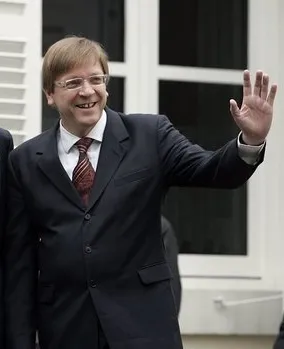
Guy Verhofstadt
Human Design Chart
Biography
Human Design Analysis: Guy Verhofstadt as Generator 1/3
Generator 1/3 — Design at a Glance
Guy Verhofstadt's design suggests a foundational disposition of endurance, akin to that of a workhorse: strong and steadfast if the inner motivation aligns. This energy source lies in the sacral center. It is not available for arbitrary initiative behavior but becomes active only when reacting to external signals. The operational motto therefore is: Do not initiate but wait until life sends an impulse and then respond with action.
This mechanism carries two specific risks. First, the wastage of energy on tasks without intrinsic interest. Working against inner resistance despite high potential leads to burnout. Second, holding back from working on heart projects even though full power is still available. Both scenarios lead to the same result: frustration and lack of energy.
Living in harmony with this design – through reactive action rather than impulsive initiatives – results in deep satisfaction for Guy Verhofstadt. The reward for using sacral energy according to the principle 'react from the gut' is a feeling of profound fulfillment. Ignoring this structure inevitably leads to a lack of power and persistent dissatisfaction.
Sacral Authority
Guy Verhofstadts design suggests a tendency to make decisions not through intellectual analysis but through immediate physical resonance. As a Generator, he possesses sacral authority, a mechanism that reduces the decision-making process to the physical reaction of the body. This inner guidance manifests as gut feelings or a palpable surge of energy triggered by external stimuli. Instead of actively taking initiatives, his strategy was to respond: wait until a situation addresses him and then listen to the bodily signals.
These signals often manifested as grunts, hums, or positive 'mmms'. Such sounds were not mere noises but reliable indicators whether something aligned with his energy. When his sacral motor engaged, he felt an upsurge of vitality and inexhaustible energy, enabling him to tackle tasks with great enthusiasm, fully immersed in the activity itself without needing external goals or purpose-driven motivation. The joy of doing was the actual result of this design.
Especially relevant is the condition of open emotional centers for this sacral authority. It ensures that the quick physical reaction is not skewed by transient moods. Through this mechanism, Guy Verhofstadt was programmed to move through life and find satisfaction in executing his work guided by the simple question: Does it feel right in my body?
The 1/3 Profile — Investigator / Martyr
Guy Verhofstadts design is characterized by an identity oscillating between theoretical thoroughness and practical experimentation. As a person with Profile 1/3 – the Researcher and Experimenter – he displays a foundational stance where knowledge is not only collected but actively tested in life. The tension in his system arises from Line 1 initially creating uncertainty: the need for complete information can lead to delayed action out of fear of not knowing enough yet. However, simultaneously, the energy of Line 3 drives the urge to simply try and learn through mistakes.
This configuration means that Guy Verhofstadt considers judgments only valid if they are both theoretically grounded and practically validated. Line 1 provides the basis of knowledge while Line 3 ensures these insights work in reality. Particularly relevant here is the aspect of mutual dependency: The third line learns through trial and error which relationships support and which do not. It recognizes that other people are necessary to rationally explain and stabilize one's inner truth.
For Guy Verhofstadt, life thus becomes a cycle of learning and doing. A judgment he makes carries the weight of double verification: it has been thought through in the mind and confirmed by experience. This process transforms uncertainty into reliability. By overcoming initial fear of ignorance and embracing the experimental nature of his design, he develops deep, self-earned competence. His strength lies in knowing as well as experiencing – thus possessing authenticity based on genuine life practice.
Split Definition — Defined & Open Centers
Guy Verhofstadt's design shows a tendency towards constant mental pressure to ask questions and form concepts. This energy source, the channel of inspiration between Head Center and Ajna Center, creates a permanent inner drive for understanding. However, since these mental centers are not connected to the motors, there was no direct energy available to immediately implement these thoughts into reality; this led to patience and waiting for the right moment being essential to avoid frustration.
The vital force came instead from the defined Sacral Center, which provided a reliable source of endurance and satisfaction if used in response to external stimuli. This was complemented by the defined Root Center, which delivered a constant survival pressure to move forward in the world. This combination of mental inspiration and physical motor required a clear separation: The mind asked the questions while the body reacted.
At the same time, Throat, G-Center, Heart, Solar Plexus, and Spleen were open. This made Guy Verhofstadt highly sensitive to external conditioning in areas like communication, identity, will, emotions, and health. Without his own constant energy in these fields, he tended to absorb the moods and expectations of the environment. For example, a pressure could develop to force attention or make promises to prove one's worth, although these centers are not mechanically designed to carry such commitments long-term. The wisdom lay in using these open areas as mirrors of the environment rather than interpreting them as his own truth.
Channels for doubt, inner truth and mature growth.
Guy Verhofstadt's design is characterized by an active, skeptical mind that filters patterns and seeks verifiable answers. The channel of logic 63-4 represents this doubting spirit: Doubt here is essential for logic because a formulation can be correct but still false. This channel constantly filters patterns on consistency; once it breaks down, pressure arises and questions for answers emerge. With little room for unfounded belief, an answer must practically work to be logical. This skepticism serves the collective by enabling well-founded predictions based on current data and recognizable patterns.
At the same time, individual inspiration is shown through the channel of awareness 61-24. This channel brings moments of knowing ("Satori") that are not controllable. The pressure in Head Center here transforms into rational answers without the individual being able to control when this mutation occurs. It's about knowing what is worth knowing and surrendering to inner truth when it arises, rather than actively seeking solutions.
The framework is set by the channel of maturation 53-42, which drives the cyclical process of experience, completion, and reflection. This mechanism requires a complete cycle – whether a project or relationship – to be run through before wisdom can be gained. Each new experience builds on the previous one; if a cycle is prematurely ended, it must be repeated. Reflecting on completed experiences allows translating the depth gained into information for others and thus contributing to collective history.
Collective Circuitry — Circuit Signature
Guy Verhofstadt's design presented itself as a dynamic tension between innovative creativity and rational strategy, underpinned by a deep emotional sense of purpose. This divided structure created two parallel, not directly connected energy flows: one in Head Center and Ajna Center for future and ideas, the other in Sacral Center and Root Center for emotional processing of the past.
In the Knowledge Circuit, his channel of awareness (Gates 24-61) was active. This linked Head Center with Ajna Center and promoted creative flashes as well as a drive to follow one's own path and transform new knowledge. Parallel to this, the Understanding Circuit activated through the channel of logic (Gates 4-63) also connected Head Center and Ajna Center. Here rational strategy was in focus: sharing logical insights free from conditioning to improve structures and lead into a better future. Both circuits thus used the same centers for different purposes – once for creative inspiration, once for focused ratio.
Separately but equally important, the Sense Circuit acted through the channel of maturation (Gates 42-53). This linked Sacral Center with Root Center and directed attention to emotional waves from the past. The energy here was cyclical; it served to reflect on past experiences, recognize their meaning, and share these felt insights with the collective.
Together, Guy Verhofstadt's profile drove innovative transformation through creative intuition, structured this by clear logical strategy, and simultaneously brought the emotional depth of past experiences into the shared learning process – all operating separately but effectively as a whole concept.
Right Angle Cross of Maya 1
Guy Verhofstadt's design inclined him to not perceive his self as an isolated entity but rather as an integral part of a larger whole. In his orientation, the individual identity often took a back seat in favor of group cohesion or universal humanity. This attitude stemmed from the configuration of the right cross of Maya 1, which describes a deep connection with humanity as a whole.
This structure allowed him to empathize with collective experiences and develop natural empathy for the fate of others through this understanding. Instead of primarily pursuing personal interests, he was marked by a desire to serve the well-being of the entire community or race. The mechanics of this design promote an awareness that blurs boundaries between 'I' and 'We', placing actions always in the context of general welfare. Guy Verhofstadt lived out his identification with collective consciousness by directing his energy towards a common goal, where the individual experienced themselves as part of a higher unit. This created a foundation for decisions that sought not only personal benefits but placed human connection and cohesion at the center.
Saturn Return · Uranus Opposition · Chiron Return · 2nd Saturn Return — Life Cycles
Guy Verhofstadt's design signaled a phase of structural maturity and transition to new levels of responsibility in his late forties and mid-fifties. This development was concretely evident in 1999, at age 46, when he became Prime Minister after parliamentary elections on June 13th. This period fell near the Chiron Return (around ages 49-51). In Human Design mechanics, this cycle does not mark healing of old wounds but a bloom: one's incarnation cross unfolds increasingly in life if strategy and authority are lived out. Meaning and purpose become tangible, here culminating in the highest national responsibility.
The structural consolidation of this role continued with his second Saturn Return. In 2009, at age 56, Guy Verhofstadt was elected to the European Parliament in the EU elections. The second Saturn Return often condenses years of groundwork into a robust, long-term result and establishes new, more stable life structures. His election on the European level signaled the next step in this maturation: from national leadership to institutional anchoring with broader but also structurally different responsibilities. Both events underscore that these age phases in Guy Verhofstadt's design are not merely career advancements but profound differentiation of his life task, where inner clarity manifested outwardly.
Generator · Sacral Authority — Synthesis
A central red thread in this design is the dynamic connection between energy and knowledge. Sacral authority (Authority) fuels an unwavering readiness to engage and learn through experimentation (Profile), underscored by the defined Sacral Center (Centers). However, this process is not linear; the Logic Channel (Channels/Gates) generates a constant mental pressure to question patterns and test their sustainability. The repeated career events in cycles seem connected with the need to generate knowledge through experience and apply it.
The central paradox lies in the interplay of deep engagement and critical distance. The design is geared towards generating and using energy (Generator), yet the Logic Channel ensures a constant doubt and necessity for validation. This tension between the impulsive 'yes' of the Sacral Center and the questioning mind manifests in an ongoing cycle of action, analysis, and adaptation – a pattern that can lead to both innovation and inner unrest (Circuit).
3 Defined Channels
Incarnation Cross - Right Angle Cross of Maya 1
Solar Return
The Solar Return shows the moment when the sun returns to its exact birth position - your personal solar year.
Life Cycles
Discover the life cycles with a detailed triple view (birth chart, cycle chart, composite).
Human Design Profile
- Type
- Generator
- Strategy
- To respond - wait for something to respond to
- Authority
- Sacral Authority
- Profile
- 1/3 - Investigator / Martyr
- Definition
- Split Definition
- Incarnation Cross
- Right Angle Cross of Maya 1
- Date of Birth
- 11.04.1953 05:00
- Place of Birth
- Dendermonde, BEL
Frequently Asked Questions
What is Guy Verhofstadt's Human Design type?
What Profile does Guy Verhofstadt have in Human Design?
Which Authority guides Guy Verhofstadt's decisions?
Which incarnation cross is assigned to Guy Verhofstadt?
When was Guy Verhofstadt born?
Discover your own Human Design
Are you also a Generator? Find out in a personal reading how to use your sacral energy correctly and discover deep satisfaction.
More Personalities
Back to overviewAaliyah

Alexia

Angèle

Anne-Marie

Arcángel

Arno