
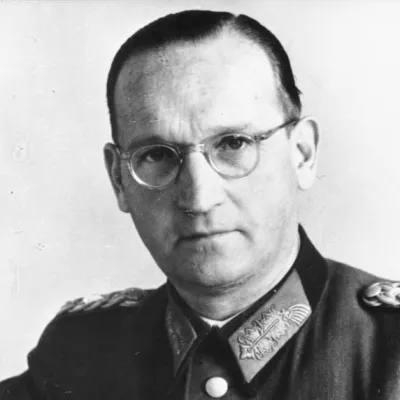
Hans Speidel
Human Design Chart
Biography
Speidel served as lieutenant-general and chief of staff to Field Marshal Erwin Rommel during the Second World War. Speidel was a nationalist conservative who agreed with the territorial aspects of the Nazi regime's policies, but strongly disagreed with their racial policies. This led him to participate in the 20 July Plot to assassinate Hitler, after which he was jailed by the Gestapo. At the end of the war, he escaped from Nazi prison and went into hiding.
During the early Cold War, Speidel emerged as one of the leading German military figures, and played a key role in German rearmament and integration into NATO. He is thus regarded as one of the founders of the Bundeswehr. He was the first officer to be promoted to full General in West Germany and served as Supreme Commander of the NATO ground forces in Central Europe from 1957 to 1963, with headquarters at the Palace of Fontainebleau in Paris. Speidel was also a historian by training and wrote several books. He received the Grand Cross with Star and Sash of the Order of Merit of the Federal Republic of Germany in 1963.
He was the father of Brigadier General Hans Helmut Speidel and the father-in-law of European Commissioner and liberal politician Guido Brunner.
He died 28 November 1984.
Human Design Analysis: Hans Speidel as Generator 4/6
Generator 4/6 — Design at a Glance
Hans Speidel revealed himself as someone with considerable inner endurance and strength. His design was that of a Generator, a configuration endowed with abundant sacral energy. This group could often be likened to workhorses: extremely strong and resilient if they used their power for suitable tasks. Hans Speidel had the potential to make things in life happen effectively, but this process did not function through mere initiative alone. Instead, his energy was primarily released when he responded to external impulses. The motto was clear: do not initiate, but respond.
His most successful strategy involved waiting for signals from life and then acting only when his sacral center gave a clear 'yes'. If Hans Speidel followed this inner resonance, he was rewarded with a sense of deep fulfillment. However, if he did not live by this principle – such as constantly initiating himself or doing things that did not give him internal pleasure – he would eventually encounter persistent frustration and energy loss. Two stumbling blocks characterized this pattern: one being the wastage of power on unsuitable tasks, which could lead to exhaustion. The other was holding back from his heart project despite having inner power available. Hans Speidel relied on making gut decisions and responding to real incentives to achieve his full capability and satisfaction.
Sacral Authority
Hans Speidel was a Generator whose decision-making was shaped by sacral authority. This internal leadership manifested as an immediate reaction to external stimuli, showing in physical signals like bursts of energy or gut feelings. Instead of deliberating, he instinctively responded with yes-no feelings, evident in sounds such as grunts or affirmations. With appropriate stimulation, he felt an inexhaustible energy and vibrant vitality that allowed him to immerse himself fully in activities without pursuing a specific purpose. His design promoted joy and satisfaction in action.
Additionally, his activated spleen center acted as supporting authority. It gave him quick, spontaneous reaction capability and reliable access to instinctive perception of his physical well-being. This combination enabled Hans Speidel to make immediate decisions guided by deep inner certainty. Since the emotional center was open, this sacral leadership remained clear and unclouded by fluctuating moods. His strategy involved responding to life, simplifying his process: he acted not out of planning but from direct feedback from his body. This shaped a lifestyle oriented towards immediate resonance, allowing him to go through life with enthusiasm as long as external impulses engaged his inner energy.
The 4/6 Profile — Opportunist / Role Model
Hans Speidel showed himself in his first thirty years as someone who acted experimentally. His Profile 4/6 appeared during this phase like a pure Line 3: he actively sought ways to assert himself and learned through direct experience. The network (Line 4) was the forefront, driven by persistence and the desire to provoke unexpected events. It involved using knowledge in the interest of higher good rather than falling into selfish attachment.
With Saturn's return, his orientation fundamentally shifted. Line 6 became active and triggered an internal conflict: the desire for belonging (Heart) against the need for detached wisdom (Head). Hans Speidel had to learn to trust the process before acting. For him, absolute certainty about the future was crucial; without assurance of adequate support, he withdrew and rejected leadership. His actions and words needed to align to be successful. Superficiality only occurred when this energetic foundation was lacking.
In his later years, it was expected that he would take on the role of a wise mentor. This happened not through isolation but through cooperation with others. His large heart remained cautious: he did not open up to everyone to avoid injuries. Instead, he used his ability to hold and network to build a trustworthy structure fulfilling both his demand for depth and his need for community.
Single Definition — Defined & Open Centers
Hans Speidel revealed himself as someone who did not draw his strength from willful action or intellectual planning but rather from a deep, physical resonance. His design was marked by a defined Sacral Center, providing him with a constant source of vital energy. This power became effective when he responded to external impulses – his inner response decided whether he had the energy for a task or not. Simultaneously, Hans Speidel possessed a defined Spleen Center, giving him a sharp, spontaneous intuition. He could intuitively grasp what was healthy and correct in the moment without consulting his mind. This combination of reactive energy and existential instinct formed the foundation of his actions: he did not act based on plans but rather on how he energetically responded in the moment and what his body recognized as safe.
In contrast, Hans Speidels design revealed several open centers that made him vulnerable to external conditioning. His open Head Center meant that he lacked a constant mental focus; he tended to engage with questions and doubts not of his own making and often sought inspiration from outside to fill mental voids. The open Ajna Center amplified this flexibility in thinking: he could adopt many perspectives but had no firm personal opinion or theory, which could make him feel unsure when lacking clear answers.
His open Throat Center indicated that Hans Speidel did not have a fixed identity or life direction. He relied on his environment to initiate and discover who he was in a specific context and where it led. At the same time, his open Solar Plexus absorbed the emotions of others, leading him to experience foreign moods as his own and make emotional decisions that were later regretted. The lack of consistent willpower in his open Heart Center meant he was not designed to keep promises or assert himself but rather tended to want to prove his worth through performance, often resulting in frustration. Finally, his open Root Center absorbed the stress from the environment, making him vulnerable to external pressure and chaos that he did not generate himself. Hans Speidels path involved seeing these open areas not as deficiencies but as mirrors to understand the energy and emotions of others while relying on his sacral reaction and spleen-based intuition.
Channels for caring preservation.
Hans Speidel was marked by a design deeply responsible for maintaining structures and values, primarily through Channel Preservation 27-50. This connection path between Sacral and Spleen Centers linked the spontaneous care of Gate 27 with the traditional laws of Gate 50. It aimed to protect tribal communities and nourish their creative endeavors through selfless concern for others' well-being. Speidel had a natural ability to inspire trust and take responsibility for those who could not look after themselves – whether by raising offspring or caring for elders. However, correct application was crucial: only through inner resonance could he know if his energy was available to serve others without overloading himself.
Additionally, other gates influenced his essence. Gate 28 challenged him to consciously take on or reject risks in the here and now based on a clear personal sense of purpose. Gate 31 brought the dynamics of leadership as pure energetic transmission, while Gate 41 focused on evolutionary changes and navigating necessary crises. In the realm of personality, Gate 34 supported his individuality through great but guided power meant to serve the common good. Gate 18 carried the task of distinguishing between necessary corrections and upholding political human rights without taking conflicts personally. Finally, Gate 44 helped with transformation through vigilance and unconditional interaction, while Gate 14 offered a skilled handling of power and direction requiring self-control. This constellation marked him as someone who both cared for the foundation and steered dynamic changes.
Tribal Circuitry — Circuit Signature
Hans Speidel revealed himself through a deeply rooted, instinctive orientation towards protection and preservation. His design connected his Sacral Center with life force directly to the Spleen Center of survival instinct via the Protector Circuit, specifically active in him over Channel Preservation (Gates 27-50). This channel focused not on pairing or emotional wave movements of other centers within this circuit but solely on care and nourishment. It aimed at securing one's genetics and familial cohesion. Hans Speidel had a simple definition, meaning this energetic connection was clear and coherent without being interrupted by other, separate groups. His fundamental stance was shaped by the need to preserve resources and provide care. This was not an abstract idea but a concrete, physical strategy of survival and life continuation. The connection between Sacral and Spleen Centers created a direct flow from action impulse to intuitive knowledge about what was necessary for continuity. Hans Speidel lived this dynamic as an integral part of his nature, with themes of 'protection' and 'preservation' in the foreground, driven by the timeless energy of this small circuit that significantly colored his chart.
Right Angle Cross of the Unexpected 3
Hans Speidels design pointed to a specific configuration known as the right cross of the unexpected. This structure shaped his inner orientation through a profound connection with the principle of surrendering oneself to something greater than one's ego. In Human Design, this cross describes an energetic connection between centers that leads to not defining oneself through constant action or proving oneself but rather through one's mere existence and authenticity.
For Hans Speidel, this often meant finding himself in situations where external circumstances took unexpected turns. Instead of fighting against these currents, he demonstrated a natural ability to accept the flow of life and anchor himself within it. This attitude spared him many unnecessary conflicts as he learned that true strength does not lie in compulsion but in the peace that arises when one stops trying to control everything. The right cross of the unexpected thus fostered a way of living where coincidences and apparent chaotic moments were recognized as part of a larger pattern. Hans Speidel lived this mechanism by focusing on what was present here and now, rather than reaching for distant goals that might not be achievable. This fundamental attitude created an inner stability that remained steady even in turbulent times.
Saturn Return · Uranus Opposition · Chiron Return · 2nd Saturn Return — Life Cycles
Hans Speidels design was characterized by a clear structuring ability and the capacity to carry responsibility at high levels. This trait was particularly evident during his Saturn returns, cycles where internal maturity manifests outwardly. His first Saturn return coincided with his promotion to Dr. phil. magna cum laude in 1925 – a moment when years of academic groundwork condensed into a solid result and confirmed his intellectual foundation.
The Chiron return, a fulfillment cycle around the age of 49 to 51, marks the peak of one's life purpose. For Hans Speidel, this pinnacle occurred in 1944 with his promotion to Lieutenant General. This was no coincidence but an expression of how his inner orientation and strategy increasingly unfolded their full impact in life. Meaning and purpose were experienced here not as healing but as confirmation of his life mission.
His second Saturn return in 1954 further underscored this development: he represented the Federal Republic of Germany at NATO negotiations for its accession. At age 57, it was again evident how structural clarity and authority worked together – not merely as power but as responsible representation of larger contexts. His design enabled him to penetrate complex situations and make decisions based on deeper insight.
Generator · Sacral Authority — Synthesis
Hans Speidel was a Generator whose life was marked by deeply rooted sacral energy. This source of strength, combined with the Channel of Preservation (27\/50), indicates a natural inclination towards conserving resources and using them for the benefit of others – an instinctive need to ensure stability and protection within his community. The Profile as Networker/Role Model (4\/6) reinforced this tendency toward connection and sharing experiences, where Line 4 always sought belonging while Line 6 took a distant perspective on questions of meaning. Repeated professional peaks during the cycles of Saturn returns and Chiron returns show that he effectively focused and used his energy to achieve goals when supported by the environment.
A central paradox lay in the tension between the need for deep engagement (sacral center) and the desire for reflection and detachment (Line 6). He lived a dynamic shaped by the search for balance between heartfelt connection and intellectual independence. This inner conflict might have manifested as an ongoing interplay between active involvement and withdrawal to self-discovery – a conflict between wanting to be part of the whole and the necessity of maintaining an overview from above.
1 Defined Channel
Incarnation Cross - Right Angle Cross of the Unexpected 3
Solar Return
The Solar Return shows the moment when the sun returns to its exact birth position - your personal solar year.
Life Cycles
Discover the life cycles with a detailed triple view (birth chart, cycle chart, composite).
Human Design Profile
- Type
- Generator
- Strategy
- To respond - wait for something to respond to
- Authority
- Sacral Authority
- Profile
- 4/6 - Opportunist / Role Model
- Definition
- Single Definition
- Incarnation Cross
- Right Angle Cross of the Unexpected 3
- Date of Birth
- 28.10.1897 02:00
- Place of Birth
- Metzingen, GER
Frequently Asked Questions
What was Hans Speidel's Human Design type?
Which profile did Hans Speidel have?
What authority did Hans Speidel have?
What incarnation cross was assigned to Hans Speidel?
When was Hans Speidel born?
Discover your own Human Design
Are you also a Generator? Find out in a personal reading how to use your sacral energy correctly and discover deep satisfaction.
More Personalities
Back to overviewAaliyah

Alexia

Angèle

Anne-Marie

Arcángel

Arno
