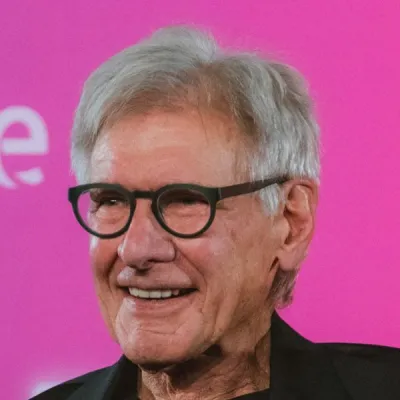
Harrison Ford
Human Design Chart
Biography
After making his screen debut in 1966 and early supporting roles in the films American Graffiti (1973) and The Conversation (1974), Ford achieved global stardom for portraying Han Solo in the space opera film Star Wars (1977), a role he reprised in five films for the eponymous franchise spanning the next four decades. He also received recognition for his portrayal of the titular character in the Indiana Jones franchise (1981–2023); Rick Deckard in the Blade Runner franchise (1982–2017); Jack Ryan in the action thriller films Patriot Games (1992) and Clear and Present Danger (1994); and Thaddeus Ross in the Marvel Cinematic Universe film Captain America: Brave New World (2025). These roles established him as an action hero and one of Hollywood's most bankable stars from the late 1970s into the early 2000s.
Ford's performance in the thriller film Witness (1985) earned him his sole Oscar nomination for Best Actor.
What does Manifesting Generator 6/3 mean for Harrison Ford?
Manifesting Generator 6/3 — Design at a Glance
Harrison Ford's design inclined him towards lightning-fast action capabilities that allowed him to skip steps and quickly pull things into his life. As an Manifesting Generator, he combined constant sacral energy with the ability for direct initiation. This hybrid configuration offered immense creative power but also posed specific challenges: The tendency to start multiple projects simultaneously could quickly lead to frustration if not every impulse was confirmed through the Sacral Center.
The strategy involved initially reacting to external stimuli and only then proceeding when inner resonance clearly signaled a 'yes'. Only under this condition did the potential rush transform into deep satisfaction. Harrison Ford showed himself capable of unleashing his greatest strength in what is called the Play Mode – through variety and parallel processing of different tasks. The danger always lay in overlooking important process steps or ignoring inner authority, which then required arduous catch-up work. His design thus demanded not linear progression but a constant, conscious synchronization of speed and inner confirmation to use natural energy efficiently without frustration.
Emotional Authority
Harrison Ford's design inclined him towards emotional wave movements that significantly shaped his perception and decision-making. His internal compass was Emotional Authority carried by the defined Emotional Center. A central mechanism of this design is the absolute priority of this authority: Whenever the Emotional Center is activated, it takes precedence over all other defined centers regardless of their configuration. Harrison Ford thus experienced a permanent up-and-down of feelings. The world appeared to him always colored by his current mood; an object or situation could appear totally exciting in one moment and negative in the next. His immediate feeling was only a snapshot, not a final judgment. Quick, spontaneous decisions from such emotional states carried the risk of unfavorable outcomes. Therefore, his design strategy required patience and time. Harrison Ford had to let decisions mature, often over several nights. Only when intense feelings subsided and emotional distance was gained did clarity set in. This process of delay was essential for long-term life decisions with significant consequences. Through conscious hesitation and multiple reviews, he regained calmness and could recognize the deeper truth behind transient mood swings.
The 6/3 Profile — Role Model / Martyr
Harrison Ford's design inclined him towards persistent experimentation and a search for extraordinary life paths. As someone with Profile 6/3, the Role Model or Experimenter, he was strongly marked by the line of the Adventurer in his first three decades of life. This meant an intense phase of self-experimentation and many mistakes that were accepted as a natural learning process. Assertiveness allowed him to turn these setbacks into advantages while excessive caution would have hindered this potential line.
After Saturn's return around age thirty, this dynamic did not fundamentally change since the experimental Line 3 in his Profile remains permanent. Harrison Ford sought not ordinary perfection or standard solutions but aimed for a life far from everyday routine. This inner restlessness and the pursuit of the extraordinary shaped his attitude. At the same time, responsibility and wisdom became natural to him. He used his unusual experiences to become a wise, visionary, and humorous role model. The pressure to repeat successful processes drove him to collect new experiences that truly paid off before he reflected and began the next cycle.
Split Definition — Defined & Open Centers
Harrison Ford's Human Design profile points towards a tendency for robust self-determination driven by clear inner direction and available willpower. His defined G Center provided him with a stable sense of identity and love, while the defined Heart Center supplied the energy to keep promises and set personal boundaries. This combination created a foundation of self-assurance that allowed him to act without external validation.
At the same time, he possessed immense vital force through his defined Sacral Center. As a motor, it continuously generated energy, which was only effective when reacting to external stimuli – not through self-initiated impulses. In contrast to this were his open Head and Ajna Centers. These undefined mental centers were vulnerable to conditioned pressure: the feeling of needing to find answers or understand ideas that actually originated from others. Rather than getting lost in this mental confusion, he tended to rely on his defined authority in the Solar Plexus Center. Here lay the necessity to wait out emotional waves until clarity emerged before making decisions.
The defined centers – G, Heart, Sacral, Solar Plexus, Spleen and Root – formed a closed circle of body intelligence and emotional depth. The open mental centers (Head, Ajna) served more as mirrors for the environment than as sources of truth themselves. Harrison Ford thus showed himself to be someone who did not seek his strength in intellectual discourse but rather in the ability to respond to what was truly there, using his emotional clarity and physical intuition as guiding principles. His actions resulted less from thought-out plans than from a deep, often unconscious resonance with the moment, supported by the constant energy of his Sacral and Heart Centers.
Channels for intimacy, leadership, status, ambition and maturation.
Harrison Ford's Human Design profile points towards profound, time-intensive intimacy paired with clear orientation on material self-determination and collective leadership. This configuration shows someone who does not use relationships superficially but nourishes them through patience and emotional clarity while simultaneously possessing the will to take responsibility for their material domain.
The Pairing Channel 59-6 connects sacral sexuality with the emotional wave of Solar Plexus. This energy requires waiting until clarity emerges in the emotional cycle before engaging in intimacy. Harrison Ford demonstrated through this mechanism as a person whose closeness and touch activated others; he easily penetrated other people's aura, fostering confidentiality but also potentially causing misunderstandings if his intensity was misinterpreted. His urge for merging was not impulsive action but a process that required time to perceive whether a connection truly existed.
Parallel to this, the Alpha Channel 7-31 shaped his approach to leadership. This channel connects logical self-role with collective leading. Harrison Ford naturally sought influence areas where he was recognized through competence and trust. He did not lead by absolute authority but rather by showing the way and being invited by the community to take on that role. His success depended on him leading the right people under the right conditions, his voice counting as a valuable influence so long as it was based on tested patterns.
The Money Line Channel 21-45 connected his will with the ability to gather resources and exercise control. Harrison Ford was willing to work hard to achieve material independence. He acted as hunter and gatherer, aiming both for personal profit and service by creating security for others. This channel drove him to master the material plane, where the secret of his success lay in maintaining a measure of independence to avoid stress on his Heart.
Additionally, the Transformation Channel 54-32 propelled ambition through constant effort. Harrison Ford used his talents to rise up and find recognition. His instincts helped him recognize the right moment for support, ensuring steady progress. The Ripe Channel 42-53 complemented this by necessitating a full experience of cycles and gaining wisdom from them. Harrison Ford learned from every cycle, reflected on their depth, built new experiences upon old ones without hasty expectations.
Influential Gates like the Gate of Plenty 55 emphasized emotional awareness and genetic mutation while the Gate of Logic 62 promoted detail and pattern recognition. The collective behavior of Gate 15 supported his adaptation to natural rhythms, and the Gate of Inaction 52 required concentrated pauses for reflection. The mutative experimentation of Gate 16 allowed him to achieve mastery through persistent trial-and-error. The Gate of Now 20 fostered authentic action in the moment while the Gate of Crisis 36 released emotional energy and prepared new experiences. Friendship and community were strengthened by Gate 37, and the Gate of Contribution 8 helped him individually advance group goals and gain attention.
This combination of intimacy, leadership, material control, transformation, and ripening created a design that made Harrison Ford someone who both nurtured deep personal connections and was capable of influencing collective structures and creating material security. His strength lay in combining patience with determination and drawing wisdom from every experience.
Tribal Circuitry — Circuit Signature
Harrison Ford's Human Design profile points towards clear, strategic communication manifesting in two separate energetic strands. Through the Understanding Circuit, he connected his Throat Center to his Identity Center (Channel 31-7). This promoted sharing logical insights and visual strategies for the future free of emotional conditioning. Parallel to this, the Purpose Circuit operated through Channel 42-53 between Sacral and Root Centers. Here it was about cyclic emotional waves from the past; experiences were reflected upon to collectively learn.
Another area involved resources and cooperation in the Ego Circuit. Harrison Ford had two unconnected segments here: The connection of Throat and Heart Center (Channel 45-21) supported amassing material means through exchange, while Spleen and Root Centers (Channel 32-54) linked instinctive transformations with stress energy. As there was no connection to the Sacral Center, pauses for rest were essential for this resource work.
Finally, the Archer Circuit showed a direct link between Sacral and Solar Plexus Centers (Channel 59-6). This gave him primordial energies for preservation and protection of his genetic line, guided by instinctive mating and nurturing impulses. These four circuits shaped his essence as divided definition: two independent groups existing side-by-side without directly flowing into each other.
Left Angle Cross of Cycles 1
Harrison Ford's Human Design shows a tendency towards cyclical patterns characterized by recurring phases of building up and breaking down. This structure is referred to in Human Design as 'The Left Cycle Cross 1'. It represents a configuration that views life not as linear progress but as a series of cycles. Harrison Ford was thus shown in a dynamic where successes and setbacks were not seen as final states, but rather as part of a larger rhythm.
The mechanics of this cross describe an energy that gains strength through the completion of full cycles. For Harrison Ford, this meant that periods of intense activity were often followed by phases of rest or failure to close the cycle and start anew. These repetitions served not for stagnation but for deepening experience. Each cycle offered the chance to question old structures and gain new perspectives. Harrison Ford's path was thus marked by this rhythmic movement: moving forward, stopping, reflecting, and starting again. This configuration supported an attitude of patience and trust in the natural flow of things rather than fighting against it. The strength lay in enduring the cycles until the inner truth of each segment revealed itself. Harrison Ford used this energy to continuously renew himself without losing connection with the essential.
Saturn Return · Uranus Opposition · Chiron Return · 2nd Saturn Return — Life Cycles
Harrison Ford's design points towards late but massive breakthroughs, marked by external recognition and career shifts. This dynamic became visible in 1973 at age 31: The first Saturn Return signified the transition from groundwork to substantial results. Attention through his role in 'American Graffiti' was no coincidence but typical for this cycle where years of effort often condensed into a major success.
At age 39, in 1981, the Uranus Opposition became active. This aspect often demands radical changes and breaking with old status quo. Ford's role as Indiana Jones in 'Raiders of the Lost Ark' suddenly transformed him into a global box office star – a classic sign of how this configuration forces or enables new identities and immense reach.
In 1992, at age 50, he reached his Chiron Return. This is not a healing process in psychological terms but an achievement cycle: The individual's incarnation cross unfolds increasingly if one follows their strategy. Taking over the role of CIA agent Jack Ryan in 'Clear and Present Danger' showed this bloom – purpose and meaning became experiential, career stabilized at a new level.
The second Saturn Return in 2000 (age 58) with the thriller 'Shadow Recruit' confirmed this structure: After initial confirmation and explosive change follows a phase of maturation and established impact, where the gained position is deepened.
Manifesting Generator · Emotional Authority — Synthesis
A central red thread runs through the design: a dynamic interaction between the urge to act quickly and achieve results (Manifesting Generator with defined Sacral Center and Channel of Partnership), as well as a deeply rooted need to let emotional decisions mature (Emotional Authority). This combination leads to a life marked by impulsive initiatives, which must be followed by thorough emotional processing – a constant swing between quick action and the need for inner clarity. The profile as role model/experimenter underscores this cycle by combining the tendency towards exploring new paths with the later necessity of wisdom and responsibility.
The central paradox lies in the tension between the defined Throat Center, which enables the expression of messages and actions, and the emotional Solar Plexus, which requires a temporal delay before speaking out. This leads to an inner conflict: the desire to react immediately to impulses (Sacral Center) versus the necessity to wait for the emotional wave and gain clarity. The documented events show a career marked by quick successes but also recurring phases of intense confrontation with the consequences of actions – constant navigation between spontaneous action and emotional maturity.
5 Defined Channels
Incarnation Cross - Left Angle Cross of Cycles 1
Solar Return
The Solar Return shows the moment when the sun returns to its exact birth position - your personal solar year.
Life Cycles
Discover the life cycles with a detailed triple view (birth chart, cycle chart, composite).
Human Design Profile
- Strategy
- To respond - wait for something to respond to
- Authority
- Emotional Authority
- Profile
- 6/3 - Role Model / Martyr
- Definition
- Split Definition
- Incarnation Cross
- Left Angle Cross of Cycles 1
- Date of Birth
- 13.07.1942 11:41
- Place of Birth
- Chicago, United States
Frequently Asked Questions
What is Harrison Ford's Human Design type?
Which Profile does Harrison Ford have in Human Design?
What Authority Does Harrison Ford Have?
What incarnation cross does Harrison Ford have?
When was Harrison Ford born?
Discover your own Human Design
Are you also a Manifesting Generator? Find out in a personal reading how to unfold your multi-talents and direct your energy wisely.
More Personalities
Back to overviewSissy Spacek
Aldair

Alizée

Anémone
Angeli

Ann-Margret