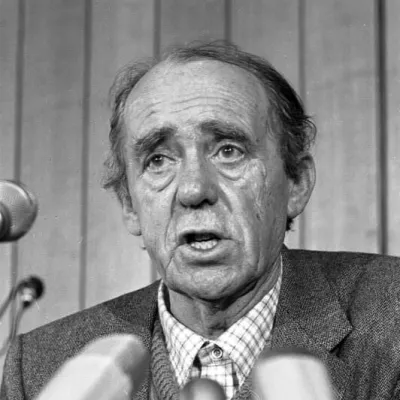
Heinrich Böll
Human Design Chart
Biography
Böll died at home on 16 July 1985, in Langenbroich. He was 67.
Human Design Analysis: Heinrich Böll as Projector 1/3
Projector 1/3 — Design at a Glance
Heinrich Böll's aura was like a focused flashlight that immediately identified systemic errors and 'dark spots' in others. As a Projector, his design had a dense beam of energy that uncovered problems in other people's systems without delay. However, directly addressing these deficits was often perceived as unpleasant; instead, passive radiation through his own harmonious example was the real attractive factor. Böll was most effective when he simply shone rather than aggressively projecting his light into others.
The central strategy involved waiting for a respectful and honest invitation rather than actively promoting himself. Living according to this design led to success; ignoring it resulted in the Non-Self theme of bitterness. Additionally, due to his undefined Sacral Center, Böll did not have constant life energy. Instead, he experienced cyclical phases of high activity followed by necessary rest periods to avoid burnout. This pattern conflicted with societal structures that expected continuous performance. His design required respect for these rhythms and the patience to wait until others sought him out rather than pushing himself forward.
Self-Projected Authority
Heinrich Böll's design established a unique decision-making structure: 'authority within', a characteristic exclusive to Projectors. This configuration combined great openness with the risk of being distracted by external motoric energies or constantly chasing energy, leading him to lose himself in his own receptivity. His inner truth lay in his identity. Decisions arose through two paths: either spontaneous self-dialogues or dialogues when invited. Crucial was listening to one's own speaking and distinguishing whether the true essence or rational mind spoke. Only the spontaneous, unconsidered expressed his authenticity and made him recognizable to others for his uniqueness. The second path led via physical directional feelings; he could feel drawn towards or away from something geographically or thematically. By recognizing and following this inner direction, he became a guide for others. There lay his specific potential. The challenge always was to separate the spontaneous expression of essence from rational analysis as well as trust in bodily impulses to develop authenticity and leadership ability without falling into the trap of being distracted by the environment.
The 1/3 Profile — Investigator / Martyr
Heinrich Böll's design established an underlying attitude that held theory and practice in a constant tension field. He oscillated between the urge to know everything beforehand and the necessity to learn through action. This dynamic resulted from his Profile 1/3, known as the Researcher-Experimentor.
The first line represented theoretical claims: the need for thorough knowledge and fear of being inadequately prepared. This could lead to hesitation in implementation due to a feeling that more learning was needed. Simultaneously, the third line acted as counterforce, driving towards experimentation and requiring adaptation through a process of trial and error. For Heinrich Böll, life was thus not a linear plan but a field where insights were validated only through practical testing and even mistakes.
Humility and adaptability formed the basis of this process. When he expressed an opinion or made a decision, it was based on self-earned experience rather than abstract speculation. His judgment was considered trustworthy because it had stood up to both theoretical analysis (Line 1) and practical trial-and-error (Line 3). The challenge lay in not confusing projections about possible futures with the present moment and instead using current mistakes for learning. Thus, his knowledge only solidified through the friction between planning and unexpected events.
Single Definition — Defined & Open Centers
Heinrich Böll's design established a tendency towards a reliable voice stemming from his own identity. His defined Throat and G Centers worked together: He did not speak impulsively or emotionally but manifested messages that were firmly connected to his higher self and inner direction. This configuration created a consistent expression where communication flowed directly from the core of his personality, without being distracted by external moods.
At the same time, his chart revealed high susceptibility to external influences in the areas of thinking and energy. His open Head Center meant he did not have constant mental inspiration; instead, he tended to engage with others' questions and doubts or absorb mental pressure from the environment, which occasionally confused him. The open Ajna Center complemented this by fostering a flexible mind that absorbed concepts and opinions without fixing them as personal truth – a state that promoted intellectual openness but also carried the risk of getting lost in endless thought processes.
Especially defining was his open Heart Center, which did not carry constant willpower or competitive drive. Böll tended to question himself in an inner monologue about whether he should do more to prove his worth, even though his design freed him from the necessity to fulfill promises that did not align with his inner authority. His open Sacral Center showed a fluctuating energy flow; he was prone to being overpowered by "borrowed" energy from others and exhausted himself when he did not pause. The open Solar Plexus Center amplified the emotions of his surroundings, leading him to experience foreign moods as his own unstable states until he learned to observe these waves only. Finally, his open Root Center absorbed the stress and adrenal impact of the world around him, a mechanism that led to inner unrest if unrecognized, since this pressure did not arise from his own life impulse.
Channels for awareness, logical leadership and reflection.
Heinrich Böll's design inclined towards individual authenticity, which was evident through a constant presence of self-love and trust in the here and now. This attitude worked as a quiet inspiration for his environment without requiring active persuasion; he simply lived the principle "I am," encouraging others to be themselves.
This emanation stemmed from the Awakening Channel 10-20, flowing through the Gate of Appearance (10) and the Gate of Now (20). This connection transformed individual knowledge into right action, guided by an underlying code that secured interactions. The G Center spoke for itself here, establishing self-acceptance as a survival strategy. Böll's design allowed him to be awake in the moment and act independently, minimizing resistance and eliciting genuine invitations for collaboration.
Additionally, the Alpha Animal Channel 7-31 shaped his way of leading logically and collectively. Through the Gate of Self Role (7) and the Gate of Leading (31), he gained trust by understanding tested patterns and trends. His leadership did not rely on authority but rather on being invited by the majority to take an influential position. He showed the path without taking it away from others, securing his success in collective contexts.
The Lost Son Channel 13-33 added a reflective aspect. The Gate of Listener (13) gathered information and secrets while the Gate of Retreat (33) offered time for reflection. Böll reflected on experiences patiently before sharing them as wisdom. This process of remembering and learning from the past conveyed stability and helped him recognize the magic of completion rather than feeling frustrated by unmet expectations.
Individual Gates like 15 (collective behavior), 46 (surrender in the here and now), 25 (spiritual innocence), and 35 (change through interaction) supported this structure by fostering adaptation to natural rhythms, physical presence, and readiness for new experiences.
Collective Circuitry — Circuit Signature
Heinrich Böll's design inclined towards rational and structured analysis. His Understanding Circuit connected the Throat Center with the Identity Center (Channel "The Alpha Animal"). This allowed him to decode complex issues through logic and strategy. Since the Solar Plexus Center was not involved, it was an "emotionless ratio." This energy served to share logical insights free from conditioning to guide society towards a better future. Perception in this context was visual and focused.
Parallelly, the Meaning Circuit also operated between Throat and Identity Centers (Channel "The Lost Son"). While the Understanding Circuit was forward-looking, this area concentrated on reflecting upon the past. It was about finding meaning behind past events. The resulting emotional waves and insights should be shared with the collective to learn together from history. This energy flows cyclically: each cycle has a beginning, a middle, and an end.
Additionally, the Integration Circuit (Channel "Awakening") presented itself between the same centers. This channel helped him gain strength from reacting to life. Through proper behavior and intuitive knowledge, he channeled this energy into the present moment. The goal was to make individual actions in the now effective, thus securing personal survival.
Since Heinrich Böll had a Simple Definition, all three circuits together with the Throat and Identity Centers formed one single, directly connected energetic flow. There were no separate groups; the cognitive structure was therefore unified through this connection of communication and identity.
Right Angle Cross of the Vessel of Love 4
Heinrich Böll's Human Design chart bore the imprint of the right cross of the Love Vessel. This configuration established a profound, often painful experience of unconditional surrender as his central life destiny. The 'Vessel' symbolized his capacity not only to hold extreme emotional intensity but also to transform it. It was not a romantic idealization but an existential test of his own limits in dealing with others.
The paradoxical nature of this cross bound pain and joy inseparably together. The ability for the deepest connection arose through experiencing loss or severe emotional challenge. Böll's chart indicated that he had to carry this intensity to understand the true depth of love. It was a process of enduring and transforming suffering into understanding. His design showed that he did not remain superficial but delved into the core of human relationships, where joy and pain were two sides of the same coin. This mechanism shaped his way of perception: He sought authenticity in pain, as there the boundaries between self and other became permeable. The surrender was not a passive state but an active, challenging force that formed and expanded his inner world by showing how far his own emotional resonance could reach.
Saturn Return · Uranus Opposition · Chiron Return · 2nd Saturn Return — Life Cycles
Heinrich Böll's Human Design chart featured recurring phases of public recognition and validation of his literary work. This structure created a rhythm in which his life's work became visible and affirmed at specific astronomical nodes.
In 1958, at the age of 41, he received the Eduard von der Heydt Cultural Prize from the city of Wuppertal. This moment fell on the Uranus opposition, a cycle often associated with sudden breakthroughs or recognition of new perspectives. It was a time when his previous approaches found their first broad resonance.
Ten years later, in 1967 at the age of 50, he received the Georg Büchner Prize for his entire body of literary work. This marked the Chiron return, a fulfillment cycle of bloom. Here it showed that his path up to this point had been guided by his inner strategy and authority; the meaning of his creation became experiential and his contribution as a whole was honored.
The third peak occurred in 1974 when he received the Carl von Ossietzky Medal at the age of 57. This corresponded to the second Saturn return, a time of maturity and structuring. At this point, his long-term work condensed into a sustainable result that was recognized not only literarily but also in its societal stance. These three events underscore the mechanics of his design: Recognition did not come randomly but followed natural cycles of development, bloom, and maturity.
Projector · Self-Projected Authority — Synthesis
Heinrich Böll's Human Design reveals a central thread of mediation. As a Projector with defined G and Throat Centers, he was designed to recognize patterns in others (Gate 7 & 31) and communicate these insights – a skill that repeatedly earned him recognition (successes at ages 41, 50, and 57). The open centers (Head, Ajna, Sacral, Solar Plexus, Spleen, Root) pointed to a high sensitivity to the energies of his environment, making him a mirror that reflected his surroundings and thereby opened new perspectives. He was not an energy generator but a catalyst who established connections through observation and reflection (Gate 13 & 33), and articulated these insights.
A central paradox lies in the combination of his ability for deep insight and undefined emotional centering. While he could precisely identify others' mistakes and patterns, he himself was vulnerable to conditioning and emotional influences (open Solar Plexus). This created a tension between his drive to convey truth and the challenge not to lose himself or be influenced by others' emotions. His design suggests that he was most successful when acting on invitation and sharing his observations rather than impulsively engaging emotionally.
3 Defined Channels
Incarnation Cross - Right Angle Cross of the Vessel of Love 4
Solar Return
The Solar Return shows the moment when the sun returns to its exact birth position - your personal solar year.
Life Cycles
Discover the life cycles with a detailed triple view (birth chart, cycle chart, composite).
Human Design Profile
- Type
- Projector
- Strategy
- Wait for the respectful invitation
- Authority
- Self-Projected Authority
- Profile
- 1/3 - Investigator / Martyr
- Definition
- Single Definition
- Incarnation Cross
- Right Angle Cross of the Vessel of Love 4
- Date of Birth
- 21.12.1917 08:00
- Place of Birth
- Köln, Germany
Frequently Asked Questions
What was Heinrich Böll's Human Design type?
What Profile did Heinrich Böll have in Human Design?
Which Authority guided Heinrich Böll?
What incarnation cross did Heinrich Böll have?
When was Heinrich Böll born?
Discover your own Human Design
Are you also a Projector? Find out in a personal reading how to unfold your leadership qualities and recognize the right invitations.
More Personalities
Back to overviewSissy Spacek

Alain-Fournier

Anémone

Angeli

Ann-Margret

Bourvil