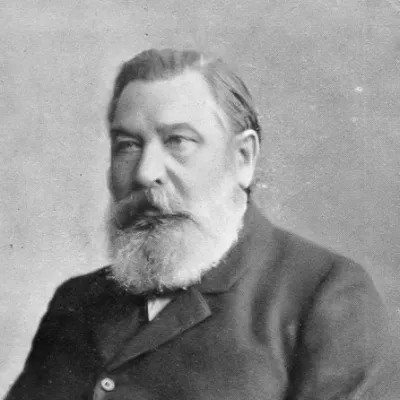
Heinrich von Treitschke
Human Design Chart
Biography
From 1871 to 1884 he was a member of the Reichstag, first as a National Liberal and then as a moderate conservative, but as a public figure he was handicapped by almost total deafness. He was one of the most prominent figures in Berlin.
As a historian, Treitschke won great influence in Germany owing to his rhetorical gifts, his masterful literary style, and his colourful descriptions of political and cultural life.
His magnum opus, Deutsche Geschichte im 19. Jahrhundert, 5 vol. (1879–94; Treitschke’s History of Germany in the Nineteenth Century), which covers the period from 1800 to 1848. Treitschke did not live to finish writing this work.
Treitschke was one of the few important public figures who supported antisemitic attacks which became prevalent from 1878 onwards.
Treitschke died 28 April 1896 in Berlin, at the age of 61.
What does Manifesting Generator 6/2 mean for Heinrich von Treitschke?
Manifesting Generator 6/2 — Design at a Glance
Heinrich von Treitschke revealed himself as someone with a hybrid energy structure: He possessed the constant, sacral power of a Generator, yet also had the ability to act swiftly and skip steps in the process. This design tended towards handling multiple things simultaneously and quickly drawing results into his life. The challenge was that this speed could lead to skipping important stages; when he had to make up for these missed steps, frustration often arose – the specific non-self theme of this type. Additionally, he tended to react to many different impulses at once and start several projects in parallel. Without proper alignment, this creative enthusiasm could quickly turn into overwhelm. The helpful strategy was not to initiate things himself but rather to respond to life first. Only when his sacral center signaled a clear "yes" after an "antest" (testing) and his inner authority agreed should he proceed. Regular checks to see if the paths he had started were still receiving this internal approval were crucial. When these conditions were met, Heinrich von Treitschke drew deep satisfaction from his work. Then parallel working was not a hindrance but a source of his strength. He found his best energy in "play mode," where variety and fun drove motivation rather than the rigid requirement to finish one thing before starting another.
Emotional Authority
Heinrich von Treitschkes Design shows a tendency towards emotional intensity and fluctuating moods. His inner authority comes from the defined Solar Plexus Center, meaning he cannot or should not make decisions immediately. Instead, he is subject to a constant emotional wave: at one moment enthusiasm for something may be present, only to see the same issue appear negative in the next. However, this acute mood is just a snapshot and not a final judgment. Quick decisions based on current emotions often proved problematic as they reflected the temporary coloring of the moment rather than the deeper truth.
The mechanics of his emotional authority require patience and time. Only through repeatedly sleeping on decisions could he gain clarity. Over time, intense feelings subsided, an emotional distance set in, and calm replaced initial turbulence. This process was essential for long-term realignments that significantly influenced his life path. Heinrich von Treitschke had to learn to properly deliberate and ask himself multiple times before acting. Only when the emotional wave had ebbed could he see what truly held up over time. This delay was not a weakness but rather the necessary mechanism to move from superficial impressions to deeper insight, enabling grounded, calm decisions that were not dictated by passing moods.
The 6/2 Profile — Role Model / Hermit
Heinrich von Treitschkes design inclined him towards deep introspection, which only fully developed after midlife. In his youth, before the return of Saturn, his 6/2 line acted like a 3-line: experiments and trial-and-error characterized this phase. Around age thirty, he metaphorically retreated into a cave to reflect on past experiences from a distance. This period of reflection was also one of healing and self-discovery. From this isolation emerged wisdom that others would seek out later.
The sixth line of Gate 47 brought themes of meaning-making and cyclical patterns. It allowed him to distinguish the meaningful from the meaningless, but also led to uncertainty or complaining when clarity was lacking. After Saturn return, he learned to deal with it more soberly. The second line of Gate 12 demanded purification of unclear emotions through withdrawal and isolation. Although it possessed the power for change, it was uncertain in social contexts. According to his strategy, boredom could be interrupted, but discipline and a desire for purity remained central. This process enabled him to emerge from his retreat as a wise person and attract others.
Split Definition — Defined & Open Centers
Heinrich von Treitschke revealed through his design as someone with a clear, strong-willed expression. His defined Heart Center gave him a constant willpower and the need to control his own life; he spoke from a strong "I" and tried to keep promises to prove his worth. This energy flowed into his defined Throat Center, steering his communication directly from this will – he articulated what he wanted or had done with reliable yet limited clarity.
At the same time, he possessed immense vital force through his defined Sacral Center. As a Generator, he was designed to react, not initiate; his energy became available only when he responded to external stimuli with an inner "yes." This was modified by his defined Solar Plexus, which gave him emotional authority: He had to wait out the waves of his feelings to gain clarity before acting or speaking. His defined Spleen Center provided spontaneous, intuitive warning signals in the present moment, while his defined Root Center supplied a constant pressure to maintain the life impulse.
In contrast, his Head, Ajna, and G Centers were open. Without fixed mental structure, he tended to engage with other people's thoughts or seek inspiration rather than hold onto his own conceptual truths. His open G Center meant a lack of firm identity; he often sought direction through his environment and relationships instead of being guided by an inner compass. This openness made him vulnerable to finding himself in the identities of others or searching for the "right place" to feel belonging.
Channels for change, emotion, intuition and value creation.
Heinrich von Treitschke was marked by a fundamental attitude that sought evolutionary change and oscillated between inner melancholy and the drive for innovation. This dynamic resulted from Channel 60-3, which connected the Root Center with the Sacral Center. Here an unpredictable energy operated, accepting limitation (Gate 60) to create new orders beyond confusion (Gate 3). This process did not proceed linearly but in pulsating waves of chaos and structure, forcing him to wait patiently for inner signals rather than rationalizing mood swings.
In communication, he revealed himself through Channel Openness 22-12, linking Solar Plexus Center with Throat Center. His articulation was heavily dependent on the emotional wave; Gate 22 brought passion and drama, while Gate 12 applied a cautious filter. He spoke most effectively when his mood aligned, as then he could deeply move others through the quality of his voice and inspire change. Coercion or poor timing led to harshness and misunderstandings.
His talent unfolded over Channel Wavelength 48-16, connecting Spleen Center with Throat Center. Gate 48 sought intuitive depth and life-critical information, which was transformed into precise skill through repeated experimentation (Gate 16). This was a process of perfecting, where intuitive insights became communicated talents through discipline and practice, requiring recognition and resources to further develop.
Furthermore, Channel the Money Line 21-45 operated between Heart Center and Throat Center. Here a strong will for control and responsibility (Gate 21) paired with the claim for material security and authority (Gate 45). Heinrich von Treitschke aimed to master the material plane by maintaining his independence while securing resources to exercise his influence and leadership functions.
Individual Circuitry — Circuit Signature
Heinrich von Treitschkes Design set a tendency towards a pulsating, acoustic mode of expression that was based on the search for his own path. The Knowledge Circuit connected his Throat Center with his Solar Plexus Center; this created a direct flow between emotional intuition and verbal expression. Parallel to this, Sacral and Root Centers worked together in the same circuit, providing urgent, mutating energy – deviations from the known were experienced here as driving forces. These two segments were energetically separate: The emotional speech did not exchange directly with the sacral urgency but existed as a parallel structure.
Another aspect was the need to share logical insights. The Understanding Circuit connected Throat and Spleen Centers. This promoted focused, visual perception of future strategies that were communicated free from emotional coloring. It was about rational sharing, not emotional conviction.
Furthermore, there was a focus on resources and cooperation through the Ego Circuit. Here, Throat and Heart Centers linked speech with willpower. This supported the joint creation of material well-being ("Money Line") and a clear give-and-take relationship in the community. Since there was no connection to the Sacral Center, pauses were necessary to regenerate these resources. Overall, three separate but defined areas shaped his work: emotional innovation, rational strategy, and will-driven cooperation.
Left Angle Cross of Informing 2
Heinrich von Treitschkes design points to a tendency towards clear and connecting communication structures. His chart includes the left cross of Sharing 2, indicating a specific way of conveying information. This configuration does not describe spontaneous radiance but rather a process where information is taken in, structured, and then deliberately passed on. It describes a pattern aimed at establishing connections between different perspectives by transforming complex content into understandable forms. Heinrich von Treitschke appears through this mechanism as someone who did more than just talk; his words often served to build bridges or organize existing discourses. The energy of this cross works less impulsively and more reflectively; it requires space for thoughts to form before they are expressed outwardly. This shaped his way of interacting: he sought not primarily attention through loud statements, but rather that his messages would be clearly received and misunderstandings avoided. Thus, the structure of his design promotes a form of dialogue based on clarity and mutual understanding rather than emotional overwhelm or mere opinion expression.
Saturn Return · Uranus Opposition · Chiron Return · 2nd Saturn Return — Life Cycles
Heinrich von Treitschke's design established a tendency to firmly take on new authoritative positions during middle life phases through external upheavals. In 1873, at the age of 39, he took over Leopold von Ranke's chair at the Berlin Friedrich-Wilhelms-University. This coincided with a Uranus opposition, a cycle that often brings unexpected career shifts or the assumption of new, influential roles as old structures dissolve.
Later, his chart showed the dynamics of a fulfillment cycle. In 1884, at age 50, he received the Verdun prize for the first two volumes of "German History". This marked his Chiron return, a period between ages 49 and 51 when one's incarnation cross unfolds and meaning and purpose become experiential – provided that one has lived according to strategy and authority up until then. It was not a moment of healing old wounds but rather a bloom and affirmation of the life path.
At age 60, in 1894, he published the fifth volume of his "German History in the Nineteenth Century". This occurred during his second Saturn return, a period of consolidation and long-term anchoring of achievements. Thus, his design charted a course where external recognition and academic positions corresponded with inner development and the formulation of personal purpose.
Manifesting Generator · Emotional Authority — Synthesis
Heinrich von Treitschke lived a life characterized by a dynamic interaction between inner perception and external expression. His design as an Manifesting Generator (with defined Sacral Center) indicates someone who was fundamentally destined to react to impulses and have constant energy available, yet also possessed the ability to act quickly and set things in motion – a hybrid of initiation and reaction. This combination manifested in a lifestyle accompanied by profound emotional processing (emotional authority), where decisions had to mature over an extended period rather than being rushed.
Central to Heinrich von Treitschke was the tension between the drive for quick implementation (Channel of Mutation) and the need for emotional clarity. He could powerfully convey messages into the world through his defined Throat, yet this expression was always tied to deeper processes in the Solar Plexus Center. The cycles – particularly the Uranus opposition with a career event and the Saturn return with the publication of an important work – illustrate a life path where rapid changes and long-term goals went hand in hand, and inner melancholy (Knowledge Circuit) served as a driving force for innovation.
4 Defined Channels
Incarnation Cross - Left Angle Cross of Informing 2
Solar Return
The Solar Return shows the moment when the sun returns to its exact birth position - your personal solar year.
Life Cycles
Discover the life cycles with a detailed triple view (birth chart, cycle chart, composite).
Human Design Profile
- Strategy
- To respond - wait for something to respond to
- Authority
- Emotional Authority
- Profile
- 6/2 - Role Model / Hermit
- Definition
- Split Definition
- Incarnation Cross
- Left Angle Cross of Informing 2
- Date of Birth
- 15.09.1834 19:00
- Place of Birth
- Dresden, GER
Frequently Asked Questions
What was Heinrich von Treitschke's Human Design type?
What Profile did Heinrich von Treitschke have in Human Design?
What authority did Heinrich von Treitschke possess?
What incarnation cross did Heinrich von Treitschke have?
When was Heinrich von Treitschke born?
Discover your own Human Design
Are you also a Manifesting Generator? Find out in a personal reading how to unfold your multi-talents and direct your energy wisely.
More Personalities
Back to overviewAldair

Alizée

Angeli

Arletty
Artus

Balthus