
Hélène de Beauvoir
Human Design Chart
Biography
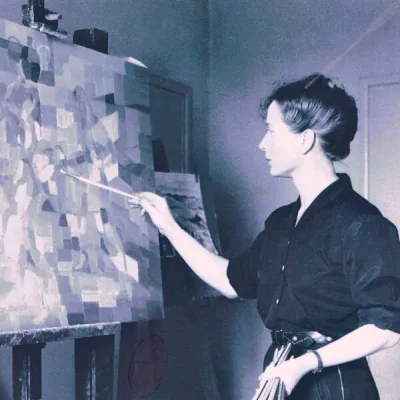
When Hélène de Beauvoir lived in Goxwiller, a village near Strasbourg, she became president of the centre for battered women. She continued painting until she was 85. Many of her paintings were related to feminist philosophy and women's issues.
In January 2025, art dealer Amar Singh staged the first UK solo exhibition of Hélène de Beauvoir's work at Amar Gallery. Harper's Bazaar writing about the exhibition stated "The show offers a mere glimpse through the keyhole of her expansive artistry, but it’s the most we’ve ever seen of de Beauvoir in this country: jewel-like landscapes, teetering on the brink of abstraction; canvases smeared with energy and passion."
Hélène de Beauvoir died on 1 July 2001 at age 91 in Goxwiller, France.
Hélène de Beauvoir as a Manifesting Generator 1/3 in Human Design
Manifesting Generator 1/3 — Design at a Glance
Hélène de Beauvoir was someone who could achieve quick results and often skipped steps. Her Manifestor Generator design combined the constant energy of the sacral center with the direct expression ability of a manifestor. She had a hybrid structure: Like generators, she possessed a stable energy source that served not for initiation but for reacting to external impulses. The key difference lay in her speed; she could bypass obstacles and quickly draw things into her life.
This quickness carried risks. Hélène de Beauvoir tended to overlook important steps or pursue multiple projects simultaneously. If she did not listen to her inner resonance, this led to frustration. The key to her success was acting only when her sacral center gave a clear “Yes!”. She had to regularly check if her authority still confirmed the current path. With this correct alignment, she developed deep satisfaction. Parallel work was not a problem for her but necessary to enter a playful creative mode. Without this variety and playfulness, her energy lost its effectiveness. Her design therefore required constant verification of inner consent to use her own dynamics constructively rather than against herself.
Emotional Authority
Hélène de Beauvoir showed an internal decision-making structure that did not rely on immediate clarity but on the processing of emotional waves. Her Emotional Authority meant that her defined emotional center determined her inner guidance – independent of other defined areas in her chart.
This configuration was subject to constant ups and downs of feelings. Hélène de Beauvoir saw the world always colored by her current mood: one moment full of enthusiasm, the next deeply negative. Her immediate feeling was only a snapshot, not a guaranteed truth value. Spontaneous decisions based on this fleeting emotion carried the risk of being misleading or harmful.
The mechanics of her design required patience and distance. Hélène de Beauvoir had to let decisions mature, often through multiple reconsiderations, to even out intense initial feelings. Only when this emotional wave subsided did she gain the necessary inner distance. Then clarity and calmness set in – the state where her true authority came into play. This process was especially crucial for long-term life decisions as it ensured that not only transient mood but deeper emotional knowledge guided her. She learned to take time, ask questions multiple times until the emotional noise subsided and a well-founded answer remained.
The 1/3 Profile — Investigator / Martyr
Hélène de Beauvoir's design was characterized by a clear tension between theoretical knowledge and practical experience. As a 1/3 profile (Researcher/Experimentor), she lived the process of learning through trial and error. Her Sun in Gate 45 on line 1 drove her need for thorough instruction; here, she attracted like-minded individuals to promote community and structure knowledge. However, this theoretical foundation conflicted with the energy of Gate 22 on line 3. This gate demanded an emotional experimentation drive and the development of “perfect grace” through direct life experience.
For Hélène de Beauvoir, it was crucial not only to plan but also to act. The mechanics of her profile showed: If line 1 dominated, hesitation before implementation out of fear of not knowing enough emerged. Line 3, however, demanded trying and learning from mistakes. Only when she combined both aspects – theoretical examination through Gate 45 and practical validation through Gate 22 – was her judgment trustworthy. She entered into commitments and dissolved them again to find perfect grace in this emotional process of openness. Her life path consisted of working out self-tested insights that held true both intellectually and practically.
Single Definition — Defined & Open Centers
Hélène de Beauvoir revealed herself through a constant, reactive life energy and a reliable voice. Her design combined defined Root, Sacral, and Throat centers into a powerful column: The Root provided the physical pressure for forward movement, the Sacral generated vital energy that was only available through reaction, and the Throat enabled a dependable expression capability. However, this configuration required strict waiting; initiating led to resistance and exhaustion.
Her defined Solar Plexus Center served as her inner authority. It forced patience: Hélène de Beauvoir had to wait for the emotional wave before acting or speaking. Emotional clarity only emerged after going through the wave movement; spontaneous decisions at its peak were misleading. Her task was to use this emotional depth as a filter, checking impulses before their verbal manifestation in the Throat.
Simultaneously, her design revealed great receptivity through open centers: Head, Ajna, G Center, Heart, and Spleen were undefined. This did not mean a lack of intelligence or willpower but rather situational absorption of inspiration, identity, and values from the environment. Hélène de Beauvoir tended to internalize others' mental questions or seek a fixed identity she could not generate herself. Her open Heart Center was vulnerable to proving herself through promises, often ending in frustration due to her constant energy's lack of persistence. The open Spleen Center made her sensitive to well-being and danger but led to false spontaneity out of fear.
The key to her design lay in the tension between her inner, constant energy source (Sacral/Throat) and the external, variable perception. By waiting for her sacral response and seeking emotional clarity instead of filling mental pressure or identity gaps, she avoided typical pitfalls of her open centers. She did not live from the mind but reacted from the depth of her emotional and energetic system.
Channels for emotional depth, powerful action and growth.
Hélène de Beauvoir was characterized by two dominant, constant energies. Her design tended to show waves of intense, charismatic activity that strongly depended on her emotional state.
The Openness Channel 22-12 connected her Solar Plexus Center with the Throat Center. This connection made her social interaction strictly bound to the emotional wave. When the mood was right, through voice and presence, she could deeply impact others; she could touch people and inspire change. Against the current, that is, at low emotional energy, this dynamic became harsh or isolating. The openness of Gate 22 was regulated by the cautious restraint of Gate 12, ensuring her effect was directed only towards those with the greatest potential for transformation.
Parallel to this, the Charisma Channel 34-20 worked. It connected the Sacral Center with the Throat Center and endowed Hélène de Beauvoir with massive physiological life force for manifestation in the here and now. This energy required sacral reaction rather than mental planning; it was self-reinforcing and inspired through mere presence and activity, not by serving others. The urge to manifest had to react to external stimuli to be correctly directed.
The combination of emotionally driven social expression and an insatiable drive for manifestation created a person who creatively and transformationally stepped out when the emotional wave was high. When it was low or she did not receive reaction, frustration or chaotic overacting threatened. Additional gates like 45 (Tribe level) and 26 (Innovation in Heart Center) supported this dynamic by gathering energy and convincing the tribe of innovations while Gate 14 brought skillful power handling. The Maturity Channel 53-42 further required experiencing fully to gain wisdom, shaping her cyclical development.
Individual Circuitry — Circuit Signature
Hélène de Beauvoir's design was characterized by a direct connection between Throat, Solar Plexus, and Sacral centers over the Root Center, enabling coherent energy flows. In the Knowledge Circuit, the Openness Channel (Gates 12-22) connected her Throat with the Solar Plexus Center. This promoted the expression of her unique identity through emotional waves that acted as pulsating creativity and initiated transformation.
Parallel to this, in the Meaning Circuit, the Maturity Channel (Gates 42-53) showed connecting Sacral with Root Center. Here it was about cyclical, wave-like processing of past experiences and emotions. This reflection served to gain insights from the past and contribute them to collective learning capacity, where energy tended to be more falling than pulsing.
The Integration Circuit concluded with the Charisma Channel (Gates 20-34), also connecting Throat and Sacral Centers. This mechanism ensured survival through the convergence of power, right action, and intuitive knowledge in the present moment. Hélène de Beauvoir used this connection to acoustically and in the now realize her highest individuality by transforming reactions to life into actionable energy. All three circuits worked together to draw a clear line from inner processing through emotional expression to immediate implementation here and now.
Right Angle Cross of Rulership 2
Hélène de Beauvoir carried the right cross of governance, a configuration that deeply anchored her life's purpose within the context of leadership and collective order. Her design suggested that she was not primarily defined by individual self-fulfillment or isolated creativity but rather by her role within larger structures. She emerged as someone who took responsibility for the whole, focusing on strategic alignment.
This mechanism describes a specific form of governance where it is less about personal power hunger than maintaining and further developing systems. Hélène de Beauvoir was programmed to establish order and shape processes so that they function sustainably for the community. Her influence impacted the structuring of connections, ensuring that rules and hierarchies not only existed but were also meaningfully applied.
Her design challenged her to act in the tension between individual intuition and collective requirements. She had to learn to align her inner authority with the needs of the system. This shaped her work as someone who built bridges between abstract principles and practical implementation. Hélène de Beauvoir lived this task by contributing to the stability and further development of complex social or organizational structures without falling into chaos. Her strength lay in keeping the big picture in mind while mastering the details of leadership.
Saturn Return · Uranus Opposition · Chiron Return · 2nd Saturn Return — Life Cycles
Hélène de Beauvoirs design was characterized by clear phases of reorientation, which acted as external catalysts for artistic liberation. In 1936, at age 26, she presented her first solo exhibition with figurative painting – a typical Saturn return moment when structural groundwork condenses into tangible success. This cycle marked the transition from development to established presence.
Later, in 1953, she found the series motif of moon girls on flooded rice fields in the Poebene. This corresponded to the Uranus opposition: a pressure point that breaks old patterns and forces radical innovation. Here her design showed its ability to activate inner creativity through external change and unlock new visual languages.
The peak of this development was in 1957 when she returned to Paris with her husband, regaining her artistic freedom. This coincided with the Chiron return – a fulfillment cycle between ages 47 and 50. During this period, one's incarnation cross unfolds increasingly; meaning and purpose become experiential. Hélène de Beauvoir used this phase not for healing but for full realization of her purpose in the art metropolis. The three cycles thus did not form random events but a logical sequence of her inner mechanics: structuring, breaking, and finally the living embodiment of her essence.
Manifesting Generator · Emotional Authority — Synthesis
Hélène de Beauvoir lived an existence marked by a deep internal drive to collect experiences and transform them through creative expressions. The connection of a manifesting generator with emotional authority points to someone who constantly had energy available (Sacral Center) but only gained clarity for authentic decisions by waiting for their emotional wave. This process, paired with the openness of various centers, led to a profound ability to take in the world and reflect its nuances artistically – a cyclical intake, processing, and passing on of experiences (Sensing Circuit).
A central paradox lay in the tension between the need for inner clarity and the fast energy of a manifesting generator. The tendency to be carried away by impulses (Gate 34) required consciously waiting for the emotional wave (Solar Plexus Center) to avoid aimless activity. This internal dynamics created a unique ability to draw creative power from life's flow itself and express it through articulation in the Throat Center – a process marked by deep self-awareness and a constant striving for authentic experience.
3 Defined Channels
Incarnation Cross - Right Angle Cross of Rulership 2
Solar Return
The Solar Return shows the moment when the sun returns to its exact birth position - your personal solar year.
Life Cycles
Discover the life cycles with a detailed triple view (birth chart, cycle chart, composite).
Human Design Profile
- Strategy
- To respond - wait for something to respond to
- Authority
- Emotional Authority
- Profile
- 1/3 - Investigator / Martyr
- Definition
- Single Definition
- Incarnation Cross
- Right Angle Cross of Rulership 2
- Date of Birth
- 09.06.1910 13:15
- Place of Birth
- Paris Arrondissement 6, France
Frequently Asked Questions
What was Hélène de Beauvoir's Human Design type?
What Profile did Hélène de Beauvoir have in Human Design?
What Authority did Hélène de Beauvoir have?
What incarnation cross did Hélène de Beauvoir have?
When was Hélène de Beauvoir born?
Discover your own Human Design
Are you also a Manifesting Generator? Find out in a personal reading how to unfold your multi-talents and direct your energy wisely.
More Personalities
Back to overviewAldair

Alizée

Angeli

Arletty

Artus

Balthus
